
Sourcing
How to Find Wholesale Suppliers for Amazon FBA in 2026
You have spotted a product that sells.
Now the challenge will be finding a reliable supplier at a price that still lets you make a profit from a source you're allowed to buy from. Finding a best-selling product can just take an afternoon. It can take weeks of emails, portal logins, and dead ends to find a real, credible supplier.
It's crucial, whether it's your 1st supplier or 50th. A new seller needs that first trustworthy supplier. A seller doing 7- 8 figures needs backup suppliers for best-selling products for stability, better cost, and to adapt quickly when a supplier gets squeezed. The process stays the same, but the stakes get higher as you grow.
In this blog, we will walk you through: what a supplier actually is, why finding one is hard, what changed in 2026, and the exact steps with a worked example, the tips that save real money, and how to vet a supplier before you wire money.
What Counts as a "Supplier"?
When we say "supplier," it means authorized distributors and brand-direct programs, as these sources keep you on the right side of brand and Amazon policy.
Why It's Hard
There isn't one place that shows who sells what. Suppliers are spread out among national distributors, regional wholesalers, and brand-direct programs, each with its own website and forms. So, resellers have to piece together the info themselves, supplier by supplier.
Two more things make it trickier:
- You may find a supplier and still be told no. Just because a supplier carries a product doesn't mean they'll sell it to you; many require you to have an approved account or permission from the brand (more on that later below).
- Prices and inventory change all the time. A price list from a few weeks ago is already outdated. By the time you've checked a few suppliers manually, the numbers have likely changed again.
What Changed For Sourcing In 2026
If you are relying on 2024–25 strategies, you are behind the curve. Four big shifts moved the ground:
- Tariffs got reshuffled. Change in trade policy through 2025–2026 increased import costs for many categories, pushing sellers to lean more on domestic suppliers or regions with lower tariffs. Wholesale resellers have an advantage here. Unlike private-label sellers, who are tied to one factory, wholesalers can switch sources in a matter of days. Being flexible has gone from a nice-to-have to a survival skill.
- Amazon's fees keep climbing. Higher fulfillment and aged-inventory charges have squeezed profit margins. The buffer that used to absorb the cost of paying a higher price has mostly disappeared.
- Authorization scrutiny tightened. Amazon now demands invoices and brand permissions for gated or branded products. It's not enough to find a supplier willing to sell to you. You need one whose paperwork is solid and can pass Amazon's checks.
- More professionalized sellers. There are fewer casual sellers and more big players in the Amazon ecosystem. So, treating sourcing as a system and not as a hustle between other tasks isn't optional anymore.
Forward vs Reverse Sourcing
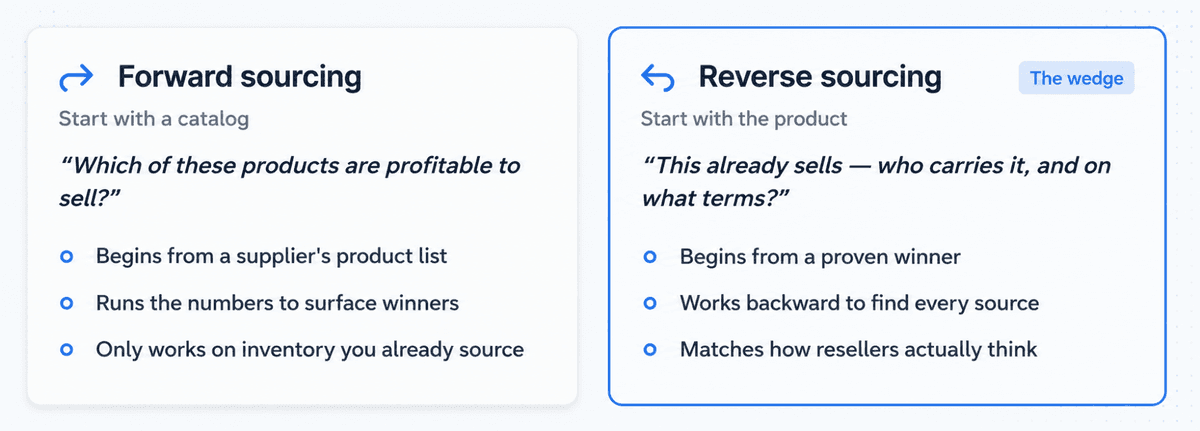
Most sourcing tools operate in a forward manner: supplier catalogues are fed to identify which products are profitable and are selling well. In contrast, reverse sourcing takes a different approach: it starts with a product that is already selling well and seeks out its suppliers. Wholesale resellers engage in both methods, but the challenge remains that no tool has effectively solved the reverse sourcing workflow.
How To Find A Supplier For A Specific Product
The part most guides gloss over. This is the manual workflow for finding who can supply a product you already want to sell.
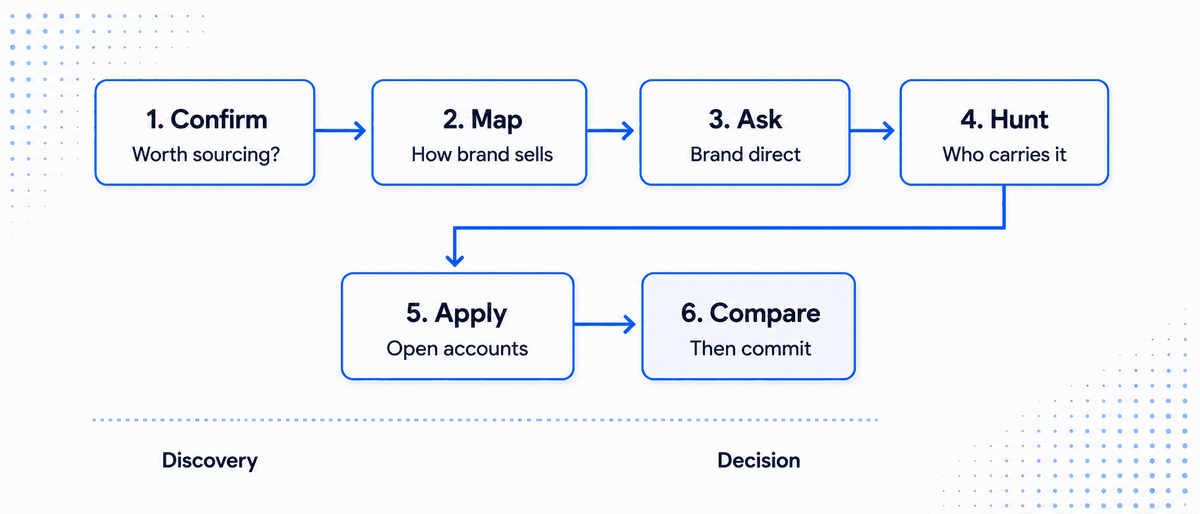
Step 1: Confirm It's Worth Sourcing
Check that Amazon itself isn't selling and shipping the product, that it's not a private label, and that the brand allows third-party sellers. If Amazon is running the show or the brand is closed off, hunting for suppliers won't get you far.
Step 2: Map How The Brand Distributes
Some brands work with just a few big national distributors, others spread out among many regional wholesalers, and some only sell directly. Regional wholesalers often have less competition, while national distributors bring scale and simpler paperwork.
Step 3: Ask the Brand Directly.
Call or email the brand's wholesale department and ask who their authorized distributors are for online resale. Brands usually share this info easily. This step gives you the best results but is often skipped by sellers.
Step 4: Hunt For Who Carries The Exact Product.
Try several methods at once:
- Search the brand name with phrases like "authorized distributor," "dealer locator," or "reseller application."
- Use file-type searches (like
filetype: pdforfiletype:xls) with the brand name to find wholesale price lists and catalogs that don't show up in regular searches. - Check the product packaging. Labels and boxes often list the distributor or importer, a clue many sellers miss.
- Once you find one legitimate distributor, search its name to find similar ones.
- Look up the product's UPC or MPN to see which catalogs list it.
Step 5: Apply For Accounts
Have your resale certificate, EIN, business registration, and a professional website ready? This shows you're serious, not just a hobbyist. Keep all invoices and authorization letters handy. Amazon may ask for proof to sell certain brands in 2026. Expect some rejections and vetting.
Sourcing tip: Apply to distributors before you need them. Approval can take days to weeks, and the worst time to start an application is when a product is already spiking, and you're out of stock. Build the relationships ahead of the demand.
Step 6: Compare Before Committing
After narrowing down to two or three viable options, do not simply go with the lowest sheet price. Take into account the total landed cost, which includes freight, terms, and fees, as well as stock reliability, minimum order quantities (MOQ), lead time, and the supplier's history with disputes. The supplier that looks the cheapest on paper often turns out to be more expensive in reality.
Remember, on Amazon, a supplier whose invoices pass brand checks is far more valuable than saving a few cents per unit.
What This Looks Like In Practice
For Example, a DeWalt drill is selling well, and you want a second authorized source. Here's where the abstract steps get concrete.
DeWalt is a Stanley Black & Decker brand, so it doesn't sell to resellers directly. It runs through authorized industrial and hardware distributors. That single fact changes your whole approach: you're not hunting for "a cheap DeWalt supplier," you're trying to get authorized with a distributor who already carries that SKU.
Instead of generic supplier hunts, you dive into the language and channels that matter, industrial distributors, MRO suppliers, authorized dealers, and then cross-check the specific SKUs or UPCs against their catalogs. That's how you figure out who actually carries the product.
And the key gatekeeper isn't price; it's brand authorization. Even if a distributor offers a good price, they can't legally sell DeWalt tools without the brand's approval. So your focus is on getting that authorization through the right channels.
The payoff is not grabbing a cheaper drill; it's securing a backup authorized source. When your main distributor runs dry, especially during peak seasons like Q4, having that secondary channel is gold. It means you're not stuck waiting or paying premium rush prices. That flexibility often outweighs a few margin points.
The brand and channels shift from case to case. The strategic logic doesn't.
How to Vet a Supplier
Don't compare on price alone. Compare what determines whether the relationship actually works:
- Landed cost — not list cost. Include freight, terms, and fees.
- Stock reliability — do they actually have what the sheet says?
- MOQ and reorder terms — can you start small and scale?
- Lead time and ETA — how fast, and how predictable?
- Authorization — are you approved, and can they supply Amazon-ready invoices?
- Track record — fill rates, dispute handling, behavior when things go wrong.
The lowest price for sheets doesn't mean much if the supplier is often out of stock. The numbers are tough: selling wholesale on Amazon usually brings in a profit margin between 10% and 20%. With fees going up in 2026, saving even one dollar when buying supplies can make a big difference in what you actually keep.
A Few Sourcing Tips That Save Real Money
The difference between a sourcing process that works and one that bleeds margin usually isn't the big decisions; it's a handful of habits experienced operators build over years:
Never single-source a winner. Not every day in business looks the same, so you have to prepare for the worst, create contingencies, and think ahead of time. One supplier providing the best prices, the desired stock, and agreeing to terms is not enough, especially when one end of the chain is Amazon, with its own uncertainty on both sourcing and sales. When we started selling on Amazon, we faced the challenge of dependency on one supplier for a specific high-selling product. But soon, we realized that ETAs vary every time, Amazon prices drop, supplier prices climb, or some other issue arises, and every one of those causes lost opportunities. Now our policy is to actively sign up with three to four suppliers per brand and keep all of those relationships active. The cost is a little extra application work and slightly less leverage on price. The payoff is that we never lose a listing to a single supplier's bad week, and during the manufacturing crises of the last few years, that policy is what kept the business moving.
Ask about terms, not just price. Working capital is where wholesale businesses live or die, we learned, thanks to our CFO. The Amazon inventory cycle typically runs 60-75 days from purchase to sale. We used to optimize purely for the best unit price, until we ran the numbers and realized that Net-60 terms effectively finance the entire purchase-and-sale cycle. That's worth roughly 5-10% in intrinsic margin, money you keep without changing a single supplier or product. Now, when we evaluate a new supplier for a product, Net-60 wins over cash terms even when their price is 3-5% higher. The headline price looks worse on the sheet. The actual economics are significantly better.
Test before you scale. Start with a small initial order before investing a lot of money. Make sure the product is genuine, the invoice looks like Amazon expects, and the stock and delivery time match what was promised. It's a low-cost way to avoid a costly error.
How Can You Do This Faster?
The workflow above is the hustle most wholesale operators run through every time they add a SKU: separate portals, spreadsheets, and re-checking pricing by hand. It scales badly, and in a tariff-volatile year, slow comparison means missed pivots.
That's what we built SupplierHub for: type a UPC and see every supplier carrying that product on one page, cost, stock, MOQ, ETA, and authorization side by side, with retail prices overlaid for margin. It doesn't remove the authorization step; it removes the hours of hunting that come before it.
The Takeaway
Finding a supplier in wholesale isn't a transaction. It's the operational discipline the whole business rests on. The brand mapping, the application timing, the authorization paperwork, the comparison across landed cost and reliability, the relationships built before you need them, every step compounds. None of it is a shortcut. It is the science of wholesale itself, and the resellers who treat it that way build businesses that hold up when tariffs shift, when a supplier goes quiet in Q4, when Amazon tightens its invoice checks.
The sellers who win in 2026 aren't the ones who got lucky with one good supplier. They're the ones who built a strong, authentic distributor network and kept strengthening those relationships with the passage of time until the network itself became the edge.
Frequently asked questions
01How many suppliers do I need to start?
02Do I need a resale certificate to buy wholesale?
03Can a distributor reject me?
04Domestic or overseas in 2026?
05Is reverse sourcing the same as product research?
The B2B SupplierHub Team
Wholesale & sourcing
Stop hunting suppliers by hand. Type a UPC instead.
B2B Supplier Hub shows the suppliers in our network carrying a product on one page: wholesale cost, stock, and retail price side by side. Free to search, no card required.