
Distributor Authorization
Authorized Distributor vs Middleman vs Gray Market: What It Means for Your Amazon Account (2026)
A product can be 100% genuine and still get your listing pulled.
That might have sounded a bit paranoid just five years ago, but today, it’s the harsh reality Amazon sellers are facing. Amazon doesn't suspend listings because a product is fake. Most of the time, it is suspended because the seller can't prove where the product came from. And "where it came from" doesn't mean the factory. It means the chain of hands between the brand and you.
If you've been sourcing wholesale for a while, you already know the three kinds of suppliers that exist. What has changed is that the difference between them now decides whether your invoice survives a verification request.
Let’s break down the differences in straightforward terms, why this is more important in 2026 than ever, and how to identify which type of supplier you’re actually dealing with before you send any money.
Authorized Distributor, Middleman, and Gray Market Defined for Amazon Sellers
What Is an Authorized Distributor (and Why Amazon Cares)
An authorized distributor is a key player who has a solid, documented relationship with the brand. They purchase directly from the manufacturer, are recognized by the brand as part of its distribution network, and can back it all up with paperwork, a distribution agreement, an authorization letter, or, at a minimum, a verifiable trade reference. When Amazon asks, "Can you show an unbroken line from the brand to you?" the authorized distributor is the crucial link that connects everything.
What Is a Middleman Supplier and Where Do They Fit in the Supply Chain
The middleman, often called a jobber, sells real goods through a broken chain. They might have bought from someone who bought from someone else, and that someone may or may not have been authorized. While the product on the shelf is authentic, the issue lies in the paper trail. A middleman typically can’t tell you who the brand is in their supply chain because they don’t have a direct relationship with the brand; their connection is solely with whoever sold them the pallet.
What Is a Gray Market Source and Why Is It Risky for Amazon Sellers
The gray market consists of genuine products that have slipped out of authorized channels. For instance, a distributor might dump overstock to free up cash, or stock meant for one region gets sold into another. Think of it like a pallet that "fell off the truck." These items are real, often just like what you'd find on the authorized shelves, and typically come at a lower price, which makes them appealing but also risky.
When you compare them side by side, the difference isn't whether the product is real. It's everything behind it. The thing to understand here is that all three can sell you an authentic product. Only one of them gives you a defensible position when your account gets questioned.
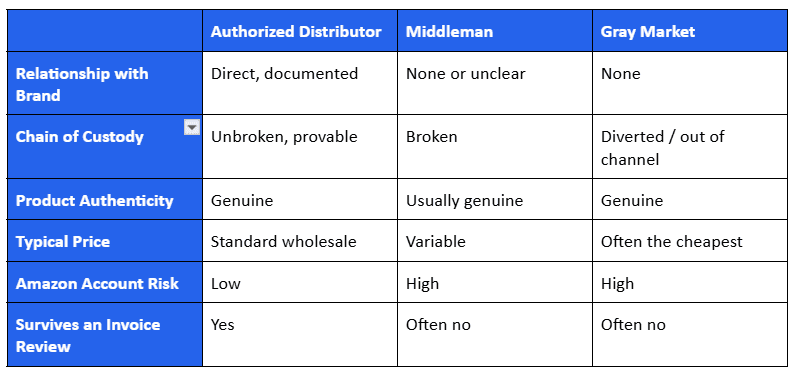
Just to clarify, the distinction isn’t really about whether a company is a distributor or a wholesaler. It’s all about authorization. A wholesaler can definitely be authorized by a brand, while a company that calls itself a "distributor" and carries a ton of brands might not have authorization for any of them. So, instead of sorting suppliers based on the title they use on their website, focus on whether they can actually demonstrate a relationship with the brand.
Why Supplier Source Type Barely Mattered Before and Now Decides Your Amazon Account's Fate
For years, sellers operated under a straightforward belief: if a supplier had a website and offered wholesale prices, they were trustworthy. But that belief has become a risky gamble.
Amazon has been steadily tightening its grip on supply-chain enforcement, and in 2026, the consequences will be significant. The platform is increasingly demanding that sellers prove a legitimate chain of custody. It means the product must trace back from the brand to an authorized distributor and then to the seller. If a supplier bought from a middleman who, in turn, bought from another middleman, they fail this test, even if the products are completely authentic. The focus has shifted from authenticity to traceability.
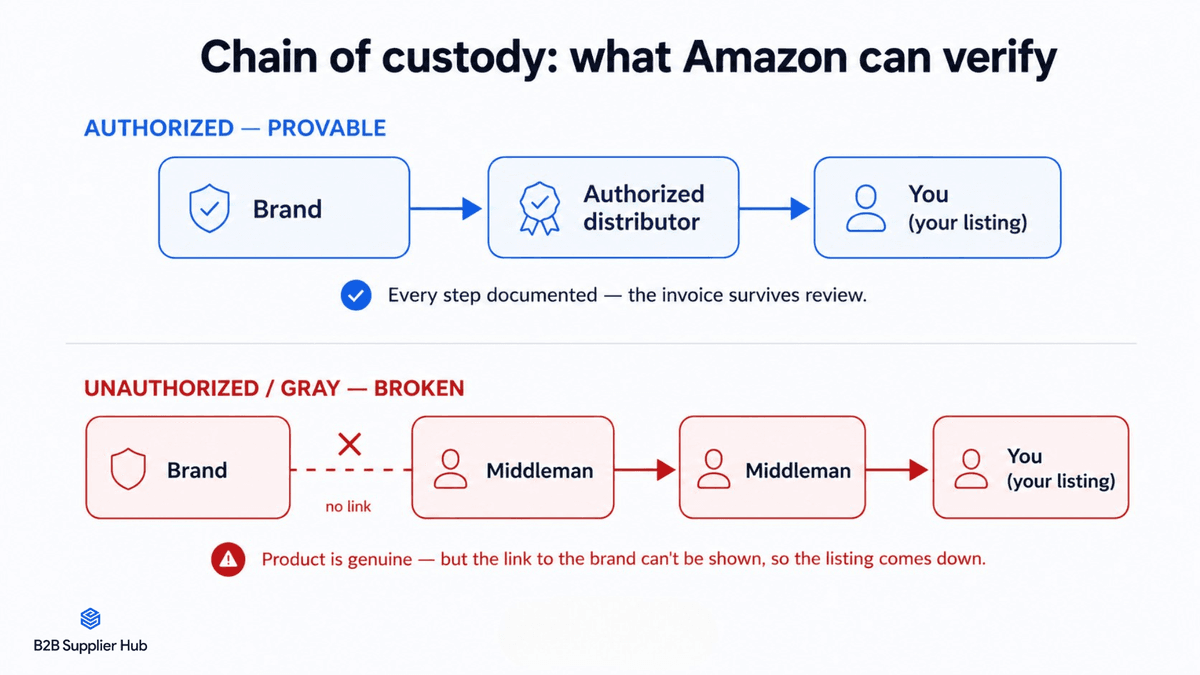
This isn't happening in isolation. Amazon's Counterfeit Crimes Unit has taken action against more than 24,000 counterfeiters and fraudulent sellers through litigation and criminal referrals since 2020. Their document-review systems have also become more adept at identifying sourcing issues. The unfortunate outcome for honest sellers is harsh and often counterintuitive: those with genuine inventory are facing authenticity complaints, ungating rejections, and, in the worst cases, suspensions, not because they did anything wrong, but because they sourced from a link in the chain that couldn’t be verified.
Here’s how it typically unfolds. A seller discovers a solid supplier for a well-known brand, let’s say a tool line, offering prices significantly lower than competitors'. The product arrives, it’s authentic, and sales begin. But months later, an authenticity complaint is lodged against the ASIN, and Amazon requests invoices to verify the supply chain. The seller submits what they have: an invoice from a wholesaler who purchased the goods from another wholesaler, neither of whom is authorized by the brand. The product was always genuine, but the chain of custody can’t be established. The listing is removed, and the inventory is put on hold while the appeal process drags on. The seller wasn’t dishonest; they simply sourced from the wrong link in the chain.
From our sourcing desk: Protecting existing listings and ungating new ones has become tougher than at any point in the last 10 years. It used to be simple: we'd source a product, whether from a middleman or the gray market, and listings would get unblocked. Amazon verified invoices and ungated categories and brands. Now it's different. Amazon wants invoices from authorized distributors in the proper format; it sometimes contacts suppliers directly, and even then, you're not sure a new listing will get ungated. Amazon regularly removes listings and then asks for inventory and invoice verification to reactivate them, which often requires extensive investigation and creates real cash-flow and profitability problems. Recently, Amazon blocked all listings of a tool brand and demanded invoices. Almost $100k was stuck, and we didn't know whether we could sell that inventory on Amazon anymore. Because we had an authentic, verifiable supply chain and supplier, we got the listings ungated and resumed selling.
What Amazon Actually Checks on Your Invoices in 2026 (And What Fails)
When a verification request comes in, your invoice serves as the proof. If it doesn't meet the necessary standards, the appeal won't succeed. Here’s what the document should demonstrate, based on what’s been consistently passing the review process lately:
- Recency: For an authenticity complaint, invoices generally need to be dated within the last 365 days; for category ungating, the window is often tighter, 180 days or less. This is a real bind if you buy in bulk and sit on a year or more of stock, since legitimate invoices can age out before the inventory sells through. Fresher is always safer.
- Quantity: A minimum of around 10 units of the product you're applying to sell. Single-unit purchases read like retail rather than supply.
- Full Supplier Identity. Business name, physical address, phone, and a working website. The website requirement has effectively become mandatory. If the supplier can't be found and verified online, the invoice is treated as unverifiable.
- Matching Details: Your business name and address on the invoice must match your Seller Central registration exactly. Small mismatches in name or address are among the most common reasons applications get rejected.
- The Right Source and a Letter of Authorization: Amazon wants a wholesale invoice from the brand or an authorized distributor. For wholesale sellers, the usual failure isn't a retail receipt, it's an invoice from a wholesaler the brand never authorized, or a supplier Amazon can't verify online or by phone (common once a supplier closes). And for branded goods, a clean invoice often isn't enough on its own: once a complaint names the brand, expect Amazon to ask for a Letter of Authorization (LOA) from the brand too.
Another important detail to keep in mind is that Amazon's reviewers are quite attentive to pricing. If your invoice shows a cost that's significantly lower than standard wholesale rates, it raises red flags about gray-market or unauthorized sourcing, which can lead to increased scrutiny instead of easing it.
The pattern across all of this is the same. While it's essential to meet all the formatting requirements, that's just the beginning. The most critical factor is whether your supplier is authorized by the brand. Everything else is just about ensuring you meet that key requirement.
The Legal Reality: Genuine Product Does Not Mean It's Safe to Resell on Amazon
This is where a lot of capable sellers often stumble, as the legal landscape and the realities of the marketplace don’t line up.
Legally, you're often on solid ground reselling genuine goods. Thanks to the first-sale doctrine, once a brand legally sells a unit, its trademark control over that specific item is pretty much over. It means the buyer can resell it without stepping on any legal toes. That's the principle that makes the entire resale economy possible. In most of the US, gray-market selling isn't illegal on its face.
However, there's a catch that can take away some of that comfort: material differences. If the items you're reselling differ significantly from what the brand offers through authorized channels (for example, missing manufacturer warranties, different packaging, lack of brand support or recall notices, or software that won't update), then the first-sale doctrine no longer has your back. Courts apply a low bar for what counts as "material"; even a difference in warranty can be enough, as law firms tracking gray-market enforcement have documented.
There are a couple more nuances to keep in mind. First, the protection is strongest for goods that were initially sold in the US; products sold overseas and then brought back in are on much weaker ground, a real pitfall if you’re tempted by those parallel-import prices. Second, gray-market sellers often overlook MAP (minimum advertised price) policies, and undercutting MAP is one of the clearest red flags that pulls a brand's enforcement attention toward a listing in the first place.
So you can be in a position where the product is authentic, your resale is arguably legal, and Amazon still pulls your listing because a rights holder filed a complaint pointing to exactly those differences. The battle for legal defensibility and the outcome on the platform are two distinct challenges. Just because you win the first doesn’t guarantee success in the second. For anyone running a business, the takeaway is clear: saying "but it's a real product" isn’t a solid strategy; it’s more like wishful thinking.
How to Tell If Your Supplier Is Authorized, a Middleman, or Gray Market
You usually can't get a straight answer by asking, "Are you legit?" Everyone says yes. But the structure of how a supplier operates tells you what they are before you've spent a dollar. A few reliable tells:
Authorized Distributors Require You to Qualify for an Account
They require business verification before opening an account: your EIN, a resale certificate, and sometimes trade references. If a supplier lets anyone buy "wholesale" with a credit card and no approval process, you're looking at a retailer or a middleman marking up the product, not a distributor.
Watch How They Handle Minimum Order Requirements
Legitimate distributors have MOQ policies. A supplier advertising "as low as one unit, no account needed" is almost certainly a dropshipper or middleman.
Check Whether the Supplier Also Sells on Amazon Themselves
If your "supplier" is also listing the same ASINs on Amazon or eBay, they're a competitor, not a partner. Their pricing will undercut yours, and their position in the supply chain isn't a distributor's.
Ask for Authorization Documentation and Verify It with the Brand
A genuine authorized distributor can show their relationship with the brands they carry: an authorization letter, a distribution agreement, or a verifiable reference. If they can't answer "Are you authorized for this brand?" with documentation, walk away. A supplier carrying "thousands of brands" but lacking authorization for any of them isn't the safety net it appears to be.
At a glance, it lines up like this:
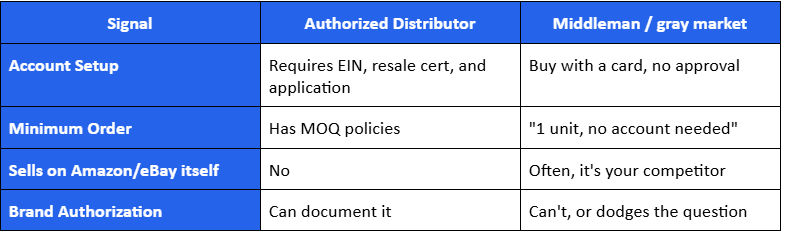
Run a prospective supplier through those four filters, and you'll sort authorized from middleman from gray market faster than any sales pitch would.
How to Move to Authorized Wholesale Sourcing on Amazon: A Step-by-Step Path
Spotting a bad source is half the job. The harder question is how you end up holding a supply that survives a verification request. A few moves that actually work:
Step 1: Contact the Brand Directly Before Approaching Any Distributor
Approach the brand on your own letterhead, ask for permission to sell, and ask to be pointed to their authorized distributor for your region. While this approach may take longer than simply buying a pallet from whoever picks up the phone, obtaining a brand authorization letter, the LOA that Amazon frequently requests, is the most powerful document you can have. Plus, since brands don’t usually offer this route, many sellers miss out on asking for it.
Insights from our CEO: Getting brand authorization to sell on Amazon or to buy directly is a long process that takes patience and resilience. Most brands already have a solid footprint and established partners on Amazon, so they assume a new seller adds no value and only increases saturation, diluting their brand image. I still remember our first Amazon authorization: it was a no initially. We sent an email and a partnership proposal highlighting our strengths and the areas where we could grow the brand, and they refused flatly, "We are not onboarding new e-commerce sellers." It was disappointing, honestly. But we pushed for an online meeting, and they agreed. A productive Zoom call helped both sides understand each other better, though they first routed us toward buying from their distributors, assuming we couldn't meet their annual MOQ. Another conversation about MOQ and an opening order built more confidence, and they finally added us to their authorized seller list, and we were ungated to sell on Amazon. The lesson: brand partnerships hinge on what you bring to the table. If a brand doesn't see real value in adding you, it won't.
Step 2: Build the Business Credentials That Get Distributor Accounts Approved
The distributors that demand an EIN, a resale certificate, and references are the ones worth having. The friction is the feature: an account that's annoying to open is an account that protects you later.
Step 3: Assemble Your Authorization Paper Trail Before Amazon Asks for It
Keep compliant invoices, authorization letters, and distributor agreements organized as you go. The time to assemble a chain-of-custody record is before a complaint lands, not in the 48 hours you're given to respond to one.
Step 4: Build a Bench of Authorized Sources for Your Top SKUs.
For each product that matters, line up more than one authorized source, so a single channel change or a distributor going dry doesn't strand the listing.
What Your Supplier Source Type Means for Your Amazon Sourcing Strategy
Here’s the crucial shift we need to recognize. For years, sourcing was all about margins: find the same genuine product at a lower price and pocket the difference. But in 2026, sourcing has evolved into a decision that weighs account risk, which happens to involve margin.
A gray-market source that offers a few points of savings isn’t really a bargain if there’s a genuine risk of an authenticity complaint that could pull the listing and the cash tied up in that inventory out of circulation. When evaluating a supplier, the cost per unit is just one piece of the puzzle. The reliability of the supply chain behind that cost is equally important, and it now deserves a spot on the same line of your spreadsheet.
This is why it’s essential to consider authorization status alongside cost, stock levels, MOQ, and lead times when you’re comparing suppliers for an SKU. You don’t want to discover these details after making a purchase, dealing with a complaint, or going through an appeal. Understanding whether each source can back up its invoice is a key part of the sourcing process itself. That’s one reason why we prioritize authorization visibility in our supplier comparison approach at B2BSupplierHub. A lower price tag means very little until you know what’s standing behind it.
For your top SKUs, the strategy isn't about "finding the lowest cost." It’s about building a reliable bench of authorized sources. This way, if one supplier runs out or a brand tightens its distribution, you can switch between trustworthy options instead of scrambling for whatever’s cheap and untraceable under pressure.
The Safest Sourcing Path for Amazon Sellers Is the Authorized One
If you keep one thing from this read, it would be: in 2026, the question is no longer "Is this product real?" It's "Can I prove where it came from?"
Sellers who approach sourcing as a matter of traceability rather than just chasing the lowest price are the ones who will still be thriving a year later.
Frequently asked questions
01Is selling gray-market goods illegal on Amazon?
02Will Amazon accept an invoice from a wholesaler who isn't authorized by the brand?
03How can I tell if a distributor is actually authorized by the Brand?
04What does Amazon require on an invoice in 2026?
05Is a cheaper supplier worth the risk if the product is genuine?
06Do I need a letter of authorization, or is a distributor invoice enough to sell on Amazon?
The B2B SupplierHub Team
Wholesale & sourcing
Stop hunting suppliers by hand. Type a UPC instead.
B2B Supplier Hub shows the suppliers in our network carrying a product on one page: wholesale cost, stock, and retail price side by side. Free to search, no card required.