
Sourcing
Reverse Sourcing for Amazon Sellers: The 5-Step Workflow (2026 Guide)
When you chat with a struggling wholesale seller about what they need, you’ll often hear them express a wish for a better product to sell. On the other hand, if you ask a high-volume seller, you'll get a different answer: a second place to buy the products they already sell.
That gap of chasing new winners versus protecting the already proven ones separates a business that scales from one that's always a stockout away from a bad month.
The solution to bridging this gap is known as reverse sourcing. In 2026, this strategy has emerged as a critical skill for Amazon wholesale resellers.
What Is Reverse Sourcing for Amazon? (And How It Differs from Forward Sourcing)
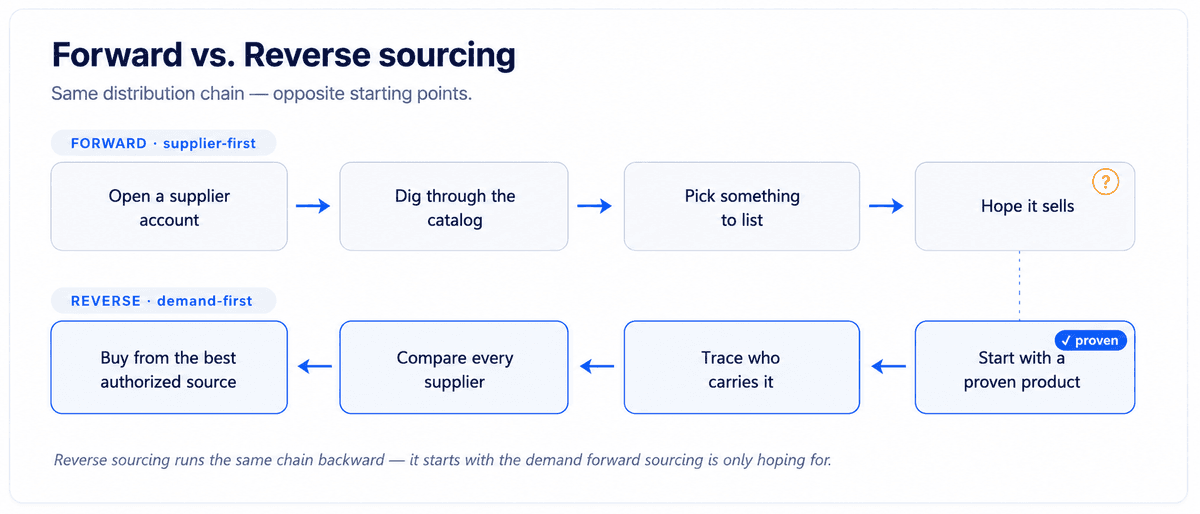
Traditional sourcing runs forward: you start with a supplier, work through their catalog, and try to find products worth listing. You're betting that somewhere in a distributor's price sheet, there's a product the market wants. Most of the time, there isn't; you evaluate dozens of items to find one worth stocking.
On the flip side, reverse sourcing takes a different approach. You begin with a product you already know is a hit. Maybe it's one of your own proven winners or an SKU you can see selling on a listing. You work backward to find every authorized distributor who carries it. Then you compare them on cost, stock, terms, and authorization, and you buy from the best one.
While the difference might seem minor, it’s actually significant. Forward sourcing feels like a guessing game with a supplier catalog, whereas reverse sourcing is rooted in proven demand and simply asks: who can supply this, and under what conditions?
For a wholesale seller, that's the whole game.
Why Reverse Sourcing Matters More for Amazon Sellers in 2026
Three things have changed that make reverse sourcing less of a nice-to-have and more of a survival skill.
Single-Supplier Dependency Is Now a Serious Account Risk
With tariff fluctuations expected to continue through 2025 and 2026, the supply chain is looking less predictable and more costly. The National Association of Wholesaler-Distributors revealed that 62% of distributors anticipated their costs would rise by 10% or more in 2025. A distributor who caught a great deal in January might find themselves out of stock or facing significantly higher prices by Q4. Sellers who depend solely on one source for a popular SKU are just one stockout away from losing the Buy Box on their top product. Those who manage to stay afloat already have their second and third sources lined up before they hit a snag.
Thinner FBA Margins Make Supplier Cost Comparisons Essential
In 2026, Amazon tightened its fee structure once again. A SKU that used to bring in a decent margin two years ago is now yielding less profit at the same selling price. When the selling side gets squeezed, the only option left is to focus on the buying side, and that means knowing what every supplier charges for the same product, not just the one you typically work with.
Amazon's Authorization Scrutiny Has Increased Significantly in 2026
This is the major point. Amazon is now more aggressively enforcing the chain of custody, as they want to see a clear, unbroken line from the brand to an authorized distributor and then to you. A supplier who technically "has" a product but got it from another middleman might not pass that test, even if the product is completely legitimate. The enforcement against counterfeits is at an all-time high. So, in 2026, reverse sourcing isn't just about "who sells this product," it's about "who sells this product and can prove they're authorized to do so."
We'll come back to that, because it's where most reverse sourcing advice falls apart.
Forward Sourcing vs. Reverse Sourcing: Key Differences for Amazon Sellers
Here's the practical difference, side by side.
-1.png&w=3840&q=75)
A serious wholesale operation needs both, but reverse sourcing is the one that protects the business you've already built. Your top 20 SKUs are your revenue. Reverse sourcing is how you make sure each of them has more than one way into your warehouse.
From our sourcing desk, we had a professional microphone that was performing well on Amazon. At the time, we were relying on a single authorized distributor for inventory. The challenge arose when the distributor informed us that the product was being discontinued (EOL) and would no longer be available. At the same time, the listing continued to sell steadily on Amazon, and multiple sellers were still replenishing inventory, which suggested there was still an active supply somewhere in the market. Rather than exiting the listing, our sourcing team conducted a reverse-sourcing exercise. We mapped the brand's distribution network, reached out to additional authorized wholesalers, and identified a second supplier with substantial remaining inventory. Not only was stock available, but the new source also offered pricing that was approximately 3-4% lower than our previous cost.
The 5-Step Reverse Sourcing Workflow for Amazon Wholesale Sellers
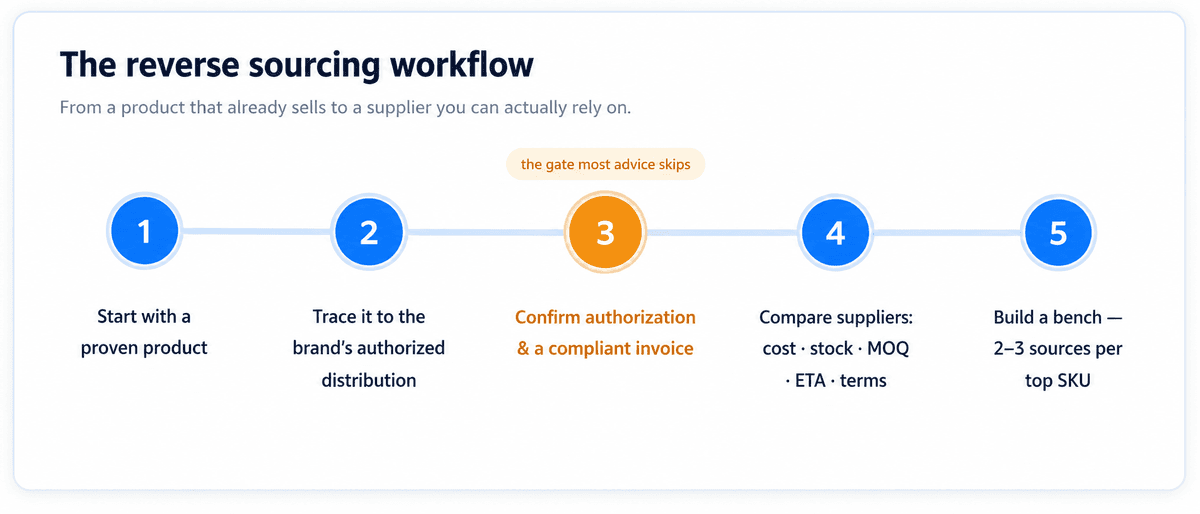
This is the part most articles skip. Here's the workflow a wholesale seller actually runs, step by step.
Step 1: Identify a Proven, Profitable Product Already Selling on Amazon
This is either one of your own winners or a SKU you can see performing on a listing. The point is that demand is already established. You're not validating the product; the market has done that for you. Your focus is on supply. Make sure to note the UPC, brand, and MPN; you’ll need all three.
Step 2: Trace the Product Back to the Brand and Its Distribution Chain
Every branded product has a distribution system behind it. The brand sells to a select group of authorized distributors, who then sell to resellers. Your task is to map out that structure: who are the authorized distributors for this brand in this category in the US? Reaching out directly to the brand is often the best route. Many mid-sized brands will happily share their list of authorized distributors if you ask and your account metrics are clean. A UPC or MPN lookup will help you get the rest of the information you need.
Step 3: Confirm Supplier Authorization — Not Just Product Availability
This is the 2026 filter. A distributor showing the product as in stock means nothing if they can't provide a compliant invoice. Before you wire money, make sure the supplier is genuinely authorized for that brand and that their invoice will pass Amazon's checks. It should include the full business name and address, phone, website, itemized products, your business name matched exactly, and all dated within Amazon’s accepted timeframe. A golden invoice from a real authorized distributor is the difference between getting ungated and getting flagged. We covered this in our guide to finding wholesale suppliers for Amazon FBA.
Step 4: Compare All Suppliers Carrying the Same Product on Price and Terms
Once you've got two or more authorized distributors carrying the SKU, put them side by side: look at cost, MOQ, stock level, lead time, ship-from location, and payment terms. The cheapest unit price isn't always the best deal. A supplier $0.40 cheaper per unit with a 30-day lead time and a high MOQ can be worse than a slightly pricier one who ships in three days with no minimum. Reverse sourcing isn’t complete when you find a source; it’s only done when you find the right one.
Step 5: Build a Supplier Bench — Never Rely on a Single Source
The whole reason to reverse-source a product you already sell is resilience. So don't stop at one alternative. For your top-selling SKUs, aim to have two or three authorized suppliers that you’ve already vetted. We've broken the exact process down in our guide to building a three-supplier bench for your top Amazon SKUs. This way, if your primary supplier runs out of stock or hikes their prices, you can switch suppliers smoothly instead of scrambling to find a solution.
From our sourcing desk, in our experience building sourcing coverage, the number of authorized distributors varies a lot by category. Sports & Outdoor brands usually have a much tighter authorized network. For the brands we work with in this category, a popular SKU is typically carried by 3–5 authorized distributors. That limited coverage makes stockouts and pricing swings more common if one distributor runs out or changes terms. Electronics brands generally have a much broader distribution network. For many mainstream electronics brands we source, we commonly see 20–25 authorized distributors per brand, which gives us more flexibility on availability, pricing, and replenishment speed.
Where Reverse Sourcing Hits Its Limits (And How to Handle Each One)
If we claimed reverse sourcing always works, you’d have every reason to be skeptical. It has its limitations, and understanding these boundaries is what distinguishes genuine sourcing advice from mere marketing fluff.
Restricted Distribution: When the Brand Controls Who Can Sell
Some brands intentionally choose to limit who can sell their products. You might pinpoint the exact distributor for a SKU, but that doesn’t guarantee you can purchase it, because the brand only authorizes a closed set of accounts.
Authorization Requirements You Don't Yet Meet (and How to Get There)
Finding the authorized distributor is just the beginning. Getting approved by them is a separate problem, as distributors often have their own criteria, and a new reseller may not meet their requirements regardless of what Amazon wants. The product being visible doesn't mean it's available to you.
Minimum Order Quantity Walls That Block Entry-Level Sellers
A distributor might have the product, approve your account, and still require a minimum order quantity that doesn’t align with your budget or your sales rate for that SKU.
None of these challenges diminishes the value of reverse sourcing. In fact, they highlight the importance of doing it right, ensuring you have the necessary authorizations upfront rather than discovering the hard way after placing an order.
From our sourcing desk, in one case, we sourced inventory from an authorized distributor and had fully compliant invoices. However, when we submitted the documentation to Amazon, the invoices were initially rejected. The issue wasn't the authenticity of the goods—the distributor was legitimate and authorized, but Amazon couldn't independently verify the supplier through its standard review process. Rather than abandoning the opportunity, we worked with Amazon's compliance team and requested that they contact the distributor directly to verify the supply chain. Once the verification was completed, the invoices were accepted, and the account was approved to sell the product. We've also encountered the opposite scenario: distributors with available inventory who were authorized by the brand but were not authorized to sell specifically to Amazon resellers. In those situations, inventory was technically source able, but not compliant with the brand's channel policies. To move forward, we approached the brand directly, secured the necessary authorization, and ultimately established a direct purchasing relationship. The broader lesson is that authorization is rarely black and white. Requirements vary significantly by brand, distributor, and marketplace policy. A supplier can have stock, legitimate invoices, and an authorized relationship with the brand, yet still require additional verification before the inventory is truly viable for Amazon.
How to Do Reverse Sourcing Faster (Tools and Shortcuts That Actually Work)
Run that workflow by hand, and you feel the tax immediately. Ten to fifteen minutes per UPC across portal logins and spreadsheets that go stale the moment you build them; multiply that by a winners list of 50 SKUs, and a sourcing day disappears.
That's what SupplierHub is built to collapse. Type a UPC or paste a list, and every authorized distributor carrying it lines up on one page: cost, stock, MOQ, lead time, and authorization status, with Amazon and Google Shopping retail prices overlaid for the margin read. An afternoon becomes one search.
The manual still works. It just doesn't scale.
The wholesale sellers who stay stable aren't the ones who never have a supplier go dark. They're the ones who already knew where else to buy when it happened. Reverse sourcing is how you become one of them, not in an emergency, but on a normal Tuesday, one SKU at a time.
Frequently asked questions
01Is reverse sourcing only for finding new products?
02How is this different from just looking up who's on a listing?
03Do I still need to apply to each supplier?
04Will a wholesale invoice from any of these suppliers get me ungated?
The B2B SupplierHub Team
Wholesale & sourcing
Stop hunting suppliers by hand. Type a UPC instead.
B2B Supplier Hub shows the suppliers in our network carrying a product on one page: wholesale cost, stock, and retail price side by side. Free to search, no card required.