
Industry Insight
Why Wholesale Distribution Is the Last Industry to Digitize
You can buy a car online. You can close a mortgage online. You can earn a university degree without ever entering a building. But if you want a wholesale price list in 2026, there is a good chance you will wait three days for a PDF attachment, and when it arrives, some of the prices will already be out of date. Here is the part almost nobody talks about: the same distributor who emailed you that PDF may be running a robot-assisted warehouse behind it.
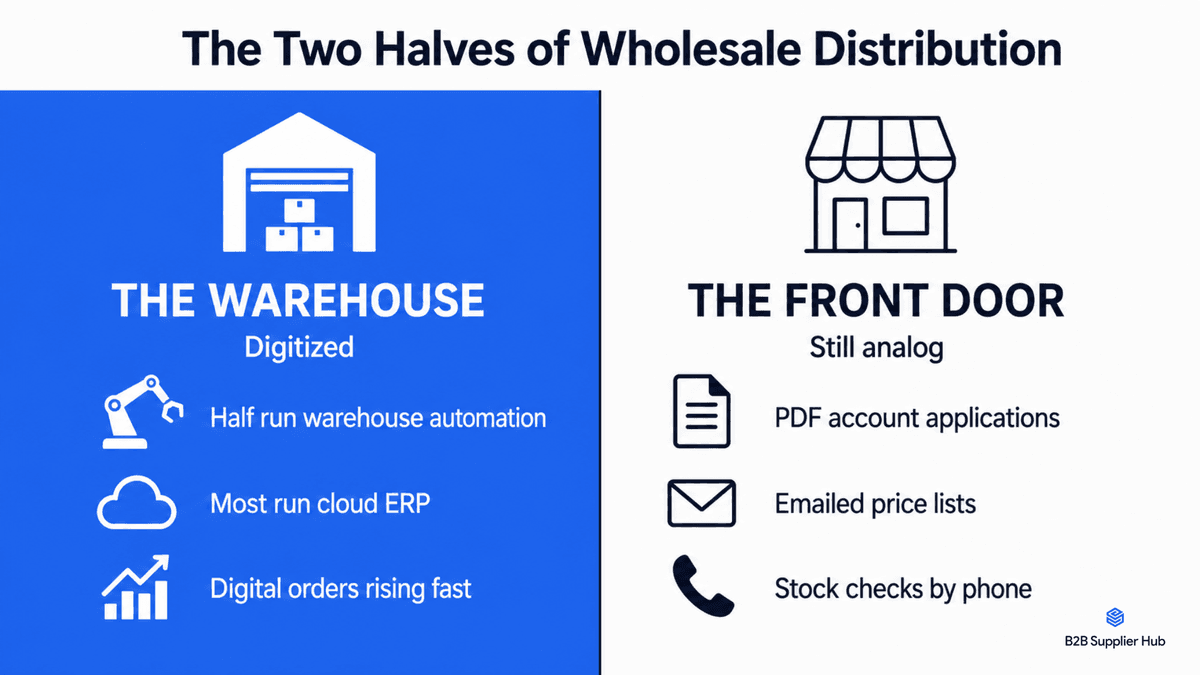
That contradiction is the real story of this industry. Wholesale distribution did not refuse to digitize. It digitized the half of the business you never see and left the half you touch every day running on email, phone calls, and spreadsheets. Understanding why tells you more about how this industry actually works than any trend report.
The Half of Wholesale Distribution That Already Digitized
Let's start by giving distributors their due, because the lazy version of this story is wrong.
Inside the warehouse, there’s been a serious push towards modernization. Industry surveys suggest roughly half of distributors now run warehouse automation systems, and well over half have moved to cloud-based ERP platforms. Over the past five years, the share of orders processed through digital channels has climbed from roughly a third to more than half. Robotic picking, AI-based demand forecasting, and IoT shipment tracking are no longer experiments at the large national players. They are standard operating investments.
Each of these investments is aimed at enhancing something internal and measurable: whether it’s picking speed, inventory accuracy, labor costs, or freight optimization. Distributors are putting their money where they see a return reflected in their own profit and loss statements. This is a smart, disciplined approach, and it’s important to highlight this because the rest of the article explains a gap, not a lack of intelligence.
The Commercial Layer: Why Pricing and Relationships Never Digitized
Now walk through the same industry from the buyer's side, and the picture changes completely.
Finding a distributor still happens mostly through word of mouth, trade shows, and Google searches that lead to websites with no catalog and no prices. Opening an account means a PDF application, a scanned resale certificate, and sometimes a document that still gets faxed. Getting a price list means asking a rep and waiting, and what arrives is usually a spreadsheet that was exported from the ERP at some point in the past. Checking stock means calling. Placing an order often means an email that a human being on the other end retypes into a system by hand.
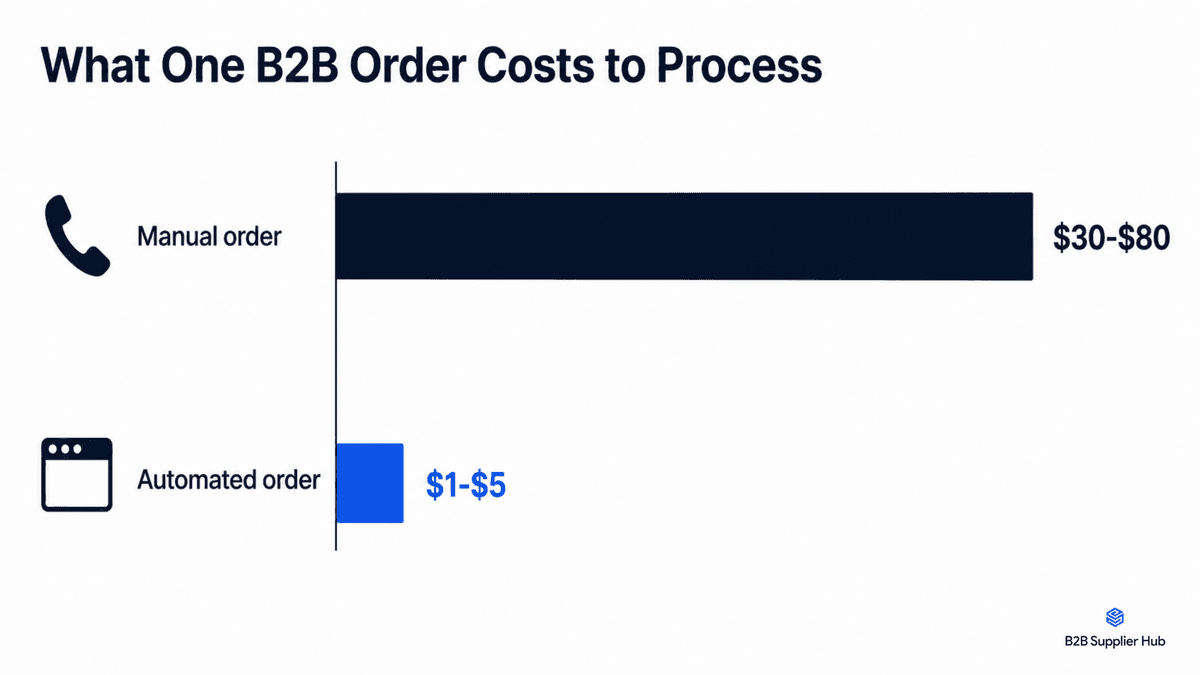
The cost of this layer is well documented. Industry benchmarks put the cost of processing a manual B2B order at 30 to 80 dollars in labor, error correction, and cycle time, compared to 1 to 5 dollars for an order placed through an integrated portal. A large share of order errors traces back to manual handling, and sales reps spend around 40 percent of their time on administrative work instead of selling. None of this is a secret inside the industry. The costs are known, tolerated, and priced in.
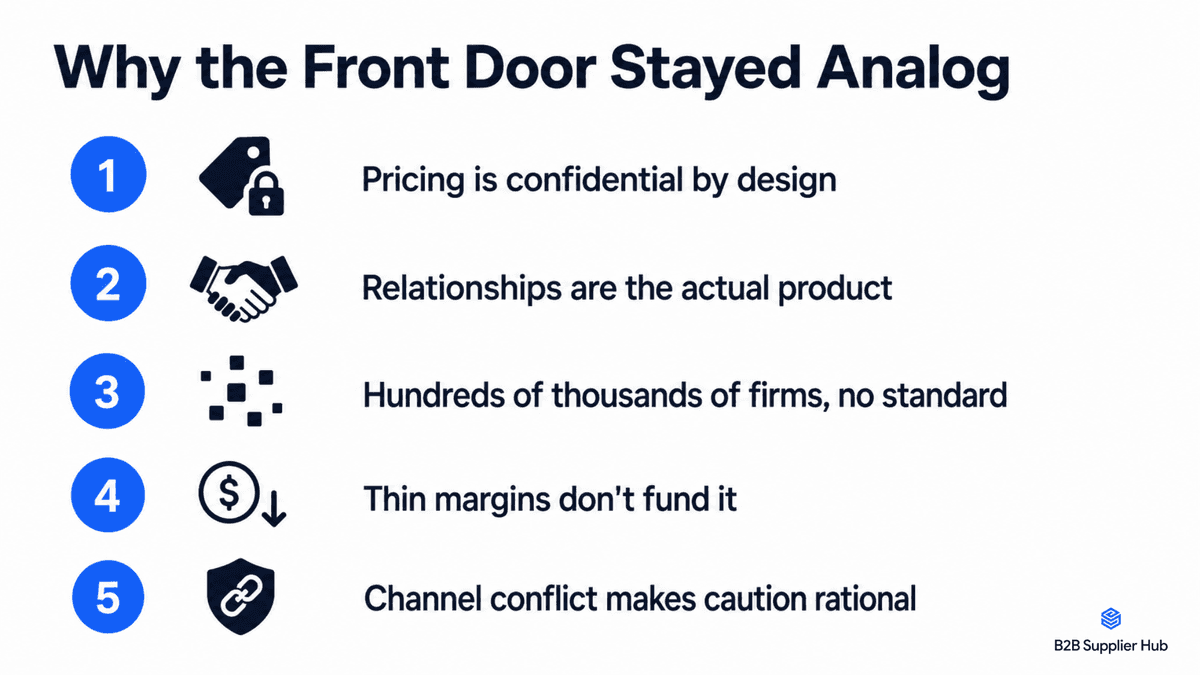
So the interesting question is not whether the commercial layer is outdated. Everyone agrees it is. The question is why an industry smart enough to automate its warehouses left its front door analog. There are five structural reasons, and none of them is laziness.
Reason One: Wholesale Pricing Is Confidential by Design, Not by Accident
This is the deepest reason, and it is the one most technology commentary misses.
A distributor's pricing is not one number. It's a complex mix of contract rates, volume tiers, customer-class discounts, and terms that have been carefully negotiated over the years for each account. This pricing structure serves as a key competitive advantage for the distributor.
Publishing it on a website would essentially give away their negotiating leverage to every competitor and lay bare to customers exactly where they stand in the hierarchy. Plus, it could lead to issues with the brands they represent, many of which are very particular about how and where their pricing is displayed.
In other words, the secrecy is not a technology gap waiting for software. It is a business model. You cannot put on a public website what your business model requires you to keep private. Any honest account of why distribution stayed analog has to start here, because no ordering portal, however slick, resolves it.
Reason Two: In Wholesale Distribution, the Relationship Is the Actual Product
Ask what a distributor really sells, and the answer is not boxes. It is credit terms, allocation during shortages, product knowledge, brand authorization, and a rep who picks up the phone when a shipment goes sideways. BCG's analysis of digital disruption in B2B distribution found that in complex categories like chemicals and machinery, only 5 to 10 percent of distributor revenue is exposed to digital attackers.
The other 90 to 95 percent is protected by relationships, contracts, product complexity, and service. In simpler categories like office supplies, exposure runs as high as 50 percent, which proves the point from the other direction: the moat is the complexity and the relationship, not the industry itself.
Now look at the digitization pitch from the distributor's chair. McKinsey's global survey found that 95 percent of B2B buyers say they are willing to make purchases without ever interacting with a salesperson. If your moat is the rep, a self-service digital channel can look less like efficiency and more like disintermediating yourself.
That fear is sometimes overstated, but it is not irrational, and it explains why the appetite for customer-facing technology has always lagged the appetite for warehouse technology. One threatens the moat. The other deepens it.
Reason Three: No Distributor Is Big Enough to Set an Industry Standard
Retail digitized quickly, partly because a few giants could force standards on everyone. Wholesale distribution has no such gravity. The US Census Bureau counts the wholesale trade sector's businesses in the hundreds of thousands, from national players down to two-warehouse regional specialists, and no single company controls enough volume to make its format the industry's format.
The result is that every integration is bespoke. One distributor offers an API, the next offers a nightly file transfer, the next emails a spreadsheet, and a surprising number still take orders by phone. The industry's one shared protocol, EDI, dates to the 1970s and is expensive enough that smaller players never adopted it. Fragmentation did not just slow digitization. It made sure no version of it could spread on its own.
Reason Four: Distributor Margins Are Too Thin to Fund Digital Transformation
Distribution runs on thin economics. EBITDA margins across the industry average 4 to 7 percent. Out of that, a distributor funds inventory, warehouses, trucks, credit risk, and people. A serious customer-facing platform is a seven-figure, multi-year commitment with uncertain payback, and a half-built digital experience is often worse than none because it frustrates customers without replacing the manual process behind it.
So when a distributor with 5 percent margins chooses between a warehouse robot with a measurable payback and a customer portal with a speculative one, the robot wins. It has been winning that internal budget fight for twenty years, which is exactly why the warehouse modernized and the front door did not.
Reason Five: Channel Conflict Makes Caution Rational
There is one more constraint that outsiders rarely see. Distributors operate under the watchful eye of the brands they carry. Those brands increasingly police where their products appear, who sells them, and how pricing is displayed. Many now require channel reporting from their distributors and maintain approved seller lists.
A distributor who exposes full catalogs and pricing to the open internet risks the authorizations that its entire business depends on. Seen this way, much of the industry's digital conservatism is not cultural at all. It is contractual. The distributor is often not the one holding things back. It is holding up its end of agreements that predate the internet and were never rewritten for it.
Why Wholesale Distribution's Resistance to Digitization Is Finally Cracking
For all of that, the ground is moving, and the force moving it is not technology. It is the buyer.
Gartner's Future of Sales research projected that 80 percent of B2B sales interactions between suppliers and buyers would occur in digital channels by 2025. And buyers are voting with their orders: a 2024 survey of 750 professional B2B buyers found that 85 percent report frustrations that lead to abandoned purchases, with missing stock and delivery transparency their single biggest complaint.
The people opening wholesale accounts today grew up on consumer e-commerce, and every year they make up a larger share of the industry's customer base. Their expectations are not a preference. They are a filter for who gets the order.
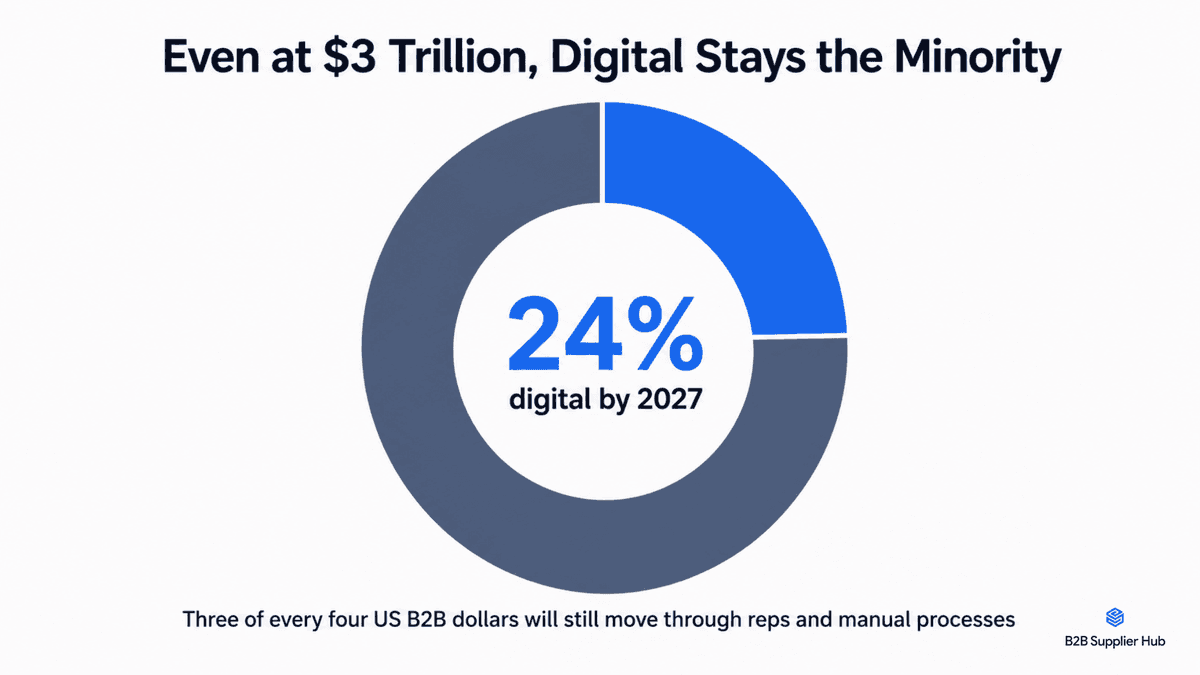
But the change is slower than the headlines suggest, and the numbers prove it. Forrester forecasts US B2B e-commerce reaching 3 trillion dollars by 2027, and even at that milestone, it will represent only about 24 percent of total US B2B sales. Read that the other way: three out of every four wholesale dollars will still move through relationships, reps, and manual processes.
It is also worth remembering that outsiders have tried to force this change before. The first wave of B2B marketplaces collapsed in the early 2000s for reasons that map almost perfectly onto the five above, a story worth its own article.
The realistic picture for the next five years is not a transformation. It is a widening split between distributors who treat the digital buying experience as a growth channel and those who treat it as a threat, with buyers quietly routing their growth toward the first group.
What This Shift Means for Amazon Wholesale Sellers Right Now
If you source products from distributors, the practical takeaway is this: the friction you deal with every week is structural, so waiting for the industry to become Amazon is not a strategy. The sellers who consistently win treat the analog layer as a known cost and build systems around it.
They keep their own records because price lists go stale. They maintain relationships with multiple suppliers because a single rep is a single point of failure. They learn to read supplier data critically because the numbers were exported by a human at some point in the past.
Part of what is genuinely changing is that the numbers are starting to become visible before the relationship starts, instead of after weeks of emails. That is the gap B2B Supplier Hub works in. You can search for a product for free, see cost, stock, and retail price from suppliers in the network, and connect with a supplier only when the numbers already make sense for you.
For the deeper mechanics behind this article, see our guides on how to find wholesale suppliers, how the distribution layers actually work, and how to find the authorized distributors for any brand.
Wholesale Distribution Isn't Behind. It's Built to Resist This Kind of Change
The industries that digitized first were the ones where the middleman added the least value, which is why travel agents and stockbrokers went early. Wholesale distribution went last because its middlemen add the most: credit, logistics, brand authorization, allocation, and judgment earned over decades.
That is also why the digitization that finally works here will look different from what happened in retail. It will not remove the distributor. It will remove the fog around the distributor so that finding one, evaluating one, and deciding to work with one no longer takes weeks of emails.
The buyers who understand that distinction have stopped waiting for the industry to change. They are already working with the version of it that has.
Frequently asked questions
01Why Don't Wholesale Distributors Publish Their Prices Online?
02Do Wholesale Distributors Use Modern Technology at All, or Just for Warehousing?
03Is Wholesale Distribution Moving Online?
04Why Did Earlier Attempts to Digitize Wholesale Fail?
The B2B SupplierHub Team
Wholesale & sourcing
Stop hunting suppliers by hand. Type a UPC instead.
B2B Supplier Hub shows the suppliers in our network carrying a product on one page: wholesale cost, stock, and retail price side by side. Free to search, no card required.