
Industry Insight
Amazon Wholesale vs Online Arbitrage: Which Wins in 2026?
Most people who want to sell on Amazon start in the same place. They have a little money saved, a bit of free time, and a long list of videos telling them completely different things. One video says online arbitrage is the smart way in. The next says wholesale is the only model that lasts. Both sound sure of themselves. Neither one tells you what actually fits your situation.
So, let's sort it out in plain terms. Online arbitrage means you buy discounted products from online stores and resell them on Amazon for more than you paid. Wholesale means you buy products in bulk from a brand or an authorized distributor at trade prices, then sell them on Amazon at normal retail. One model is about hunting for deals. The other is about building a supply you can reorder again and again.
This post walks through both using real 2026 numbers, so you can pick the one that matches your money, your time, and how you want to grow. If you want the bigger picture on sourcing before you choose our guide to finding wholesale suppliers for Amazon covers how it all works.
Startup Cost and Speed: Where Online Arbitrage Wins
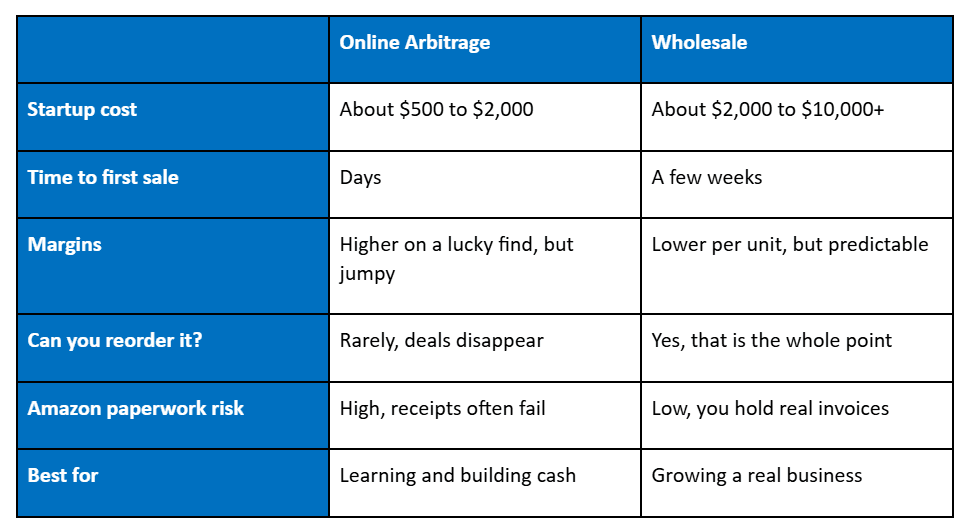
If money is tight, online arbitrage is the easier door to walk through. You can get going with roughly $500 to $2,000, and you are not locked into buying a big batch of anything. You find one good deal, you buy a few units, you ship them in. If it sells, great. If it does not, you are not out much.
Wholesale asks for more up front. Because you are buying in bulk to hit a distributor's minimum order, the starting cost is usually between $2,000 and $10,000 or more. You also spend the first few weeks opening supplier accounts and getting approved before a single unit sells.
So, on speed and cost, arbitrage clearly wins the start. That is exactly why so many sellers begin there. It is a low-risk way to learn how Amazon fees work, how sales rank moves, and what actually sells, all while you build a bit of cash. A lot of sellers treat online arbitrage as a stepping stone and move into wholesale once they have the money and the confidence. If wholesale is where you are headed, our Amazon wholesale for beginner's roadmap walks through the first steps.
Margins and Repeatability: Where Wholesale Pulls Ahead
This is where the two models start to look very different.
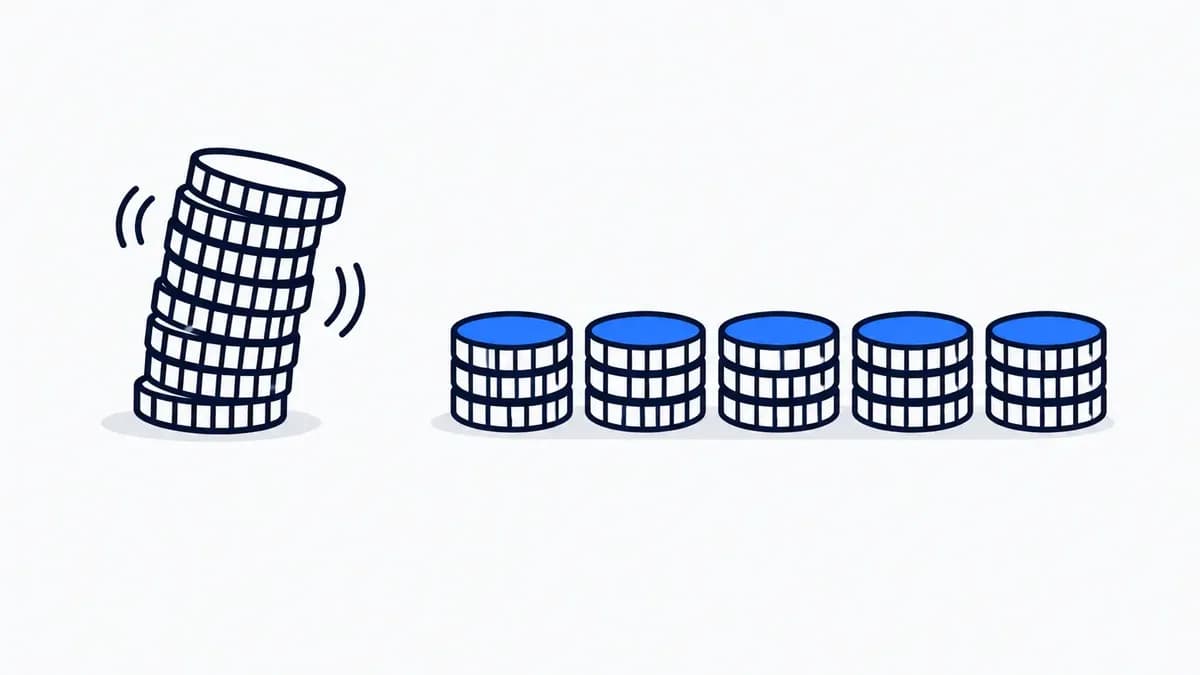
Online arbitrage margins bounce around a lot. A great find might hand you 40% or more. But across a full inventory, once you count the duds and the price drops, the average usually settles closer to 15%. Your profit depends heavily on how good you are at finding deals and how fast you move on them.
With wholesale, you give up that lucky upside, but you get numbers you can count on. Your profit per unit is often smaller than a hot arbitrage flip, but because you agree on the cost with the supplier ahead of time and can restock the same product, your numbers are far easier to predict. You know what you are paying, you know what you are selling for, and you can plan your cash flow around it.
The real gap is repeatability. An arbitrage deal is temporary by nature. That clearance price you found today is gone next week, and you are back to hunting. Wholesale gives you a price list you can order from every month. You are not starting over each time.
That difference is also why wholesale grows more easily. Once you have a supplier and a set of products that sell, growing just means ordering more and adding new lines. It shows up in the data too, with a large share of wholesale sellers making over $5,000 a month in sales. Online arbitrage has a built-in limit, because you can only grow as fast as you can find and pay for good deals by hand.
The 2026 Amazon Fee Reality Both Models Face
Whichever model you pick, Amazon's fees in 2026 will take a bigger bite than a lot of new sellers expect, and this is where the "in 2026" part of the question really matters.
At the start of the year, on January 15, Amazon raised FBA fulfillment fees by about $0.08 per unit on average. That was the first increase since 2024, so it is not huge on its own. Then in April, Amazon added a 3.5% fuel and logistics surcharge on top of all FBA fulfillment fees. Small pieces, but they add up.
But that one small number never tells the whole story. For a typical FBA seller, referral fees plus fulfillment fees alone often come to somewhere between 25% and 40% of the sale price, and that is before you spend a cent on ads. Storage costs, returns, and aging inventory pile on from there.
This matters for the wholesale versus arbitrage question more than those small numbers make it look. Picture a product you sell for $30. Amazon's referral fee takes about 15%, or $4.50. The fulfillment fee for a normal-sized item runs somewhere around $5 to $6. So before you have paid for the product itself or run a single ad, close to a third of that $30 is already gone to Amazon.
Now run that same $30 item through both models. Say you found it on a clearance run and paid $15. After fees you clear roughly $5, and you get that once. One fee bump or a small price drop wipes it out. Now say you buy the same item from a distributor at a trade price and can reorder it every month. That thinner-looking margin turns into real money, because you earn it again and again instead of chasing the next deal. This is why the 2026 fee increases hurt arbitrage more. A one-time flip has no cushion. A line you can repeat does.
The Paperwork Gap: Proving Where Your Product Came From
This is the difference that decides more Amazon accounts than any margin math, and most "wholesale vs arbitrage" posts barely mention it.
Amazon allows arbitrage. You are legally allowed to resell a product you bought. The catch that trips people up is this: Amazon will not accept a retail store receipt as proof that your product is real. A store receipt does not show where the product really came from, so it does not count in Amazon's eyes.
That becomes a real problem when Amazon asks for documents. Amazon's automated checks can flag your account when the invoice quantity does not cover how many units you sold, or when it cannot verify who your supplier is. No customer even has to complain for this to happen. And when it does, a seller who bought from ordinary online stores, which is most online arbitrage, often has nothing to hand over except receipts, which get rejected. The few who buy from an authorized distributor's website can get a real invoice, but at that point they are basically doing wholesale anyway.
And a rejection is not a slap on the wrist. When Amazon flags a listing, your sales on it stop, the inventory you already shipped sits locked in a warehouse, and the money you sank into it is frozen until you can prove something you were never able to prove in the first place. Plenty of sellers have watched a good month turn into a dead account over a single complaint they had no paperwork to answer.
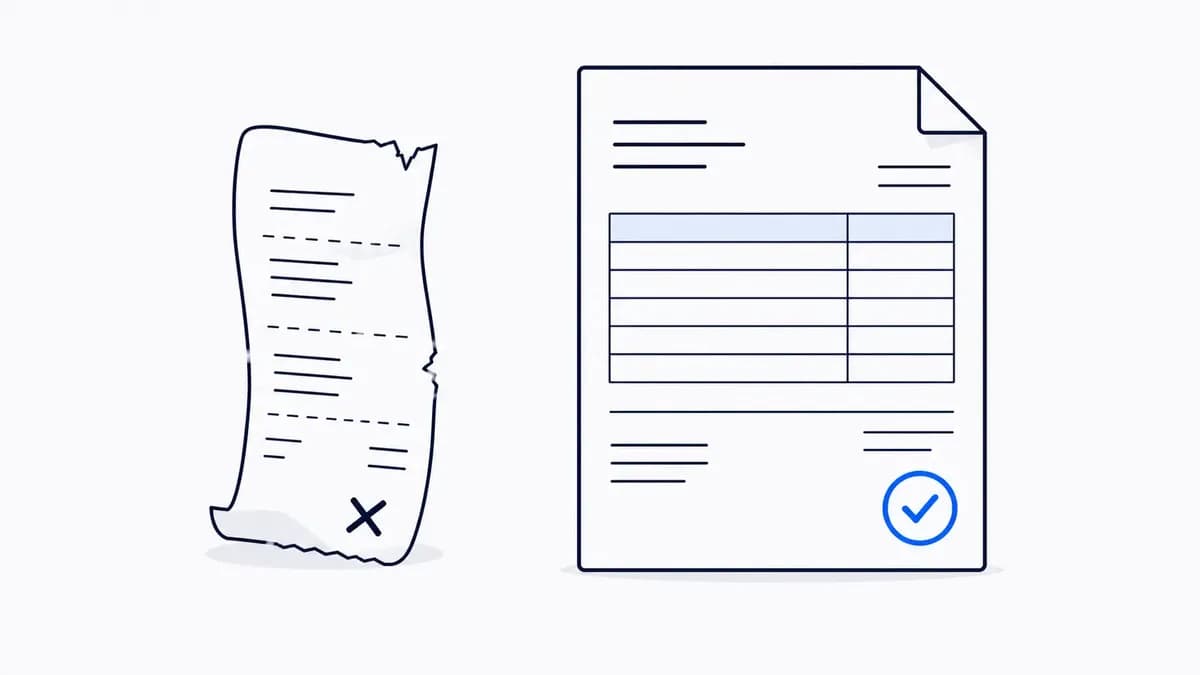
The document that actually passes is a proper invoice from an authorized wholesale distributor. And that is exactly what a wholesale seller already has on hand. That is the real advantage of wholesale. Your paperwork is built to survive the checks that shut an arbitrage seller down.
The gates are getting tighter, too. In 2025, a major athletic brand went back to selling directly on Amazon and now asks sellers for its own invoices or approval letters, not ones from a distributor. Amazon also replaced its old authorization letter with a stricter agreement that many brands simply will not sign for small sellers.
None of this makes wholesale risk-free, and it would be dishonest to pretend it does. Wholesale swaps one kind of risk for another. Instead of worrying whether a deal will sell, you deal with getting approved by brands, sharing a listing with other sellers, and depending on a supplier who might run out. Even a real distributor invoice does not guarantee a brand will approve you to sell. But the paperwork itself is solid, and that is worth a lot when your account is on the line.
So Which One Wins In 2026?
If you are a serious seller trying to grow past the $5,000 to $10,000 a month range, and you want documents that hold up when Amazon asks questions, wholesale wins. It is more work to start and it costs more, but it gives you a business you can repeat and build on, instead of a constant hunt.
Online arbitrage still wins in one clear case. If you are short on cash, still learning how Amazon works, or you just want quick bursts of profit on the side, it is a smart place to be. It works best as a way to learn the platform and build capital, not as a hands-off income stream.
And honestly, most sellers do not treat this as an either-or fight. They start with arbitrage to learn and save up, then move into wholesale as their money grows, and plenty run both at once. Some go further and build their own brand instead, which is a different trade-off with its own costs and risks. The market is now rewarding the sellers who take the slower, more careful route. New seller signups in 2025 were the lowest in about ten years, while the number of sellers making $100 million a year has climbed from around 50 four years ago to more than 230. Fewer newcomers, more serious operators. That is a market that pays off steady, repeatable sourcing over lucky flips.
The hardest part of moving into wholesale is answering one question: this product already sells well, so who actually carries it, at what cost, and with what stock? Getting that answer used to mean weeks of emails, phone calls, and trade show visits. That is the exact question B2B Supplier Hub was built to solve. You search a product you already know sells, see the real cost, real stock, and retail price from distributors in the network for free, and only connect with a supplier once the numbers make sense to you. It takes the slow, manual part of going wholesale off your plate.
So ignore the people online insisting that one model is dead and the other is the only way. Both of them work. They just work for different sellers at different stages. Online arbitrage is a smart way to start moving, learn how Amazon really behaves, and build a little money without risking much. Wholesale is how you take that start and turn it into something solid enough to grow on, with paperwork that holds up when Amazon asks questions. You do not have to choose your model forever today. Pick the one that fits the money and time you have right now, get really good at it, and let it pay for the next step when you are ready for it.
Frequently asked questions
01Is online arbitrage still worth it in 2026?
02Is wholesale more profitable than online arbitrage?
03Can I get suspended for online arbitrage?
04Should I start with arbitrage or wholesale?
The B2B SupplierHub Team
Wholesale & sourcing
Stop hunting suppliers by hand. Type a UPC instead.
B2B Supplier Hub shows the suppliers in our network carrying a product on one page: wholesale cost, stock, and retail price side by side. Free to search, no card required.