
Sourcing
Amazon Wholesale for Beginners: Step-by-Step Roadmap (2026)
-1200x627.webp&w=3840&q=75)
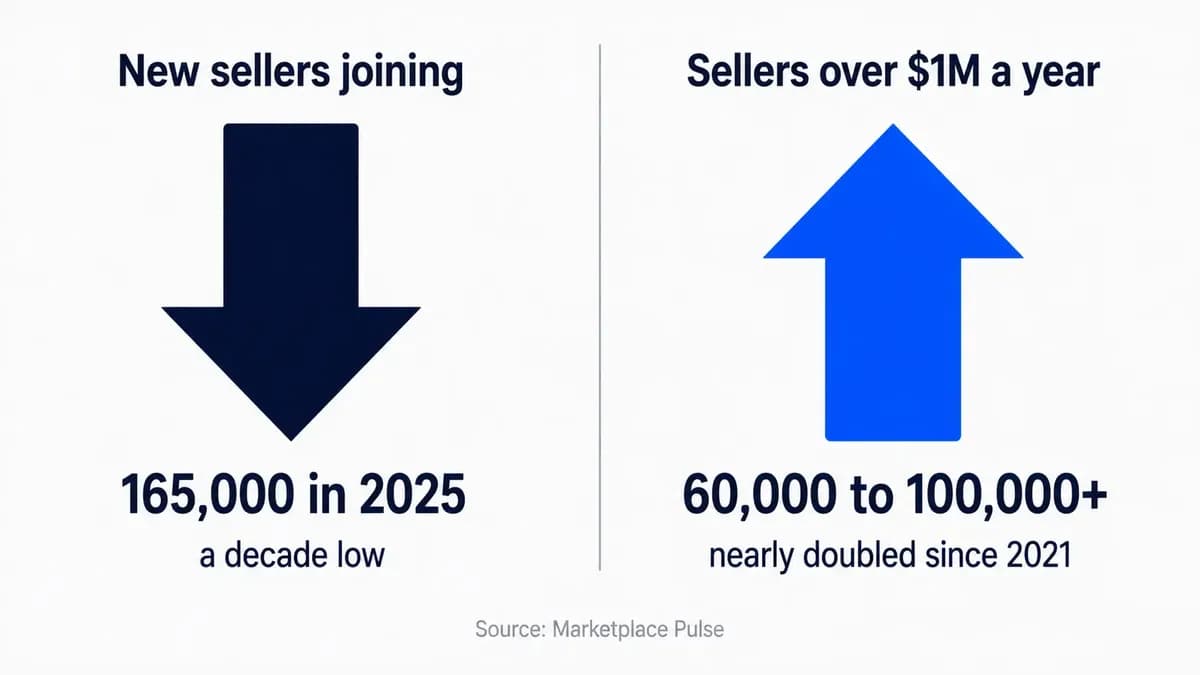
Most guides on starting Amazon wholesale were written for a marketplace that no longer exists. Sign up, find a supplier, upload products, profit. That version of Amazon ended a few years ago, and the numbers prove it: in 2025, fewer new sellers joined Amazon than in any year on record, while the number of sellers doing a million dollars or more nearly doubled.
So, this roadmap is written for the market you are actually walking into, not the easy one from 2021. It will not promise you fast money. It will give you the steps in the order that actually works, with the hard parts said out loud.
Amazon Wholesale in 2026: The Market You Are Entering
Here is what changed. According to Marketplace Pulse, only 165,000 new sellers launched their first product on Amazon in 2025. That is the lowest number since tracking began in 2015, and it is down 44% from the year before. Over the same stretch, sellers making over a million dollars a year grew from about 60,000 in 2021 to more than 100,000. And because fewer sellers are competing, traffic per active seller has gone up around 31% since 2021. The pie you are selling into is not small either: independent sellers now account for roughly 69 percent of everything sold on Amazon.
Read those numbers again, because they say two things at once. Getting in casually no longer works. But for people who enter with a plan, there is actually more room than before. Fewer competitors, more buyers per seller. Amazon did not get worse. It got professional.
Wholesale fits this market well. You sell branded products people already buy, so you do not have to build a brand or create demand from nothing. Your job is different: get real products from real distributors at a price that leaves you a profit. That is a business skill, not a trick, which is exactly why it still works in 2026.
What This Roadmap Will Not Promise You
Before the steps, a quick word on what you will not find in this guide. No income claims. No quit-your-job-in-90-days talk. No secret supplier list. Anyone selling you those things is selling you a story.
What you will find is the order of steps that holds up when it meets real distributors and Amazon's real verification process. One more thing before we start: this guide is about wholesale, meaning you buy branded products in bulk from authorized distributors and resell them. It is not private label and it is not arbitrage. If you are not sure about the difference, start with our guide on authorized distributors, middlemen, and gray market , then come back.
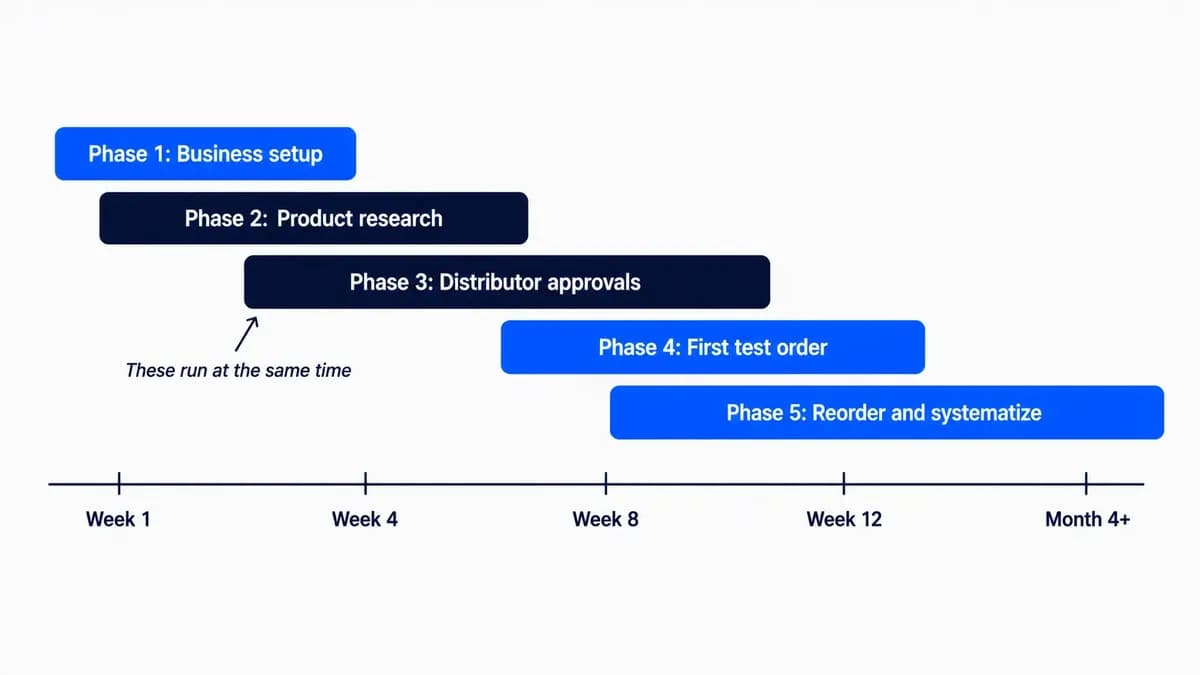
Phase 1: Set Up The Business You Will Be Locked To (Weeks 1 to 3)
Every guide tells you to register a business, get an EIN, and get a resale certificate. That advice is fine. What most guides skip is why the order matters so much in 2026.
Amazon now verifies who you are before you can sell. Under the INFORM Consumers Act, Amazon has to collect and check your name, a government-issued ID, your business address, your bank details, and your tax ID. A P.O. box will not pass as your business address. Some sellers are asked to do a video call to confirm their identity. And a warning: sellers report that once your account is registered, the legal entity behind it is very hard to change later. The old trick of signing up as an individual now and fixing it later can freeze your account instead of fixing it.
So do it once and do it right. Register the business you actually plan to run. Get your EIN. Get your resale certificate, because distributors will ask for it before they sell to you. Set up a business email and a business phone number, not a personal Gmail.
Then open your Amazon Professional seller account, which costs $39.99 a month. Notice that the account comes after the paperwork, not before. There is a second reason for this order that has nothing to do with Amazon: distributors check you out too. When they look you up and find a registered business with a real address and a real email, you look like a retailer. When they find a Gmail address and no paper trail, you look like a hobby. Hobbies get rejected. Our guide on how to get approved by wholesale distributors covers this in full.
Phase 2: Find Products First, Then Suppliers (Weeks 3 to 8)
Most guides tell you to find a supplier, get their catalog, and hunt through it for something profitable. That works, but it is the slow way around. The faster way is to flip it: find products that are already selling well on Amazon, then work backwards to find who supplies them. This is called reverse sourcing, and it is how experienced wholesale sellers actually operate.
What makes a product worth chasing? Three simple checks. It sells consistently, not just in spikes. The listing has room for one more seller, meaning it is not already crowded. And neither Amazon itself nor the brand is selling on the listing, because competing with them rarely ends well.
Once you have a short list of products, you start looking for distributors who carry them. This is where a lot of beginners burn money on supplier directories that sell a list of names with no prices and no proof. So, build one habit early: never pay for a name before you have seen the numbers. On B2B Supplier Hub you can search any UPC for free and see the wholesale cost, real stock, and retail price from distributors in our network, and you only connect with a supplier when you are ready. Whatever tool or method you use, hold on to that rule. See the numbers first, names second.
Something else the tidy step-by-step guides get wrong: this phase and the next one run at the same time. Distributor applications take weeks to process, so you send applications while you keep researching products. If you wait to finish one before starting the other, you add a month to your timeline for nothing.
Phase 3: Getting Approved, The Real Bottleneck (Weeks 4 to 12)
Here is the part almost nobody says clearly: finding a distributor who carries your product does not mean you can buy from them. Distributors approve accounts, and they say no a lot. Sellers on Amazon's own forums report applying to a hundred distributors and hearing no from 95 percent of them.
Understanding why they say no helps you get to yes. Picture it from the distributor's side. A product listing on Amazon can only support so many sellers. If a distributor already has a few Amazon sellers buying that product, adding you does not increase the brand's total sales. It just splits the same pie thinner and raises the chance that one of their accounts fails and cannot pay its bills. You are not being rejected because you are new. You are being rejected because you have not yet given them a reason to say yes.
What moves the odds in your favor is boring and real. A registered business with a professional presence. A complete application with your resale certificate ready. A first order plan that sounds realistic, not a request for the best price on everything. And patience, because a no today is often a not yet. We break down what distributors look for before approving a seller in a separate guide.
Phase 4: Your First Order Is A Test, Not A Bet (Weeks 10 to 16)
You got approved. The price list is in your inbox. Slow down, because this is where beginners make the mistake that quietly kills more wholesale businesses than anything else: they spend their whole budget on the first order.
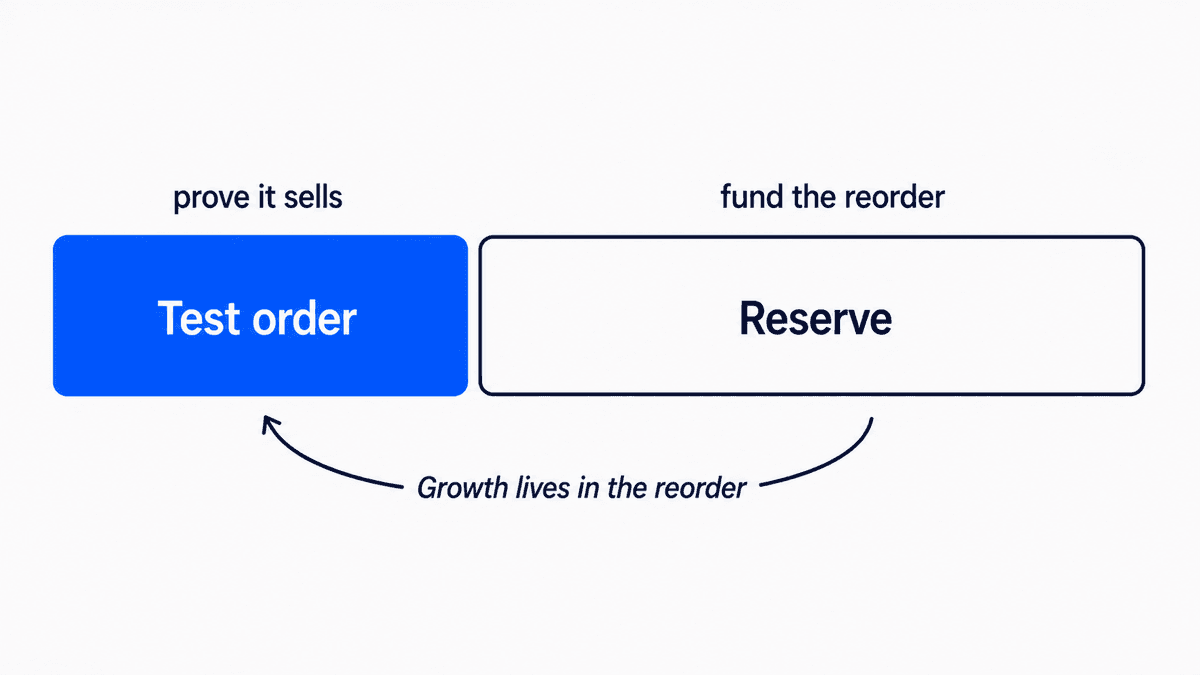
The first order has one job, which is to prove the product sells at a profit. Before you send money, check the full math. Product cost, plus shipping, plus prep, plus Amazon's fees. If the profit is not there after all of that, the product does not work, no matter how good the unit price looked.
Then order small and keep money in reserve. Growth in wholesale does not come from the first order. It comes from the reorder, when you already know the product sells and you can buy with confidence. If your cash is all sitting in inventory from order one, you cannot reorder, and the business stalls right when it started working.
And from your very first invoice, keep every document. When Amazon asks you to get approved for a restricted product, it typically wants supplier invoices from the last 180 days showing at least 10 units purchased. A clean folder of invoices is one of the most valuable assets a new wholesale seller owns.
Phase 5: Reorder, Add Suppliers, Build A System (Months 4 to 12)
Once a product proves itself, the job changes from finding to managing. Reorder what sells. Drop what does not, without emotion. Watch your numbers every week: what is selling, what your real profit is, and when to reorder so you do not run out of stock.
Then protect what you built. If your best product depends on one supplier, one email from them can shut down your income. Single-supplier dependency is one of the most common ways wholesale businesses die. Before that email ever arrives, build a bench of two or three suppliers for your top products.
By the end of year one, a good result is not a million-dollar business. A good result is a small, profitable operation with a few approved distributors, a few proven products, clean records, and a weekly routine you actually follow. That is the base everything bigger gets built on. The sellers crossing a million dollars a year did not get there with a hack. They got there by doing what you just read, over and over, for years.
Frequently asked questions
01How much money do I need to start Amazon wholesale?
02Why do distributors reject new sellers?
03How long until my first sale?
04Do I need a registered business to sell wholesale on Amazon?
05Is Amazon wholesale still worth starting in 2026?
The B2B SupplierHub Team
Wholesale & sourcing
Stop hunting suppliers by hand. Type a UPC instead.
B2B Supplier Hub shows the suppliers in our network carrying a product on one page: wholesale cost, stock, and retail price side by side. Free to search, no card required.