
Distributor Authorization
Brand Letter of Authorization (LOA) for Amazon: What It Is, Who Can Issue It, and How to Get One (2026)
%2520for%2520Amazon%2520What%2520It%2520Is%252C%2520How%2520to%2520Get%2520One-1200x627.webp&w=3840&q=75)
A brand Letter of Authorization (LOA) is a written document from a brand giving your business permission to sell its products on Amazon. Amazon asks for it during brand approval applications, IP complaints, and authenticity reviews, and it may contact the brand directly to check that the letter is real.
Here's how most sellers meet this document. An ungating application comes back rejected with “please provide a letter of authorization from the brand or rights owner.” You've never heard of it, your distributor has never mentioned it, and half the advice online contradicts the other half.
So let's clear it up properly. What this letter is, when Amazon actually wants it, and the one mistake that gets almost every first submission rejected.
A quick note before we start: this is operational guidance from sellers' working experience, not legal advice. For anything involving trademark law or a live IP dispute, talk to a lawyer.
What an LOA Is (And the Two Kinds Sellers Mix Up)
The term "LOA" actually covers two different documents. Mixing them up is where most of the confusion starts.
The license agreement is what Amazon's own help pages describe: a formal agreement between the brand (the licensor) and your business (the licensee). It gives you the legal right to use their trademark or other intellectual property, usually in exchange for payment. This is a real contract. It's what Amazon expects when the issue is about trademarks, copyrighted images, or design patents. A company that makes products under another company's brand name works under this kind of agreement.
The authorization letter is what most resellers actually deal with: a simple letter on the brand's letterhead that says, in plain words, "this business is allowed to sell our products on Amazon." No lawyers, no licensing fees. Just written proof that the brand knows you and is fine with you selling their products. When an ungating application or a complaint asks for an LOA, this is usually the document sellers submit.
Both are letters of authorization, and here's the practical rule: whichever one you're submitting, build it to the same standard. The five terms Amazon lists for license agreements (covered below) are the safe checklist for a simple authorization letter too. A letter that names both parties and states what's allowed, where, and for how long gives reviewers very little to reject.
One more thing seller mix up all the time. An LOA is not an invoice, and an invoice is not an LOA. Your wholesale invoice proves where you bought the product. An LOA proves you have permission to sell the brand. Amazon can ask for either one, or both. One never replaces the other. Plenty of sellers with perfect invoices have learned this the hard way.
When Amazon Asks for an LOA: 4 Situations
Most listings never need an LOA. You can sell thousands of products for years without anyone asking. But there are four situations where the request shows up, and when it does, you can't skip it.
Brand approval applications.
Some brands are gated on Amazon. The application to sell them may ask for an LOA along with invoices, or instead of them. More brands have moved this way over the past couple of years.
IP complaints.
If a brand files a trademark or copyright complaint against your listing, Amazon asks you to prove you have the right to use that brand's property. That proof is an LOA.
Authenticity complaints.
If a buyer or competitor claims your product is fake, Amazon reviews where your stock came from. Sellers report that these reviews often demand invoices covering past sales, and an LOA on top of them.
Automated brand protection.
Amazon runs automated systems that flag listings on protected brands. Nobody sets these triggers by hand, not even the brands in most cases. Your listing simply stops working one day and asks for authorization.
Look at the last three again. The request usually comes after you already bought and sold the inventory. That's the trap. You can't go back in time and get permission for stock you sold six months ago. This is why careful sellers sort out authorization before the first order, not after the first complaint.
What Amazon Checks in the Document
Amazon's help pages list five things that must appear in every licensing agreement it reviews:
• Licensor: the brand giving the rights
• Licensee: the business receiving them (yours)
• Grant: what rights you're getting and what you're allowed to do with them
• Geographic scope: where the permission applies (it can be worldwide)
• Term: how long it lasts (it can be permanent)
Amazon also checks the document itself. It should be on the letterhead of the company that owns the rights. It needs a signature. And it should be sent as a PDF, a scanned image, or a Word file.
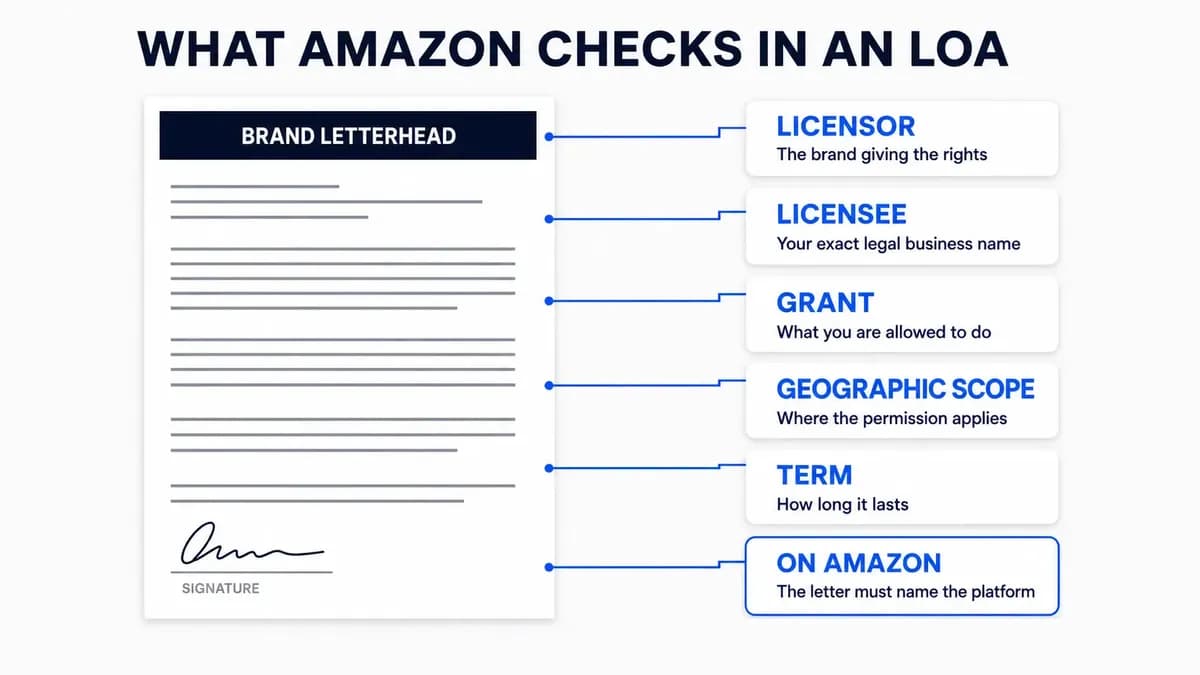
Two more points come from seller experience rather than official rules, but they show up often enough to treat as rules. First, the letter should use your exact legal business name, the same one on your Seller Central account. If the names don't match, expect a rejection. Second, the letter should say you're allowed to sell on Amazon, not just that you're an “authorized reseller” in general. Letters that never mention Amazon get bounced often enough that it's not worth the risk.
And one warning before anyone thinks about shortcuts. Amazon says clearly that it may contact the brand named in your letter to check it. A template letter the brand never saw is not a clever trick. It's a fast way to a suspension that's much harder to fix than the problem you started with.
Who Can Issue an LOA (This Is Where Most Sellers Go Wrong)
Read this part twice, because it's the single most common reason LOA submissions fail.
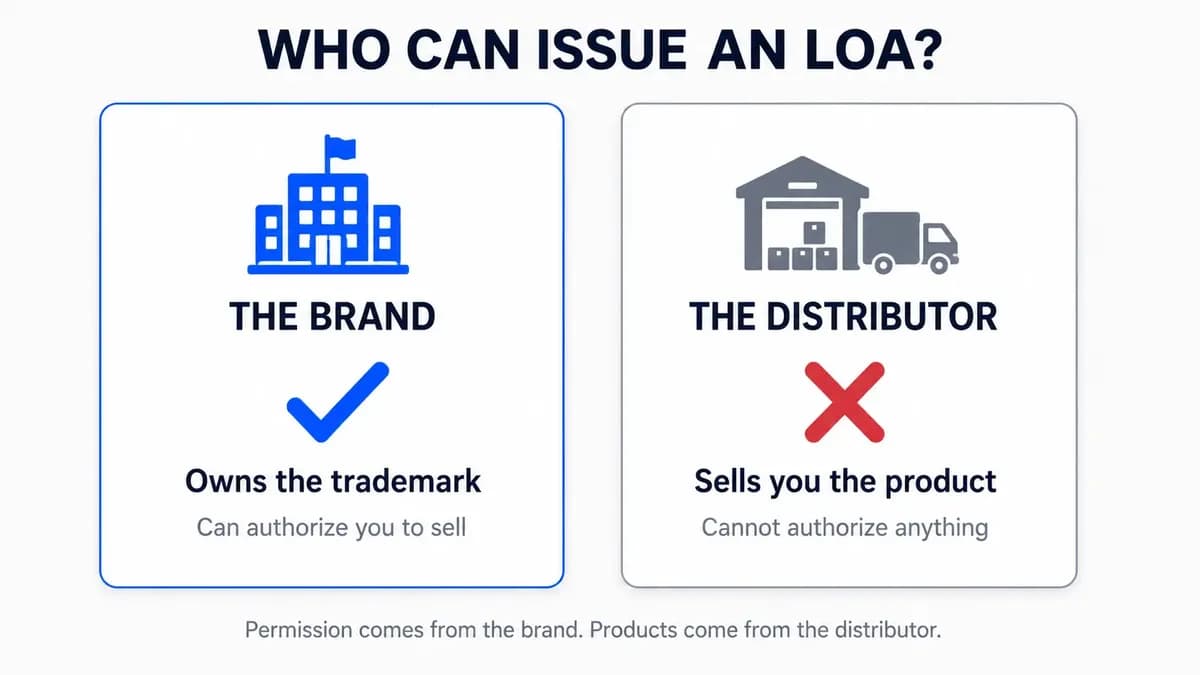
Only the brand can issue a letter of authorization. Your distributor cannot.
A distributor sells you products. That's the whole relationship. They don't own the brand's trademark, so they have no legal power to give anyone permission to use it. A letter on your distributor's letterhead saying you're allowed to sell a brand means nothing to Amazon. It doesn't matter how real the distributor is, how long they've been in business, or that the brand's own website lists them as authorized. The seller forums are full of people who submitted exactly this letter again and again and couldn't understand the rejections. Permission comes from the brand. Products come from the distributor. Amazon wants proof of the first, and only one party can give it.
If you're unsure whether a supplier sits on the authorized side of a brand's distribution map in the first place, we've covered how to find the authorized distributors for any brand and why an invoice from the wrong side of that map fails even when it looks legitimate. The difference between authorized distributors, middlemen, and gray market sources is the foundation this whole topic rests on.
There's one special case worth knowing: licensed products. When a company makes products under another company's brand (think of a toy maker producing figures of licensed characters), the LOA should come from the company that actually makes and sells the product, not the original brand owner higher up the chain. The original owner has no relationship with resellers of those products and won't answer requests.
How close you are to the brand decides how hard this letter is to get. If you buy directly from the brand, it's one signature away. If you buy from an authorized distributor, you're one step removed and need to reach up the chain. If you're further out than that, an LOA is close to impossible. And honestly, that difficulty is telling you something about the supply chain you're in. We covered this in detail in our guide to brand authorization tiers.
How to Get an LOA From a Brand
The short, honest answer: become a customer first, then ask.
Brands write LOAs for accounts they know, not for strangers. An email from an unknown seller asking for permission sounds like "please create a new competitor for your current sellers." It gets ignored. An email from an account that buys regularly, pays on time, and represents the brand well gets a very different answer.
A few things that shape your odds. Big household-name brands almost never give LOAs to independent resellers, so don't waste weeks chasing them. Mid-size brands are much more open, especially if you come across as a real business with a clean account and a clear plan. And when you do talk to a brand, ask for their list of authorized distributors in the same conversation. You'll probably need invoices from those distributors along with the letter anyway. Authorization status belongs on your evaluation list before the first order goes in, and it's one of the factors that can veto everything else in our framework for comparing wholesale suppliers.
One last practical tip: keep every LOA you receive in one folder, along with the invoices that go with it. When Amazon asks, it usually asks fast, and the sellers who respond the same day are the ones who never scramble.
7 Mistakes That Get LOAs Rejected
- A letter from your distributor instead of the brand. The number one failure.
- Business name mismatch. The letter says one name, Seller Central says another. Easy rejection.
- No mention of Amazon. A general reseller letter without the platform named often fails.
- Missing terms. No duration, no territory, no clear statement of what's being allowed.
- No letterhead or signature. An unsigned Word document proves nothing.
- A template the brand never saw. Amazon checks. Don't try it.
- Assuming the LOA alone gets you approved. It usually works together with invoices, not instead of them. And even complete, honest paperwork sometimes gets rejected by automated review on the first try. If that happens, submit again, and escalate through seller support if the rejections keep contradicting your documents. Frustrating, but normal.
The Bottom Line
An LOA is not paperwork for its own sake. It's Amazon asking one simple question: does this brand actually know you're selling their products? If the honest answer is yes, the letter is usually within reach. If the honest answer is no, the letter is the least of your problems, because sooner or later a complaint or a gate will ask the same question, and by then your money is already sitting in inventory.
So treat authorization like you treat price and stock. Check it before you buy, not after Amazon asks. The sellers who never panic about LOAs are not the ones with clever templates. They're the ones who built real relationships with the brands they sell, and already have the letter in a folder before anyone asks for it.
Frequently asked questions
01Do I need an LOA to sell on Amazon?
02Can my distributor write me a letter of authorization?
03What does Amazon require in a letter of authorization?
04Does an LOA guarantee I'll get ungated?
The B2B SupplierHub Team
Wholesale & sourcing
Stop hunting suppliers by hand. Type a UPC instead.
B2B Supplier Hub shows the suppliers in our network carrying a product on one page: wholesale cost, stock, and retail price side by side. Free to search, no card required.