
Sourcing
How to Find Regional Distributors: Build a Territory Map
"We don't cover your area."
If you have applied to enough distributors, you have had that reply. It comes after a week of waiting, it is two lines long, and it sounds final. It is easy to read it and move on to a different product. That is usually the wrong move. The distributor is not saying nobody will sell you this product. They are saying they won't, because the brand gave them a different part of the country to look after. Another distributor was given yours. The question is which one, and how to find them without applying to every name on the list.
In this blog post we covers that. Our guide on how to find a distributor for any product explains the general method. This one adds the part that confuses people most: what "regional" really means, who decides it, and why the distributor closest to you is not always the best one.
What a Regional Distributor Is: Territory, Ship-From, and Coverage
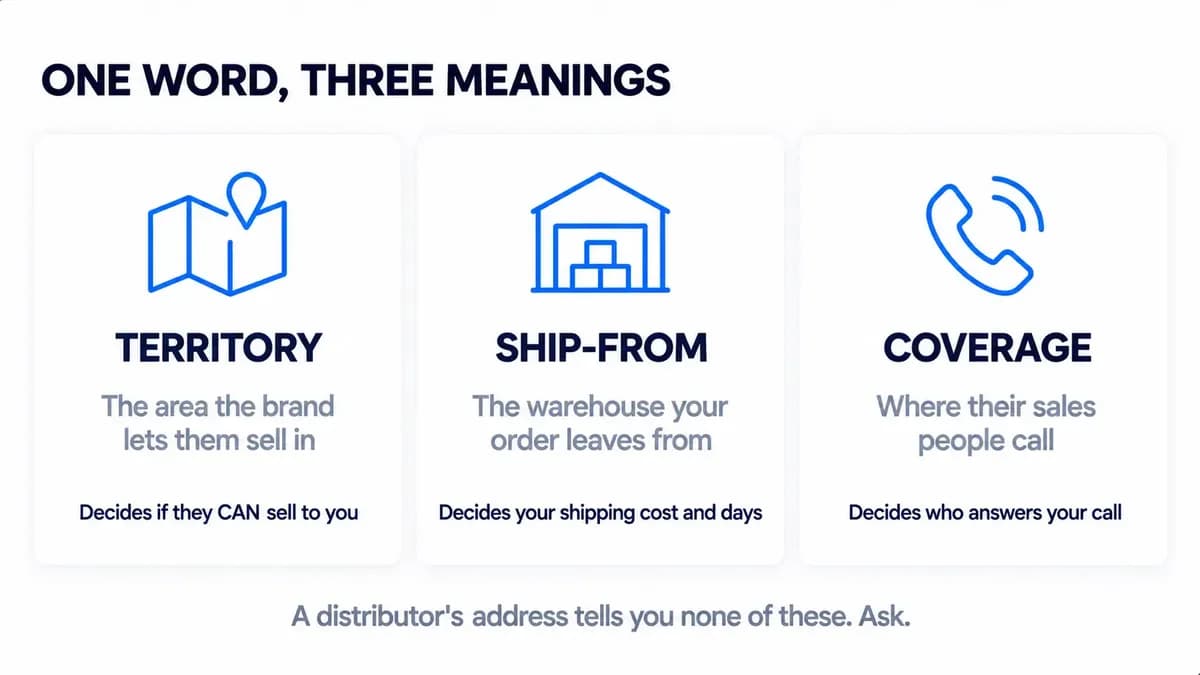
When someone calls a distributor regional, they could mean one of three things. Each one matters to you in a different way.
The first is territory. Brands often split the country into areas and give each distributor one area to sell in. If you are inside that area, that distributor is supposed to sell to you. If you are outside it, they may not be allowed to sell to you, or they may simply prefer not to.
The second is ship-from. This is the warehouse your order actually leaves from. It has nothing to do with where the distributor's main office is. A distributor based two states away might have a warehouse in your state, while the one down the road from you might ship everything from a warehouse on the other coast.
The third is coverage. This is the area where the distributor's sales people call and visit. It tells you who is likely to answer your call, and not much more.
A distributor's address tells you none of these three things. That is why the most useful question on a first call is: "Which warehouse would ship this product to my ZIP code?" The answer often changes which distributor you want to work with. If you sell on Amazon or another marketplace, it also decides how far every box travels to your prep center or to Amazon's warehouse, and that adds up over a year.
Which Distributor Covers My Region? The Brand Decides
The brand sets the territories, not the distributor. Some brands are strict about it, so a distributor cannot sell outside their area even if they want to. Other brands just hand out the areas and leave it there. In that case the distributor could sell to you, but they would rather not upset the brand or the distributor whose area you are in.
This is allowed. The FTC's own guidance says that limits on where a dealer can sell a product are generally legal when the manufacturer sets them on its own. So when a distributor says they do not cover your area, there is no point arguing. The rule was never theirs to change.
What works is asking the brand directly. Many brands have a sales team that can tell you which distributor handles your state, and often one email is enough.
There is one more reason a distributor might turn down an out-of-state reseller, and it has nothing to do with territory. Some distributors will not accept a resale certificate from a different state. Ask about this before you apply. It saves you a week of waiting for a no.
When a Distributor Outside Your Region Is Cheaper: 3 Cases
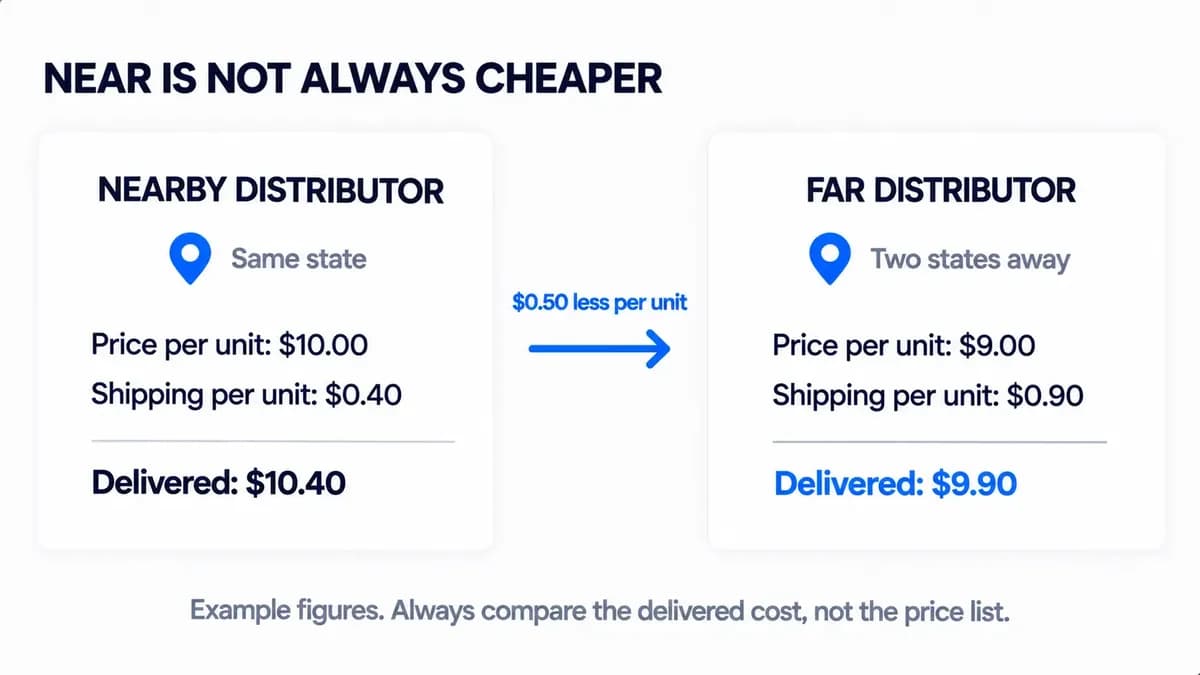
It is natural to think the nearest distributor is the cheapest. Often it is. But not always, and the difference can be big enough to matter.
Our post on FOB vs delivered pricing walks through the freight math. Here are the three situations where the far distributor wins.
The first is when the price gap is bigger than the shipping gap. If a distributor across the country sells the product for a dollar less per unit and shipping adds fifty cents, they are cheaper, even though they are farther away.
The second is when the far distributor pays for shipping. Some distributors ship free once your order is over a certain size. When that happens, distance no longer affects your cost. It only affects how long you wait.
The third is when the far distributor is the only one with stock. A nearby distributor with nothing in stock is not cheap, whatever their price list says, because you lose sales while you wait.
Heavy or bulky products are the exception. Shipping on those gets expensive fast as the distance grows, so for them the nearby distributor is usually the right choice even at a higher unit cost.
The Territory Map: 5 Columns for One Product
Here is the table. You make one for each product, and it has five columns. The figures below are made up to show how it works.
Distributor | Covers my region? | Ships from | Days to arrive | Cost per unit, delivered |
|---|---|---|---|---|
Distributor A | Yes | Same state | 2 | $10.40 |
Distributor B | No rule | Two states away | 4 | $9.90 |
Distributor C | No | Other coast | 6 | n/a (won't sell to me) |
Once it is filled in, cross out any row with "No" in the second column. That distributor cannot or will not sell to you. Then put the remaining rows in order by delivered cost. The top row is your main supplier for this product, and the row under it is your backup.
In the example, Distributor C is out. Distributor B is fifty cents a unit cheaper than Distributor A, even though B is farther away. That is easy to miss until the numbers are next to each other.
The map will not stay accurate for long. Shipping quotes change, prices change, and distributors move stock between warehouses. Update it when any of those change, and at least once a year even if nothing seems different.
Filling In the First Column
The first column used to be the hardest part. To find out which distributors carried a product at all, you had to find them one at a time, apply to each, and wait to see their price.
That has changed. You can search a product free on B2B Supplier Hub and see the real cost and stock from every verified distributor in our network that carries it, before you apply to anyone. That fills in the first column and gives you a starting point for the last one.
The middle columns are still yours to fill in. The search shows you cost and stock, but it does not tell you a distributor's area or which warehouse they ship from. Those are the two questions you ask each distributor before you apply. The answers are what turn a list into a map.
When Every Row Says "Not Your Region"
Sometimes you finish the map and every distributor carrying the product has said no, or none of them in the network carry it. That happens. Some brands are strict enough that no distributor will open an account for a reseller outside their area.
When that happens, submit a request through Request a Supplier. Our team looks for an authorized distributor who carries the product, reviews their business and catalog, and brings them onto the platform. It is free on every plan, and you get an answer within 30 days either way.
Pick One Product And Map It This Week
You do not have to do this for your whole catalog. Start with one product you reorder often. Search it to see which distributors in our network carry it and what they charge. Then ask each of them two questions: do you cover my area, and which warehouse would ship to me. Fill in the five columns.
Do it once and there is a good chance the table shows you a distributor you had written off as too far away. If the map comes back empty, send us the request and we will look for one. Either way, the next time a distributor says "we don't cover your area," you will know it is not the last word.
Frequently asked questions
01What is a regional distributor?
02Why are there regional differences in authorized resellers?
03Can I buy from a distributor outside my region?
04Is the nearest distributor always the cheapest?
The B2B SupplierHub Team
Wholesale & sourcing
Stop hunting suppliers by hand. Type a UPC instead.
B2B Supplier Hub shows the suppliers in our network carrying a product on one page: wholesale cost, stock, and retail price side by side. Free to search, no card required.