
Wholesale Economics
FOB vs Delivered Pricing: Which Costs Less? (With Example)
FOB pricing means the price on your quote stops at a handoff point, usually the distributor's dock. You pay the freight from there. Delivered pricing means freight is already built into the price, so the quote is your cost at the door. To compare the two fairly, you have to turn both into landed cost per unit.
This is where resellers lose money. Two distributors quote you the same product. One says $10.00 a unit, the other says $10.60 delivered. Most resellers take the $10.00 quote, and a few weeks later the freight bill eats the savings. The cheaper number on paper isn't always cheaper once it's sitting in your warehouse.
This post breaks down what both terms mean, who carries the risk under each, and the one calculation that makes any two quotes comparable. It's part of our supplier operations hub.
What does FOB price mean?
FOB price is the price of the goods up to the handoff point named in the quote, usually the supplier's warehouse or port. It does not include the freight to get the goods to you, insurance, or import charges. A lower FOB price does not always mean a lower total cost.
What Is FOB vs Delivered Pricing in Wholesale?
Start with FOB. It stands for "free on board," though nobody thinks about the words anymore. In US wholesale, FOB marks the spot where the goods stop being the distributor's problem and become yours. The two versions are mirror images.
FOB Origin vs FOB Destination: Who Pays Freight and Who Owns the Risk
FOB origin (you'll also see "FOB shipping point") means the goods become yours the moment the carrier picks them up at the distributor's dock. From that second on, you pay the freight and you carry the risk. If the truck crashes somewhere in Kansas, that's your claim to file, not theirs. The quote covers the product only. Freight is a separate bill.
FOB destination flips it. The distributor owns the goods, and the risk, until the shipment reaches your door. They pay the freight and usually build it into their price.
Delivered pricing is the simple one. One all-in number, freight already inside. The quote is what the product costs standing at your dock.
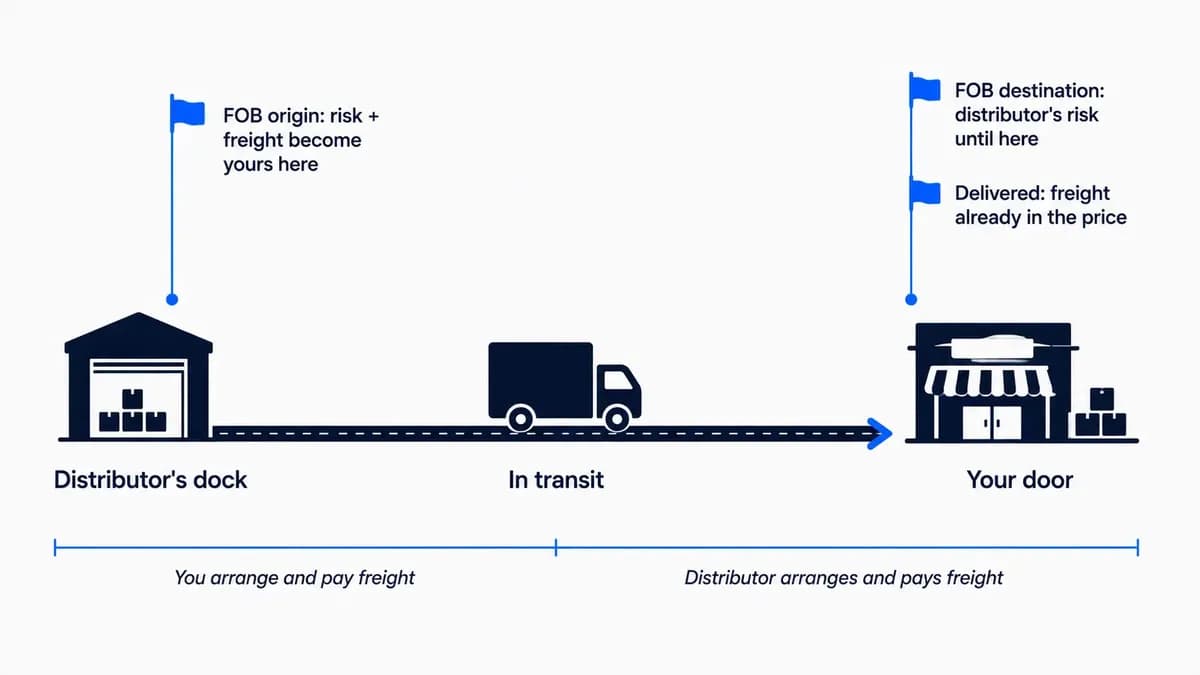
A delivered price usually pairs with FOB destination, but the two are separate statements. One is about money: is freight in the price or not? The other is about risk: who owns the goods while they're on the truck? Those two answers don't always line up.
"Freight collect" means the carrier bills you. "Freight prepaid" means the distributor pays the carrier, often adding it to your invoice anyway. These mix with FOB terms in every combination, so a quote can read "FOB origin, freight prepaid and charged back": the risk is yours from the dock, but the distributor fronts the freight and bills it back. Our guide on how to read a distributor's price sheet covers those surprise lines.
One more thing. If the purchase order says nothing about FOB, US law fills in the blank, and the default under UCC 2-319 is the seller's location. That's FOB origin, so the risk sits with you without anyone saying so out loud. Put both terms in writing on every order.
FOB in International Shipping vs Domestic FOB (Incoterms 2020)
"FOB" means something narrower in international shipping. Under the Incoterms 2020 rules, FOB is a sea freight term: the seller's job ends once the goods are loaded on the ship you named, and everything after that, ocean freight, insurance, import duties, is yours. It's also the wrong term for most container shipments, where FCA fits instead. So a US distributor's FOB and an overseas supplier's FOB are different things. Don't carry assumptions between them.
FOB vs landed cost
FOB is what the supplier charges for the goods at the handoff point. Landed cost is what you actually pay per unit once freight, insurance, duties, and warehouse fees are added. Always compare quotes on landed cost per unit, never on FOB price alone.
How to Calculate Landed Cost Per Unit (Formula)
Landed cost is what one unit actually costs by the time it's sitting in your warehouse, ready to sell. The formula is short:
Product cost + freight + prep and handling, divided by units.
If you import, duties and tariffs stack on top, which is its own subject. For domestic wholesale there's no duty line. Freight and prep are the swing factors, and freight is the one most resellers guess at. That's a bad idea, because freight is hard to eyeball. Moving a pallet between businesses runs roughly $120 to $250, and most shippers pay 50 to 80 percent off the carrier's published rates depending on their volume, so two resellers shipping the same pallet on the same lane can pay very different amounts.
Small orders cost the most per unit to move: carriers set a minimum charge they won't go below, so a light shipment can cost almost as much to ship as a heavy one.
That's why an FOB origin quote can't be compared on sheet price. Until you add your actual freight, you only have part of the cost. Once you have the full landed number, the rest of the profit math follows from it. We walk through that full calculation in our wholesale profit calculator guide.
FOB vs Delivered Pricing Example: 150 vs 600 Units
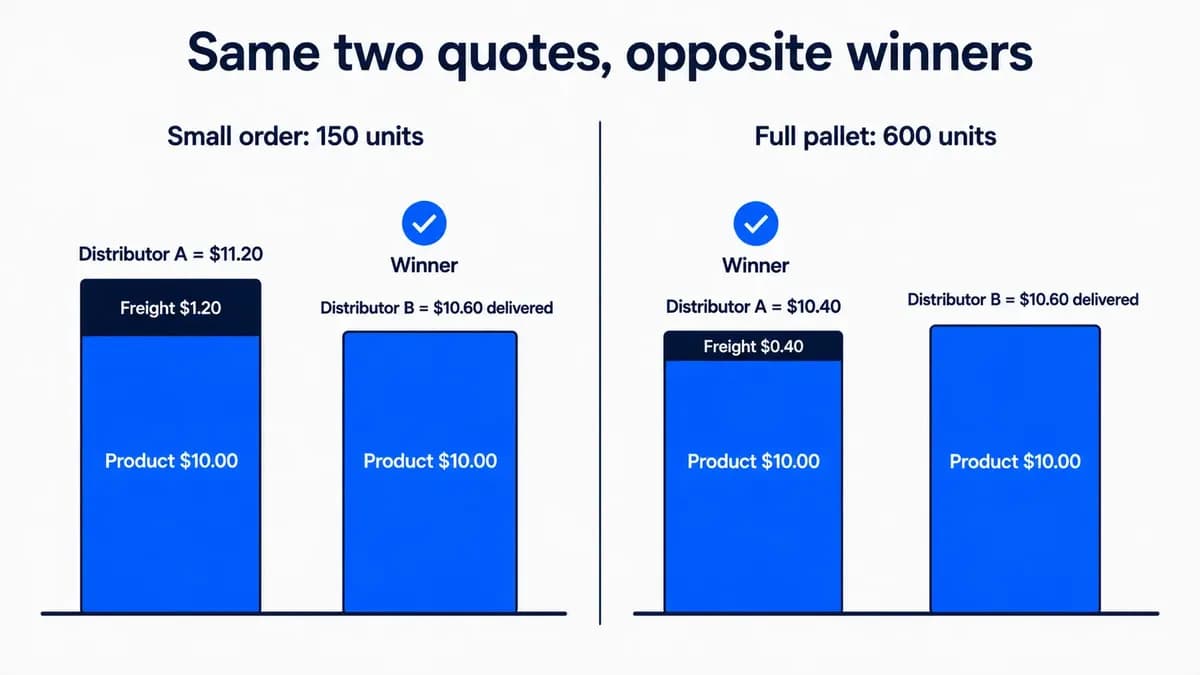
Say two distributors carry the same product, and it weighs about a pound a unit. Distributor A quotes $10.00 a unit, FOB origin. Distributor B quotes $10.60 delivered. The numbers below are made up to show the math. Yours will differ.
First, you order a small batch, 150 units, to test how it sells. Freight has a floor here: carriers set a minimum charge they won't go below, and a 150-pound shipment sits right at it, so you pay that minimum no matter what. Say it's $180. Spread over 150 units, freight adds $1.20 each, so Distributor A really costs you $11.20. Distributor B's $10.60 delivered wins easily.
The product sells, so you reorder a full pallet, 600 units. Now the shipment is heavy enough to earn a real rate instead of the minimum. Say the pallet ships for $240, which is $0.40 a unit. Distributor A lands at $10.40 and takes the win back.
So the same two quotes flip depending on how much you order. Neither term is better on its own. FOB origin costs more on small orders and less on full pallets, and delivered pricing works the other way around. The only way to know which one wins is to run the landed number both ways. If you sell on Amazon, FBA fees stack on top of landed cost after that.
6 FOB and Delivered Pricing Mistakes to Avoid
- Comparing an FOB quote to a delivered quote on sheet price alone. One number has freight in it and the other doesn't, so they aren't comparable until you add it.
- Treating FOB as just "who pays shipping." It mainly decides who owns the goods and who eats the loss if something goes wrong in transit.
- Leaving FOB off the purchase order. The legal default is FOB origin, so staying silent leaves the risk with you.
- Assuming the FOB term and the freight term are one decision. They're two separate things. Confirm both.
- Treating per-unit freight as a constant. It falls as the pallet fills. A quote that loses on a small order can win on a full pallet.
- Carrying domestic FOB thinking into import contracts. Ocean FOB is a different term with different rules, and containers usually call for FCA instead.
Compare Wholesale Quotes on Landed Cost, Every Time
The cheapest quote isn't really the cheapest until you know what freight does to it. FOB and delivered are easy to skim past on a price sheet, but they decide whether the number you're comparing is the number you'll actually pay. So keep it simple: every time a quote comes in, ask two things. Where does the risk transfer, and is freight already in the price? Then work out the landed cost per unit and let that pick the winner.
The catch is that the math only works if you can see the numbers first, which is the problem B2B Supplier Hub was built around. Search the catalog free and see the wholesale cost, real stock, and retail price from distributors in our network, side by side, before you spend a dollar. Run your landed cost on real numbers, and connect with a supplier only when you're ready.
Frequently asked questions
01Does FOB mean the buyer or the seller pays shipping?
02Is delivered pricing the same as FOB destination?
03What's included in an FOB price vs a delivered price?
04How do I compare an FOB quote against a delivered quote?
05Does FOB apply to domestic freight or only ocean shipping?
The B2B SupplierHub Team
Wholesale & sourcing
Stop hunting suppliers by hand. Type a UPC instead.
B2B Supplier Hub shows the suppliers in our network carrying a product on one page: wholesale cost, stock, and retail price side by side. Free to search, no card required.