
Industry Insight
Is Amazon Wholesale Still Profitable in 2026?
Every January, two things land in a wholesale seller's inbox. The first is Amazon's fee update. The second is a wave of posts announcing that wholesale is finally dead. This year the posts got louder, because fees went up again and tariffs were all over the news. So, it's a fair thing to ask before you wire money to a distributor: is Amazon wholesale still profitable in 2026?
Short answer is yes. Wholesale still makes money, and 2026 barely moved the math. But the longer answer is more useful than a flat yes or no, because what changed isn't whether wholesale works. It's who it works for. Rather than trade opinions, here's what the actual numbers say.
The Short Answer: Yes, in 3 Numbers
If you only remember three things from this piece, make it these.
First, Amazon's 2026 fee increase was small. FBA fees went up by an average of about eight cents per unit, which is under half a percent of what a typical item sells for, and Amazon added no new fee types this year. That came on top of no fee increase at all in 2025.
Second, wholesale still makes money. Industry benchmarks put net margins for the wholesale model at roughly 10 to 20 percent. That's thinner than private label, but you're selling products that already have buyers, so you make it back on speed and volume.
Third, and this is the one most people miss: fewer people are starting on Amazon than at any point in a decade, while the sellers who stay are getting bigger. Only about 165,000 new sellers launched their first listing in 2025, down 44 percent from the year before. Over the same stretch, the number of sellers doing a million dollars or more a year grew past 100,000, up from around 60,000 in 2021.
Put those together and you get the real answer. Wholesale isn't dying. It's growing up. It got a little harder to start and a lot more rewarding to run well.
What Changed in 2026: Fees, Surcharges, and Prep
Most "wholesale is dead" posts lean on fees, so it's worth looking at what actually changed. The headline increase was about eight cents a unit on average, and referral fees, the percentage Amazon takes on each sale, didn't move at all. They still run 8 to 45 percent depending on category, with most categories sitting at 15 percent.
Two things are worth putting on your radar this year. In April 2026, Amazon added a 3.5 percent fuel and logistics surcharge on top of every FBA fulfillment fee, which works out to roughly 17 cents on a standard-size unit. And on January 1, 2026, Amazon stopped offering its own prep and labeling services, so bagging, labeling, and bundling are now on you or your prep partner. On the brighter side, peak fourth-quarter storage rates came in slightly lower than last year, which helps a little heading into Q4.
Here's what all of that adds up to. For a typical FBA seller, Amazon's total cut lands somewhere around 30 to 40 percent of revenue once you count everything. Against a number that big, eight cents is rounding error. The lever that decides whether a product makes money isn't the fee sheet. It's what you paid for the product in the first place.
Amazon Wholesale Profit Margins vs Private Label and Arbitrage
So how does wholesale stack up against the other ways to sell?
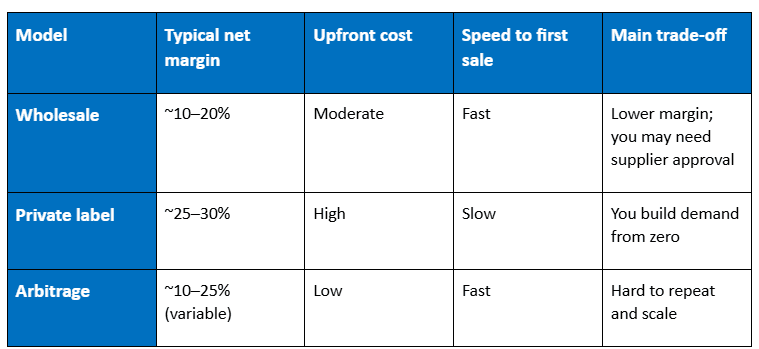
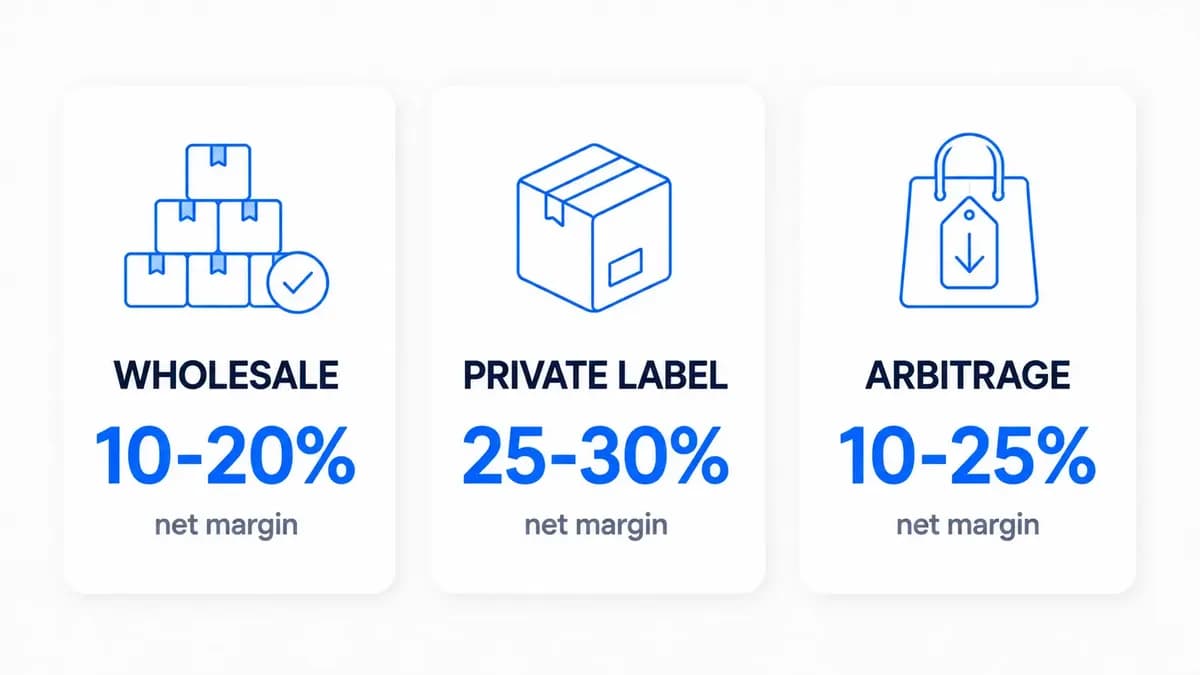
Ranges reflect industry benchmarks (Jungle Scout and others), 2026. Your actual numbers depend on buy price, category, and fees.
The pattern is clear enough. Wholesale trades the higher margins of private label for speed and predictability, because you're buying proven products instead of gambling on a new one. About a quarter of Amazon sellers run wholesale for exactly that reason: less guessing.
There's one more thing in wholesale's favor this year, and it's about where your costs come from. In 2026, for the first time, nearly every imported package is taxed at the border. The old rule that let shipments under $800 come in duty-free ended for China and Hong Kong in May 2025 and for every other country that August. If your model depends on importing cheap goods, that change hit your landed cost directly. Wholesale sourced from US distributors buys product that's already in the country, so it didn't take the same shock. That's not a free pass, since distributors can pass their own cost increases along, but it does mean your cost base moves slower.
Is Amazon Too Saturated in 2026? Fewer Sellers, Bigger Businesses
This is the part that breaks the "dead" story. Amazon's marketplace is consolidating. Active sellers dropped from 2.4 million in 2021 to about 1.65 million by the end of 2025, and new signups hit a decade low. But the sellers who stayed are doing more, not less.
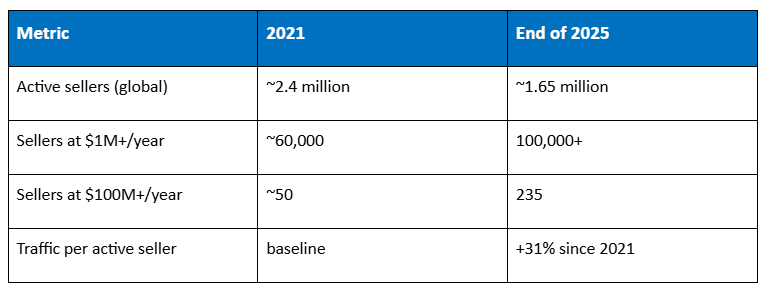
Source: Marketplace Pulse, 2026.
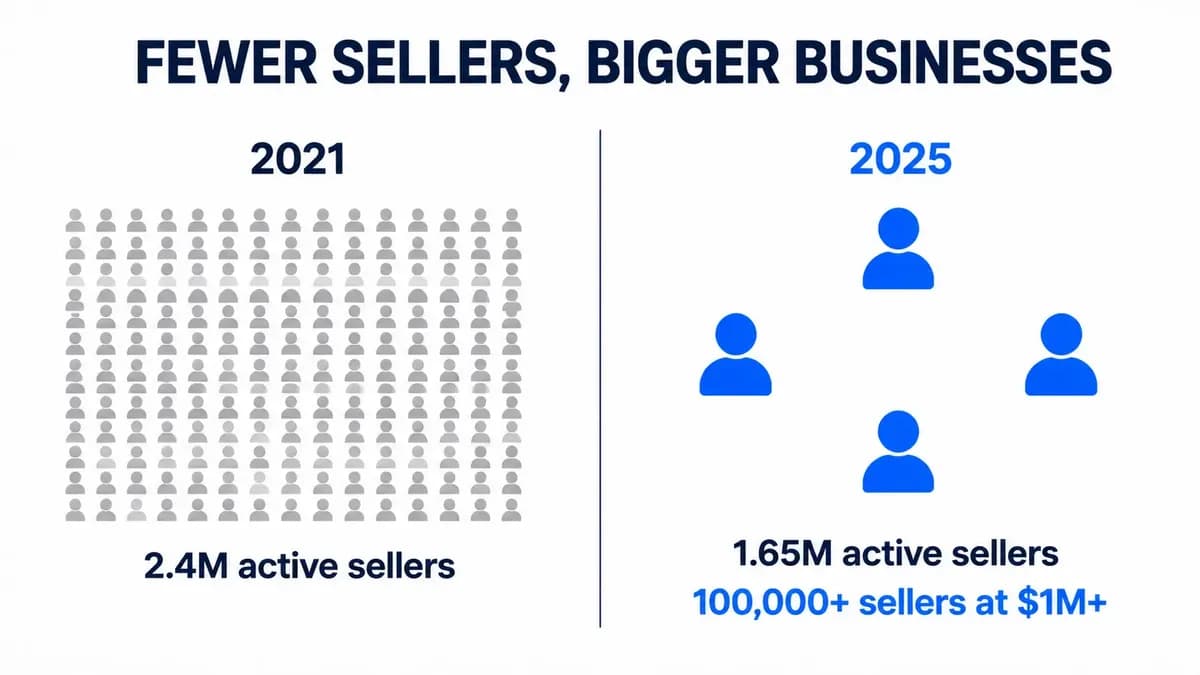
A small group, fewer than 8,000 sellers, now accounts for about half of all US third-party sales. Marketplace Pulse, the firm that tracks these numbers, calls it the competition paradox. Fewer people are competing, but the ones who remain are stronger.
Now the honest half, because a data piece owes you both sides. The same research is clear that the middle got harder. The moderate-scale, comfortably profitable operation, the seller doing a few hundred thousand to a couple million with no real system, is exactly who's feeling the squeeze. The same effort that produced easy margins a few years ago produces thinner ones now, because the sellers above them have better tools, deeper catalogs, and lower costs.
That reframes the whole question. "Is wholesale still profitable?" is really "can you operate like a professional?" in disguise. If the answer is yes, there's arguably more room than there was in the crowded years. If you're hoping to wing it, that era is over.
How to Stay Profitable in Amazon Wholesale: What Operators Do
The good news is that operating like a professional in wholesale isn't complicated. It's a few habits, done consistently. Profit lives in your cost of goods, not in clever tricks. A 5% better buy price does more for your bottom line than obsessing over an eight-cent fee, which is why the sellers who last put their energy into sourcing.
They keep more than one supplier for their best products, so a stockout or a price hike from one distributor doesn't sink a SKU. They work out the true landed cost, product plus freight plus prep plus fees, before they buy, not after. And they judge a supplier on the actual numbers instead of paying a directory for a name and hoping it turns out to be worth it.
That last habit is the whole idea behind B2B Supplier Hub. You search a product for free and see the real numbers first: the wholesale cost and current stock from distributors in our network, alongside the retail price the product is selling for. You connect with a supplier only once those numbers already make the decision for you. It's the opposite of buying a list of names and finding out later whether any of them were any good. The platform comes from the team behind Leverify, so the sourcing know-how is grounded in ten years of running an actual wholesale distribution business.
One honest caveat, because sourcing is never frictionless. Finding a supplier who carries a product isn't the same as being allowed to buy it. Plenty of brands and distributors gate their accounts, so you may still have to apply and get approved. If you're just getting started, our guide to Amazon wholesale for beginners walks through that part.
The Bottom Line: Wholesale Isn't Dying, It's Growing Up
If you ignore the noise, picture is pretty clear. Fees barely moved. Wholesale margins are holding. And the flood of new competitors that made the last few years feel so crowded has slowed to a trickle.
What's actually happening is that Amazon is turning into a market for operators. That's uncomfortable if you were hoping to coast, but it's genuinely good news if you're willing to do the work. The people winning at wholesale in 2026 aren't the ones with a secret. They're the ones who know their costs, keep a backup supplier, and check the numbers before they buy. That's the whole game. The opportunity didn't leave. It just started rewarding the sellers who take it seriously.
Frequently asked questions
01Is Amazon wholesale still worth it in 2026?
02What profit margin should I expect from Amazon wholesale?
03Did the 2026 fee increases kill wholesale profitability?
04Is Amazon too saturated for wholesale in 2026?
05How much money do you need to start Amazon wholesale?
The B2B SupplierHub Team
Wholesale & sourcing
Stop hunting suppliers by hand. Type a UPC instead.
B2B Supplier Hub shows the suppliers in our network carrying a product on one page: wholesale cost, stock, and retail price side by side. Free to search, no card required.