
Industry Insight
What "Made in USA" Means on a Wholesale Listing: FTC Rules for Resellers
Under the Federal Trade Commission (FTC rule), an unqualified Made in USA claim means all or virtually all of the product was made in the US. A reseller who repeats the claim in a listing is responsible for it, so check the brand's own documentation before you use it.
That second sentence is where made in USA labeling requirements stop being the brand's problem and start being yours. The FTC writes its guidance for "manufacturers and marketers." Its wording is strict. An unqualified Made in USA claim needs a reasonable basis behind it. The FTC says the marketer must have that basis and must rely on it. You did not make the product. You bought it from a wholesale distributor who bought it from the brand. But when you write the listing copy, you are the marketer.
The FTC Made in USA Rule in One Paragraph
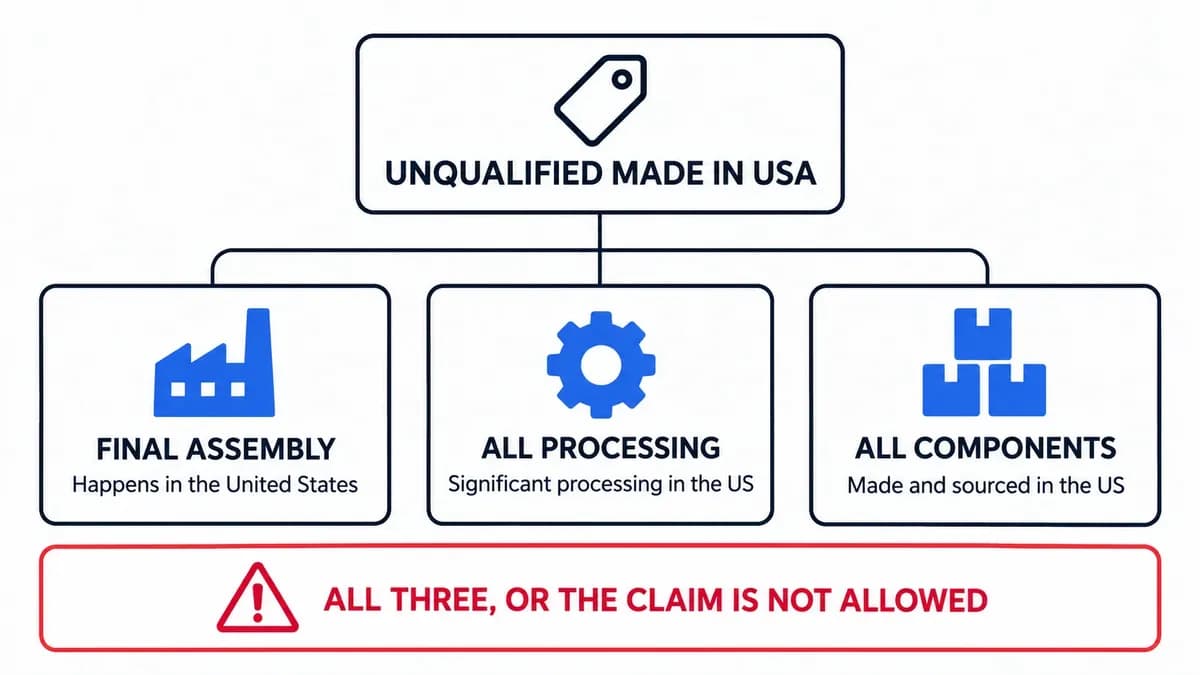
The FTC's Made in USA Labeling Rule sets three conditions. An unqualified claim is allowed only when three things are true. Final assembly or processing happens in the United States. All significant processing happens there too. And all or virtually all ingredients or components are made and sourced in the United States.
All three. Not two of three.
When the FTC issued the rule in 2021 it set civil penalties of up to $43,280 per violation. Penalty ceilings are adjusted over time, so treat that as the figure at issue rather than today's number.
What the "All or Virtually All" Standard Actually Means
"All or virtually all" sounds vague. The FTC's guidance on complying with the Made in USA standard is more concrete than the phrase suggests.
It means the final assembly or processing happens in the US. The product contains no foreign content, or so little that it counts as negligible.
Two details catch people.
Cost is not the test on its own. The FTC says foreign content can be more than negligible even when it is a small share of cost. What matters is whether that content is important to how the product works or how it was processed. A cheap imported part doing an important job still counts.
How far the foreign content sits from the finished product matters too. A US-made component built from imported raw material is treated differently from an imported component bolted on at the end.
Made in USA vs Assembled in USA
These are not the same claim and they do not carry the same burden.
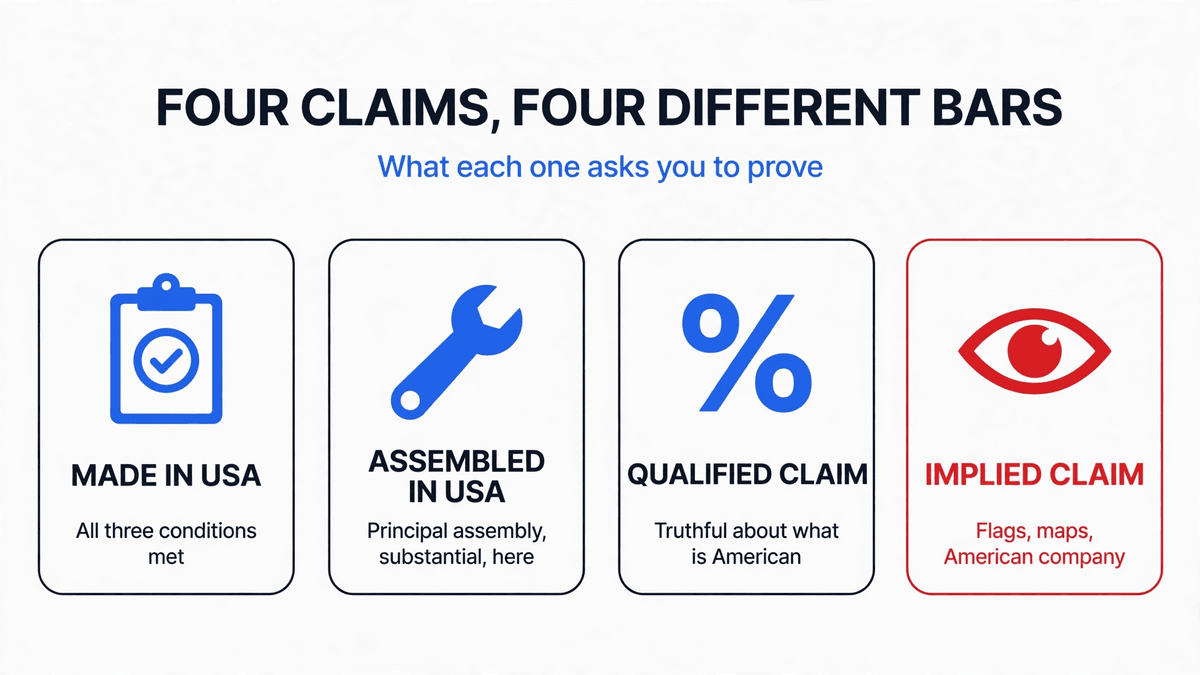
"Assembled in USA" is allowed on a product with foreign components when the principal assembly happens in the US and that assembly is substantial. The last substantial transformation should happen in the US too. That phrase means the step that turns parts into the finished product, rather than a final tidy-up.
What does not qualify is a screwdriver operation. The FTC's own example is a computer put together in the US from imported major components. Turning a few screws on finished foreign parts is not substantial assembly, and an unqualified "Assembled in USA" claim on it would be deceptive.
The contrasting example in that same FTC guide is a lawn mower with 15 to 20 percent foreign content, assembled in the US. That one can carry the claim.
Qualified Claims, Including "Made in USA With Globally Sourced Materials"
A qualified claim describes the extent, amount or type of US content. The FTC gives examples like "60% U.S. content" and "Made in USA of U.S. and imported parts."
Phrases such as "made in USA with globally sourced materials" belong in this family. The FTC's published guidance does not address that exact wording, so do not read an approval into it. What the guidance does say is that a qualified claim still has to be truthful and backed by evidence. It also says to avoid one unless the product has significant US content or processing.
The treadmill example in that same guide shows how thin a qualified claim can get. A treadmill labeled "Made in USA of U.S. and Imported Parts" was deceptive because US parts were only about 3 percent of part costs. The same product could have said "Made in U.S. from Imported Parts" or "Assembled in U.S.A." without deceiving anyone.
The lesson for a reseller is simple. A qualifier does not make a weak claim safe. It has to be accurate about what is actually American.
You Can Make the Claim Without Writing the Words
The FTC treats implied claims as claims. Its guidance names US flags, outlines of US maps, and references to a US headquarters or US factory. Any of these can convey a Made in USA claim, on their own or combined with other content.
This is the one that catches Amazon sellers. You did not type "Made in USA" anywhere. You used a flag icon in your A+ content, or a bullet that says "proudly American company," and the overall impression does the work.
Brand names are usually safe on their own. The FTC says a name does not count as an origin claim unless it specifically denotes US origin. "Made in America, Inc." would.
Where the Rule Bites on an Amazon Listing
There is a distinction worth understanding, because it changes which law applies.
The Labeling Rule covers labels. The FTC says marketers face civil penalties for an unqualified Made in USA label on a product that falls short of the standard. That includes catalogs and online. Separately, the FTC says it will keep pursuing deceptive US-origin claims that fall outside the rule under Section 5 of the FTC Act.
For a reseller, the practical upshot is the same either way. If the claim is in your listing and it is not true, the obligation was yours.
One category has its own rules. For textiles, the FTC's guidance for businesses selling American-made products goes further. Print and online catalogs must disclose whether the item was made in the USA, imported, or both. If you sell apparel or home textiles, country of origin labeling requirements apply to your catalog copy, not just the garment tag.
There Is No Made in USA Certification
Sellers ask which body certifies a Made in USA claim. None does.
The FTC does not pre-approve advertising or labeling claims. Its guidance puts the obligation on whoever makes the claim: have a reasonable basis before you make it, and keep reviewing the evidence behind it.
Private "Made in USA" certification marks exist as commercial programs. They are not an FTC approval, and the obligation still sits with the business making the claim.
How to Check Before You Copy a Claim
We are sharing a short workflow below which you can follow.
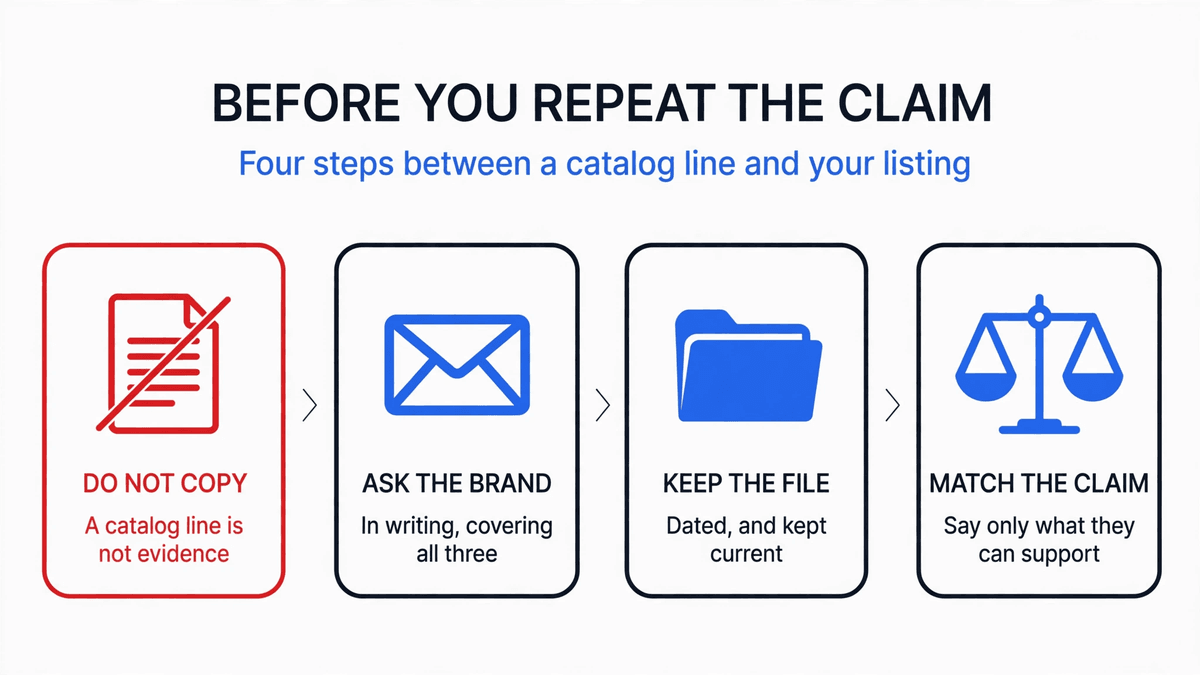
Do not copy origin wording from a distributor's catalog line. A distributor's product description is marketing copy they received from somewhere upstream. It is not evidence, and it is not the brand speaking.
Ask the brand, in writing, for the basis of the claim. You want something that addresses all three conditions. Where final assembly happens, where significant processing happens, and where components are sourced. A one-line email saying "yes it's American made" is not that.
Keep what they send you. The FTC expects the evidence behind a claim to be reviewed and kept current. A file with the date on it is worth more than a memory of a phone call.
Match the claim to what you were told. If the brand can only support "Assembled in USA," your listing says "Assembled in USA." Downgrading a claim costs you nothing. Repeating one you cannot support is the risk.
Check your images and bullets, not only your title. Flags, maps and "American company" lines carry the same weight as the words.
If the brand will not answer, that is an answer. Sell the product without the origin claim. Cannot reach the brand at all? Our guide on how to find the manufacturer of a product covers the label, barcode and trademark trail. You can also ask our team to find an authorized wholesale distributor for it. That is free on every plan, with an answer within 30 days either way.
Made in USA Labeling Requirements: The Takeaways
Usable whether or not you ever open our site:
- An unqualified claim needs all three conditions met, not just final assembly in the US.
- Cost share alone does not decide whether foreign content is negligible.
- "Assembled in USA" needs principal, substantial assembly here. A screwdriver operation does not qualify.
- A qualifier does not rescue a weak claim. It has to be accurate about what is American.
- Flags, US maps and "American company" lines can make the claim for you.
- Nobody certifies these claims. The obligation sits with whoever makes it.
Weighing a different supplier for the same item? You can search a product free and see real cost and real stock before you apply anywhere.
The Claim Is Yours Once You Publish It
Most origin problems in wholesale start the same way. A distributor's catalog line says American-made; it gets pasted into a listing, and nobody upstream is ever asked what it rests on. Made in USA labeling requirements do not care who wrote the sentence first. They care who is making the claim now. Checking takes one email and one saved file.
This is general information about how the FTC describes its own rules, not legal advice. For a decision about a specific product, talk to a lawyer.
Frequently asked questions
01What are the labeling requirements for Made in USA products?
02Does the FTC have guidance on Made in USA claims?
03Can I say my product is made in the USA?
The B2B SupplierHub Team
Wholesale & sourcing
Stop hunting suppliers by hand. Type a UPC instead.
B2B Supplier Hub shows the suppliers in our network carrying a product on one page: wholesale cost, stock, and retail price side by side. Free to search, no card required.