
Distributor Authorization
The Reseller's Guide to MAP Pricing and Authorization: What Amazon Sellers Need to Know (2026)
%2520Pricing%2520and%2520Authorization-1200x627.png&w=3840&q=75)
MAP pricing isn't complicated in theory. A brand sets a floor. You don't sell below it. Simple.
In practice, it's one of the most misunderstood compliance requirements in Amazon wholesale and one of the most expensive to get wrong. Resellers lose distributor accounts over violations they didn't know they were committing. They get cut from brand programs because a repricing tool undercuts MAP at 2 am. They sign MAP agreements without understanding which clauses actually apply to Amazon.
This guide covers how MAP works at the mechanics level. If you're building a wholesale business on Amazon, MAP compliance isn't a technicality. It's a credential. The resellers who treat it that way are the ones brands and distributors keep.
What MAP Pricing Actually Is and What It Isn't
The Difference Between MAP, MSRP, and Wholesale Cost
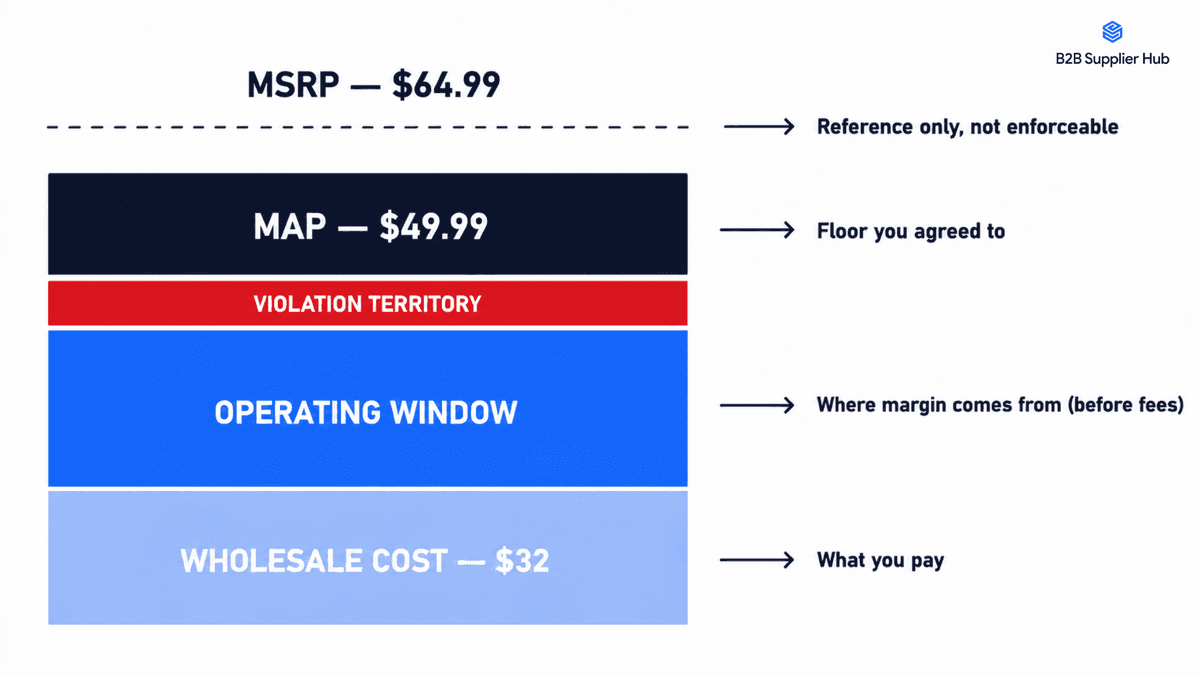
These three numbers show up in the same conversation but mean completely different things.
Wholesale cost is what you pay the distributor. Your cost of goods. Nothing else.
MSRP (Manufacturer's Suggested Retail Price) is a suggestion. Brands cannot legally force you to sell at MSRP. It exists as a reference point, the crossed-out "was" price next to a sale figure, with no enforcement mechanism behind it.
MAP (Minimum Advertised Price) is the floor below which you agree not to advertise a product and, under broader modern policies, not to let the effective price a customer pays fall either. Unlike MSRP, MAP comes with teeth. It's written into your distributor agreement or a separate brand policy you sign when you open an account. Violate it, and the brand has contractual grounds to cut you off.
The margin between your wholesale cost and MAP is your entire operating window. If MAP is $49.99 and you paid $32 wholesale, everything you make after Amazon fees, FBA costs, returns, and PPC has to come from that $17.99 gap.
Why MAP Is a Supplier Policy, Not a Legal Price Floor
MAP is not a law. The US does not require anyone to honor a minimum price. What MAP is, legally, is a pricing policy you agree to as a condition of carrying the brand, either a term in your distributor agreement or a separate policy you accept at account opening.
The Supreme Court's 2007 Leegin decision removed the automatic illegality of resale price maintenance under federal antitrust law, making it judged under the "rule of reason" instead. What this means practically is that MAP is enforceable as a contract term. Violate it, and you're not breaking the law, but you are breaching your agreement, and the brand can terminate your account or cut off supply.
What MAP does not do is protect you. It doesn't stop a competitor from going below it. It doesn't stop Amazon from price-matching below MAP. It doesn't prevent your Buy Box from being suppressed because someone else violated the policy. MAP protects the brand's pricing ecosystem. The reseller benefits only indirectly when everyone else in the channel is also following the rules.
Why MAP Violations Are a Bigger Problem on Amazon Than Anywhere Else
How Brands Monitor MAP Compliance in 2026
Five years ago, MAP monitoring was a manual exercise. Someone at the brand would search Amazon periodically, note prices, and flag violators. Coverage was spotty, and enforcement was slow. Today, brands use automated tools like Wiser, TrackStreet, and PriceSpider that crawl Amazon listings continuously and flag violations in real time.
The moment your listing drops below MAP, the system logs it with a timestamp, your seller name, and the ASIN. Some tools capture screenshots as evidence. The result is that a MAP violation on Amazon is faster to detect, better documented, and harder to dispute than in almost any other sales channel. There is no "I didn't know" defense when the monitoring software caught it at 3:14 am.
The Competitive Repricing Trap
This is where good-faith sellers get burned. You set your repricer to match the lowest FBA price. A competitor, possibly an unauthorized seller who doesn't care about MAP, drops to $43.00 on a product with a $49.99 MAP. Your repricer follows. You're now in violation.
The fix is straightforward but requires intentional setup: a per-ASIN price floor set at MAP, so the repricer can't follow a competitor below it. (Full setup details are in the repricing section below.) If your repricer doesn't support per-ASIN floors, you have no real protection on any MAP-protected catalog.
How One MAP Violation Can End a Distributor Relationship
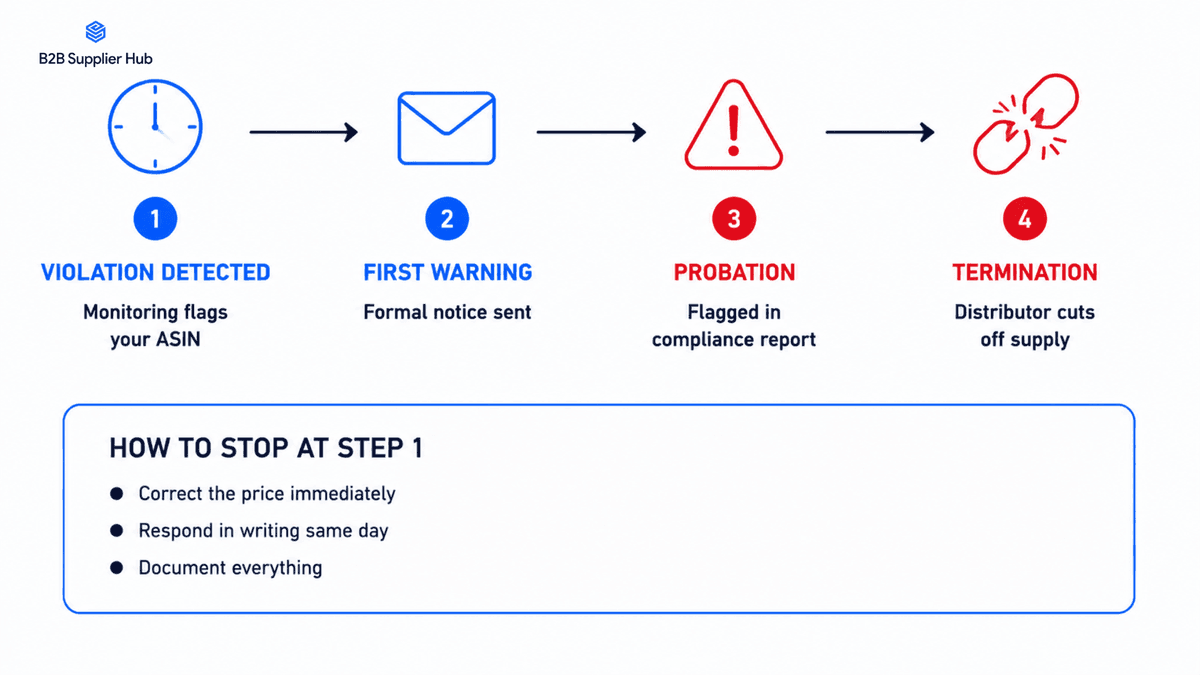
First violations get a warning. You correct the price, reply acknowledging the issue, and move on.
Repeat violations land differently. Distributors receive compliance reports from the brands they carry. If your account shows up on those reports consistently, the distributor's account manager has to decide whether to keep a reseller who is creating brand friction or protect the brand relationship by cutting you off. Distributors make money on brand relationships, not on individual seller accounts. When forced to choose, the seller loses.
How MAP Policies Are Written and What You're Actually Agreeing To
Most resellers sign MAP agreements without reading them carefully. The clauses that matter most are the ones that rarely get explained at account opening.
The MAP price list is either embedded in the agreement or referenced as a separate document that the brand updates periodically. Some brands update with a 30-day notice. Others update the list and consider you bound immediately. Know which type you've signed.
The definition of "advertised price" is where policies diverge most. Some define MAP narrowly as the listed price on a product detail page. Others extend it to any publicly visible price, including prices shown in the cart or in search results. The broader the definition, the more exposure you carry.
The promotional carve-out matters too. Most MAP policies allow price reductions during brand-sanctioned events, but these windows are narrow and often require advance approval. Using a Lightning Deal or coupon outside an approved window may result in a violation, depending on how the policy defines "advertised."
Finally, look at the enforcement escalation path. Explicit policies state the progression: first violation is a warning, second is probation, and third is termination. Vague policies leave enforcement at the brand's discretion, which is almost always worse for you.
Read the full document before signing. The clauses most resellers skip are the ones that matter most when something goes wrong.
Building a MAP Compliance Paper Trail
At minimum, keep: the MAP agreement or policy you received at account opening; each updated MAP price list; your per-ASIN repricer floor settings as a date-stamped export; and every violation notice with your written response.
This isn't bureaucratic overhead; it's what makes a disputed violation close in your favor rather than cost you an account. Brands make mistakes, monitoring software throws false positives, and competitors can trigger a repricing event and then report you. When a notice arrives, correct the price immediately and respond in writing the same day with your documentation attached.
MAP and Authorization: Why They're Two Sides of the Same Coin
This is the connection most MAP guides never make and the one that matters most for how you build a wholesale business.
Why MAP Enforcement Is Tiered
Brands don't enforce MAP the same way against authorized and unauthorized sellers. MAP is a contractual obligation, and you can only hold someone to a contract they've signed. An unauthorized seller hasn't signed your MAP agreement.
Brands handle unauthorized violators differently. They work to get the listing removed, the seller flagged, and the distribution tightened. Every MAP violation from a gray market seller on your shared listing makes authorized status harder to achieve, not just for you but for everyone trying to enter that brand's distribution.
Authorized sellers who violate MAP get warnings because the brand has a relationship to protect. Unauthorized sellers who violate MAP accelerate the brand's decision to restrict distribution entirely.
How MAP Compliance Strengthens Your Distributor Application
When you apply for a wholesale account, the distributor's account manager is evaluating your risk profile. The implicit question is whether you will create brand friction.
A reseller who can demonstrate clean pricing practices, no violations, proper channel disclosure, and a documented repricing floor policy is a low-friction account. Distributors approve low-friction accounts because they protect their own brand relationships. Presenting your compliance practices during an application is a credibility signal most resellers never think to offer. It's worth presenting.
The practical problem is keeping track of all of it, which brands you're approved with, which applications are still open, and which suppliers carry a product before you bother applying. That visibility is part of what we're building B2B SupplierHub around: see which suppliers stock a product, what authorization each requires, and where your applications stand, in one place instead of across a dozen portals and a spreadsheet.
Brands Using MAP Compliance as an Authorization Precondition
At the premium brand level, some brands now require prospective resellers to demonstrate a history of pricing compliance before approving an account. Brand monitoring tools can cross-reference seller IDs and storefront names. A pattern of gray market selling at below-MAP prices is visible to an account manager before you ever apply.
The cleanest path to authorization is a clean history. If you've been sourcing a brand through unauthorized channels, the time to clean up your pricing behavior is before you apply, not after you've been flagged.
The Amazon-Specific MAP Problem: Buy Box, Repricing, and Price Matching
When Amazon Itself Breaks MAP
Amazon operates as a retailer on its own platform. When Amazon sources a product directly and prices it below MAP, which it does regularly, the MAP policy you've signed doesn't bind Amazon. Amazon didn't sign your brand's MAP agreement.
If your repricer is matching Amazon's price, you're now in violation through no intent of your own. The defensible position is to document it. Screenshot the listing price when Amazon drops below MAP. If you receive a violation notice covering that period, your documentation showing Amazon triggered the price drop is your defense.
Some MAP policies include an Amazon carve-out clause. If Amazon breaks MAP, authorized resellers are temporarily released from MAP obligations on that ASIN. Push for this clause if it's not already in your agreement.
Repricing Tools and MAP Floors
Every repricer handles MAP floors differently. The right setup is SKU-level floor input, where you enter the MAP price per ASIN, and the repricer treats it as an absolute floor it will not cross. Rule-based floors built on a percentage above cost don't protect you against MAP violations unless MAP is already factored into your cost calculation. If your repricer doesn't support per-ASIN floors, set up manual floors or switch tools before going live on MAP-protected products.
MAP Gray Zones: Where Experienced Sellers Still Get Caught
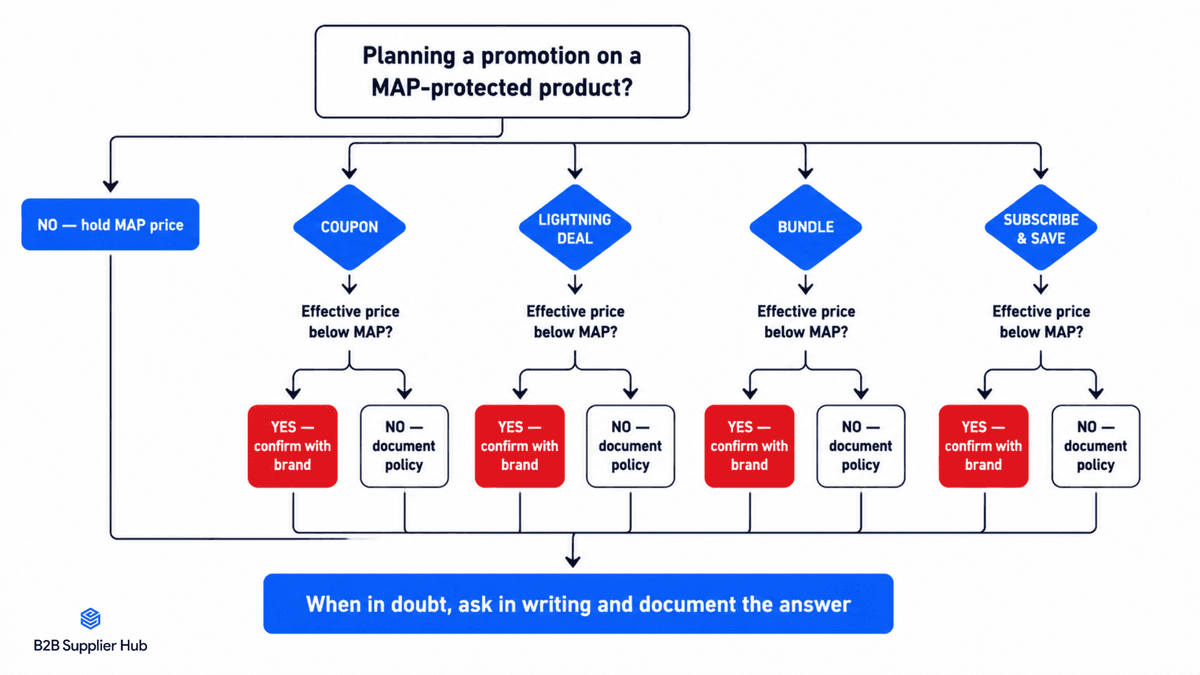
The trap in all four is identical: your listed price stays at MAP, but the effective price the customer pays drops below it. Whether that's a violation depends on whether your policy covers "effective selling price" or "final price paid." When the wording is broad or unclear, confirm with the brand in writing before running the promotion.
Coupons
A "with coupon" price displays publicly in search and on the listing. Under a broad policy, a coupon that pushes the effective price below MAP is a violation even though your listed price never changed.
Lightning Deals and Prime Day
Amazon approves Lightning Deals on its own criteria and never checks your MAP policy. Run one on a MAP-protected product without brand sign-off and you carry the violation risk alone.
Bundle Pricing
A $49.99 MAP item bundled with a $5 accessory and sold at $52 implies a $47 unit price — below MAP. Bundle only when the total keeps the MAP item's effective price at or above its floor.
Subscribe and Save
A 10% S&S discount on a MAP-priced item means the customer pays 10% under MAP. Many brands tolerate it because Amazon controls the mechanism, but tolerated isn't permitted — ask your account manager and document the answer.
MAP Compliance Is a Reseller Credential, Not Just a Rule to Follow
Most resellers treat MAP as a constraint, a floor enforced by brands protecting their own margins at the reseller's expense. That framing is incomplete.
Brands with strong MAP enforcement are almost universally the brands worth selling. Clean pricing ecosystems mean healthy margins, stable distributor relationships, and a Buy Box that's actually winnable without racing to the bottom. Brands that don't enforce MAP are usually the ones where the category is already commoditized, and the margin is gone.
A clean MAP compliance record is also a competitive differentiator at the distributor level. Account managers remember which resellers create friction and which ones don't. Resellers who hold MAP, report violations professionally, and demonstrate they understand the brand's pricing ecosystem get faster account approvals, better treatment during inventory allocation, and a real relationship instead of a transactional one.
The resellers who treat MAP compliance as a credential rather than a constraint are building businesses that distributors actively want to keep. That's the goal.
Frequently asked questions
01Is MAP pricing legal in the United States?
02Can Amazon force me to lower my price below MAP?
03What happens if I violate MAP as an authorized reseller?
04Does MAP apply to FBA sellers the same way as FBM?
05How do I know if a brand has a MAP policy before I start selling?
The B2B SupplierHub Team
Wholesale & sourcing
Stop hunting suppliers by hand. Type a UPC instead.
B2B Supplier Hub shows the suppliers in our network carrying a product on one page: wholesale cost, stock, and retail price side by side. Free to search, no card required.