
Supplier Management
How to Reapply to a Wholesale Distributor After Rejection
You found the right product. You found a distributor who carries it. You applied, and the answer was no. Or worse, the answer was nothing at all. Here is what most sellers get wrong about that moment: they treat rejection as a verdict when it is usually just a first response.
On Amazon’s own seller forums, sellers describe approaching dozens of distributors cold and being refused by nearly all of them, and getting approved consistently ranks among the hardest parts of the wholesale model. Those accounts sound discouraging until you realize what they actually mean. Almost every wholesale seller you admire has a folder full of rejections behind their best accounts. The difference is that they learned how to reopen them.
Why Distributors Reject Amazon Sellers (It Is Rarely Personal)
Start with the math from the distributor’s side, because it explains almost everything.
A distributor’s Amazon sales do not grow when they add a tenth seller to the same listing. Amazon customers will buy roughly the same number of units whether three sellers or thirteen sellers share that listing. What does grow is the distributor’s risk. More sellers on one listing means more price competition, and more price competition means a higher chance that one of those sellers fails and cannot pay their invoices.
Once a distributor has a few reliable Amazon accounts for a product line, there is very little upside in adding another one. When you understand this, rejection stops feeling personal. You were not judged and found unworthy. You simply arrived after the seats were filled, or you failed to show why you deserve one of them.
The competitive backdrop makes this sharper. Roughly a quarter of Amazon sellers run the wholesale model, which means every good distributor is fielding a steady stream of applications that look a lot like yours. Distributors are comparing you against a stronger, more professional pool of operators than they were five years ago. Standing out is not about applying more. It is about applying better.
There is also a newer layer that many sellers miss. More brands now require their distributors to share sales channel reports, and more brands maintain whitelists of approved sellers. That means some rejections are not the distributor’s decision at all. The brand made it for them. Understanding what type of rejection you received can completely change your next steps.
For the full picture of what happens before the decision, read our guides on what distributors look for before approving an Amazon seller and how to get approved by wholesale distributors.
Decode the Rejection Before You Respond: Three Types of No
Not all rejections are the same, and each type has a different reopening play.
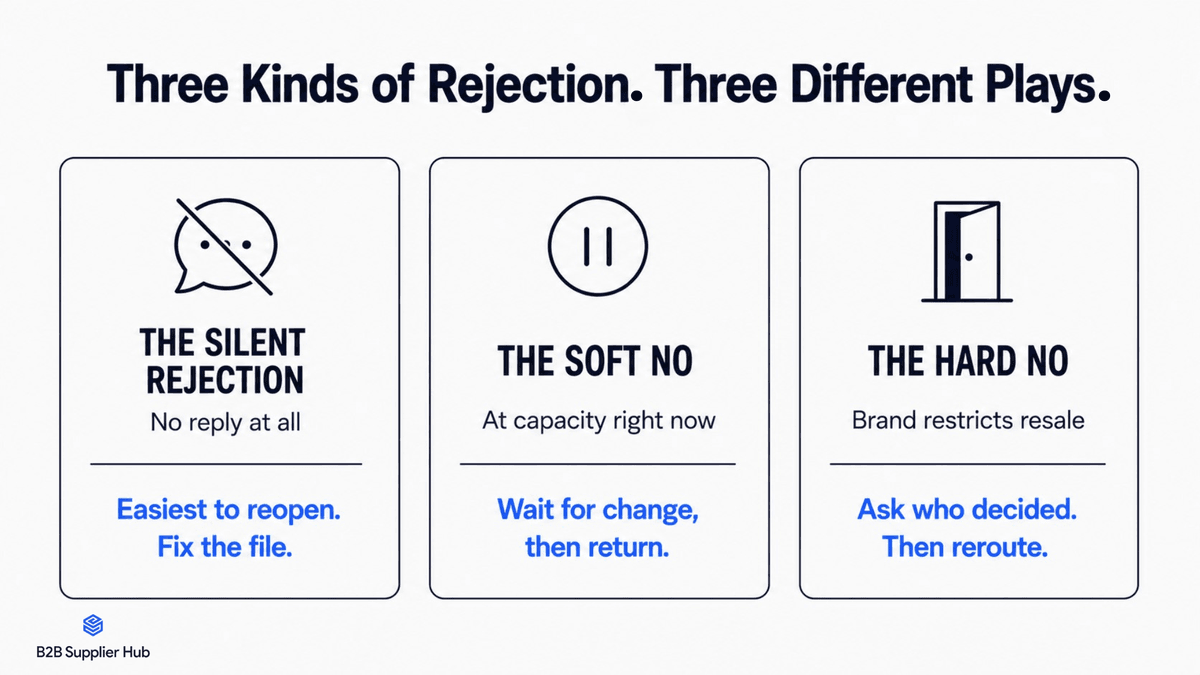
The Silent Rejection: No Response at All
You applied and heard nothing. This is the most common outcome, and it usually means your application never made a case worth answering. A web form with a Gmail address and no order commitment does not get a reply. It gets deleted. The good news is that silence is the easiest rejection to reopen, because there is no decision on record to reverse.
The Soft No: Vague Reasons or a Distant Follow-Up Date
“We are not adding accounts right now.” “We are at capacity for that brand.” Read these carefully, because they are invitations dressed as refusals. A distributor at capacity today may lose two sellers by next quarter. A soft no is a request to come back when something has changed, either on their side or on yours.
The Hard No: A Direct and Specific Decline
“We do not work with Amazon sellers.” “The brand restricts online resale.” This is often structural. If the brand caps its seller count or bans marketplace sales entirely, no email will fix it, and pretending otherwise wastes months. When you get a hard no, ask one polite follow-up question: Is this the distributor’s policy or the brand’s requirement? Most reps will tell you, and the answer determines whether this door can ever open.
A useful skill here is reading the language distributors actually use, because they rarely say no in plain words. “We are brand-directed on that line” means the brand controls who gets access, so the decision is above your rep’s pay grade. “We are at capacity for that brand” or “not adding accounts on that listing” usually means the seller seats are full for now, which is a timing problem, not a you problem.
“Send us your website and resale certificate, and we will review.” followed by silence means the file did not pass, and the fix is the file. And a flat “we do not supply Amazon sellers” means exactly what it says. Matching your response to the sentence you actually received is half the skill of reopening.
Fix What Got You Rejected Before You Write Anything
Reopening a rejected distributor application with the same file that got rejected is asking the same question and hoping for a different answer. Change the file first.
Legitimate distributors verify specific things before approving an account: your EIN, your resale certificate, your business entity, your address, and often trade references. Any gap in that list is a reason to say no. So close the gaps. Register a proper entity if you have not. Get your resale certificate in order.
Set up a real website with a domain email, because an application from orders@yourcompany.com reads very differently than one from a personal Gmail account. If you already buy from other suppliers, ask two of them for a trade reference. A reference from an existing supplier answers the distributor’s biggest unspoken question, which is whether you pay your bills.
Then fix your positioning. A first order framed as “I want to test with a small quantity” tells the distributor you are exactly the kind of account that creates work without creating revenue. Commit to a credible opening volume and say it plainly.
And address the Amazon question directly instead of hiding it. Distributors worry about the same things every time: poor communication, inconsistent orders, and pricing behavior that upsets the brand. Tell them how you handle each one. A seller who names the objection before the distributor does sounds like a professional.
One warning that will save you from real damage. Do not reapply under a different business name, and do not fire off repeated fresh applications hoping one slips through.
Amazon moderators have said on the seller forums that repeatedly resubmitting the same application can trigger automated rejections instead of human review, and the same behavioral logic applies to distributors. Same address, same EIN, same person. You will be recognized, and what was a fixable rejection becomes a trust problem that cannot be repaired.
The Reapproach: When to Reach Out and What to Say
Give it 60 to 90 days or move sooner only if something material has changed: new entity documents, a strong trade reference, a bigger committed budget, or a face-to-face meeting at a trade show.
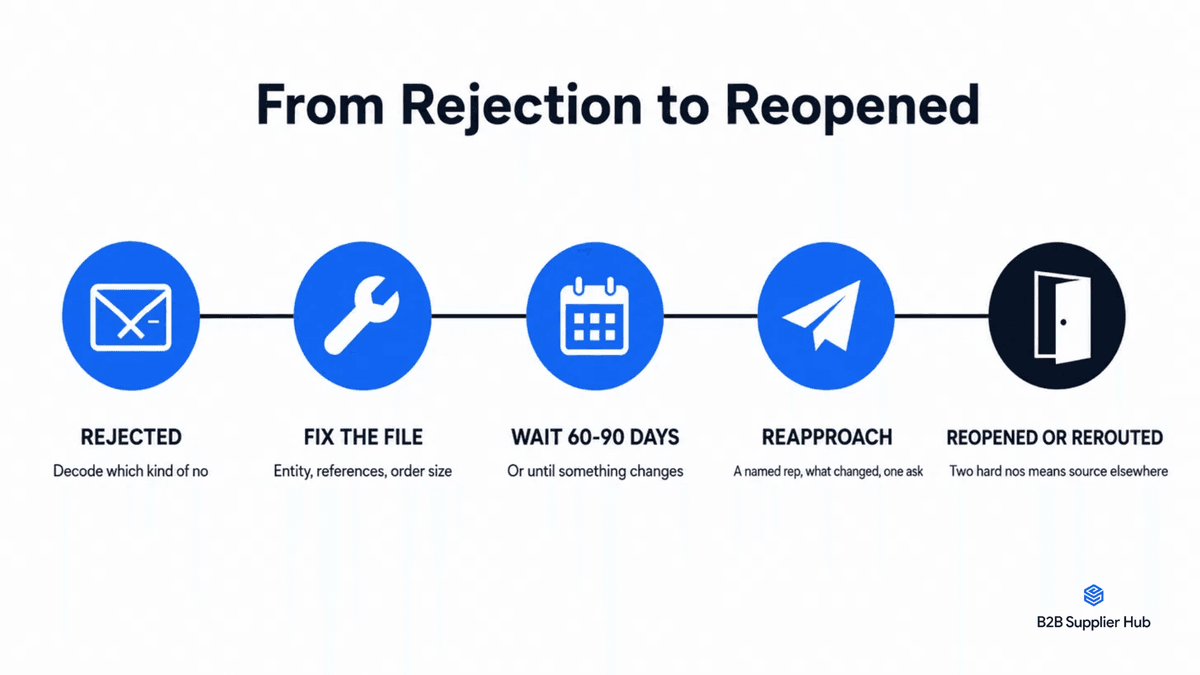
Skip the web form this time. The web form is what silently rejected you before. Find a named sales rep, because a person can be persuaded and a form cannot.
The email itself should be short. Two paragraphs. Here is a template you can adapt. It is a model we wrote for this article, not a real message, so make it yours before sending:
Subject: Reopening our account application — [Your Company Name]
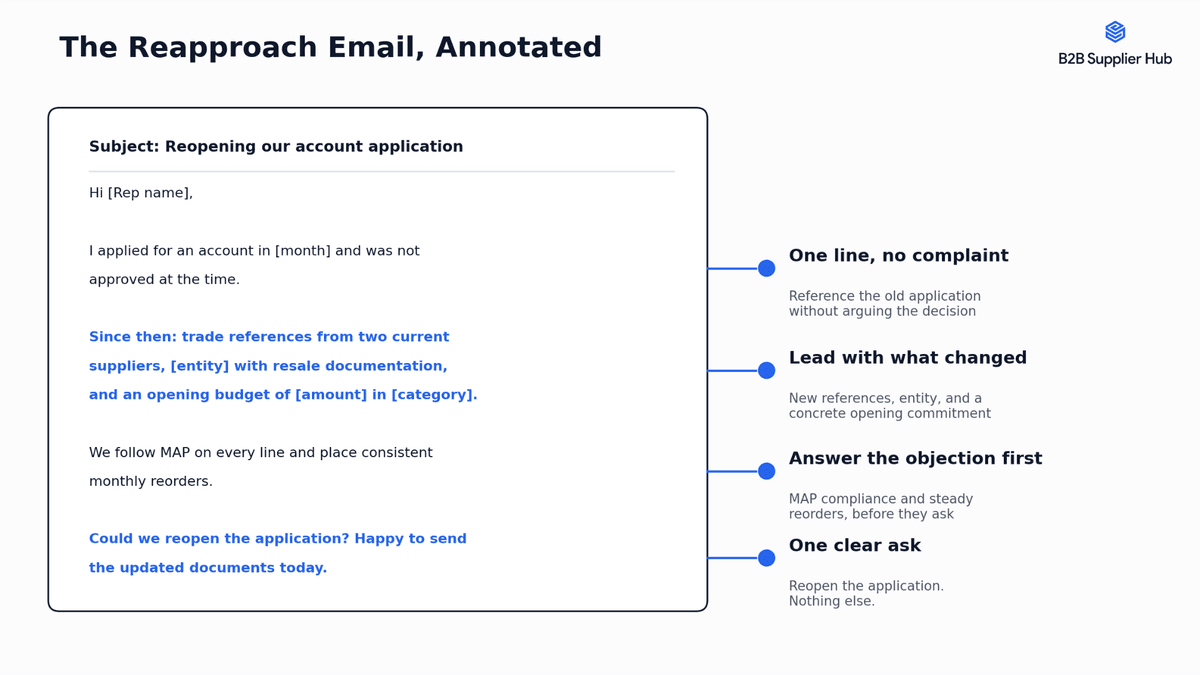
Hi [Rep name], I applied for an account with you in [month] and was not approved at the time. Since then, a few things have changed on our side: we have added trade references from [two current suppliers], moved to [business entity] with resale documentation in place, and set an opening order budget of [amount] focused on [category].
We sell on [channels], we follow MAP on every line we carry, and we place consistent monthly reorders rather than one-off buys. If it makes sense, I would like to reopen the application. Happy to send the updated documents today. Thanks for taking another look. [Name, company, phone]
Notice what the template does. It references the earlier application in one line without complaint, leads with what changed, states a concrete opening commitment, answers the Amazon objection before it is raised, and makes one clear ask. Notice also what it leaves out: no argument about the original decision, no mention of other sellers they approved, no pressure.
When to Stop Reopening and Source Somewhere Else
When you get two hard rejections on the same file, it’s pretty clear that the answer is final. Structural rejections, the ones driven by brand whitelists or marketplace bans, do not reopen no matter how good your email is. Continuing to push a closed door costs you the one thing distributors respect least, which is your time.
Here is the reframe that experienced sellers make: a rejection is a routing problem, not a dead end. The product you want almost never has a single path to it. Other suppliers carry the same items, often at different costs and with different stock positions.
This is exactly what B2B Supplier Hub is built for. You can search for any product for free and see each carrying supplier’s cost, stock, and retail price before you decide who is worth applying to. That way, your next application goes to a supplier whose numbers already work for you, not another cold guess. See the deal first, then pursue the relationship.
Our supplier comparison framework and reverse sourcing guide walk through that evaluation step by step.
The Takeaway: Rejection Is a Data Point, Not a Verdict
Every rejection carries one of two messages. Either your file was not strong enough, or their constraints left no room for you. The first is fixable, and this post showed you how. The second is a signal to reroute your effort toward a supplier who can actually say yes.
The sellers who build durable wholesale businesses treat both messages the same way, without ego and with a clear next step. A rejection from a distributor is not the end of the product. It is just the end of one path to it, and the sellers who understand that are the ones who always seem to have another path ready.
Frequently asked questions
01How long should I wait before reapplying to a distributor?
02Should I reapply under a different business name?
03Why do distributors reject new Amazon sellers?
04Can a rejection come from the brand instead of the distributor?
The B2B SupplierHub Team
Wholesale & sourcing
Stop hunting suppliers by hand. Type a UPC instead.
B2B Supplier Hub shows the suppliers in our network carrying a product on one page: wholesale cost, stock, and retail price side by side. Free to search, no card required.