
Supplier Management
What Distributors Look For Before Approving an Amazon Seller (2026 Guide)
Most Amazon sellers assume that getting approved by a wholesale distributor is mainly about having the right paperwork. Submit a resale certificate, show a business license, fill out the application, and wait. If the documents check out, the account opens.
That is not how distributors actually think.
Documents are the baseline. Every serious applicant has them. What distributors are really doing when they evaluate a new reseller is assessing risk. They want to know whether approving you will help their brand relationships or hurt them. Whether you will place consistent orders or disappear after two. Whether you are the kind of account that requires constant hand-holding or one that runs professionally with minimal friction.
This guide explains what distributors are actually looking for, why they look for it, and what you can do to present yourself as the kind of account they want to approve.
Why Distributors Are More Selective Than They Used To Be
Five years ago, most distributors were relatively open. If you had a business license and a resale certificate, you could get an account with most mid-tier distributors without much scrutiny.
That has changed. Brands have pushed their authorized distributors to tighten approval standards because of what happened when they did not. Unauthorized resellers got accounts, violated MAP, flooded Amazon with discounted inventory, and damaged the pricing ecosystem the brand spent years building. Brands started holding distributors accountable for who they were selling to. Distributors responded by getting more selective.
The result is that today, a wholesale distributor approval is closer to a business evaluation than a paperwork process. Your documents have to be right, but so does everything else.
The Business Credentials Every Distributor Checks Before Approving an Amazon Seller
Before anything else, distributors verify that you are a real, operating business. This sounds obvious, but many sellers underestimate how much detail is expected.
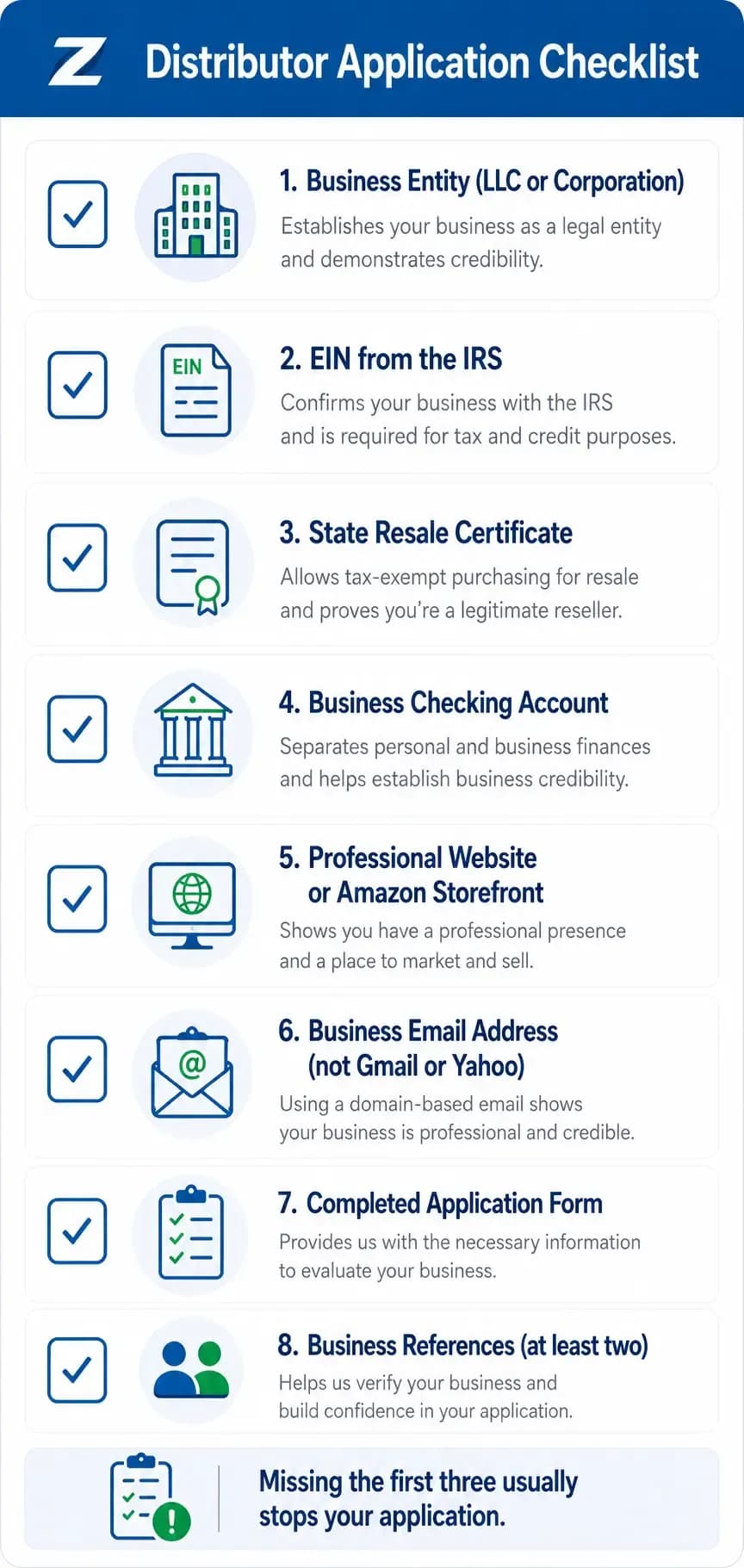
A legitimate business entity is non-negotiable. Sole proprietorships applying under a personal name create friction immediately. An LLC or corporation with a proper EIN signals that you are operating seriously. Most distributors will not process an application from a sole proprietor using a personal Social Security number.
A resale certificate issued by your state is required by virtually every distributor. This is what allows them to sell to you without collecting sales tax. If you do not have one, get one before you apply. The application without it will not move forward.
A business checking account in the business's name matters more than most sellers realize. Distributors extend net payment terms to accounts they trust, and they need to see that the business has its own financial infrastructure before they consider offering any terms. A personal bank account signals that the business is not fully established.
A professional website or Amazon storefront is increasingly expected. It does not need to be elaborate, but it needs to exist and clearly show what you sell. A distributor's account manager will look you up before approving your account.
How Distributors Think About Order Volume
Once your credentials are confirmed, the next thing a distributor evaluates is whether you are worth the operational cost of maintaining your account.
Distributors do not make money on small, sporadic orders. Every new account they open creates overhead: a credit check, a setup in their system, an account manager's time, and ongoing order processing. If your orders are small and infrequent, the account costs more to maintain than it earns.
This is why distributors ask about your expected order volume and frequency. They are not just making conversation. They are calculating whether your account will contribute enough margin to justify the cost of running it.
Being honest about where you are is better than overpromising. A new seller who projects $5,000 in monthly orders and actually places $800 will be flagged as a low-priority account quickly. A new seller who says they are starting at $1,500 a month and want to grow to $5,000 within six months, and then actually does it, becomes exactly the kind of account a distributor wants to develop.
What distributors want to see in terms of volume depends on the category and the distributor's size. A small regional distributor might be perfectly happy with $1,000 monthly orders. A large national distributor with a minimum spend policy might not open an account unless the monthly spend is at least $2,500 or $5,000. Ask the question before you apply so you do not waste time applying to distributors whose minimums you cannot meet.
The Channel Question: Should You Disclose You Sell on Amazon?
This is where many Amazon sellers make a mistake; they do not realize they are making.
When a distributor's application asks where you sell or how you plan to resell the products, many Amazon sellers either leave it blank, give a vague answer, or say "online retail" without specifying Amazon. They do this because they assume that mentioning Amazon will hurt their chances.
In most cases, the opposite is true.
Distributors know their products are on Amazon. They can search for them in thirty seconds. If you hide your channel and they find your Amazon storefront on their own, you have damaged trust before the account even opens. If you are transparent and can explain how you operate professionally on Amazon — meaning you hold MAP, manage your account health, and source correctly — you become a lower-risk account than a seller who is evasive.
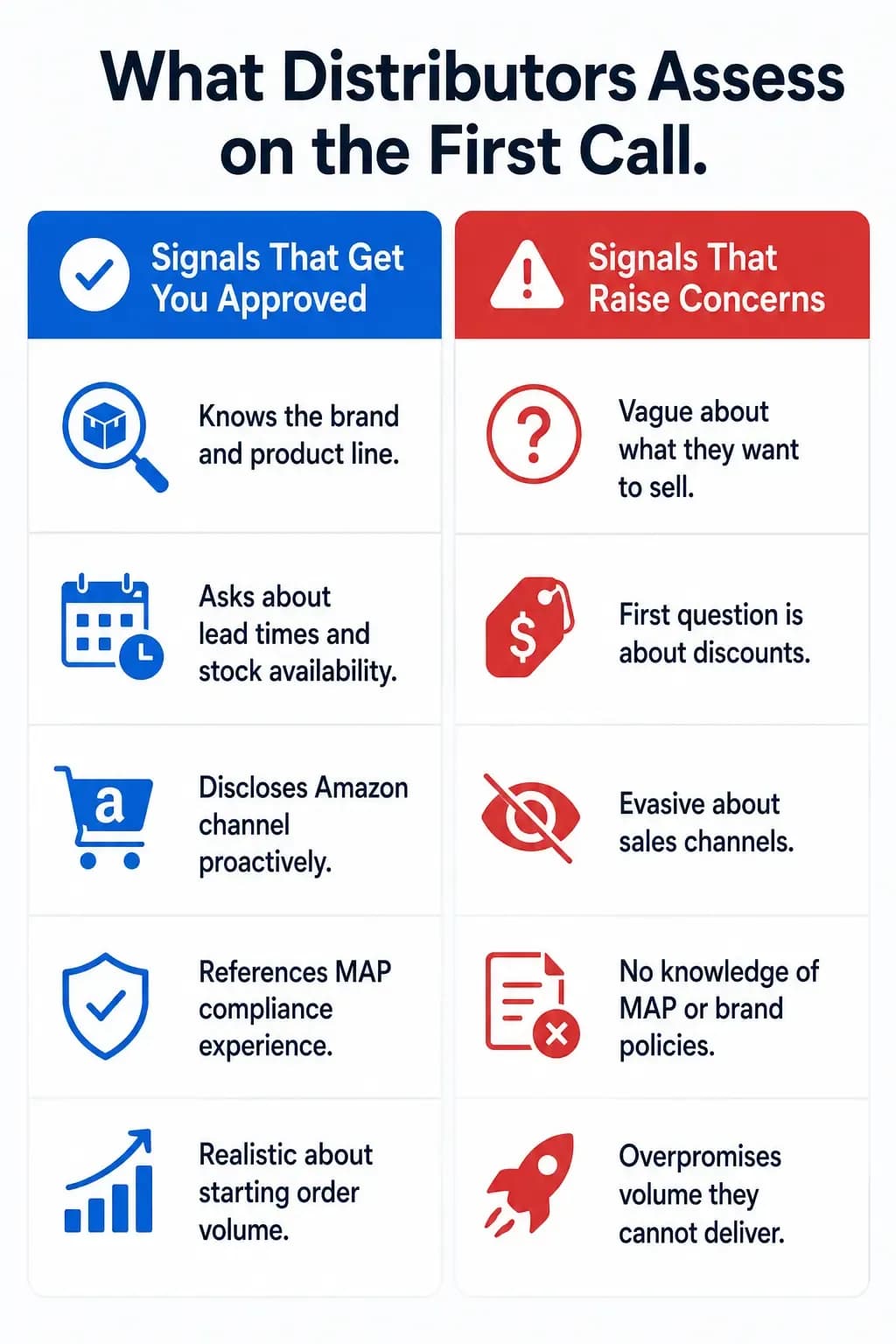
What distributors are worried about with Amazon sellers specifically is MAP erosion and channel conflict. Those are legitimate concerns. Address them directly. Tell the distributor that you understand MAP requirements and have compliance procedures in place. If you have a track record of MAP-compliant selling on Amazon, that is worth mentioning.
Some distributors do have explicit policies restricting marketplace selling. If they do, you will find out on the call or in the application. Better to know before you open the account than to hide it and get terminated later.
How Your First Contact Is Evaluated
Distributors evaluate the quality of your first contact as a signal for what working with you will be like.
Account managers deal with hundreds of resellers. The ones who call or email with vague questions, who do not know basic information about the products they want to sell, or who immediately ask for the biggest discount available, tend to require the most support and create the most problems. Account managers have learned to spot these patterns early.
Professional first contact means knowing the brand you want to carry, having a clear sense of the products and quantities you are interested in, asking intelligent questions about lead times, stock availability, and payment terms, and being straightforward about your business and sales channels.
It also means not asking for things on the first call that signal you are not ready. Asking for net 90 terms before you have placed a single order, demanding to know what happens if you want to return your entire first order, or pushing for the distributor's lowest pricing before they have any sense of your volume—these are red flags that experienced account managers recognize immediately.
The right posture for a first call with a distributor is professional curiosity. You are evaluating them as much as they are evaluating you, and you have done enough preparation to ask informed questions.
Why Trade References and Business History Matter to a Distributor
More distributors are now asking for trade references as part of their standard application process. A trade reference is another business, usually a supplier or distributor, who can confirm that you pay on time, order consistently, and are easy to work with.
If you are brand new and have no trade references, say so. Trying to fabricate references or list personal contacts as business references is something account managers detect quickly, and it ends the application. What you can offer instead is evidence of professional operation: good Amazon account health metrics, documented MAP compliance with brands you already carry, or a track record with smaller suppliers. These do not replace references, but they show you have been running a real business.
References matter more as the size of the distributor increases. A regional distributor may not require them. A national distributor for a premium brand almost certainly will.
Time in Business and Why It Matters
Most distributors have an informal or formal minimum for how long a business has been operating before they will approve an account. Informally, many account managers are skeptical of businesses that are less than six months old. Formally, some distributors have a stated policy of not opening accounts for businesses operating for less than a year.
This does not mean a new business cannot get approved. It means you need to understand that time in business is a credibility signal, and if you are new, you need to offset that with stronger signals elsewhere: better documentation, a clearer business plan, a professional website, and demonstrated knowledge of the category you are entering.
If your business is less than a year old, be transparent about it rather than trying to obscure the registration date. Account managers look this up. A business that has been operating for three months is not automatically disqualified, but a business that appears to be hiding how new it is creates an immediate trust problem.
How MAP Compliance Fits Into the Approval Picture
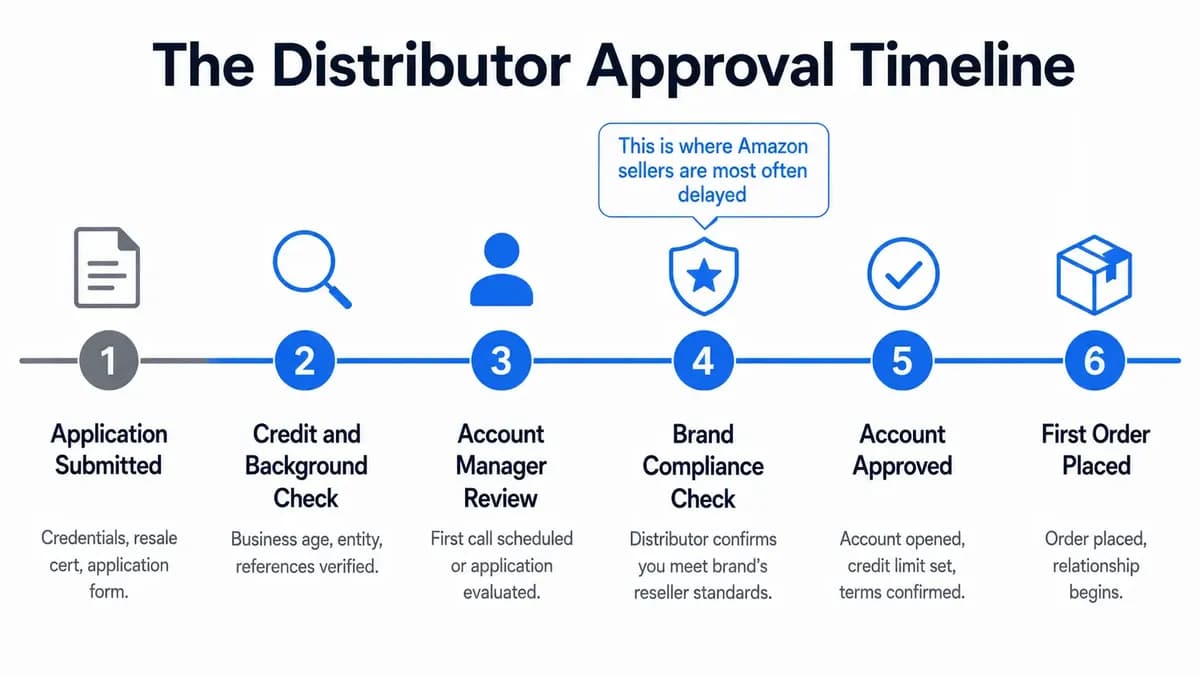
Distributors are not just approving resellers. They are approving resellers on behalf of the brands they carry. Every distributor has a relationship with each brand in their catalog, and that relationship depends on them not creating brand problems.
MAP violations are the most common way that resellers create brand problems. A reseller who price-cuts below MAP not only hurts their own margin — they also force every other authorized reseller to either match the price or lose the Buy Box, which can trigger a cascade of violations across the entire brand's Amazon presence. Brands hold their distributors responsible for this.
When you tell a distributor you understand MAP and have compliance procedures in place, you are directly addressing the risk that matters most to them. You are telling them that approving you is unlikely to create a brand friction problem.
If you have a history of selling other MAP-protected brands correctly, bring documentation. A screenshot of your repricing floor settings, a reference from another distributor whose MAP-protected brands you carry, or even a clear explanation of your repricing workflow demonstrates that you have thought about this and take it seriously.
How to Improve Your Odds of Getting Approved by a Distributor
Get your entity and documents in order before you contact anyone. LLC, EIN, resale certificate, business checking account. If any of these are missing, the first conversation will expose the gap.
Build a professional Amazon presence before you pursue national distributors. Account managers look you up. A storefront with real reviews and clear branding signals that you know how to sell.
Start with distributors whose volume requirements match where you actually are. Getting approved by a distributor you can genuinely grow with is more valuable than getting rejected by one whose minimums you cannot meet.
Be transparent about Amazon from the first contact. Hiding your channel creates trust problems. The distributors who work with Amazon sellers want to know that you understand what that means.
Prepare for the first call the way you would prepare for a business meeting. Know the brand, know the products, know your numbers.
Where the Search Fits Into All of This
Everything above assumes you've already found a distributor worth applying to. For most sellers, that's the slowest part, weeks of research just to figure out who even carries the products you want, at what cost, before a single application goes out.
That's the part B2B Supplier Hub was built to compress. Search any product free by UPC, name, or MPN and see every number upfront: exact wholesale cost, live stock, and retail price from the human-verified distributors in our network carrying it. You only reveal a supplier's identity when the numbers already make sense for your business, and a revealed supplier is yours permanently, even if you cancel. So by the time you're preparing the application and the first call this guide describes, you already know the deal is worth pursuing. You're never paying for a name and hoping the pricing works out.
The Short Answer: What Gets a Reseller Approved
Distributors look for business legitimacy, realistic order volume, professional presentation, transparent channel disclosure, and evidence that you understand MAP and brand compliance. They are not looking for the biggest buyer or the most impressive pitch. They are looking for the account that will be easiest to work with and least likely to create brand problems.
Get the fundamentals right, be transparent about Amazon, and approach the first conversation as a professional business meeting. That is the profile of the account distributors want to approve.
Frequently asked questions
01What do wholesale distributors check when evaluating a new Amazon seller?
02Do distributors care if I sell on Amazon?
03How long does it take to get approved by a wholesale distributor?
04Do I need trade references to get approved by a distributor?
05What is the most common reason distributor applications get rejected?
The B2B SupplierHub Team
Wholesale & sourcing
Stop hunting suppliers by hand. Type a UPC instead.
B2B Supplier Hub shows the suppliers in our network carrying a product on one page: wholesale cost, stock, and retail price side by side. Free to search, no card required.