
Supplier Management
The Safest Ways to Pay Wholesale Suppliers: Wire vs ACH vs Card vs Net Terms
Here's an awkward fact about wholesale: the payment method almost every distributor prefers is the one that protects you least. Wires are the industry standard, and a wire is the closest thing banking has to handing over cash. Once it's sent, it's gone. Meanwhile, the method that protects you most, a credit card with full dispute rights, is the one distributors either charge extra for or flat-out refuse. So, when it comes to payment, you’re essentially making a trade-off, whether you realize it or not: cost and convenience on one side, protection on the other. Where you should sit on that trade is not fixed. It moves with every order, depending on one thing: how well you actually know the supplier you're paying.
Why Suppliers Prefer Certain Payment Methods Over Others
Before comparing the methods, it helps to see them from the distributor's side. Their payment preferences are not random.
Why Wires Are Cheap and Final for the Supplier
The money lands fast, it can't be pulled back, and no processing fees are eating into their margin. That's why "wire only" is standard for new accounts and large orders. It's not a scam signal by itself. It's a distributor protecting themselves from a buyer they don't know yet, the same way you're trying to protect yourself from a supplier you don't know yet.
Why Credit Cards Cost Suppliers Real Money in Processing Fees
A distributor working on a 10 to 20 percent gross margin loses a painful slice of it to card processing fees. That's why many distributors cap card payments, add a surcharge, or refuse cards entirely. When a supplier says no to your card, they're usually protecting margin, not hiding something.
Why Net Terms Are Effectively the Supplier Lending You Money
Net-30 means the distributor ships the product and waits a month to get paid. This puts them in a position where they’re taking a bit of a gamble on your creditworthiness. That’s why these terms are something you earn over time rather than just being handed out, and it’s also why new accounts rarely start with them.
Understand these three things, and every payment policy you'll ever see from a distributor starts making sense.
Wire vs ACH vs Card vs Net Terms: The Four Methods Compared
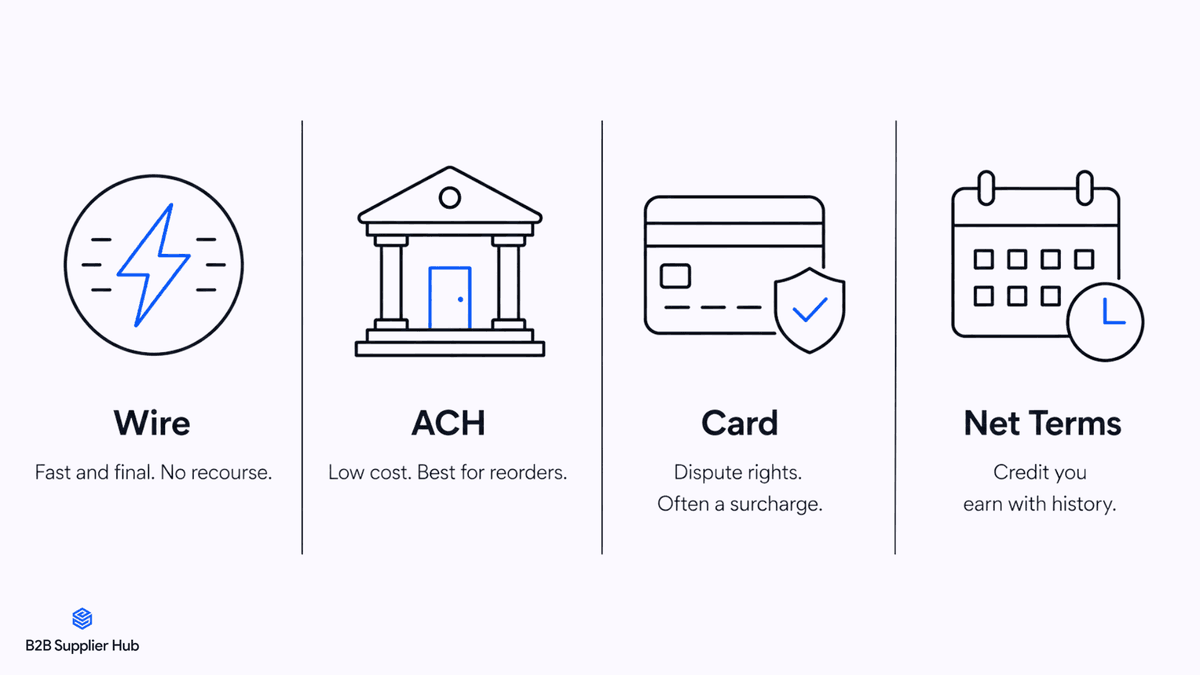
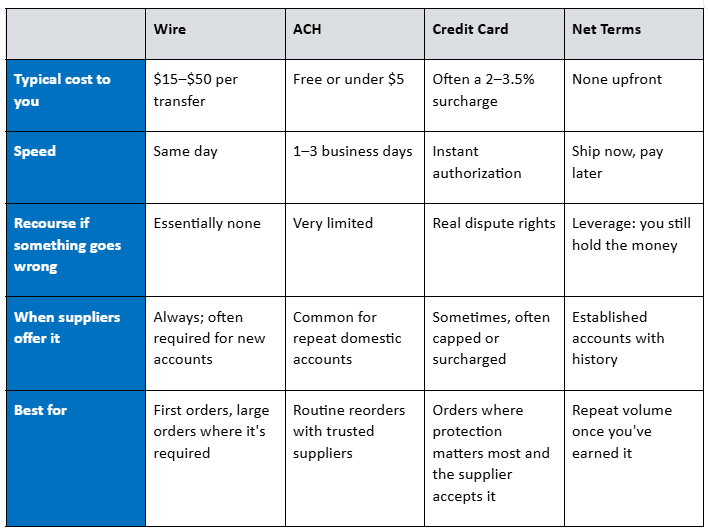
A few notes the table can't hold:
Wire
Wire is the default for wholesale. They are quick, definitive, and universally accepted. The key here is that finality is crucial for the suppliers, but it can be a bit of a hurdle for you. That’s why it is essential to double-check your supplier before hitting that send button, rather than waiting until after.
ACH
ACH is like the unsung hero of payments. Once you're reordering from the same domestic supplier every month, ACH does the same job as a wire for a fraction of the fee. The tradeoff is speed: it takes a few days, so it’s not the best option for those last-minute purchases.
Credit Card
A credit card is the only method in which a third party will fight for you. If goods never arrive or arrive wrong, you can dispute the charge. That protection is worth paying a surcharge for in the right situation. The card also gives you 20 to 50 days of float, which matters when cash is tight. The catch: the suppliers most willing to take your card without limits are not always the ones you should be most excited about.
Net Terms
Net terms turn payment into credit. Net-30 means the distributor is funding your inventory for a month, and once you have it, your cash flow math changes completely: you can sell through part of an order before you've paid for it. The catch is that terms are earned. Distributors extend them based on order history, so treat terms as the end state you're working toward with every good supplier, not the starting point.
Which Payment Method to Use in Three Common Scenarios
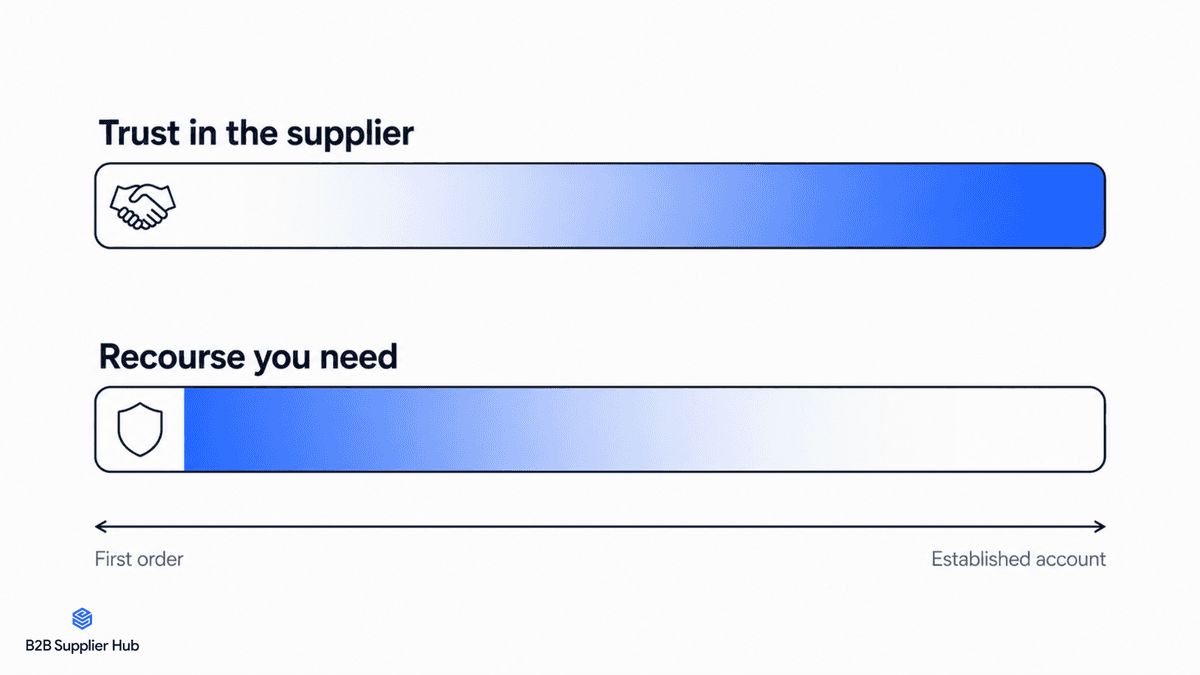
The table tells you what each method is. This section tells you what to do. The rule underneath all three scenarios is simple: the less you trust the supplier, the more recourse you need.
Scenario 1: Paying for Your First Order with a New Supplier
This is the highest-risk payment you'll ever make with this supplier, because you have no history. Your order of preference:
- Card, if they take it. Pay the surcharge without complaining. On a first order, dispute rights are worth 3 percent. Think of the surcharge as insurance you hope to waste.
- Wire, if card isn't an option. But only after full verification, and only for an order size you can afford to lose. Many sellers deliberately keep the first order small, partly for this reason. If you haven't verified the supplier yet, stop here and read How to Verify a Wholesale Supplier Before You Wire Money first.
- Never a personal account, payment app, or crypto. More on that below.
Scenario 2: Paying for a Repeat Order With a Trusted Supplier
You have received two or three clean orders. The goods lined up perfectly with the invoice, the counts were spot on, and communication was smooth. At this stage, recourse is less of a concern, and cost is becoming a bigger factor.
If your supplier is on board, switch to ACH. You'll save the wire fees, and on a monthly reorder rhythm, those fees add up to real money over a year. If they only take wires, fine, keep wiring. This is also the point where you can start the net terms conversation since you now have the one thing that makes it possible: a solid history
Scenario 3: Paying for a Large Seasonal Inventory Buy
A big Q4 order concentrates risk. Even with a supplier you trust, a $40,000 order going wrong hurts far more than a $4,000 one.
Here are two tips that can really make a difference. First, if you can, put part of your order on a card and handle the rest using your regular method. Second, consider asking if you can split the order into two shipments with separate payments. Most distributors are usually open to this, especially for larger orders, and it helps limit your exposure at any given time. If a supplier is unwilling to offer any kind of structure for a big first-time order, that’s a red flag you shouldn’t ignore.
Payment Hygiene: The Paper Trail Most Sellers Ignore Until It's Needed
Here's the part almost nobody talks about. How you pay also shapes what your records look like later, and your records matter more than most sellers realize.
Every payment should connect cleanly to an invoice: the invoice number, the exact amount, and the supplier's business name should all match the name on the account you used for payment. A wire confirmation that matches an invoice from a verified distributor is strong documentation. A payment app screenshot of someone's personal name is worthless, and worse, it's the kind of gap that surfaces at the worst possible time.
Having a wire confirmation that aligns with an invoice from a verified distributor is solid proof. On the flip side, a payment app screenshot to someone's personal name is worthless, and worse, it's the kind of gap that surfaces at the worst possible time.
Save the confirmation for every payment, in the same place, every time. It takes thirty seconds, and the habit is simple: no payment without an invoice, no invoice without a saved confirmation. Six months from now, when you need to prove a chain of custody or reconcile a supplier statement, that folder is the difference between a five-minute job and a lost afternoon.
Payment Red Flags
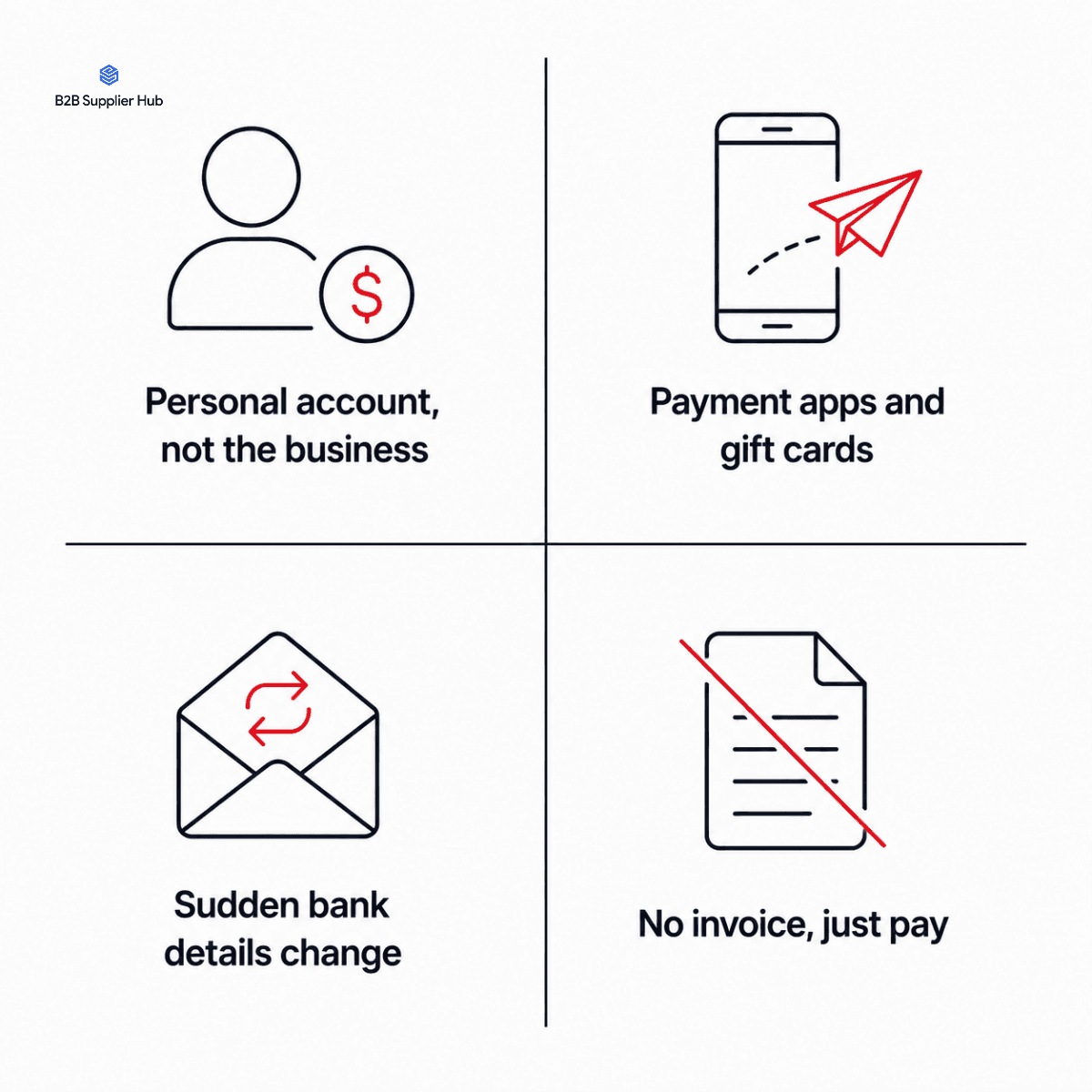
All the warning signs in one place. Any one of these should stop the order until you've verified what's going on:
- Payment to a personal account instead of the business name on the invoice.
- Requests for Zelle, Venmo, Cash App, gift cards, or crypto. No legitimate distributor collects this way. These methods exist on this list because they are irreversible and untraceable, which is exactly why fraudsters love them.
- A sudden email changing the payment account, especially right before a payment is due. This is one of the most common wholesale fraud patterns. Always confirm account changes by phone, using a number you already have, not one from the email.
- Pressure to pay without an invoice, or discounts offered for skipping paperwork.
- A price that only works if you pay right now. Real distributors don't run countdown timers. Urgency exists to stop you from doing the one thing that kills most payment fraud: slowing down and checking.
None of these is about the payment method. They're about who's asking and how. A wire to a verified distributor is routine. A wire to a stranger who found you yesterday is a donation.
The Bottom Line: Match the Payment Method to the Risk
Here's the whole blog in four lines:
- New supplier: opt for a card payment if you can; if not, go for a small, verified wire transfer
- Trusted suppliers with whom you place repeat orders, use ACH and start working towards better payment terms.
- Large orders: consider splitting the payment to minimize risk.
- Always remember to invoice first, use a business account only, and keep a record of confirmations.
Payment methods might seem like a minor detail, but on your first order, they’re your safety net, and by the time you reach your 100th order, they can become a cost you can manage. Choose it on purpose.
This article is an operational comparison based on common industry practice. It is not financial, legal, or tax advice.
Frequently asked questions
01Is it safe to wire money to a wholesale supplier?
02What's the safest way to pay a new supplier?
03Why do distributors charge a fee for credit cards?
04Can I get net terms as a new account?
05What payment methods should I avoid?
The B2B SupplierHub Team
Wholesale & sourcing
Stop hunting suppliers by hand. Type a UPC instead.
B2B Supplier Hub shows the suppliers in our network carrying a product on one page: wholesale cost, stock, and retail price side by side. Free to search, no card required.