
Industry Insight
SaleHoo Alternatives: 7 Supplier Directories Compared (2026)
-1200x627.png&w=3840&q=75)
If you're reading a SaleHoo alternatives article, you're probably past the question of whether SaleHoo is legitimate. It's been running since 2005, and its core product, a directory of vetted suppliers screened for real business registration and genuine wholesale pricing, does what it says.
The more useful question is different: is a static supplier directory the right tool for what you're actually trying to do, or is there a format that fits your sourcing better?
That question matters because directories, SaleHoo included, all share the same shape. You pay for access, browse or search a list, and get a supplier's name and contact information.
What you don't get, from any directory, is that supplier's current price for the exact product you need today or whether they have it in stock right now. Directories answer "who exists." They don't answer, "What can I buy this week, and for how much?"
Here are seven alternatives, including where a directory is genuinely the right call and where it isn't.
What a Directory Actually Gives You
Worth being precise about this before comparing options, since it shapes every entry below.
A supplier directory is a vetted list. The vetting is real work; someone checked that the supplier is a registered business with a real address and prices that are genuinely wholesale rather than marked-up retail, and that work has value. What you're buying is trust and a starting point: names you don't have to verify from scratch yourself.
What a directory can't do is show live data, because a static or periodically updated list can't reflect a supplier's actual cost tiers, current stock, or whether they've raised prices since the listing was checked. You still make contact, ask for a current price sheet, and negotiate the same work you'd do finding a supplier any other way, just starting from a screened name instead of a cold search.
That's not a flaw in directories. It's a structural limit of the format, and it's the axis most of this comparison runs on.
7 Alternatives Of SaleHoo
1. Worldwide Brands: The Certified, Pay-Once Alternative
Worldwide Brands is SaleHoo's closest direct competitor and its oldest, launched in 1999. It claims a certified catalog of over 16 million wholesale products, vetted by a research team that the company says visits trade shows and contacts suppliers directly before approval, rather than relying on supplier self-submission.
The practical difference from SaleHoo is depth versus breadth. Worldwide Brands is generally regarded as the stronger catalog for established US wholesale sourcing, while SaleHoo's directory adds categories like liquidators that Worldwide Brands doesn't specifically filter for.
Worldwide Brands has also long used a one-time lifetime access fee, commonly cited around $299, against SaleHoo's subscription model, which changes the calculation for a seller planning to source for years rather than months.
Choose it if you want the deepest US-based wholesale catalog and prefer paying once. Choose SaleHoo instead if liquidation sourcing or its lower entry price matters more to you.
2. Wholesale Central: The Free Directory
Wholesale Central takes the opposite pricing model entirely: it's free to browse, funded by supplier listing fees rather than buyer subscriptions. That makes it the lowest-commitment way to see whether a directory turns up anything useful in your category before paying for one.
The tradeoff is vetting depth. A free, supplier-funded directory generally does less verification work than a paid, buyer-funded one, so treat any supplier you find there as a starting point for your own diligence rather than a pre-cleared source. It's worth a free look before paying for SaleHoo or Worldwide Brands, not necessarily instead of one.
3. ThomasNet: For Industrial and Custom Manufacturing
ThomasNet sits outside the consumer-goods wholesale space SaleHoo serves and covers industrial suppliers, custom manufacturing, and B2B sourcing for parts and components rather than finished retail products.
If your sourcing is genuinely industrial, specialized manufacturing, custom parts, equipment, ThomasNet is the more relevant directory entirely, and SaleHoo's consumer-goods catalog won't have what you need. If you're sourcing consumer products to resell on Amazon, this one isn't a fit, and it's worth naming precisely so you don't waste a signup.
4. eSources: A UK and European-Weighted Option
eSources runs on the same basic model as SaleHoo, a vetted directory of wholesalers and dropshippers, with stronger representation of UK and European suppliers than SaleHoo's more US-weighted catalog.
For a seller specifically building supply relationships in UK or EU markets, that regional weighting can matter more than the total supplier count. For a US-focused Amazon wholesale operation, it's a narrower fit than SaleHoo or Worldwide Brands.
5. Faire: For Low-Minimum Branded Retail Stock
Faire is structured differently from a directory. It's a wholesale marketplace where independent brands list directly, with notably low order minimums compared to traditional wholesale, which makes it accessible for smaller test orders.
The fit is narrower for Amazon wholesale specifically, since Faire's brand relationships and terms are built around retail storefronts rather than marketplace resale, and some Faire brands restrict where their products can be sold. It's a genuinely useful source for certain categories and worth knowing about, with the caveat that you should confirm marketplace resale is permitted before building a sourcing plan around it.
6. B2B Supplier Hub: Live Data Instead of a List
Disclosure first: this is our platform, so weigh this entry accordingly. It's included because it addresses the exact structural limit named at the top of this article, and it's a genuinely different format rather than another directory.
Directories give you a supplier's name and let you take it from there. B2B Supplier Hub gives you the current numbers directly: search a product by UPC, MPN, name, or brand and see every verified distributor in the network carrying it, with exact wholesale cost, live stock depth, retail price, and the date each listing was verified before you ever make contact. Supplier identities stay masked until you choose to reveal one, and the search itself is free with no limit, covered in more detail in what the free tier includes.
The categories are narrower than a broad directory like SaleHoo, currently Electronics, Sports & Outdoors, and Tools & Home Improvement, so it isn't a general-purpose replacement for a catalog spanning every product type. Where it wins is specificity: for the categories it covers, you know the actual price and whether stock exists before spending time on outreach, rather than starting from a name and finding that out yourself.
7. Direct Manufacturer and Trade Show Outreach: The Free, Slow Alternative
Every directory is, at its core, doing outreach you could do yourself: finding manufacturers and distributors and confirming they're legitimate. Attending trade shows in your category, searching manufacturer websites directly for "become a distributor" or dealer application pages, and cold outreach to brands cost nothing but time.
This is the free alternative that most directory comparisons skip, and it's genuinely viable for sellers with the time to invest, particularly for brands where a direct manufacturer relationship beats any distributor markup a directory would lead you to. It's slower and offers none of a directory's pre-vetting, so weigh the time cost honestly against a modest subscription fee before choosing it purely to save money.
How to Choose the Best Alternative
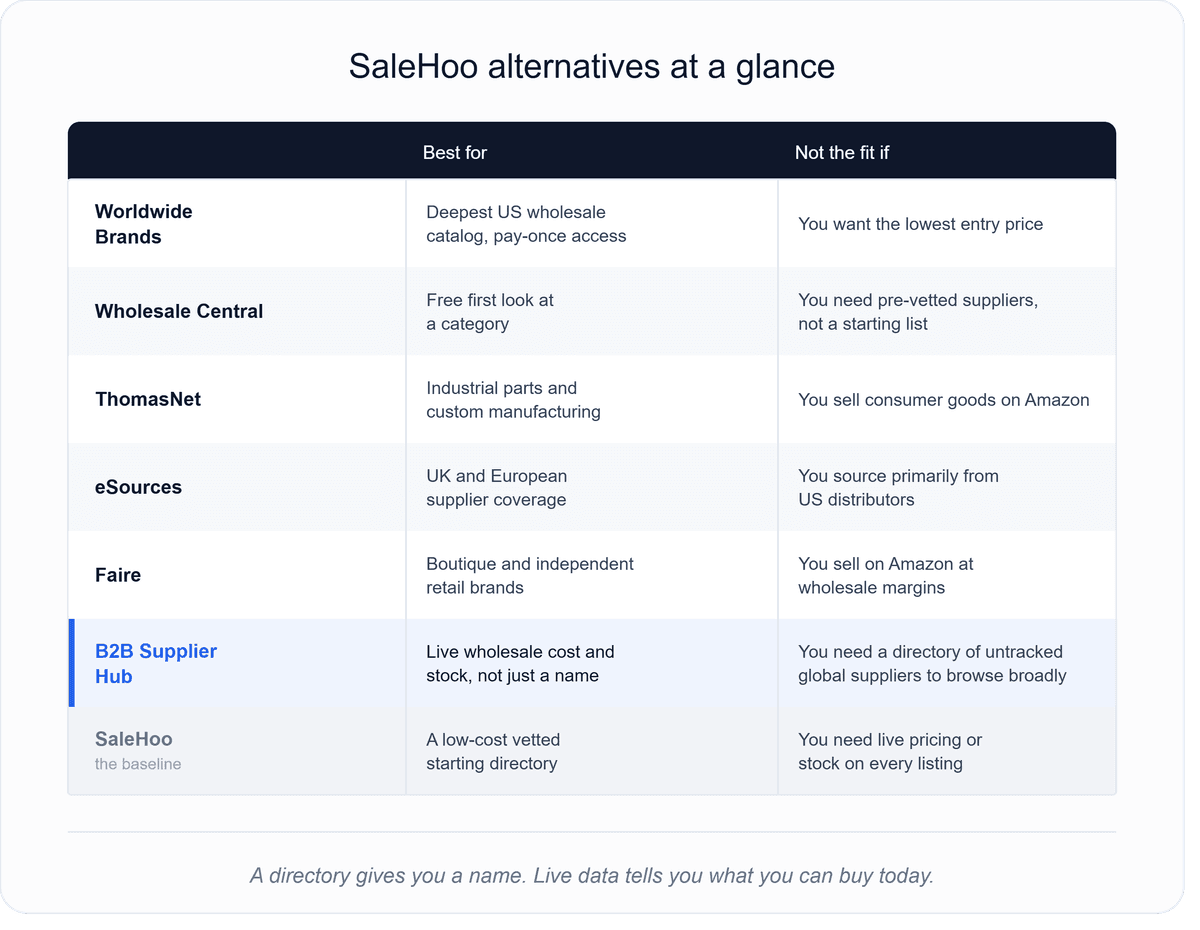
The honest filter is what you're actually missing. If it's a screened starting list of suppliers you trust without independently verifying, Worldwide Brands or SaleHoo. If it's zero budget for the research phase, Wholesale Central or direct outreach.
If your sourcing is industrial rather than consumer goods, ThomasNet. If it's UK or EU-weighted supply, eSources. If it's low-minimum branded stock, Faire. And if what's actually slowing you down is not knowing a product's real wholesale cost and stock before you reach out, that's the gap B2B Supplier Hub and its live listings exist to close.
Many sellers end up using a directory and a live-data source together rather than choosing one: the directory for breadth across categories it covers well, live pricing for the products where speed and current numbers matter most.
Skip the Name, Get the Numbers
A directory's real job is saving you from cold outreach to unverified suppliers, but it still leaves you to find out the price and stock yourself. B2B Supplier Hub skips that step: search any product by UPC, MPN, name, or brand and see every verified distributor in the network carrying it, with exact wholesale cost, live stock depth, and the date each listing was verified, free and unlimited. If your category is covered, you'll know what you can actually buy before you've spent an afternoon working through a directory list.
Frequently asked questions
01Is SaleHoo worth it in 2026?
02What's the difference between SaleHoo and Worldwide Brands?
03Is there a free SaleHoo alternative?
04Do supplier directories show current prices and stock?
05Which SaleHoo alternative is best for Amazon wholesale sellers specifically?
The B2B SupplierHub Team
Wholesale & sourcing
Stop hunting suppliers by hand. Type a UPC instead.
B2B Supplier Hub shows the suppliers in our network carrying a product on one page: wholesale cost, stock, and retail price side by side. Free to search, no card required.