
Supplier Management
Why Single-Supplier Dependency Kills Wholesale Businesses
-1-1200x627.png&w=3840&q=75)
A seller we'll call Marcus built his entire Amazon business around one product. A kitchen brand, one SKU, sourced from a single distributor he'd worked with for two years. The margins were good, the reviews were strong, and by his second year, he was doing six figures a month, almost entirely on that one item.
Then the distributor's rep left the company. The replacement rep didn't know Marcus, didn't recognize the account's history, and flagged it for a routine compliance review that took eleven weeks to close. Marcus had no product to sell for most of that time. The listing lost its sales velocity, the ranking dropped, and when the account finally reopened, it took another four months to climb back to where it had been.
Nothing illegal happened. No fraud, no violation, and no bad decision on Marcus's part that you could point to and say, "Don't do that." A person left a job. That was the entire chain of events that nearly ended his business.
This is what single-supplier dependency actually looks like in practice. It rarely shows up as a dramatic betrayal. It shows up as a staffing change, a system migration, a brand renegotiating its distribution agreements, or a warehouse fire three states away that has nothing to do with you and everything to do with your only source of inventory. The business doesn't fail because something went wrong. It fails because nothing was built to survive when something inevitably does.
The Math Sellers Don't Do Until It's Too Late
Ask most wholesale sellers what percentage of their revenue comes from their top supplier, and many won't know off the top of their heads. Ask them to calculate it, and the number is often uncomfortable. It's common to find sellers with sixty, seventy, or even ninety percent of their revenue running through a single distributor relationship.
That concentration feels efficient while everything is working. One relationship to manage, one set of terms to negotiate, one account manager who knows your business. The problem is that efficiency and fragility are often the same decision viewed from different angles.
A business that depends on one supplier for the majority of its revenue has built a single point of failure into the center of its operations, and single points of failure eventually fail. Not because the odds are stacked against you specifically, but because over a long enough timeline, distributors change ownership, brands restructure their channels, warehouses have bad years, and account managers move on to other jobs.
The sellers who get hurt the worst are usually the ones who were doing everything right on paper. They had a strong relationship, they paid on time, and they never violated any policy. None of that protects you when the disruption has nothing to do with your own performance.
What Actually Causes Supply Disruptions
It helps to be specific about what actually goes wrong, because the vague fear of "something bad happening" doesn't motivate action the way concrete scenarios do.
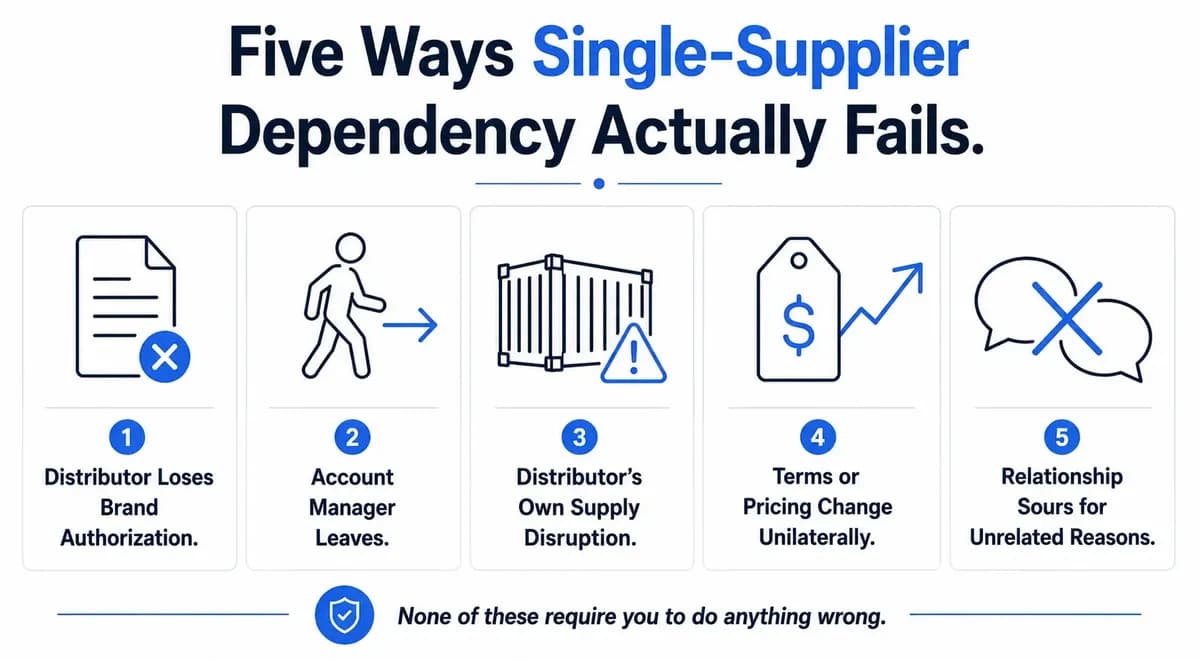
Distributors lose their own authorization from the brand. This happens more than most sellers realize. A brand reorganizes its distribution network, consolidates around fewer, larger distributors, or decides to bring more of its sales in-house. When that happens, every reseller who depended on that distributor loses access at the same time, through no fault of their own.
Account managers leave, and institutional knowledge leaves with them. The person who understood your account history, vouched for you internally, and gave you the benefit of the doubt on a shipping delay is gone, and the next person starts from zero. Marcus's story is this scenario exactly.
Distributors have their own supply problems. A manufacturing delay, a raw material shortage, or a shipping disruption at a port—any of these can leave a distributor unable to fulfill orders for weeks or months, and if they're your only source, that becomes your problem immediately, with no transition time.
Pricing or terms change unilaterally. A distributor going through their own financial pressure might raise prices, tighten payment terms, or reduce your credit limit with little notice. If you have no alternative source, you have no leverage to push back.
The relationship simply sours. Businesses are run by people, and people have disagreements, misunderstandings, and changes of priority. A single supplier relationship that goes cold for reasons that have nothing to do with product quality or payment history can end a product line overnight.
Why Sellers Stay Concentrated Anyway
If the risk is this real, it's worth asking why so many sellers stay concentrated in a single supplier relationship for years without addressing it. The reasons are practical, not careless.
Volume pricing rewards concentration. Distributors offer their best tiers to their biggest accounts, and splitting order volume across two or three suppliers can genuinely mean paying more per unit in the short term. This is a real cost, not an imagined one, and it's the main reason diversification gets postponed indefinitely.
Finding a second authorized source takes real effort. Locating another distributor who carries the same brand, verifying their authorization, and going through a new account application is work that competes with everything else on a seller's plate, and it rarely feels urgent until the moment it becomes critical.
The relationship feels secure precisely because it has been reliable. Two or three years of smooth orders create a reasonable sense of trust, and that trust quietly becomes an assumption that the relationship will keep behaving the way it always has. The problem is that the disruption, when it comes, is rarely caused by anything in the relationship itself.
None of these reasons is irrational. They're the ordinary tradeoffs of running a lean operation. The issue isn't that sellers are making a bad decision by concentrating. It's that they're making a reasonable short-term decision without weighing the long-term exposure it creates.
What Diversification Actually Looks Like
Diversification doesn't mean splitting every order evenly across three distributors for every product. That would sacrifice the volume pricing that makes the business work in the first place, and it isn't necessary for most SKUs.
What it means in practice is building a small backup relationship for your highest-revenue products, specifically, the ones where a disruption would actually hurt. This typically means identifying a second authorized distributor for that brand, opening the account, and placing a small order periodically, not necessarily every month, but often enough that the relationship stays real rather than dormant. It also means knowing before you need it whether a third emergency option exists, even if you never order from them under normal circumstances.
The goal isn't redundancy for its own sake. It's having a functioning alternative you can activate within days rather than weeks if your primary source becomes unavailable. A cold relationship you have to build from scratch during a crisis, which provides almost none of the protection that a warm, occasionally used one does.
Which Products Actually Need This
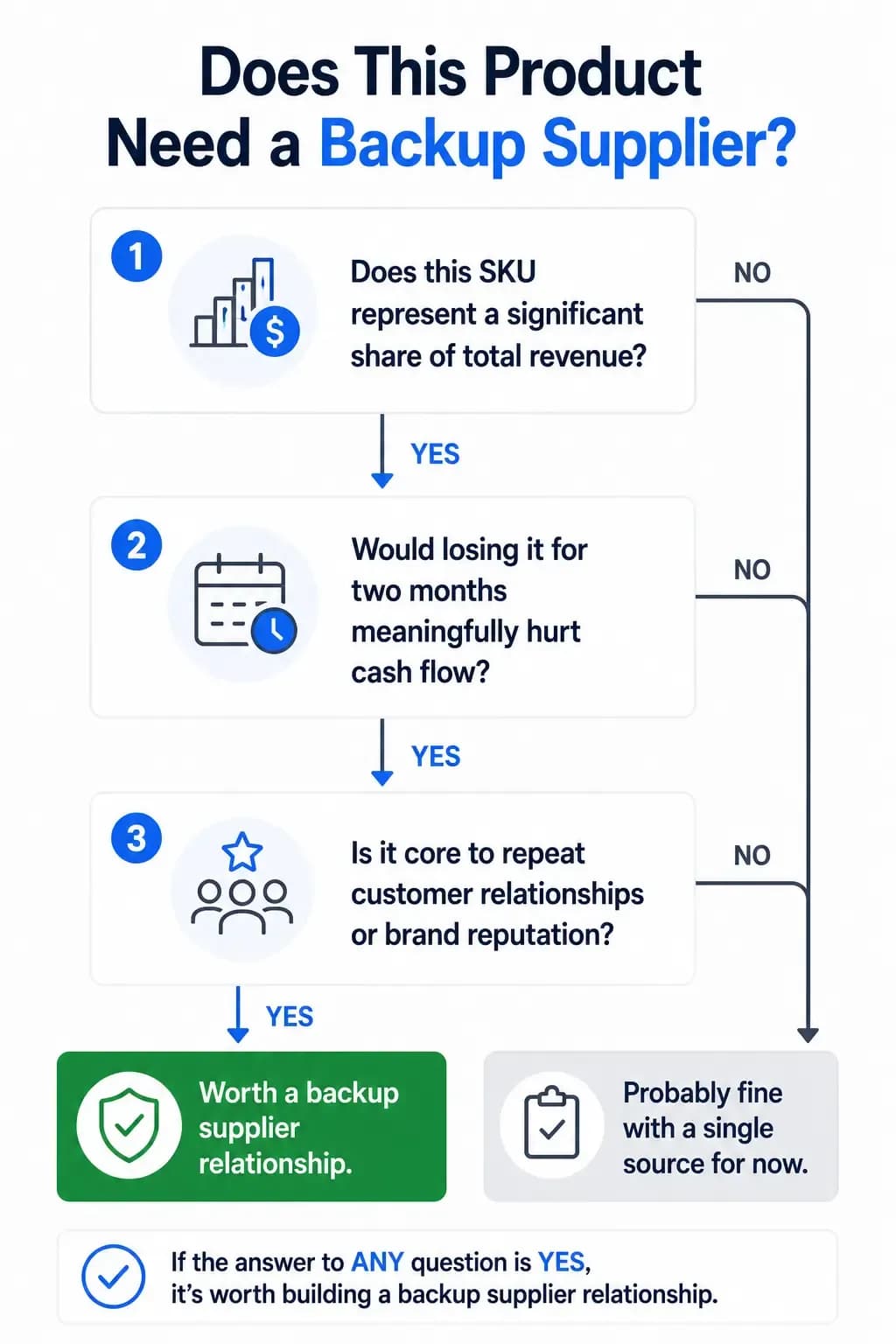
Not every SKU in your catalog justifies the effort of maintaining a second supplier relationship. A product doing a few hundred dollars a month in revenue probably doesn't need a backup source, because the cost of maintaining that relationship exceeds what you'd lose if it disappeared.
The products that genuinely need protection are the ones where a disruption would be financially serious. If a single SKU represents a meaningful percentage of your total revenue, if losing it for two months would materially damage your cash flow, or if it's core to your brand's reputation with repeat customers, that's a product worth the effort of a backup relationship. A useful rule many experienced sellers apply is to identify their top few SKUs by revenue and start there rather than trying to diversify their entire catalog at once, which is neither realistic nor necessary.
The Real Cost of a Backup Supplier Versus the Cost of Not Having One
It's worth being honest about the tradeoff rather than pretending diversification is free. Maintaining a second supplier relationship costs something. You may pay a slightly higher per-unit price without the volume tier that your primary supplier offers. You spend time on an application and periodic small orders that don't move the needle on their own. There's real overhead here, and pretending otherwise doesn't help anyone make a good decision.
But weigh that against the cost of the alternative. An eleven-week gap on a product doing six figures a month, the kind of disruption Marcus experienced, costs far more in lost revenue and ranking recovery than years of slightly higher unit costs on a backup account ever would. The math almost always favors diversification once you actually run the numbers on your specific top products, rather than treating the decision abstractly.
Building the Backup Relationship Without Damaging the Primary One
A common hesitation is the worry that opening a second distributor account will offend the primary supplier or somehow violate the relationship. In most cases, this concern is overstated. Distributors know that resellers work with multiple suppliers, and a professional account manager understands that diversification is standard business practice, not a signal of distrust.
What matters more than whether you have a second source is how you communicate about it, if it comes up at all. There's rarely a need to announce it proactively. If a primary distributor does ask whether you're sourcing the same product elsewhere, honesty is almost always the better path than evasion, since a legitimate business reason like continuity planning is easy to explain and doesn't reflect poorly on you.
Where to Find a Second Authorized Distributor to Start Building This Protection
If you're realizing your business is more exposed than you'd like on your top products, a practical starting point is to identify which authorized distributors exist for your key brands beyond the one you already use. This is often the slowest part of the process, since finding and verifying a second legitimate, authorized source can take real time and effort on your own.
If you want to take a shortcut in that search, B2B Supplier Hub was built to help wholesale sellers find pre-verified, authorized distributor relationships without having to start the discovery process from scratch every time. Instead of spending weeks tracking down a second authorized source for a brand you already carry, you can access a network of vetted distributor accounts and move directly to opening the relationship.
The Short Answer: Why One Supplier Is Never Enough
Single-supplier dependency doesn't fail because something went wrong on your end. It fails because concentration creates a single point of failure, and single points of failure eventually get tested, usually for reasons that have nothing to do with your business at all. Identify your highest-revenue products, find a second authorized distributor for each one, and keep that relationship warm with occasional small orders. It costs something. It costs far less than the alternative.
Frequently asked questions
01What percentage of revenue from one supplier is considered risky?
02How do I find a second authorized distributor for a brand I already carry?
03Will opening a second distributor account hurt my relationship with my primary supplier?
04Is it worth paying more for a backup supplier if my primary pricing is better?
05How often should I order from a backup supplier to keep the relationship active?
The B2B SupplierHub Team
Wholesale & sourcing
Stop hunting suppliers by hand. Type a UPC instead.
B2B Supplier Hub shows the suppliers in our network carrying a product on one page: wholesale cost, stock, and retail price side by side. Free to search, no card required.