
Industry Insight
Amazon Wholesale vs Private Label: Cost, Speed & Real ROI
Private label can tie up $10,000 for 6 months before you find out whether it even works. Wholesale can have you making sales in two weeks on a few thousand. Almost every comparison online will tell you that much, then hand you the same tired scoreboard: private label wins on margin, wholesale wins on speed, now go pick one.
That scoreboard is measuring the wrong thing. Margin per sale is not what builds a business. What builds a business is how fast your money comes back and how many times a year you can put it to work again, and on that measure the "obvious" winner often loses. This blog compares wholesale and private label on cost, risk, and speed like any other guide, but it also gives you the two things most of them leave out: the number you should actually be comparing, and why experienced operators do not treat this as a one-time choice at all.
Wholesale vs Private Label: The Two Models Explained
Private label means you take a generic product, usually made overseas, put your own brand on it, and sell it under a listing you own. You are creating something new and building demand for it. Wholesale means you buy established, brand-name products from authorized distributors and resell them on listings that already exist. You are riding demand that is already there.
Private label is the model most sellers picture, and more than half of them use it. Wholesale is the quieter path, but it is where a lot of steady operators quietly make their living. Neither is the "smart" choice by default. They just ask different things from you. If you are also weighing retail or online arbitrage, we cover how wholesale compares to online arbitrage in its own guide.
Cash-on-Cash Return: The Metric That Actually Decides It
This is the part the other guides get wrong, so it is worth syour attention. Every comparison leans on the same fact: private label has better margins, usually 25 to 40 percent against wholesale's 10 to 20 percent. True, and almost useless on its own, because margin per sale tells you nothing about how hard your money works over a year. The number that does is cash-on-cash return: how many times you can recycle the same dollars, multiplied by what you make each time.
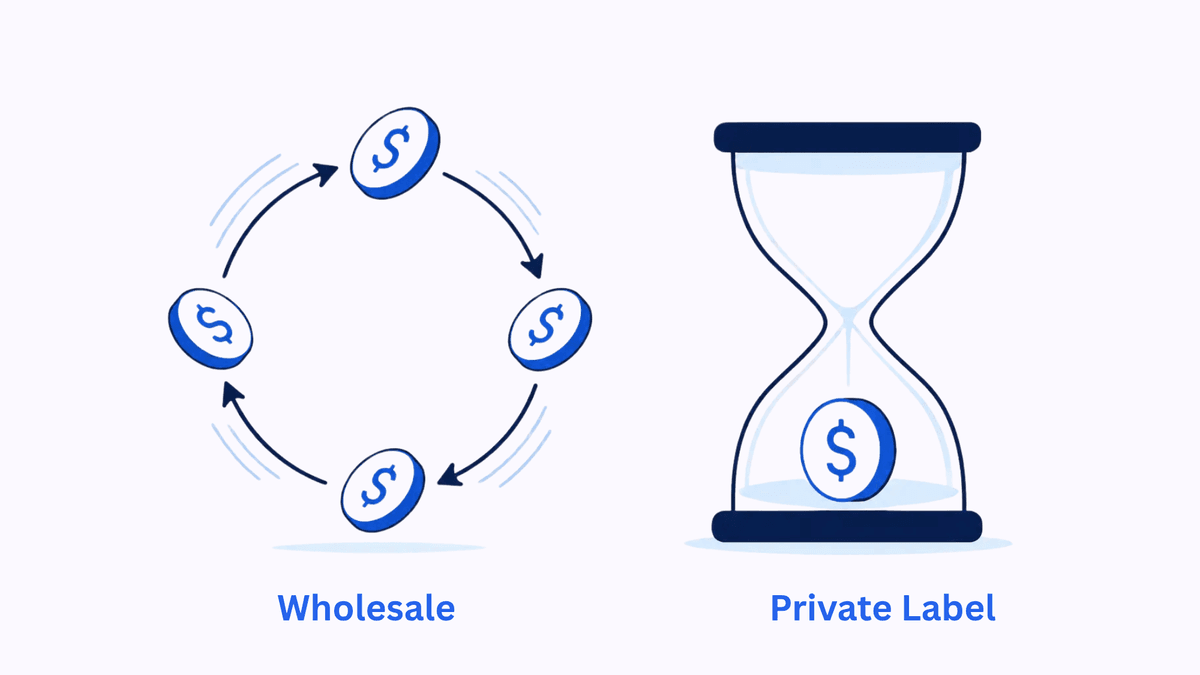
Say you have $5,000 to put to work. In wholesale you are buying products that already sell, so you can often move that stock in around six weeks, make your 10 to 20 percent, and buy again. Do that through the year and the same $5,000 might get used eight or nine times. A 15 percent margin earned eight times is a completely different result than earning it once, even though each sale looks small.
Now run private label. Your margin per sale is better, call it 30 to 40 percent. But your money is locked in one product for months before the first sale, and even once it is selling you might cycle that cash only once or twice a year. A bigger margin earned once or twice can easily lose to a smaller margin earned eight times. That is the part the margin column never shows you.
This is not a trick to make wholesale look magical. Wholesale margins get competed down, not every product moves in six weeks, and Amazon's fees take a bite out of every turn. Private label also has something wholesale does not: a ceiling that is much higher. If one of your products takes off, you own the listing and can pour money into scaling it in a way a wholesaler splitting a Buy Box never can. The point is only this. Compare how hard your money works across a year, not how much you make on a single sale, and the ranking often flips.
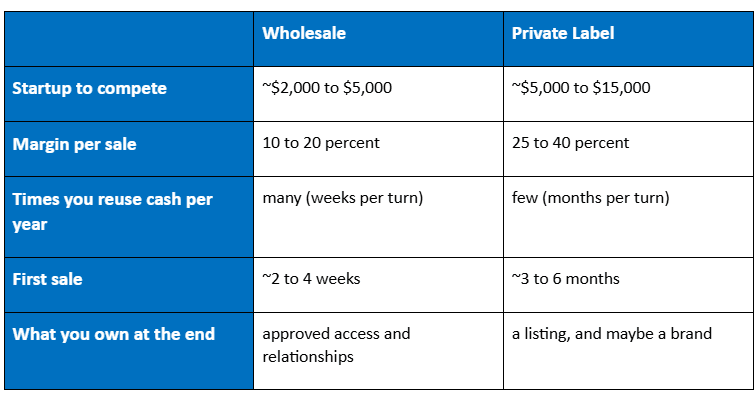
(The numbers above are examples to show how the math works, not fixed figures. Your real results depend on your products, your category, and how competitive your listings are.)
Risk Compared: Why Wholesale and Private Label Fail Differently
Every guide will tell you private label is riskier and wholesale is safer. That is roughly true, but it hides the more useful point, which is that the two risks are different in kind. Private label is a lumpy, all-or-nothing bet: a lot of money on one product that either works or it does not. Wholesale spreads smaller bets across many proven products, so no single mistake hurts much. In exchange you carry a constant, grinding risk instead, other sellers competing your margin down on the same listings you are on.
Two frictions on the wholesale side are worth being honest about, because the cheerful guides skip them. First, authorization: finding a distributor who carries a product does not mean you are approved to buy it, since brands control who gets to sell their goods. Second, since March 31, 2026, if you are not enrolled in Brand Registry, and resellers usually are not for the brands they resell, Amazon wants its own label on every unit even when the box already has a barcode. It is a small cost, roughly ten to fifty-five cents a unit, but it is new and it lands on wholesale sellers specifically.
Then there is the line every private label pitch leans on: you are building a real asset, and wholesale builds nothing you can sell. Take that one with a grain of salt. A logo on a generic product, with no demand off Amazon and nothing stopping a competitor from copying it, is not much of an asset, and the buyers who once paid good money for these small brands have mostly stopped. Private label becomes a real asset when you actually build a brand, with genuine demand and protected products, and most sellers never get there. Wholesale, meanwhile, quietly builds its own kind of equity: approval to sell brands that are hard to get approved for, distributor relationships, and a system for reading demand. It is less glamorous and harder to sell, but pretending it is worth nothing is just the cliché talking.
Speed to First Sale: Wholesale vs Private Label
If cash flow is the thing keeping you up at night, speed settles it. Wholesale can have you selling within two to four weeks and often breaking even inside the first month or two. Private label usually takes three to six months just to reach the first sale and five to eight before profit is steady. A trademark takes most of a year, though you can sell on a pending one, and Brand Registry is now close to mandatory for any serious private label seller. If you need the money working this quarter, these two are not in the same race.
What Changed in 2026: Tariffs, FNSKU, and Seller Consolidation
Most of the online articles on wholesale-versus-private-label were written a couple of years ago, and 2026 quietly changed the math on both. Three things worth knowing.
Tariffs hit the two models very differently. Private label usually means importing, and the China tariffs under Section 301 are still in force. A major court ruling in February 2026 struck down one set of tariffs, but the government replaced most of it with a new global surcharge, kept the duty-free rule for small parcels suspended, and by its own estimate the year's total tariff bill barely moved. Wholesale of brands already distributed inside the US mostly sidesteps all of that. Fair point: if you import in bulk to Amazon's warehouses, the small-parcel rule was never really your issue, but the China tariffs and the new surcharge still are.
The crowd is also thinning. New sellers starting in 2025 hit a ten-year low, down 44 percent from the year before, while the number of sellers doing a million dollars or more doubled. That is not a market too crowded to enter. It is a market getting more professional, and it rewards whoever runs their model with real discipline, whichever one they choose.
Wholesale or Private Label First? The Order That Matters
Here is the reframe that matters most. Wholesale and private label are not two teams you join for life. They are stages, and for a lot of durable operations the smart move is to run wholesale first and add private label later, in that order, for a reason.
Wholesale first does two things private label cannot do for a beginner. It generates cash flow you can actually live on and reinvest, and it teaches you to read real demand: what sells, at what price, how fast it moves, where the margin actually sits. That skill is the single biggest predictor of whether a private label product will work, and you cannot learn it from a course. The classic way people lose their savings is doing private label first, with no cash cushion and no feel for demand, betting everything on one product they hoped would sell.
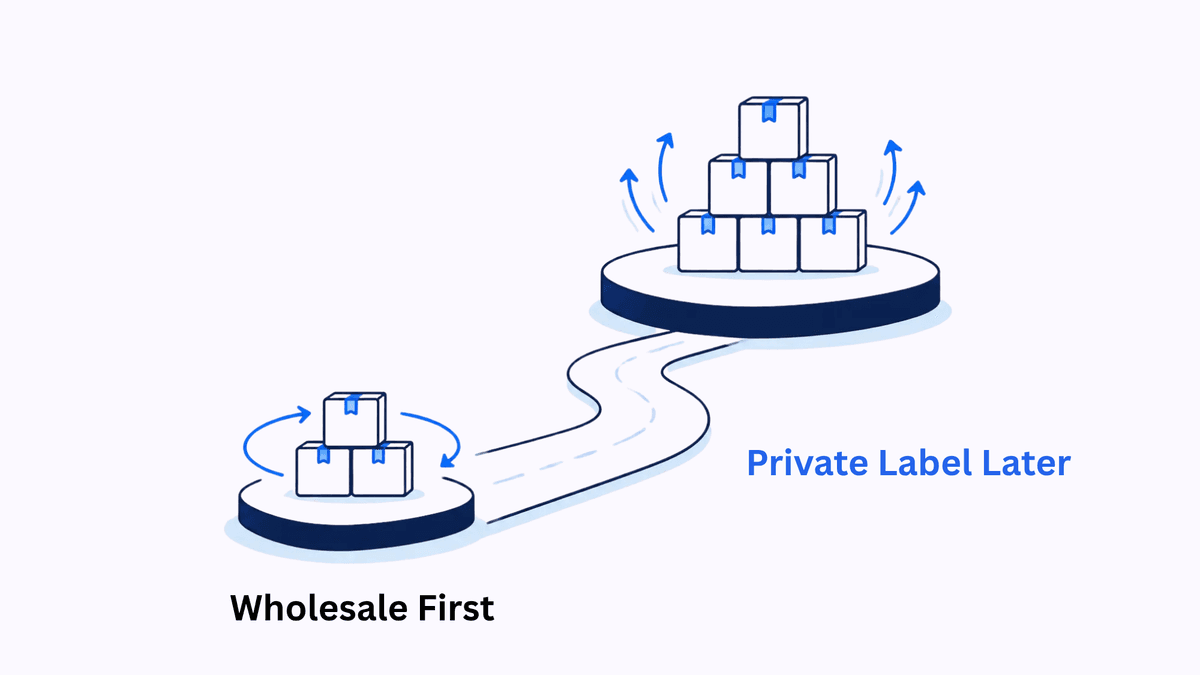
So the real question is not which model to pick. It is which one to start with, and what has to be true before you add the other. For most people the honest answer is wholesale first, then private label once you have steady cash flow, a category you understand deeply, and money you can afford to lock away for half a year.
The daily reality of wholesale, once you are in it, is finding who carries a product that already sells and at what cost. That is exactly the problem B2B Supplier Hub was built for. You can search any product for free and see the real cost, live stock, and retail price from distributors in our growing network, with a freshness date on every listing, then reach out to a supplier when you are ready.
The Bottom Line: Match the Model to Where You Are
Pick the model that fits where you are, not the one that sounds best at a meetup. If money is tight and you need cash moving, wholesale gets you selling fast, teaches you how Amazon really works, and does not ask you to bet everything on a single guess. If you have money you can afford to tie up and the patience to build, private label can grow into something bigger, as long as you actually build a brand and not just a listing.
But the sharper lesson is the one the usual guides skip. Stop comparing margins and start comparing how hard your money works across a year, and stop treating this as a permanent choice when it is really a sequence. Get those two things right and you are already thinking like an operator instead of a beginner reading a pros-and-cons list. If you want the full walkthrough, start with our guide to Amazon wholesale for beginners.
Frequently asked questions
01Is private label actually more profitable than wholesale?
02How much do you need to start each in 2026?
03Should I do wholesale or private label first?
04Which is faster to your first sale?
05Do tariffs affect both models the same way?
The B2B SupplierHub Team
Wholesale & sourcing
Stop hunting suppliers by hand. Type a UPC instead.
B2B Supplier Hub shows the suppliers in our network carrying a product on one page: wholesale cost, stock, and retail price side by side. Free to search, no card required.