
Industry Insight
Do You Need a Business License to Buy Wholesale? (State by State Reality)
-1200x627.png&w=3840&q=75)
A distributor's application form asks for your "wholesale license number," and you don't have one, because as far as you can tell, no such thing exists. You're not wrong. There is no single document called a wholesale license, which is exactly why this question confuses so many new resellers.
Here's the short answer: In most cases, you do not need a general business license to buy from wholesale distributors. What you almost always need is a resale certificate, which requires you to register for a sales tax permit in your state first. Those are three different documents that people use interchangeably, and knowing which one a distributor is actually asking for is the difference between a smooth application and a stalled one.
This guide separates them, covers how the answer shifts by state, and explains what distributors genuinely check.
Three Documents People Confuse Constantly
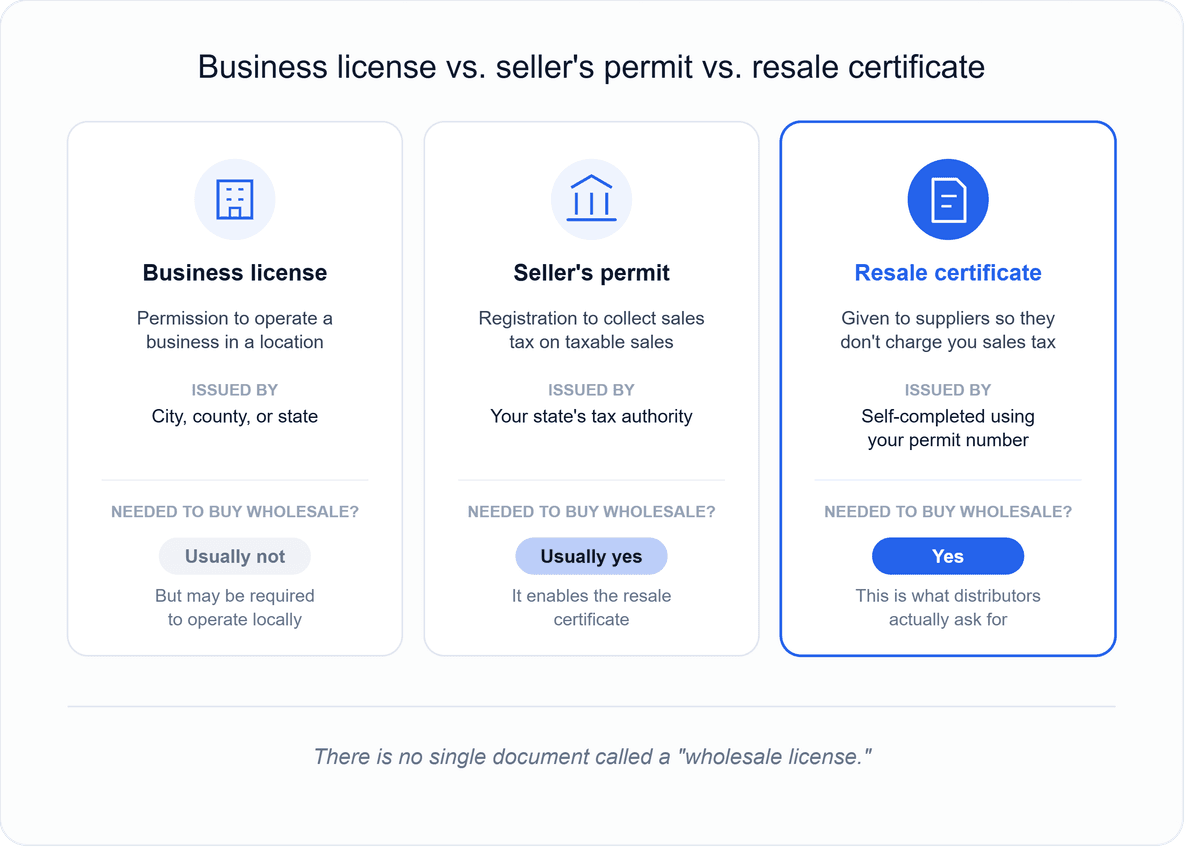
A business license is permission to operate a business in a specific place. It's issued by your city, county, or sometimes your state, and whether you need one depends on your location and business type rather than on the fact that you buy wholesale.
A home-based online reseller in one county may need a general business license; another county may not require one at all. It has nothing directly to do with buying inventory.
A seller's permit, also called a sales tax permit, sales tax license, or certificate of authority depending on the state, is your registration with the state's tax authority to collect sales tax on taxable sales. If you sell taxable goods in a state with sales tax and have nexus there, this is generally required. Crucially, this registration is what makes the third document possible.
A resale certificate, also called a resale license or exemption certificate, is the document you hand to a supplier. It certifies that you're buying goods to resell rather than to consume, so the supplier doesn't charge you sales tax on the purchase.
The tax gets collected later, from your end customer. In most states you can only issue a valid resale certificate once you hold a seller's permit, which is why the two get treated as one thing even though they aren't.
The practical hierarchy is straightforward: register for the seller's permit with your state, then use that registration to issue resale certificates to your distributors. The business license, where required, sits alongside all of this as a separate local matter.
What Distributors Actually Ask For
Set the terminology aside and look at the application forms themselves. Legitimate wholesale distributors typically ask for a resale certificate or your state sales tax registration number, an EIN or tax ID, and business details such as your legal entity name, address, and sometimes a website or storefront.
They ask for the resale certificate for a concrete reason: without it, they are generally obligated to charge you sales tax on the purchase, which breaks the resale model and creates a compliance problem on their side. It's not gatekeeping; it's their own tax exposure.
Notice what usually isn't on that list. Most distributors don't ask to see a municipal business license, because it tells them nothing about the tax treatment of the sale. When a distributor's form says "wholesale license," they are nearly always asking for the resale certificate or permit number. Answering with that document is almost always the right move.
What they're really evaluating alongside the paperwork is whether you look like a real business, which is a separate question covered in what distributors look for before approving an Amazon seller.
The State by State Reality
The answer genuinely does change with geography, in three ways.
Most states with a sales tax follow the standard pattern: register with the state's revenue or taxation department for a seller's permit, then use it to issue resale certificates. Registration is free in a number of states, including California and Washington, while others charge a modest application fee. Processing can be near-instant online or take a few weeks, so this is worth doing before you need it rather than while a distributor waits.
Five states have no statewide sales tax: New Hampshire, Oregon, Montana, Alaska, and Delaware. Sellers there often can't obtain a conventional resale certificate for the simple reason that there's no sales tax to be exempt from.
Some of these states issue an alternative document or a business registration you can present instead, and out-of-state distributors are generally used to handling this. Alaska is the wrinkle worth knowing: it has no statewide sales tax, but local jurisdictions can impose their own, so local rules may still apply.
Multi-state selling adds the third layer. Some states accept an out-of-state resale certificate, others require registration in their own state, and many accept multi-state uniform forms. If you're buying from distributors across several states, this is the point where a tax professional earns their fee, because nexus rules and acceptance policies vary and change.
Business license requirements sit on their own track entirely, set mostly at the city and county level. Some municipalities require a general license for any business, including a home-based one; others require nothing for a small online operation. The only reliable check is your own city and county clerk, not a national blog.
A note this post should be honest about: the above describes general, widely documented practice, not legal or tax advice for your situation. Rules change, and details vary by state, city, and business structure. Confirm with your state's revenue department or a tax professional before relying on any of it.
What to Do, in Order
If you're starting from nothing, the sequence that keeps distributors from stalling your applications looks like this.
Form your business entity, or at least decide your structure, since permits are issued to a legal entity and mismatches cause problems later. Get an EIN from the IRS, which is free and takes minutes online; distributors ask for it routinely. Register for your state's seller's permit or sales tax license through the state revenue department.
Complete resale certificates for each distributor using that permit number, since certificates are usually per-supplier documents rather than one universal card. Then check your city and county for any local business license requirement, which is a separate errand from all of the above. The information provided in this blog is for general purposes, not legal or tax advice. Also, the information is limited to the published date; the state regulations can change with time.
The deeper distinction between the resale certificate and the sales tax permit, including how they interact at filing time, is covered in our guide to resale certificate vs. sales tax permit.
Paperwork Ready? Find the Distributors Next
Once your resale certificate is in hand, the bottleneck shifts immediately: you need distributors worth applying to. That search is where most new resellers lose weeks. B2B Supplier Hub turns it into a lookup.
Search any product by UPC, MPN, name, or brand and see every verified distributor in the network carrying it, with exact wholesale cost, live stock depth, and the date each listing was verified, free and unlimited. Get the certificate sorted, then search the products you plan to sell and apply to the suppliers whose numbers actually work.
Frequently asked questions
01Do you need a business license to buy wholesale?
02What is a wholesale license, then?
03Can you buy wholesale without a resale certificate?
04What if my state has no sales tax?
05Do I need to register in every state I buy from?
The B2B SupplierHub Team
Wholesale & sourcing
Stop hunting suppliers by hand. Type a UPC instead.
B2B Supplier Hub shows the suppliers in our network carrying a product on one page: wholesale cost, stock, and retail price side by side. Free to search, no card required.