
Supplier Management
Resale Certificate vs. Sales Tax Permit: What Distributors Actually Require (2026)
-1200x627.webp&w=3840&q=75)
DISCLAIMER: This is not tax or legal advice. This blog explains the documents distributors ask for and why. Rules differ by state and change over time. Always confirm with your state’s revenue department and a tax professional.
Thousands of new resellers search for how to get a “wholesale license” every month. Here is the problem: no such document exists.
What distributors actually require is two documents with boring names and a strict order. A sales tax permit, then a resale certificate. Mix them up and your application will be stuck for weeks. Get them right and opening wholesale accounts becomes routine. This guide covers both in plain words: what each one is, why distributors insist on it, and how to get yours without the confusion everyone else goes through.
Resale Certificate and Sales Tax Permit, Explained in Plain Words
There are two separate documents, and they always come in the same order.
The Sales Tax Permit: What It Actually Is
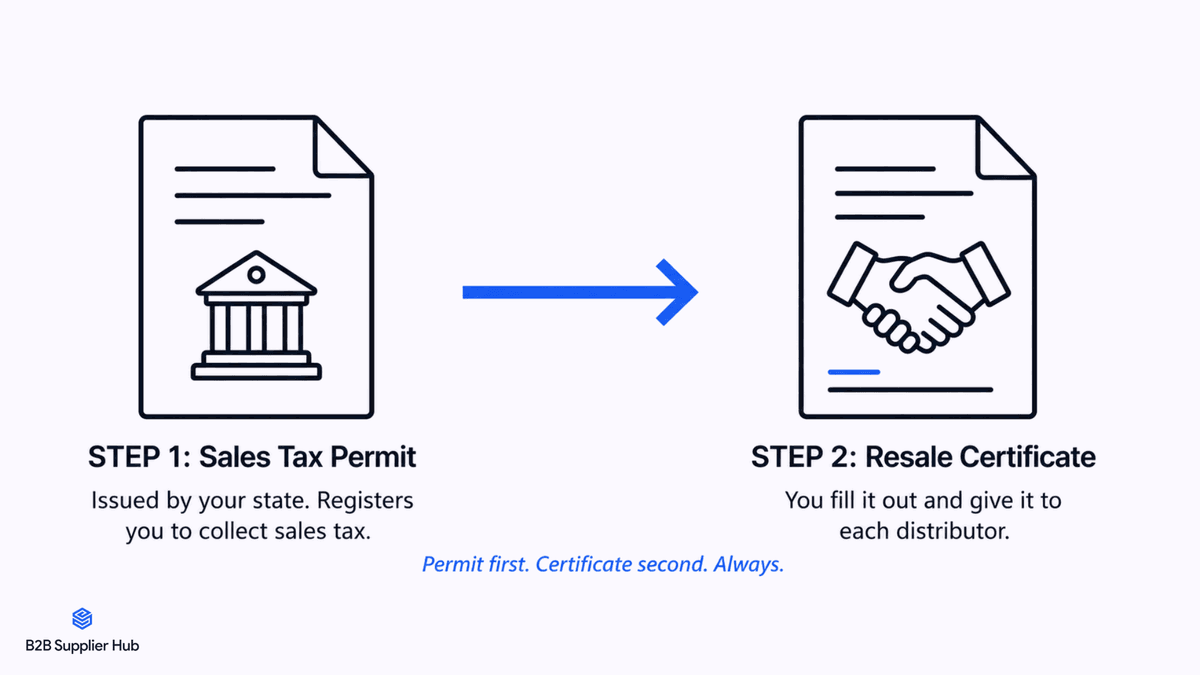
Your state gives you this. Some states call it a seller’s permit, a sales tax license, or a certificate of authority. Different names but they all serve the same purpose. It registers your business to collect sales tax from your customers. You apply through your state’s revenue department, usually online, usually free or cheap. Nothing else in this blog matters until you have this.
The Resale Certificate: What It Actually Is
This is the one distributor ask for. The state does not mail it to you. It is a form you fill out and hand to each supplier you buy from. It says, "I am buying these goods to resell them, not to use them myself." The form includes your sales tax permit number. That is why the permit has to come first.
Permit first, certificate second. Mix up that order, and your application stalls. Many resellers send their permit to a distributor and then scratch their heads when nothing happens. The distributor was actually waiting for the certificate. It’s a different piece of paper for a different task.
Is There Really a "Wholesale License"? (No, Not Officially)
As the intro said, no state issues a document with that name for buying goods to resell. What people really mean is the two documents above. Some websites will happily sell you information about a wholesale license anyway. If a site offers you one, close the tab.
Is a Sales Tax License the Same as a Resale Certificate?
No. A sales tax license,, which many states also call a sales tax permit or seller's permit registers your business to COLLECT sales tax on what you sell. A resale certificate is the document you show a distributor so you can BUY inventory without paying sales tax on it.
Most resellers need both, and in most states you must have the license/permit first, because its number goes on the resale certificate. The confusion exists because states use the words license, permit, and certificate interchangeably; what matters is the function: one is for collecting tax, the other is for buying tax-free. When a distributor asks for your "tax documents," they almost always mean the resale certificate.
,
Why Distributors Care So Much
Most guides say distributors want a resale certificate and leave it there. The reason behind it changes how you see the whole application.
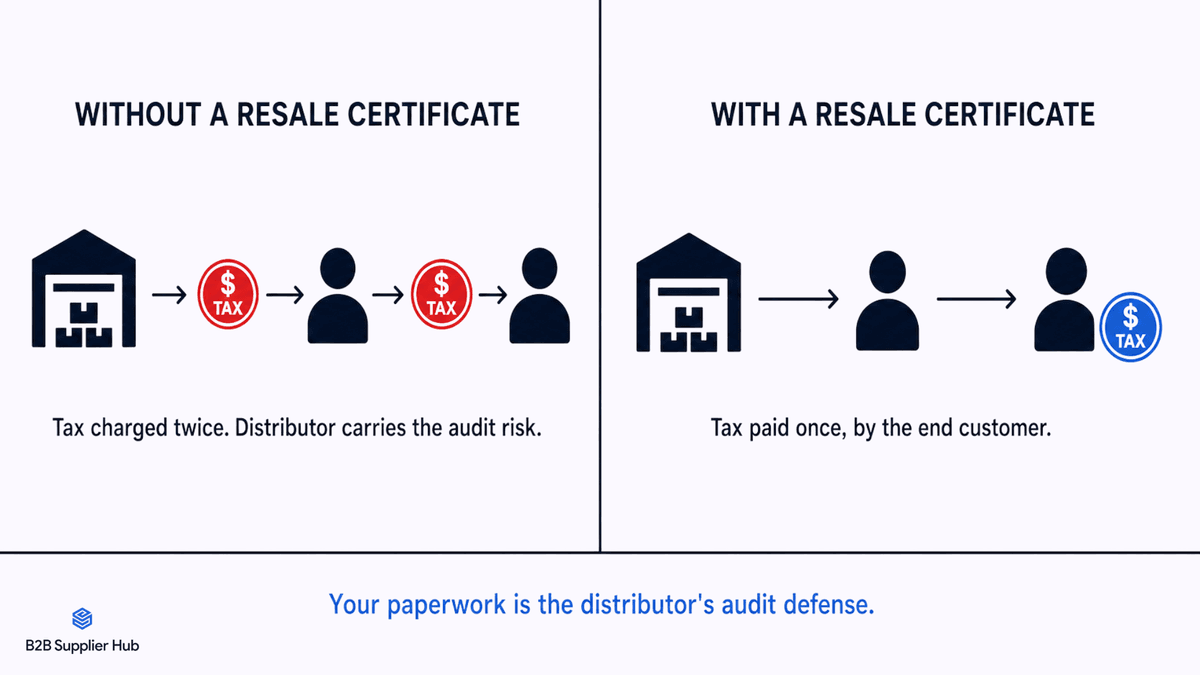
Sales tax in the US is meant to be paid once, by the final customer. When a distributor sells to you, one of two things has to happen. Either they charge you sales tax like you are a regular shopper, or you sign a certificate saying the goods are for resale, and the tax gets collected later when your customer buys. Without the certificate, the same product gets taxed twice. Once when you buy it and again when your customer does. Guess whose pocket that comes out of.
Now the part that explains why distributors are so strict. If the state audits a distributor, the distributor has to prove every tax-free sale was really a resale. The proof is your certificate. If it is missing, expired, or has the wrong business name on it, the distributor pays the tax you never paid, plus interest and penalties, on every invoice they ever wrote you. States run tens of thousands of sales tax audits every year. Missing certificates are one of the most common things auditors catch.
So, when a distributor rejects your application because your certificate says a slightly different business name, they are not being difficult. Your paperwork is their protection. A distributor who checks it carefully is running a clean business, and that care usually shows up in everything else they do too.
The opposite is also a warning sign. A “distributor” who sells to anyone with a credit card and never asks for a certificate is telling you something. Real wholesalers check that they are selling to real businesses. If nobody looked at your paperwork, you are probably buying from a retailer or a middleman pretending to be a distributor. We cover how to spot those in How to Verify a Wholesale Supplier Before You Wire Money.
What a Distributor Application Actually Asks For
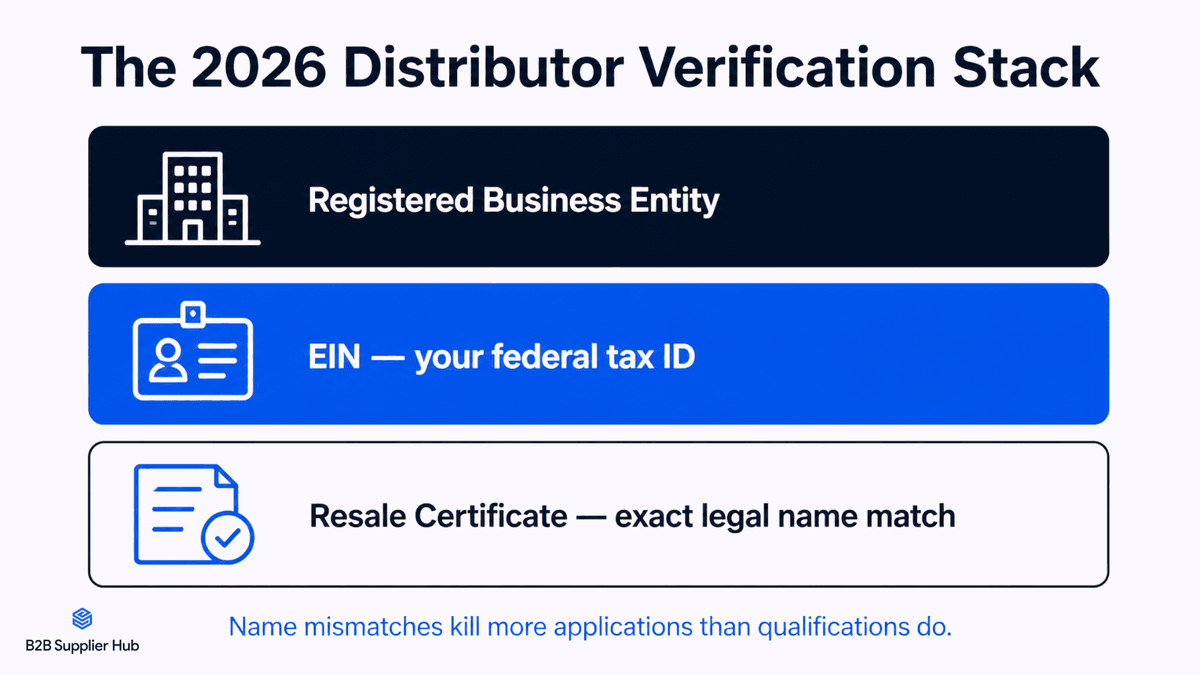
Every distributor is a little different, but in 2026 almost all of them want the same three things:
A Registered Business Entity
Usually, an LLC or corporation. Some accept a sole proprietor with a DBA. They just want a business that exists on paper and can be looked up.
An EIN From the IRS
Your federal tax ID. Applying with your personal SSN where an EIN belongs makes you look like a hobbyist. Distributors have gotten noticeably stricter about this in recent years.
A Valid Resale Certificate
A resale certificate needs to be current, complete, and matching. The matching part is where applications die. The business name on your certificate must match your application, your registration, and later your invoices, exactly. A difference as small as "Smith Trading LLC" versus "Smith Trading, LLC" has been the downfall of more than a few wholesale accounts.
Some distributors also ask for trade references, a business bank account, a website, or a minimum first order. That is a separate conversation, covered in What Distributors Look For Before Approving a Reseller. The three items above are the floor. Show up without them, and the conversation ends before it starts.
If you sell on Amazon, the name-matching habit pays off twice. The name on your distributor account ends up on your invoices, and marketplaces care about that consistency when they review your documents.
How to Get a Resale Certificate and Sales Tax Permit
The steps are the same almost everywhere. The forms, fees, and wait times differ by state.
- Register your business and get your EIN. The EIN comes from the IRS, free, online, in minutes. Most permit applications require both.
- Apply for your sales tax permit through your state’s revenue department. Most states do this online. Some approve you instantly, some take a few weeks.
- Fill out your state’s resale certificate form. Some states have a dedicated resale form. Others use a general exemption form where you tick “resale” as the reason. A few do it differently. Your state’s revenue department website is the only source that counts here. Not a blog. Not even this one.
- Give a copy to every distributor you buy from. One certificate per supplier. Most let you upload it during the application. Keep a folder of what you sent to whom, and when.
Buying from distributors in other states can add wrinkles, because which state’s certificate they accept varies. Check the rules for each state you deal with directly with that state’s revenue department, ideally with your tax professional beside you.
Keeping Your Resale Certificate and Permit Active
Here is the step almost nobody does, and it bites at the worst time.
Certificates expire or need renewal, and the schedule depends on the state. Distributors also re-request fresh certificates from time to time, because their own audit risk depends on the file being current. If your certificate lapses and their email lands in an inbox nobody reads, your account goes on hold. Usually, the same week you needed to reorder your best seller.
Treat it like any other system in your business. Know your renewal dates. Keep a current copy per supplier. Update every distributor the moment your business name or address changes. It is ten minutes a quarter, and it saves you from the on-hold email at the worst possible time.
The Bottom Line: Two Documents, Two Different Jobs
Strip away the confusion, and this is a small task. Get your permit from the state. Fill out a certificate. Hand it to each distributor with your exact legal business name on it. Keep it current. That is the entire game.
But small does not mean unimportant. This paperwork is the first thing a distributor learns about you. Clean, complete, matching documents say, "This person runs a real business, and working with them will be easy." Sloppy paperwork says the opposite before you have said a word about your sales.
Most of your competitors will fumble this and lose weeks going back and forth. You now know better. Sort your two documents this week, and the next time a great distributor application is in front of you, you will be the applicant who gets approved while everyone else is still confused about which paper is which.
Frequently asked questions
01Is a resale certificate the same as a sales tax permit?
02Do I need a wholesale license to buy from distributors?
03Can I use one resale certificate with every supplier in every state?
04What happens if I buy wholesale without a resale certificate?
05Do distributors actually check resale certificates?
The B2B SupplierHub Team
Wholesale & sourcing
Stop hunting suppliers by hand. Type a UPC instead.
B2B Supplier Hub shows the suppliers in our network carrying a product on one page: wholesale cost, stock, and retail price side by side. Free to search, no card required.