
Licenses & Compliance
Certificate of Insurance for Wholesale Accounts
A certificate of insurance, or COI, is one-page proof from your insurer that you carry liability coverage. Wholesale distributors ask for $1 million per occurrence and $2 million aggregate, the standard small-business limits, and often ask to be named as additional insured. The certificate itself costs nothing. The policy behind it is what you pay for, and one broker's customer data puts that between a few hundred and a few thousand dollars a year.
Search the phrase and you'll find pages written by insurers selling policies, or by software companies selling COI tracking. Neither one explains the reseller's version of the problem. That's a distributor's new-account packet with a line that says "attach COI, $1M/$2M, name us as additional insured," and nothing else. This post is that explanation.
What a Certificate of Insurance Is, and Isn't
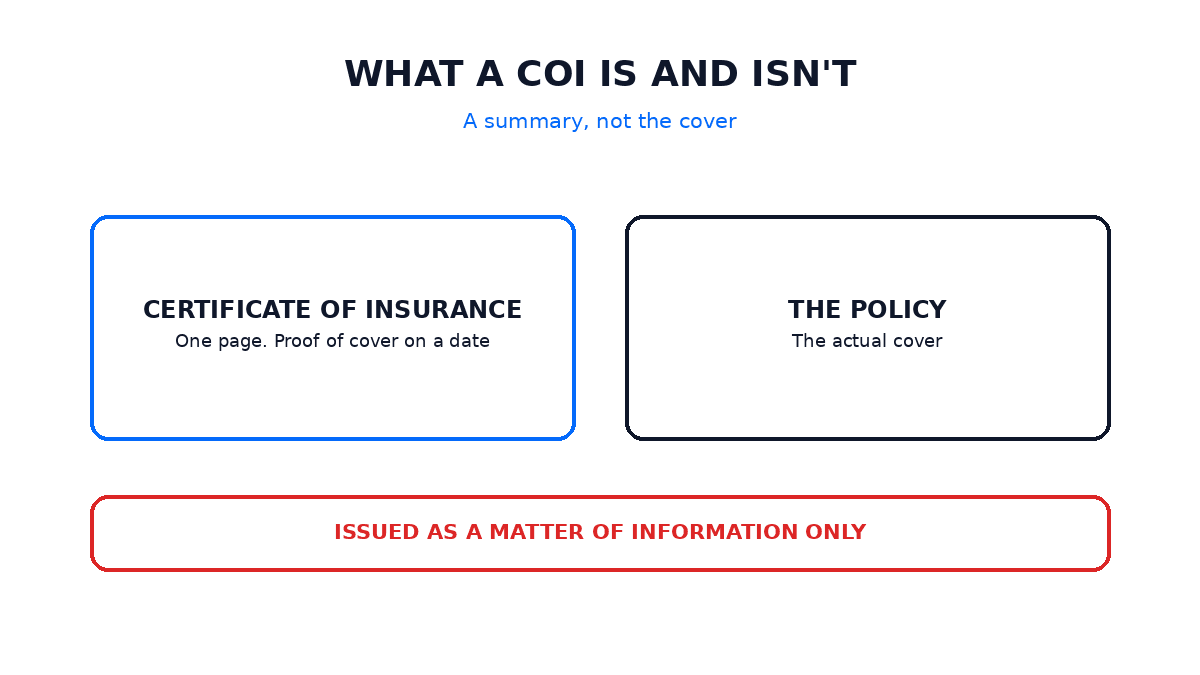
The form distributors mean is the ACORD 25, the Certificate of Liability Insurance. ACORD, the body that publishes it, describes a certificate as "a document that provides information about insurance policies." Your insurance agent or broker issues it, not you and not ACORD.
The important part is what it isn't. ACORD's own FAQ says a certificate "is NOT an insurance policy." It "does not serve to provide, endorse, amend, extend, or alter in any way the terms of an insurance policy." The form carries that warning in capitals across the top: "THIS CERTIFICATE IS ISSUED AS A MATTER OF INFORMATION ONLY AND CONFERS NO RIGHTS UPON THE CERTIFICATE HOLDER."
So when a distributor asks for your COI, they're asking for a snapshot of your policy on a date. It tells them you have coverage, what kind, how much, and when it expires. It doesn't give them any coverage itself. That distinction matters for the additional insured question below.
Why a Distributor Wants One
Distributors ask for a COI for the same reason they ask for a resale certificate and trade references. It's part of deciding whether you're a real business they can safely deal with.
Two risks sit behind it. The first is product liability. A product you sell can hurt someone, and the claim can reach anyone who sold it, not only the maker. The NAIC's consumer glossary describes product liability coverage as protecting "the manufacturer, distributor, seller, or lessor of a product against legal liability." If you're uninsured and a claim lands, the distributor worries it lands on them next.
The second is simpler. A business with a liability policy has been checked by an insurer, has an address, and has paid for a policy. That's a simple sign the business is real, and distributors use it as one. Our guide to what distributors look for before approving a seller covers the rest of that check.
Not all distributors ask. The application will tell you, and if the certificate is on the list of required documents, treat it as required.
What Limits Distributors Require
The line on the application reads something like "$1,000,000 per occurrence, $2,000,000 aggregate," and both numbers mean something specific.
Per occurrence is the most the insurer pays for one event. IRMI, the insurance reference publisher, defines it as "the maximum amount the insurer will pay for all claims resulting from a single occurrence," no matter how many people are hurt or how many claim. Aggregate is the most the insurer pays in a whole policy year. IRMI's definition is "the maximum limit of insurance payable during any given annual policy period."
So $1M/$2M means up to a million for any one incident, and up to two million across all incidents in the year. The ACORD 25 has a box for each: "EACH OCCURRENCE," "GENERAL AGGREGATE," and a third one worth knowing, "PRODUCTS - COMP/OP AGG," which is the aggregate for product claims specifically.
Why those numbers? They're the standard small-business general liability package. Insureon, a commercial insurance broker, reports from its own customers that "most small business owners (85%) choose general liability policy limits of $1 million / $2 million." That's a broker's figure, not a rule, but it's why a distributor's form asks for it. It's the limit most of that broker's customers already carry.
If your policy carries lower limits, the distributor will see it on the certificate. Ask your agent what raising them costs before you apply.
What "Additional Insured" Means
The limits are the easy half of the request. "Additional insured" is the phrase that stops people.
An additional insured is, in IRMI's words, "a person or organization not automatically included as an insured under an insurance policy" who is added to it at your request. When a distributor asks to be named as an additional insured, they're asking for your policy to cover them too, for claims that come from what you do. If a customer sues both of you over a product you sold, your policy can respond for the distributor too, depending on how the endorsement is written.
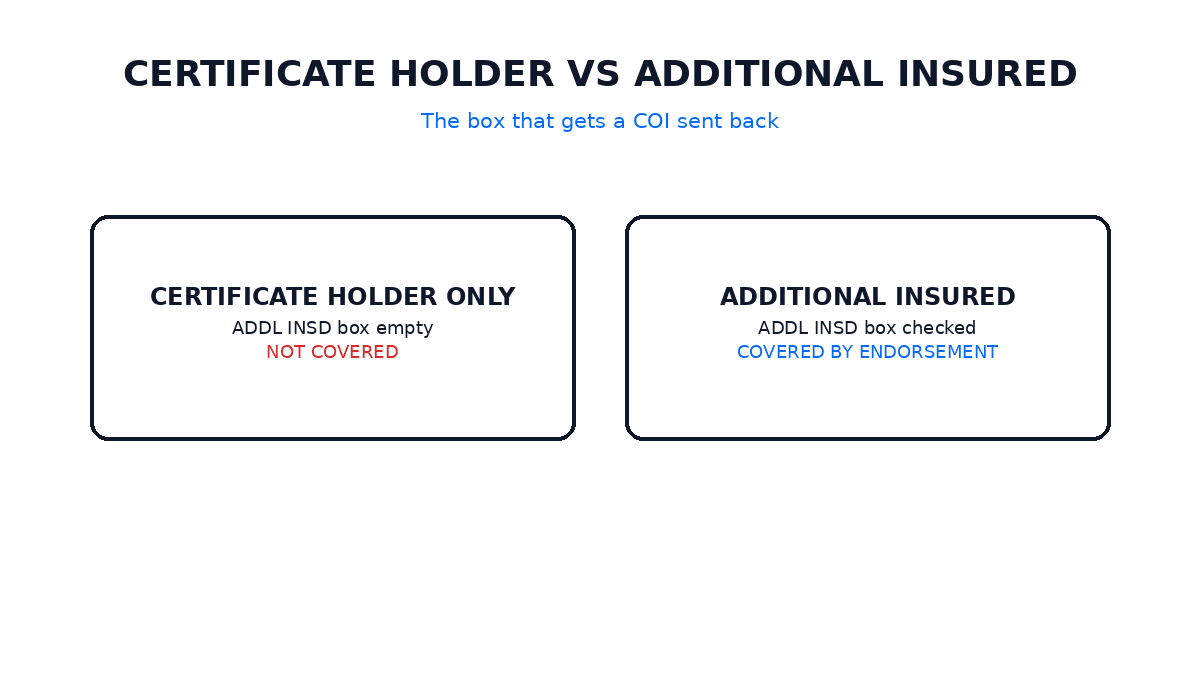
Writing the distributor's name in the certificate holder box doesn't make them an additional insured. The ACORD 25 says so in a boxed paragraph. "If the certificate holder is an ADDITIONAL INSURED, the policy(ies) must be endorsed." And "a statement on this certificate does not confer rights to the certificate holder in place of such endorsement(s)." An endorsement is a change to the policy itself, made by the insurer.
So the request takes two steps, not one. You ask your agent to add the distributor to the policy as an additional insured, and ask what that costs, and then the agent issues a certificate showing the "ADDL INSD" box checked for that distributor. A certificate with the distributor's name on it and that box empty is one that gets sent back.
How Much Does a COI Cost?
The certificate is free. Your agent issues it and can issue one for each distributor who asks. What costs money is the general liability policy behind it.
Insureon's customer data, updated in March 2026, puts the average general liability premium at "$45 per month," with annual costs that "range from around $250 to over $3,000 per year, depending on certain factors about your business." The factors are what you sell, how much, where, and your claims history. Those are a broker's own numbers from its own customers, so treat them as a range, not a quote.
One thing to check before you buy: does the policy include product liability? Some policies include it under the name "products-completed operations" coverage, and some sell it separately. For a reseller, it's the coverage that matters, so ask your agent which yours does.
Two posts in this series cover insurance from different sides. This one is about what the distributor wants. Amazon Seller Insurance: When You Need $1M Coverage is about what Amazon wants, and the two overlap but aren't the same.
How to Get One
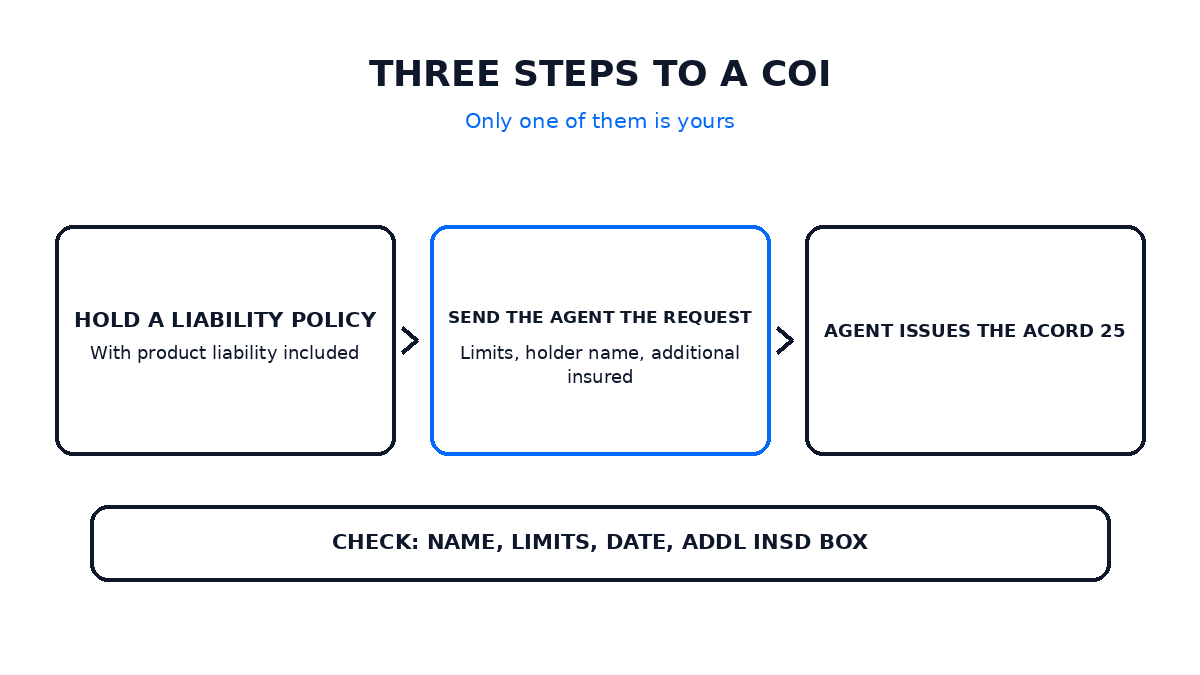
Getting the certificate takes three steps, and your agent does two of them.
First, have a general liability policy. If you don't, get quotes from two or three insurers for a small business selling physical goods, with product liability included and $1M/$2M limits.
Second, send your agent the distributor's exact request. Copy the wording from the application: the limits, whether they want to be an additional insured, their legal name and address for the certificate holder box. If an endorsement is needed, this is when it gets added.
Third, your agent issues the ACORD 25 and sends it to you or directly to the distributor. Check it before you forward it. The insured name must match the business name on your distributor application. The limits must match or exceed what they asked for. The expiration date must be in the future. And if they asked for an additional insured, the box must be checked.
Then put the policy expiration date in your calendar, because the distributor may ask for a new certificate when it passes.
Can You Make Your Own Certificate?
No. A certificate is issued by the insurer or its agent as evidence of a real policy. One you type up yourself, or edit, is a false document. Texas, for instance, bars anyone from altering "a certificate of insurance form" under its insurance code. It separately bars requiring a certificate "that contains any false or misleading information concerning the policy." California's insurance department has pursued forgery charges against someone who "provided fraudulent certificates of liability insurance." Other states have their own rules.
Beyond the law, it doesn't work, because a distributor can call the agent named on the certificate to confirm it. A made-up agent, or a real agent who's never heard of you, ends the application. So the only route is the real one: a policy, an agent, and a certificate they issue.
Where the COI Fits in the Application
The certificate is one document in a packet that also asks for your resale certificate, bank and trade references, and often a credit application. Our guide to how to open a wholesale account covers the rest, and some distributors fold the insurance requirement into their distributor agreement rather than the application, so read both.
It's also worth knowing what the supplier charges before you pay an insurer to cover the relationship. You can search a product free and see real cost and real stock from the verified distributors in our network carrying it. And when nobody you can reach carries the product, you can ask our team to find an authorized wholesale distributor for it, free on every plan, with an answer within 30 days either way.
Certificate of Insurance: The Takeaways
- A COI is a one-page summary of your policy, issued by your agent. It isn't coverage itself.
- Distributors usually ask for $1M per occurrence and $2M aggregate, because that's the standard small-business package.
- "Additional insured" means your policy covers the distributor too. It needs an endorsement, not just their name on the form.
- The certificate is free. The policy behind it is a few hundred to a few thousand dollars a year.
- Make sure the policy includes product liability.
- Check the issued certificate: name, limits, date, and the additional insured box.
- Never make or edit one yourself. It's a false document and distributors can check it with the agent.
This is general information, not insurance or legal advice. Policies differ, and for what your business needs you should talk to a licensed insurance agent.
One Page, Two Steps
A certificate of insurance is paperwork, and your agent does most of it. The one thing to get right is the additional insured request, because it takes two steps: the distributor goes on the policy by endorsement, and then the certificate shows it. Get that right and the rest is your agent's job.
So have the policy, send the agent the exact request, and check the certificate before you forward it. You can open a free account and see real cost and real stock from the verified distributors in our network before you add anyone to your policy.
Frequently asked questions
01Which vendors need a certificate of insurance?
02How do I obtain a certificate of insurance?
03Why would a vendor need a certificate of insurance?
04Can I make my own certificate of insurance?
The B2B SupplierHub Team
Wholesale & sourcing
Stop hunting suppliers by hand. Type a UPC instead.
B2B Supplier Hub shows the suppliers in our network carrying a product on one page: wholesale cost, stock, and retail price side by side. Free to search, no card required.