
Supplier Management
The Economics of MOQ: When Bigger Orders Hurt Margin
A seller messaged a distributor rep about a product moving well, roughly 300 units a month, priced comfortably at a 35 percent margin. The rep mentioned that jumping from a 500-unit MOQ to a 2,000-unit MOQ would drop the per-unit cost by 18 percent. On paper, that looked like free money. The seller placed the bigger order.
Six months later, only 1,100 of those units had sold. The other 900 sat in an Amazon warehouse accumulating long-term storage fees, tying up cash that could have funded three other product launches, and eventually got sold off at a loss during a clearance push just to stop the fees from compounding further. The 18 percent unit discount never had a chance to offset what the extra inventory actually cost to hold.
This is the part of the MOQ math that the unit price alone never shows you. A bigger order almost always looks cheaper per unit. Whether it's actually cheaper for your business depends on variables that live nowhere near the price sheet.
Why Unit Price Is Only Half the Equation
Distributors quote lower unit prices at higher order quantities because it genuinely costs them less to fulfill one large order than several small ones. That discount is real, and it's not a trick. The problem is that sellers frequently evaluate an MOQ decision using only that one number, when the actual cost of a larger order includes several other line items that never appear on the distributor's price sheet at all.
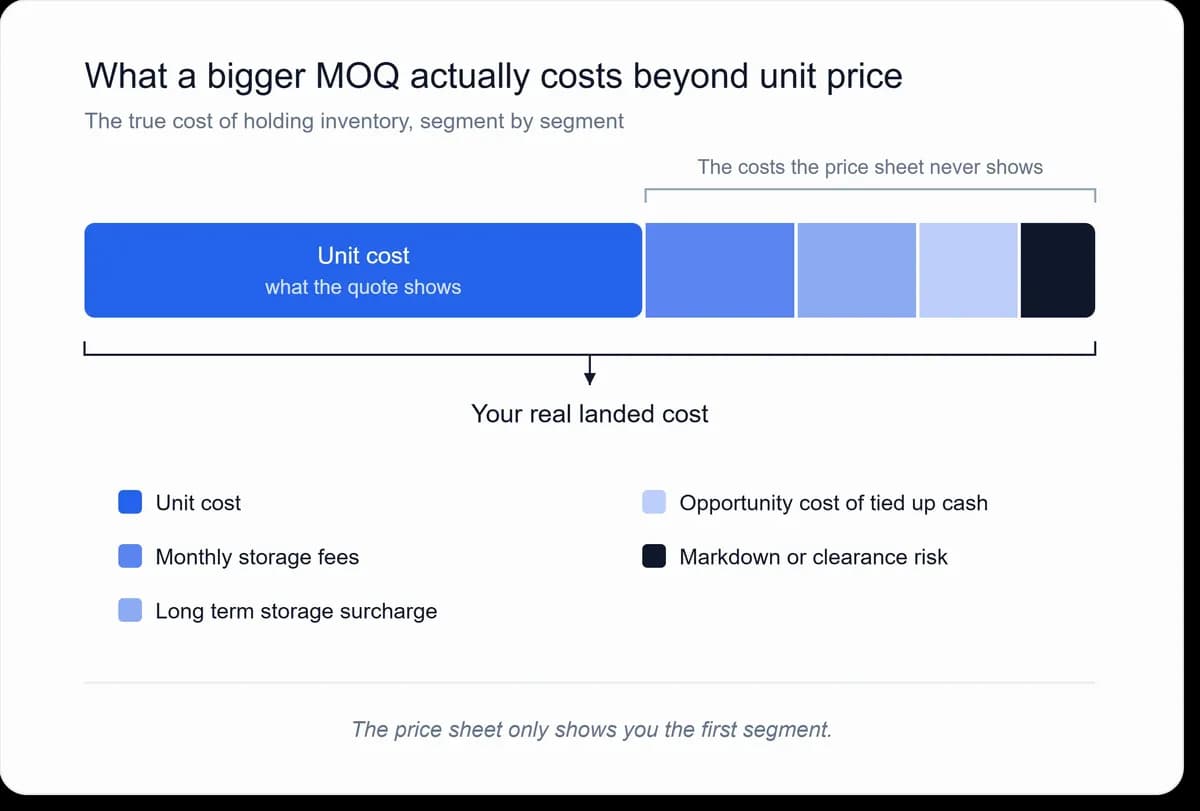
Every unit sitting in inventory costs money simply by existing there. It ties up cash you can't deploy elsewhere. It occupies warehouse space you're paying for, whether that's an Amazon fulfillment center or your own storage. It carries the risk of becoming unsellable if the product goes out of season, gets discontinued by the brand, or simply falls out of favor with customers.
None of these costs show up when you're comparing a $4.20 per unit price against a $3.45 per unit price at the bigger MOQ tier. They only show up later, usually on a fee statement or a clearance sale, by which point the decision has already been made.
The Real Cost of Holding Inventory
"Carrying cost" is the term for everything it costs to hold a unit of inventory beyond what you paid the distributor for it. Most sellers have never calculated this number for their own business, which is exactly why MOQ decisions get made on unit price alone.
Amazon's storage fees are the most visible piece. Monthly storage fees apply to every unit sitting in an FBA warehouse, and they roughly double during the fourth quarter of the year. On top of that, Amazon charges long-term storage fees on inventory that's been sitting for more than a certain number of months, and these fees step up sharply the longer a unit remains unsold. A product that looked profitable at the point of purchase can quietly turn unprofitable after half a year of storage fees eating into the margin that unit price alone suggested you had locked in.
Beyond Amazon's fees, there's the opportunity cost of the cash itself. Money spent on 2,000 units instead of 500 is money that isn't available for a new product launch, an unexpected reorder on a different SKU, or simply sitting in reserve for when a genuinely good opportunity comes along. This is a real cost even though no invoice ever itemizes it.
Then there's obsolescence and markdown risk. Products go out of season, brands discontinue SKUs, trends shift, and packaging gets updated. A larger order sitting in inventory for longer has more time exposed to all of these risks, and when a product does need to be cleared out, it's almost always sold below the margin the original unit price implied, sometimes at a loss.
The Formula for Comparing MOQ Tiers Properly
The way to actually compare a 500-unit MOQ against a 2,000-unit MOQ is to calculate the total landed cost per unit at each tier, including how long that inventory is realistically expected to sit before it sells.
Start with your actual monthly sell-through rate for the product, not a hopeful projection. If you sell 300 units a month on average, a 500-unit order covers roughly 50 days of inventory, while a 2,000-unit order covers close to 200 days, nearly seven months. Multiply the expected months of storage by Amazon's monthly storage fee per unit for that product's size tier, and you have a rough estimate of the storage cost alone. Add in the fact that a meaningful portion of that 2,000-unit order will likely cross into long-term storage fee territory, which most sell-through timelines beyond six months will do, and the true cost of the larger order starts climbing well past what the unit price discount saved you.
Compare that total landed cost per unit, the unit price plus expected storage cost per unit, across both MOQ tiers rather than comparing the unit prices alone. In a lot of cases, especially for slower-moving products or those with thin baseline margins, the smaller MOQ actually wins once storage is factored in, honestly, even though its sticker price per unit is higher.
When a Bigger MOQ Genuinely Makes Sense
None of this means larger orders are always the wrong call. There are real situations where a bigger MOQ is the right decision, and it's worth being clear about what those look like so this doesn't read as a blanket argument against volume buying.
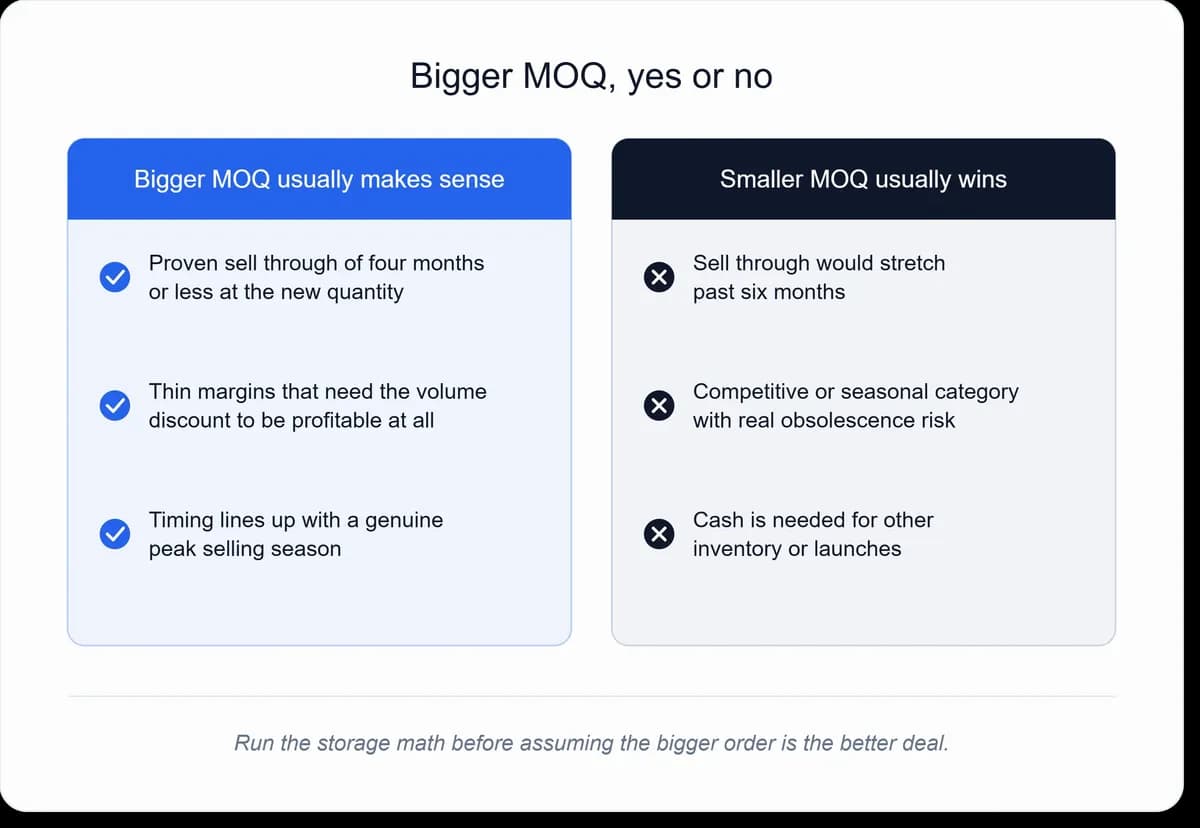
Fast-moving products with a proven, consistent sell-through rate are the clearest case. If a product reliably sells 500 units a month and has for over a year, a 2,000 unit order covers about four months of inventory, well within the window before long-term storage fees kick in, and the unit price discount is captured almost entirely as real margin with minimal added risk.
Products with genuinely thin unit economics can also justify a bigger order, if the discount at the higher tier is what actually makes the product profitable in the first place. In that specific case, the calculation isn't really about the tradeoff described above; it's about whether the product is viable at all at the smaller MOQ's pricing.
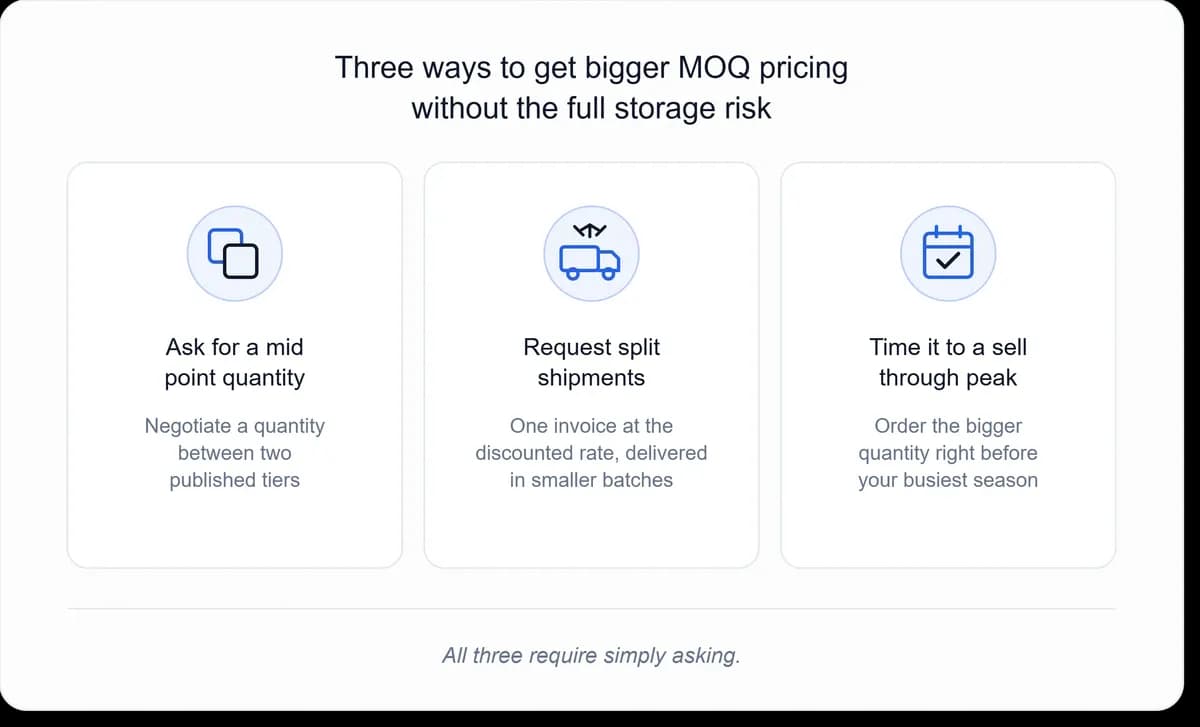
Seasonal timing matters too. Ordering a larger quantity right before a product's peak selling season, when the inventory will move fast regardless of the general sell-through average, is a different risk profile than ordering the same quantity during a slow period.
The distinction in every one of these cases comes down to the same question: will this inventory sell fast enough that storage cost and obsolescence risk stay small relative to the unit price savings? When the honest answer is yes, take the bigger MOQ. When the honest answer is "no" or "uncertain," the smaller tier is very often the better financial decision even though it looks worse on the price sheet.
Negotiating Around MOQ Instead of Just Accepting the Tiers
It's worth knowing that MOQ tiers are sometimes more flexible than distributors present them as being, especially once you have some order history with a supplier.
Asking about a midpoint quantity between two published tiers is a reasonable request that many sellers never make. A distributor's published tiers might jump from 500 to 2,000 units, but a 1,000 or 1,200-unit order at a partial discount is sometimes available if you simply ask, giving you some of the unit price benefit without the full carrying cost exposure of the largest tier.
Split shipment arrangements are another option worth raising. Some distributors will agree to invoice a larger order at the discounted rate while physically shipping it in smaller batches over a few months, which reduces the amount of inventory you're actually holding and paying storage on at any one time, while still capturing the better unit price on paper.
Neither of these arrangements is guaranteed, and not every distributor will offer them. Still, they cost nothing to ask about and can meaningfully change the real economics of a larger order in your favor.
Finding Suppliers Who Offer Flexible MOQ Terms
Not every distributor is willing to negotiate midpoint quantities or split shipments, and some brands enforce rigid MOQ tiers with no exceptions, regardless of how the conversation goes. Finding suppliers who are genuinely flexible on this, without sacrificing authorization or product quality, is its own kind of research.
This is the problem B2B Supplier Hub was built around. Search any product free by UPC, name, or keyword and see every number upfront, exact wholesale cost, live stock, and retail price from each distributor in our network carrying it before spending anything. When one supplier's numbers make sense for your order volume, you reveal that supplier and connect directly. The revealed supplier is yours permanently, even if you later cancel.
The Short Answer to Why Care with a Bigger Order is Necessary
A lower unit price at a bigger MOQ is only a real discount if the inventory sells fast enough that storage cost, tied-up cash, and markdown risk stay smaller than what the price break saved you. Calculate your actual sell-through rate before committing to a larger tier, and don't assume the biggest available discount is automatically the smartest purchase.
Frequently asked questions
01What is a good MOQ for a new Amazon product?
02How do I calculate the true cost of a larger MOQ order?
03Do Amazon storage fees really make a bigger MOQ unprofitable?
04Can I negotiate a smaller MOQ with a wholesale distributor?
05Is it better to order less often at a higher unit price?
The B2B SupplierHub Team
Wholesale & sourcing
Stop hunting suppliers by hand. Type a UPC instead.
B2B Supplier Hub shows the suppliers in our network carrying a product on one page: wholesale cost, stock, and retail price side by side. Free to search, no card required.