
Supplier Management
How to Negotiate Wholesale Pricing Without Burning the Relationship
Most sellers either never negotiate or negotiate badly. The first group leaves margin on the table indefinitely because asking feels awkward. The second group asks the wrong way, at the wrong time, and damages an account they will need for years.
Negotiating wholesale pricing is not about being aggressive or extracting the maximum discount on a single call. It's about understanding what a distributor can actually move on to when they are able to move on to it and how to ask in a way that makes them want to say yes.
Done well, negotiation strengthens a distributor relationship because it signals that you are a serious, growing account worth investing in. Done poorly, it signals that you see the relationship as purely transactional, which is exactly the kind of account distributors deprioritize when supply gets tight.
This guide covers how to negotiate wholesale pricing in a way that gets you better terms while keeping the relationship intact, because you will need that relationship long after this order ships.
Why Most Sellers Negotiate at the Wrong Time
Timing is the single biggest factor in whether a pricing conversation goes well, and it's the factor most sellers ignore entirely.
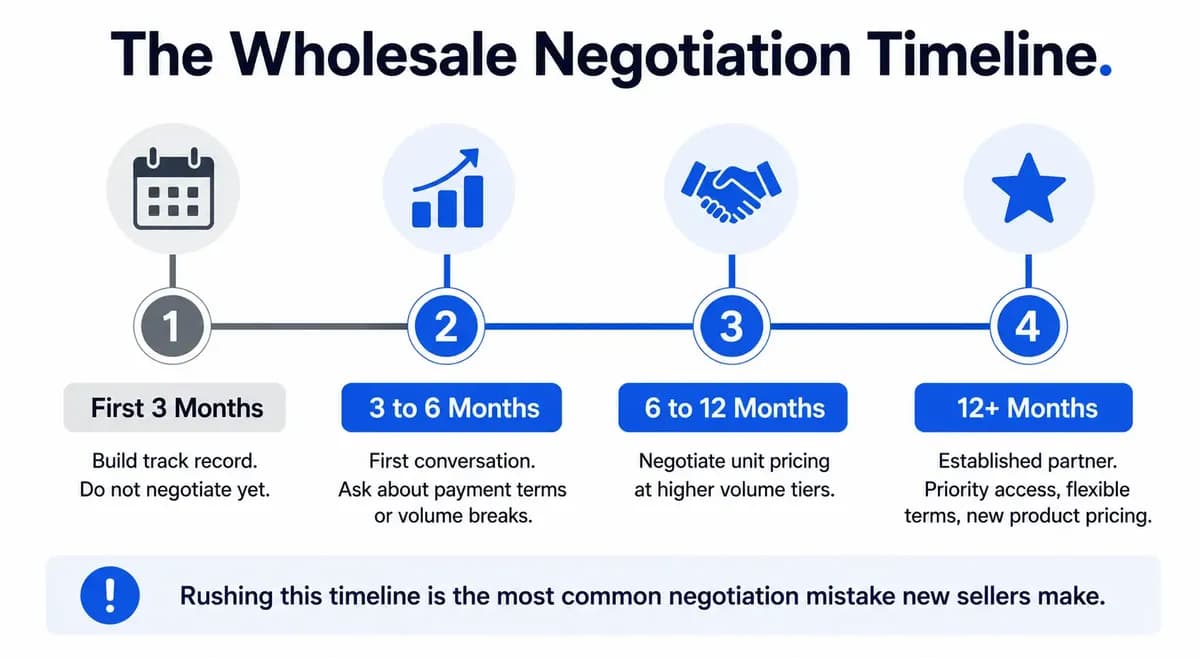
Asking for a discount on your first order, before you have placed a single purchase, is asking a distributor to take a bet on you with no evidence to justify it. You have no order history, no payment history, and no track record of how you manage inventory or handle communication. From the distributor's side, this is the weakest possible negotiating position, even if your reasoning is sound.
The right time to negotiate is after you have established a pattern. Three to six months of consistent ordering, on-time payment, and professional communication give you something to negotiate with: a track record. At that point, you are not asking a distributor to trust you. You are asking them to reward trust you have already demonstrated.
There are exceptions. If you are placing a genuinely large first order, well above the distributor's typical minimum, that volume itself is a legitimate basis for a pricing conversation even without history. But for most sellers starting with modest order sizes, patience before the first negotiation is not a weakness. It's a strategy.
What Distributors Can Actually Move On
Before you ask for anything, understand the levers a distributor has. Not every distributor can move on to every one of these, and knowing the difference changes how you frame your ask.
Unit pricing at higher volume tiers is the most common lever. Most distributors have informal or formal volume breaks that are not always advertised. Asking what the pricing looks like at double or triple your current order size often reveals room that was never offered proactively.
Payment terms are frequently more negotiable than price itself, and they matter more to your cash flow than most sellers realize. Moving from prepayment to net 15, or from net 15 to net 30, has a real financial impact without costing the distributor anything in margin. This is often the easiest concession for a distributor to grant because it doesn't touch their profit on the transaction.
Freight and shipping cost allocation is another lever that gets overlooked. Some distributors will absorb shipping costs above a certain order threshold or split the cost, even when they won't move on the unit price. This can meaningfully affect your true landed cost without the distributor discounting the product itself.
Case pack flexibility matters if you are ordering just under a volume breakpoint because of packaging constraints. Asking whether a distributor can break a case pack or adjust the increment you are required to order sometimes unlocks better, more effective pricing without any formal discount at all.
What most distributors genuinely cannot move on from is MAP-related territory or anything that would put them in conflict with the brand's pricing policy. Asking a distributor to sell below what the brand's cost structure allows puts them in a position they cannot accommodate, regardless of how much you order. Understanding this distinction before you ask prevents you from making a request that damages trust for no possible gain.
%2520Move%2520On-1200x800.webp&w=3840&q=75)
How to Build the Case Before You Ask
The strongest negotiating position is one where you don't have to argue. You simply present evidence and let the distributor draw the obvious conclusion.
Before you request better pricing, put together a short, factual summary of your account. How long have you been ordering from them? What is your total order volume over that period, your on-time payment record, and your growth trajectory if it's meaningfully upward? This isn't a sales pitch. It's a one-paragraph summary that makes the case for you before you have said a word.
If you are asking for better pricing because you are planning to significantly increase order volume, be specific about the number and the timeline. Saying "I would like better pricing" is a vague request that is easy to deflect. Saying "I am planning to move from 200 units a month to 500 units a month starting next quarter, and I want to understand what pricing looks like at that volume" gives the account manager something concrete to evaluate and take to their own management if needed.
Distributors are more willing to negotiate with resellers who make their reasoning easy to follow. An account manager who can clearly explain to their own boss why a price adjustment makes sense is far more likely to get it approved than one who is negotiating on a vague feeling that a good customer deserves a better deal.
The Conversation Itself: How to Ask Without Damaging Trust
How you frame the request matters as much as the request itself.
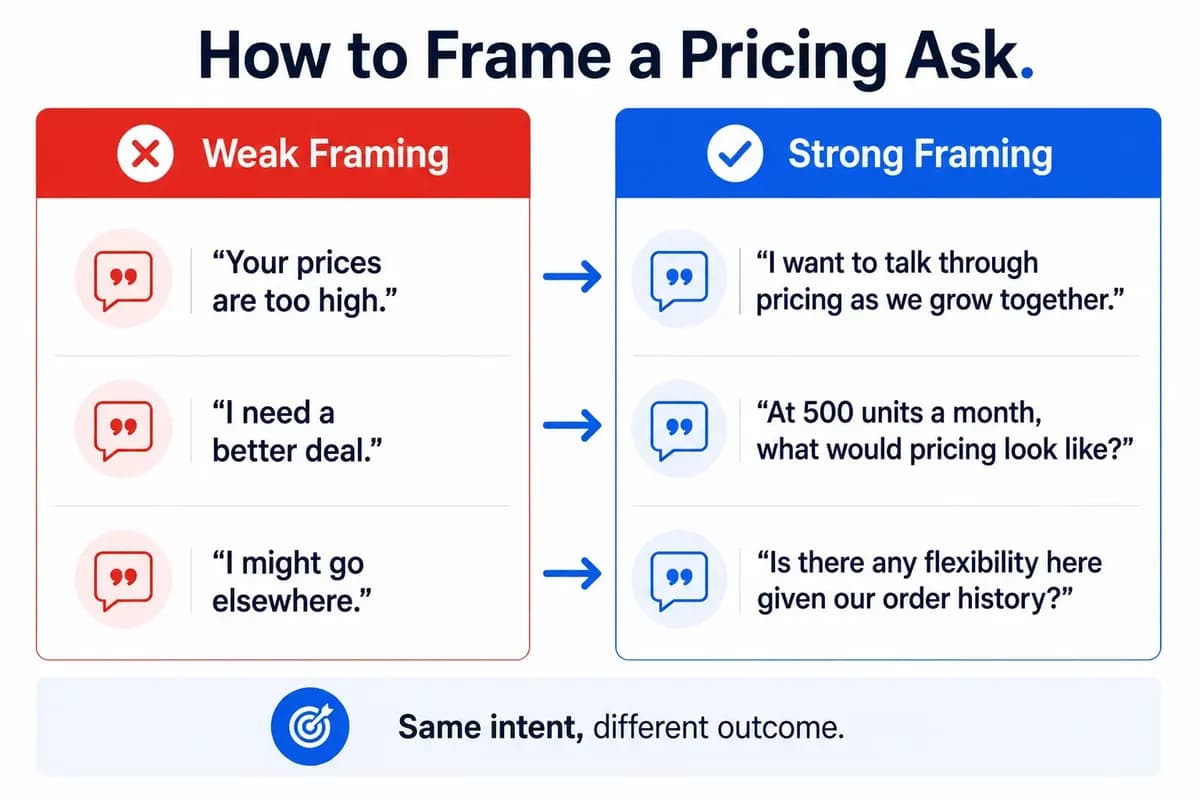
Start from a position of partnership, not demand. Distributors respond better to something like "I want to talk through what our pricing could look like as we grow together" than to "your prices are too high." The first framing invites a conversation. The second puts the account manager on the defensive before you have even stated what you want.
Be specific about what you are asking for. A vague request for better pricing forces the account manager to guess what would satisfy you, which usually results in them offering the smallest possible concession to see if it's enough. A specific ask, such as a particular per-unit target or a specific payment term, gives them something concrete to evaluate and respond to directly.
Never threaten to leave unless you actually mean it and are prepared to follow through. Distributors have heard "I'll just go to your competitor" from resellers who never actually leave, and it has stopped functioning as leverage. If you genuinely have a better offer elsewhere and are willing to walk, that's different information and can be shared honestly. But using it as a bluff, especially with an account manager who has been in the industry a while, tends to damage credibility more than it helps your position.
Give the account manager room to say no gracefully. Asking "is there any flexibility here" rather than demanding a specific concession lets them decline without it becoming confrontational. This matters because you will likely be back at the table again in six months, and how this conversation ends affects how that one starts.
What Happens When the Answer Is No
Not every negotiation succeeds, and how you respond to a no matters more than most sellers realize.
If a distributor says they cannot move on price, ask what would need to change for that to be possible in the future. This turns a rejection into a roadmap. An account manager who says "we could revisit this at 1,000 units a month" has just given you a concrete target and implicitly committed to reconsidering when you hit it.
Don't escalate a single no into a threat or an ultimatum. Distributors remember resellers who handled rejection professionally, and that memory works in your favor the next time a real opportunity for better terms comes up, whether that's a volume-based repricing, a new product line, or a promotional allocation.
If the "no" is really about brand-mandated pricing floors rather than the distributor's own discretion, understand that pushing further will not change the outcome and may create the impression that you don't understand how the relationship works. Distributors who explain this distinction are usually straightforward with you, not deflecting
.
Negotiating New Products vs. Negotiating Existing Ones
The negotiation dynamic is different depending on whether you are asking for better terms on a product you already carry or discussing pricing for a new product you want to add.
For existing products, your leverage comes from your track record. You have real order history, real payment behavior, and a real relationship to point to. This is the stronger negotiating position, and it's why patience before the first ask pays off.
For new products, you have less individual leverage on that specific item, but you can use your overall account relationship as context. Saying something like, "We've been a strong account on your existing catalog for a year, and we'd like to add this product line. What would pricing and terms look like?" is a legitimate way to extend goodwill from one part of the relationship into a new area. Distributors are generally more willing to offer reasonable terms on a new product to an account they already trust than to a completely unknown one.
The Long Game: Why Restraint Pays Off
The sellers who get the best long-term pricing are rarely the ones who negotiate the hardest on any single call. They are the ones who negotiate the right amount, at the right times, while consistently being an easy account to work with in every other respect.
Distributors allocate scarce resources during shortages, prioritize accounts for new product launches, and extend flexibility during difficult periods to the resellers they consider genuine partners. A reseller who has pushed hard on every single pricing conversation, treating each negotiation as purely adversarial, is not the account that gets the benefit of the doubt when supply is tight or a mistake needs to be forgiven.
The goal of negotiation isn't to extract the maximum possible discount from every conversation. It's to secure fair, competitive terms while building the kind of relationship that pays off in ways that go beyond the price sheet. Priority access to new inventory, flexibility during your own cash flow crunches, and the benefit of the doubt when something goes wrong.
Where to Find Distributors Worth Building This Relationship With
Negotiation only matters if you are working with a distributor worth investing months of relationship-building into. Spending a year establishing trust with a supplier who turns out to be unauthorized, unreliable, or a poor long-term fit wastes the very patience this guide is asking you to have.
If you want to start relationships with distributors who are already vetted for authorization, stability, and fair terms, B2B Supplier Hub was built to shortcut that discovery process for Amazon wholesale sellers. Instead of spending months finding out whether a distributor is even worth negotiating with, you can start from a network of pre-verified accounts and focus your relationship-building time where it will actually pay off.
The Short Answer: When and How to Ask for Better Wholesale Pricing
Wait until you have a track record before negotiating. Ask for what is realistically negotiable, things like payment terms, volume pricing, and freight allocation, rather than what isn't. Frame the request as a conversation about growing together, not a demand. Be specific about what you want. And if the answer is no, respond professionally, because the relationship matters more than any single pricing conversation.
Frequently asked questions
01When is the right time to negotiate pricing with a wholesale distributor?
02What wholesale pricing terms are usually negotiable?
03How do I ask a distributor for better pricing without sounding demanding?
04What should I do if a distributor rejects my pricing request before explanation?
05Can negotiating too aggressively damage a distributor relationship?
The B2B SupplierHub Team
Wholesale & sourcing
Stop hunting suppliers by hand. Type a UPC instead.
B2B Supplier Hub shows the suppliers in our network carrying a product on one page: wholesale cost, stock, and retail price side by side. Free to search, no card required.