
Distributor Authorization
EIN vs Resale Certificate: Which One Distributors Actually Ask For
-1200x627.png&w=3840&q=75)
Look at almost any wholesale distributor's new account application, and you'll find two fields side by side: "Tax ID / EIN" and "Resale Certificate #." Some forms add a line in bold at the bottom warning that your application won't be processed without the resale certificate attached.
That layout answers the question in the title before we start. Distributors usually ask for both. But only one of them does the job most resellers think it does, and mixing them up is behind one of the most expensive misconceptions in wholesale: that having an EIN means you can buy tax-free. It doesn't, and here's the clean separation.
What an EIN Is (and Isn't)
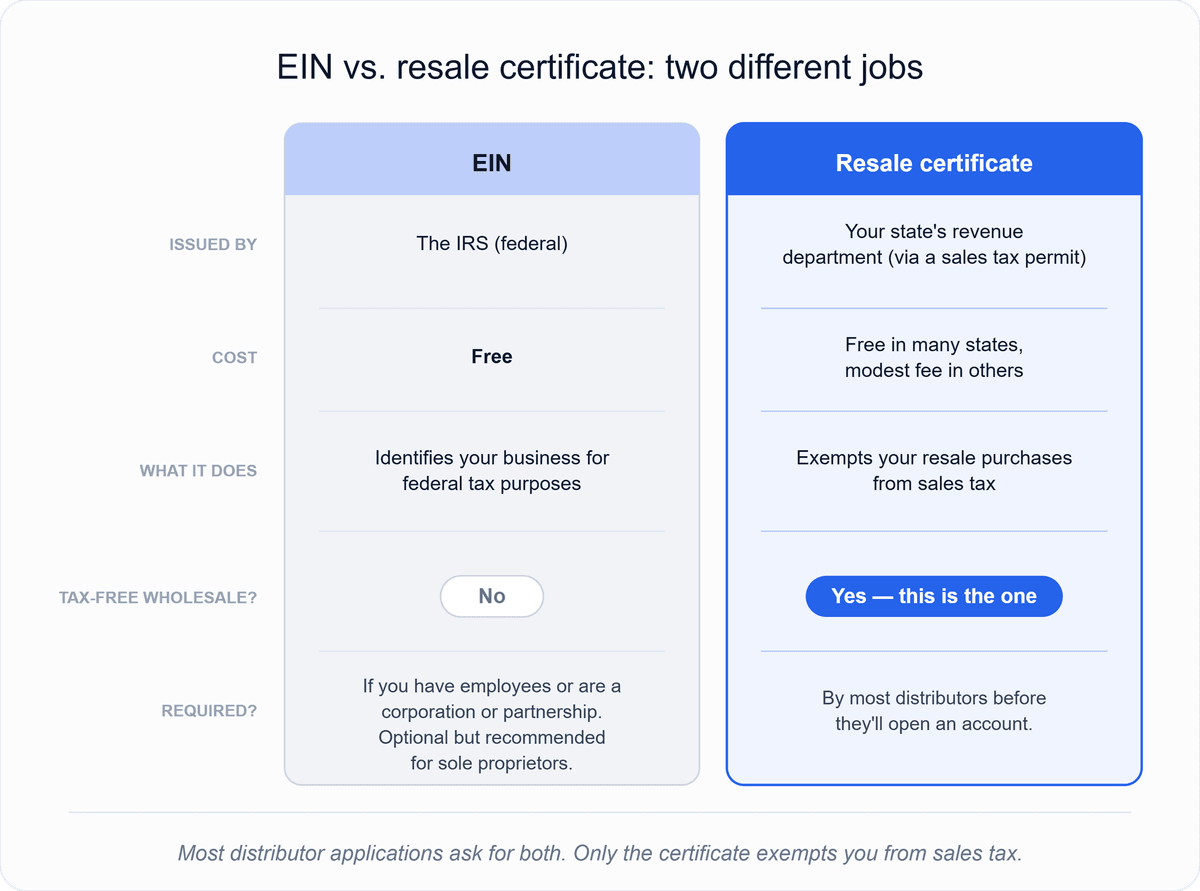
An EIN, or Employer Identification Number, is a federal tax ID issued by the IRS. It identifies your business to the federal government the way a Social Security number identifies a person, and you apply for it directly through the IRS website, free, in a process that usually takes minutes.
You're generally required to have one if your business has employees, operates as a corporation or partnership, or files certain federal returns. A sole proprietor with no employees isn't required to have an EIN and can often operate under their Social Security number instead.
Even so, most resellers should get one anyway, for a practical reason unrelated to requirements: without an EIN, every distributor application, every credit application, and every trade reference form asks you to write your Social Security number on it. An EIN keeps your SSN off those documents. It also opens the door to a business bank account, which distributors quietly notice when they're deciding whether you're a real business.
Here's what an EIN does not do. It does not let you buy inventory without paying sales tax. Sales tax is a state matter, and a federal ID number has no authority over it. This misconception costs sellers real money when they assume the EIN is enough, order inventory, and get charged sales tax on the whole purchase.
What a Resale Certificate Is
A resale certificate is the state-level document that actually exempts your wholesale purchases from sales tax. You give it to your supplier; it certifies that you're buying goods to resell rather than to use, and the supplier, therefore, doesn't charge you sales tax on the order. The tax gets collected downstream, from your end customer.
Getting one usually runs through your state's revenue or taxation department: you register for a sales tax permit, also called a seller's permit, and that registration gives you the number and authority to issue resale certificates to suppliers. The permit and the certificate aren't the same document. The state issues the permit; you complete a certificate for each supplier you buy from.
This is the document distributors care about most, and not for bureaucratic reasons. If a distributor sells to you tax-free without a valid resale certificate on file, the unpaid tax becomes their exposure in an audit.
Your certificate is what protects them, which is why so many applications refuse to process without it attached. The fuller comparison between the permit and the certificate is in our guide to resale certificate vs. sales tax permit.
Why Distributors Ask for Both
The two documents answer two different questions a distributor has about you, which is why the application form has two fields rather than one.
The resale certificate answers, "Can I legally sell to this buyer without charging sales tax?" That's a compliance question with an audit attached, and it's the reason the certificate is usually mandatory.
The EIN answers, "Is this a real business entity I can set up in my system, invoice, and potentially extend terms to?" It's an identity and bookkeeping question. Distributors use it to open your account record, run credit checks where relevant, and issue invoices to a business rather than a person.
Neither substitutes for the other. A resale certificate with no EIN can still work for a sole proprietor using an SSN, though it looks less established. An EIN with no resale certificate means the distributor either declines the account or sells to you with sales tax added, which quietly eats margin on every order. What else distributors weigh alongside the paperwork is covered in what distributors look for before approving an Amazon seller.
If You Have Neither: The Order to Do This In
Decide your business structure first, since permits and EINs are issued to an entity and mismatches cause problems later. You do not need an LLC to buy wholesale; sole proprietors open distributor accounts routinely.
Get the EIN from the IRS. It's free and typically takes minutes online. Be aware that a cottage industry of paid services charges to file this free form for you.
Register for your state's sales tax permit through the state revenue department, then complete resale certificates for each distributor using that permit number.
Apply to distributors with both in hand. Having them ready before you apply is the difference between an account that opens this week and one that stalls while you scramble for documents.
A necessary caveat: this describes general, widely documented practice, not legal or tax advice for your situation. Rules vary by state and business structure and change over time.
Confirm with your state's revenue department or a tax professional before relying on it. Multi-state selling in particular has real complexity, since a number of states won't accept an out-of-state resale certificate and economic nexus rules can create obligations in states you've never visited.
Documents Ready? Now Find Suppliers Worth Applying To
Once the EIN and resale certificate are in hand, the next bottleneck is knowing which distributors are worth the application in the first place. B2B Supplier Hub answers that before you fill out a single form: search any product by UPC, MPN, name, or brand and see every verified distributor in the network carrying it, with exact wholesale cost, live stock depth, and the date each listing was verified, free and unlimited.
Shortlist the suppliers whose numbers actually work for your products, then send your paperwork where it counts.
Frequently asked questions
01Do I need an EIN to buy wholesale?
02Can I use my EIN instead of a resale certificate?
03Which one do distributors require?
04Is an EIN the same as a tax ID?
05How much does an EIN cost?
The B2B SupplierHub Team
Wholesale & sourcing
Stop hunting suppliers by hand. Type a UPC instead.
B2B Supplier Hub shows the suppliers in our network carrying a product on one page: wholesale cost, stock, and retail price side by side. Free to search, no card required.