
Sourcing
How to Find Local Distributors Near You (US Guide)
Search "wholesale distributors near me" and most of what comes back is a national directory with a location filter bolted on, not suppliers who are actually close to you. That's a real gap, because local genuinely means something different in wholesale than it does in retail: a distributor two states away is a lead time and a freight bill, while one forty-five minutes down the highway is a will-call pickup and a relationship you can build in person.
Whether local matters to your operation depends on how you sell. For a brick-and-mortar store or a market stall, proximity is close to the whole point: lower freight, faster restocks, and a supplier you can walk into if something goes wrong.
For an Amazon FBA seller shipping everything to a fulfillment center anyway, geography matters less than it feels like it should, since your product still travels the same distance to Amazon's warehouse regardless of which state it started in.
Local can still help an FBA seller through lower freight costs to the nearest FBA facility and the kind of relationship that's easier to build face-to-face, but it's a secondary factor rather than the deciding one.
Either way, here's how to actually find distributors in your area, using methods that return real regional results rather than a national list with your city name pasted on top.
Method 1: Your State's Manufacturer and Wholesaler Registry
Every state maintains some form of public business registration, and a growing number of states and economic development offices publish searchable directories of manufacturers and wholesalers specifically, often built to help local businesses find local supply chains.
Search "[your state] manufacturer directory" or "[your state] wholesale distributor registry," and check your Secretary of State's business search as a backup, since registered businesses often list an industry classification you can filter by.
This method is slower than a national directory, and the interfaces vary widely by state, but it surfaces genuinely local operations that paid national directories often don't bother listing, since there's no fee incentive for a small regional wholesaler to pay for placement on a site targeting a national audience.
Method 2: Chamber of Commerce Directories
Local and regional chambers of commerce maintain member directories, and manufacturers and wholesalers are common members, since chambers exist partly to connect local businesses with each other.
Every city and county in the US has a chamber, and most publish a searchable business directory online, filterable by industry.
This method works especially well for two things a national directory won't give you: businesses too small or too local to bother marketing nationally and warm introductions. Chambers regularly run networking events, and a wholesaler you meet through a chamber mixer starts the relationship differently than a cold email to a directory listing.
Method 3: State and Regional Trade Shows
Trade shows remain one of the highest-value ways to meet distributors because you're seeing product in person, negotiating face-to-face, and building the kind of relationship that a directory listing can't replicate.
The advantage compounds when the show is regional rather than national: attendees and exhibitors skew toward businesses that already operate in your area, so the wholesalers you meet are more likely to be a reasonable shipping distance away.
Search for trade shows in your specific product category combined with your region or state, since most industries run both major national shows and smaller regional ones. A regional gift, hardware, or general merchandise show in your area is worth attending even if it feels less prestigious than a national one; the exhibitor list is disproportionately regional, which is exactly what you're looking for.
Method 4: Know the Regional Hubs, Even If You're Not Near One
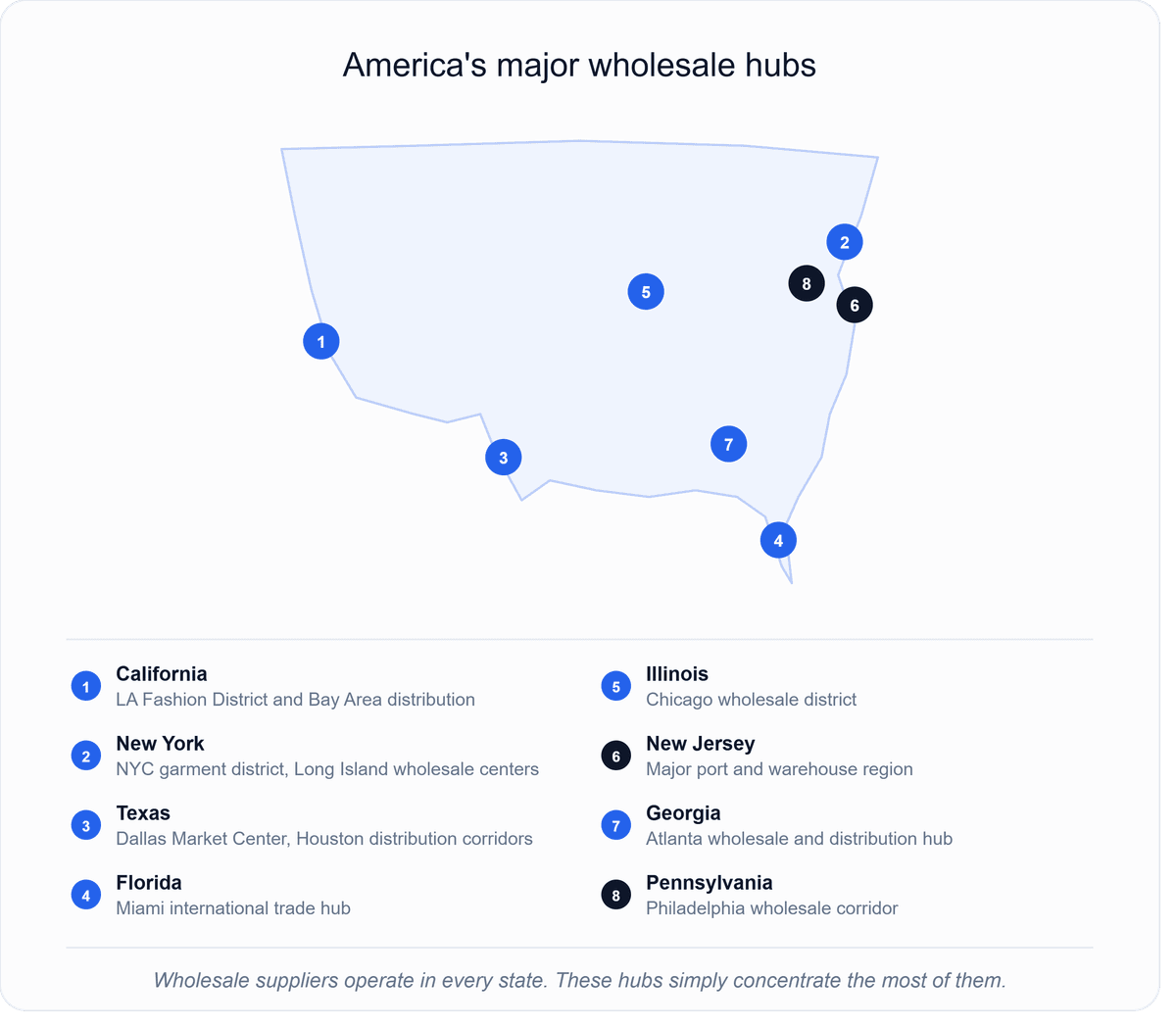
Wholesale distribution isn't spread evenly across the country. A handful of regions concentrate a disproportionate share of it, and knowing them helps even if you're not local to any of them, because these are also the regions where regional trade shows and manufacturer reps cluster.
The Los Angeles Fashion District and broader Bay Area distribution network cover apparel and general goods on the West Coast. New York City's garment district and Long Island's wholesale centers anchor the Northeast. Dallas Market Center and Houston's distribution corridors serve Texas and the broader Southwest. Miami functions as an international trade hub, particularly for goods moving through Latin American supply chains.
Chicago's wholesale district serves the Midwest. New Jersey's port and warehouse region is one of the busiest logistics corridors in the country. Atlanta anchors wholesale and distribution for the Southeast, and Philadelphia runs its own established wholesale corridor.
If you're near one of these regions, that's a real advantage worth building your sourcing search around first. If you're not, distributors still operate in every state, just in lower concentration, which is exactly what Methods 1 and 2 are built to surface.
Method 5: Ask Manufacturers Directly for Distributors in Your Area
If you already know the brand you want to sell rather than starting from a blank search, manufacturers routinely maintain a list of authorized distributors by region, and most will share it if you ask.
Go to the brand's website and look for a "Wholesale," "Trade," "Dealers," or "Where to Buy" section. If nothing's posted, call or email their sales department and ask specifically who distributes their products in your state or region. This method has a real advantage over a general directory search: any distributor you get this way is confirmed authorized for that brand, which sidesteps the gray market risk covered in selling gray market goods on Amazon.
Method 6: Referrals From Other Local Businesses
The least scalable method and often the most reliable one. Retailers and resellers in your area who already buy wholesale know which local distributors are legitimate, responsive, and worth the relationship, and that's information no directory captures.
Ask at chamber of commerce events, in local business groups, or directly of retail owners in your category whose supply chain you respect. A referral also tends to open doors faster than a cold approach, since a distributor treats a lead who says "so-and-so sent me" differently than an unknown inquiry.
Once You Have a Name: Verify Before You Commit
Every method above gets you a lead, not a vetted supplier. Before placing an order with any distributor you find locally, confirm the basics: a real business registration, a genuine physical address rather than just a mailing address, and pricing that's actually wholesale rather than lightly discounted retail.
Our guide to what distributors look for before approving an Amazon seller covers the other side of that conversation, what a legitimate distributor will expect from you before opening an account, so you can walk in prepared regardless of how you found them.
Search by Product, Not Just Location
Local search finds you distributors in your area; it doesn't tell you which one actually carries the specific product you want to sell, at what cost, or whether they have it in stock.
B2B Supplier Hub answers that question directly: search any product by UPC, MPN, name, or brand and see every verified distributor in the network carrying it, with exact wholesale cost, live stock depth, and the date each listing was verified, free and unlimited. Use local search to find suppliers worth a relationship and a product search to confirm they're actually worth the order.
Frequently asked questions
01Does it matter if my wholesale distributor is local if I sell on Amazon?
02How do I find wholesale distributors in my state without a paid directory?
03What are the biggest wholesale hubs in the US?
04Are local trade shows worth attending if I can find suppliers online?
The B2B SupplierHub Team
Wholesale & sourcing
Stop hunting suppliers by hand. Type a UPC instead.
B2B Supplier Hub shows the suppliers in our network carrying a product on one page: wholesale cost, stock, and retail price side by side. Free to search, no card required.