
Supplier Management
How to Work With a New Wholesale Distributor: Your First 30 Days After Approval
The approval email lands in your inbox, and it feels like the finish line. Months of research, a few calls that went nowhere, one distributor who finally said yes. Most sellers read that email, feel the relief, and move straight to placing their first order. What actually happens in the days right after approval, before that first order even ships, quietly decides whether this account becomes something you can rely on or something you're still fighting with six months from now.
Approval opens a door. It doesn't tell you how to walk through it. The account has a portal you haven't logged into, an ordering system you haven't tested, a payment process you haven't confirmed, and a person on the other end who doesn't actually know you yet, no matter how friendly the sales call was. The first 30 days are where all of that gets sorted out, and most of the friction sellers experience three or four months into a new distributor relationship traces back to something that was never nailed down in this window.
This is a practical, week-by-week look at what to actually do in that first month. If you want the longer view of how a supplier relationship matures over a full quarter, that's covered separately in our guide to onboarding a new supplier over 90 days. This one stays close to the ground, the specific things worth doing in the 30 days right after that approval email arrives.
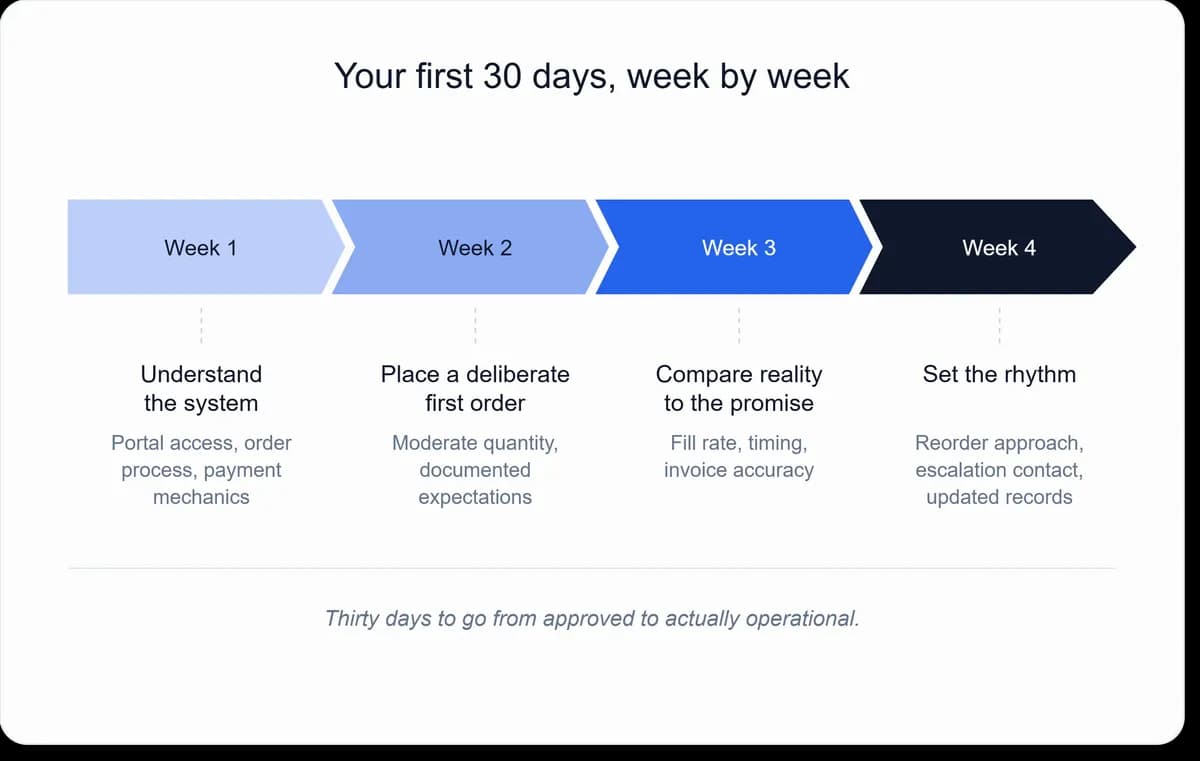
Week 1: Get Inside the Account Before You Order Anything
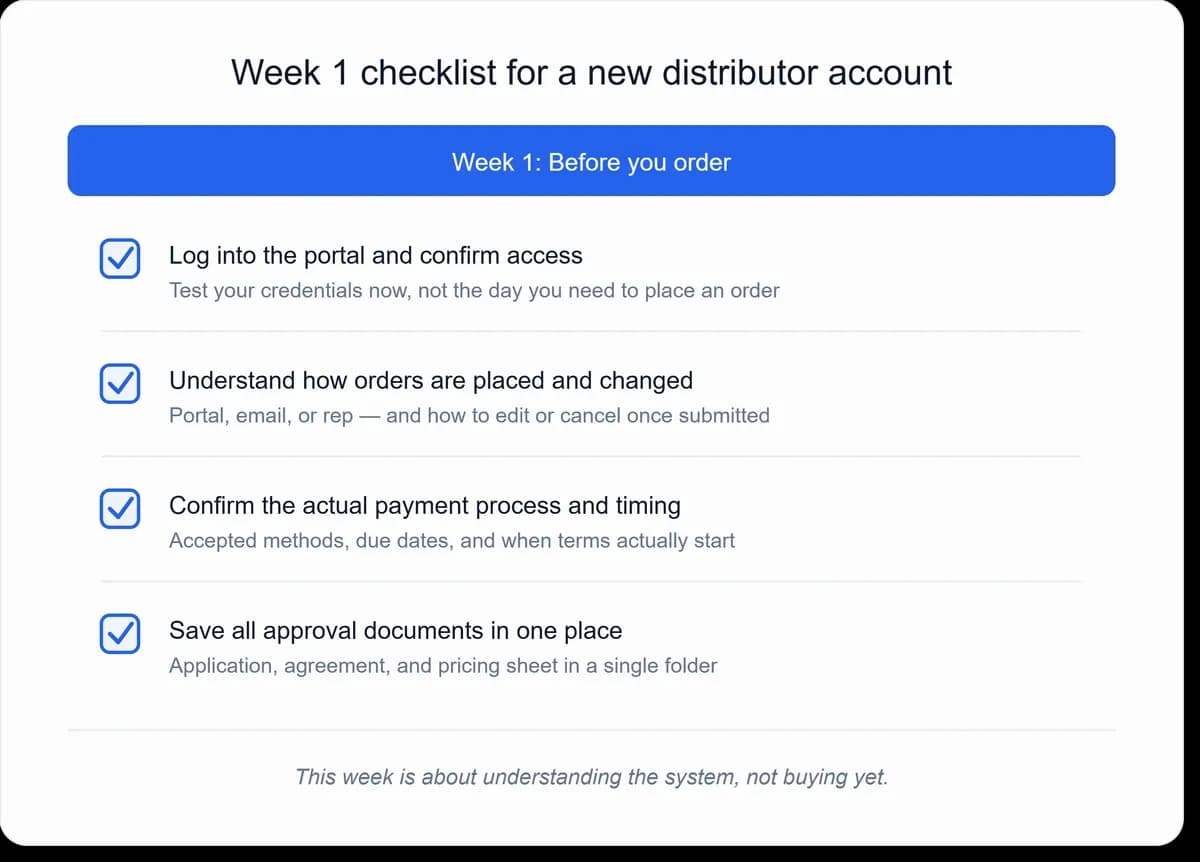
The first week isn't about buying. It's about understanding exactly how this distributor operates, because every distributor's systems are slightly different, and assuming yours works like the last one is where avoidable mistakes start.
Log into the portal, if there is one, before you do anything else. Some distributors run everything through an online ordering system with live pricing and stock levels; others still work primarily through email, and a sales rep, and a fair number use some mix of both. Knowing which one you're dealing with changes in how you should plan to place orders and check inventory going forward.
Confirm exactly how orders get placed and how changes or cancellations are handled. This sounds basic, but it's genuinely different across distributors. Some allow same-day order changes with a phone call, others require 48 hours' notice or treat a placed order as final. Finding this out during a calm moment in week one is far better than discovering it while trying to fix a mistake under pressure.
Get the actual payment process confirmed, not just the payment terms you agreed to during approval. This means knowing exactly how to submit payment, whether that's a portal, a wire, or a check, what the invoice will look like, and when the clock actually starts on any net terms you were given. A surprising number of early account friction points come from a payment being sent the wrong way or on the wrong timeline simply because nobody confirmed the mechanics.
Save every document you received during approval in one place. The signed agreement, the price sheet, any authorization letters, and the contact information for your rep. This takes fifteen minutes and prevents a genuinely common problem, which is a seller needing one of these documents months later and not being able to find it.
Week 2: Place a Deliberate First Order
The second week is when the first real order should go out, and how you approach it matters more than most sellers expect.
Order a moderate quantity rather than either a token minimum or your full planned volume. A very small order doesn't give you a real read on how the distributor performs under normal conditions, and a very large one puts more on the table than makes sense before you've seen how this relationship actually works in practice. Something in between gives you a genuine test without unnecessary exposure.
Write down what you're told to expect before the order ships. The quoted lead time, the exact items and quantities confirmed, and the price you were given. This isn't about distrust; it's about having something concrete to compare against once the order actually arrives, since that comparison tells you a lot about how reliable this account is going to be.
Ask a real question during this window, even a small one. Something like confirming stock on a related item or asking about reorder timing. How quickly and how usefully that question gets answered tells you more about the working relationship you're building than the sales process ever did, since the sales conversation is designed to win you as a customer, and this is what happens after that's already settled.
Week 3: Compare What Happened Against What Was Promised
By the third week, the first order has likely arrived, and this is the point to actually sit down and check it against what you documented in week two, rather than assuming everything matched just because nothing obviously went wrong.
Check the fill rate honestly. Did you receive everything you ordered in the quantities you ordered it, or were there partial shipments or substitutions that weren't flagged in advance? A small discrepancy here is worth raising directly and calmly, since how it gets resolved tells you something real about the distributor's willingness to make things right early in the relationship.
Compare the actual delivery timing against the quoted lead time. A one- or two-day variance is normal and rarely worth raising. A pattern of consistently missed quoted timelines, even in week one, is a signal worth paying attention to rather than dismissing as a one-time issue.
Check the invoice against what was actually shipped. Pricing errors and quantity mismatches on invoices happen more often than sellers expect, usually as a genuine mistake rather than anything deliberate, but catching them early and flagging them professionally sets a clear expectation for how your account handles this going forward.
Week 4: Set the Rhythm That Will Define This Account
The final week of the first month is where you move from a single test order toward the pattern that will actually define this relationship for the next several months.
Decide on a reorder approach rather than leaving it open-ended. This might be a fixed schedule, like ordering every three weeks, or a reorder point tied to how much inventory you have left. Having a defined approach, even a simple one, makes it easier for the distributor to plan around your account and reduces the odds of an accidental stockout catching you off guard.
Confirm who to contact if something goes wrong and how. This is worth asking directly if it hasn't come up naturally, since knowing the answer before you need it means you're not scrambling to figure out an escalation path when a problem arises.
Update your own records with what you've actually learned in this first month, not just what was promised during approval. Real lead times sometimes run a little different than quoted ones, and having your own accurate numbers, based on what actually happened, matters more than what's written on the original price sheet.
The Mistakes That Show Up Most in This Window
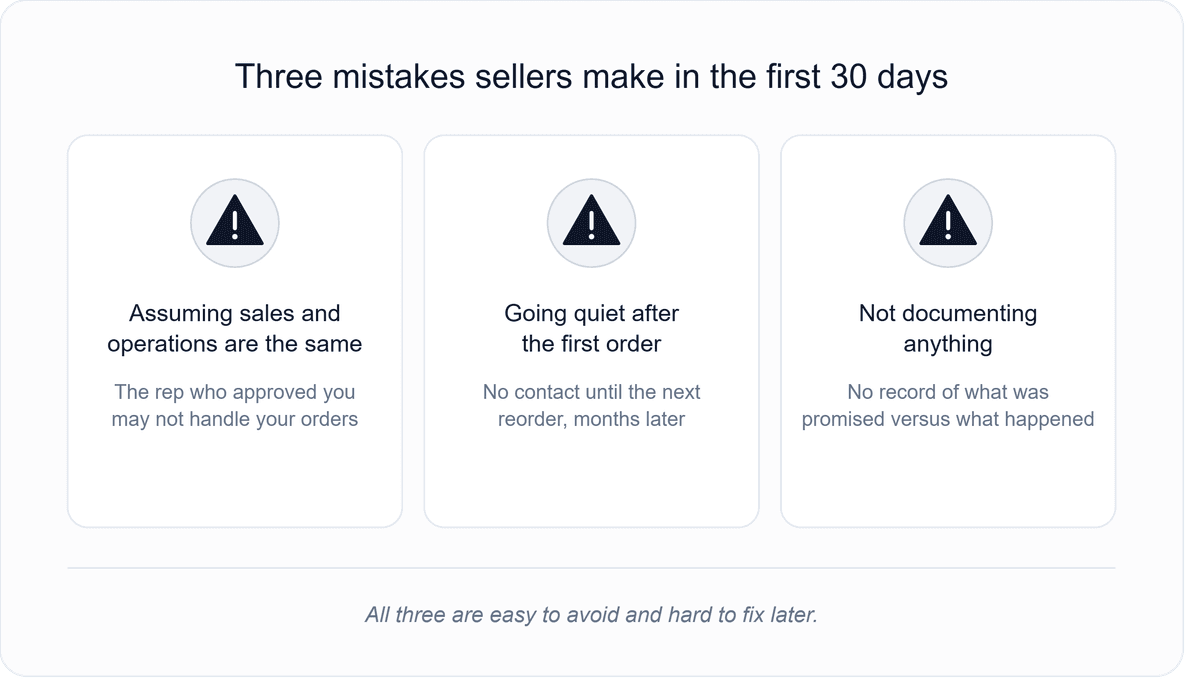
A handful of patterns come up repeatedly in the early weeks of a new distributor relationship, and most of them are avoidable simply by knowing to look for them.
Assuming the sales process and the operational reality are the same thing is probably the most common one. The person who approved your account and the person handling your actual orders are sometimes different people entirely, with different priorities and different familiarity with your specific situation. Building the operational relationship deliberately, rather than assuming the warmth from approval carries over automatically, prevents a lot of early confusion.
Going quiet after the first order is another frequent mistake. Some sellers place one order, everything goes fine, and then months pass with no contact until the next reorder. A short check-in during week three or four, even just confirming reorder timing or flagging a minor question, keeps the relationship active and gives the distributor a reason to remember your account as an engaged one rather than a one-time buyer.
Not documenting anything during this window is the quiet mistake that causes the most damage later. Three months in, when a discrepancy comes up, or pricing needs revisiting, having your own record of what was actually promised and what actually happened during onboarding is the difference between a quick resolution and a frustrating back-and-forth trying to remember details from memory.
Finding Distributors Worth This Effort
The first 30 days take real attention, which is exactly why it's worth being selective about which distributor relationships are worth that effort in the first place. A carefully managed first month with an unauthorized or unreliable supplier is still time spent on a relationship that was never going to hold up.
If you want to start with distributors who are already vetted for authorization and operational reliability, B2B Supplier Hub was built to help Amazon wholesale sellers connect with pre-verified accounts, so the effort you put into these first 30 days goes toward a relationship worth building.
The Short Answer to Work on First 30 Days
Approval is the start of the relationship, not the end of the process. Spend the first week understanding how the distributor actually operates, place a deliberate first order in week two, compare what happened against what was promised in week three, and set a real reorder rhythm by week four. Sellers who treat this first month intentionally end up with accounts that run smoothly. Sellers who skip straight to ordering usually spend the next few months untangling avoidable confusion instead.
Frequently asked questions
01What should I do immediately after getting approved by a wholesale distributor?
02How big should my first order be with a new distributor?
03How long does it take for a new distributor relationship to feel normal?
04Should I contact my distributor if I have not placed a second order yet?
05What is the biggest mistake sellers make right after getting approved?
The B2B SupplierHub Team
Wholesale & sourcing
Stop hunting suppliers by hand. Type a UPC instead.
B2B Supplier Hub shows the suppliers in our network carrying a product on one page: wholesale cost, stock, and retail price side by side. Free to search, no card required.