
Industry Insight
Wholesale Price Calculator for Amazon: Landed Cost to Real Net Margin
Amazon wholesale has one rule that catches out almost everyone coming from another kind of selling: you don't get to set your price.
You're sharing a listing with other sellers. The price a buyer sees is whatever the Buy Box says that day, and you can't push it up a dollar to save a thin margin. So your whole profit is set in one moment, before you sell a single unit: the price you agree to pay your distributor. Pay a little too much and you're stuck with it. The deal is already done.
That's why the math you do before you buy matters more here than almost anywhere. A wholesale price calculator does it for you. It takes the price on a distributor's sheet, adds up every fee Amazon and your supply chain will charge, and shows you what you'll actually keep while you can still say no.
So let's run that math the right way, from what a unit really costs you down to what you actually pocket.
What Is Landed Cost? (Start Here, Not the Price Sheet)
Landed cost is what it really takes to get one unit into an Amazon warehouse, ready to sell. Start with your buy price from the distributor. Add the freight to ship it in. Add prep and packaging. Add duties if you're importing. Add Amazon's inbound placement charge.
The supplier's quote is only the first line of that. A unit that costs $10 on the sheet might cost you $10.50 or $11 by the time it reaches a warehouse. Get this number right, because everything else is built on top of it. And if reading a supplier's price sheet still confuses you, start there first.
Amazon FBA Fees in 2026: The Full Stack
Once a unit sells, Amazon takes its cut in more places than most sellers expect. Here's the full stack in the US, as of 2026. Know each line, because a good calculator subtracts all of them.
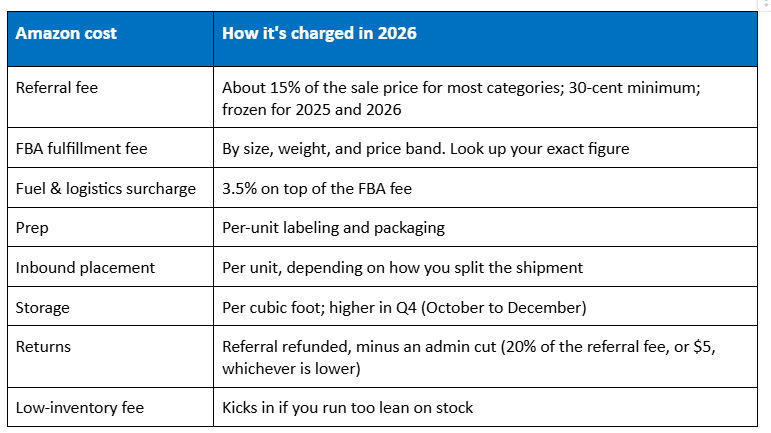
A few of these need explaining. The referral fee is Amazon's commission on the sale. For most categories it's 15% of the sale price, and it's stayed there for 2025 and 2026. There's a 30-cent floor that only matters on cheap items.
The FBA fee is the one to look up, not guess. In 2026 Amazon sets it by size, weight, and even the price of the item, so two products that look alike can cost different amounts to ship. Pull the real number from your Seller Central Fee Preview. It changes your profit more than any other line.
The 3.5% fuel surcharge sits on top of the FBA fee. It's small, and it's easy to forget, which is why it belongs in the calculator instead of your head. Prep, placement, storage, and returns are the quiet ones. None is big on its own. Add them up and they can cost you two or three points of margin, and they're the fees people forget most.
Net Margin vs ROI: What Each Number Tells You
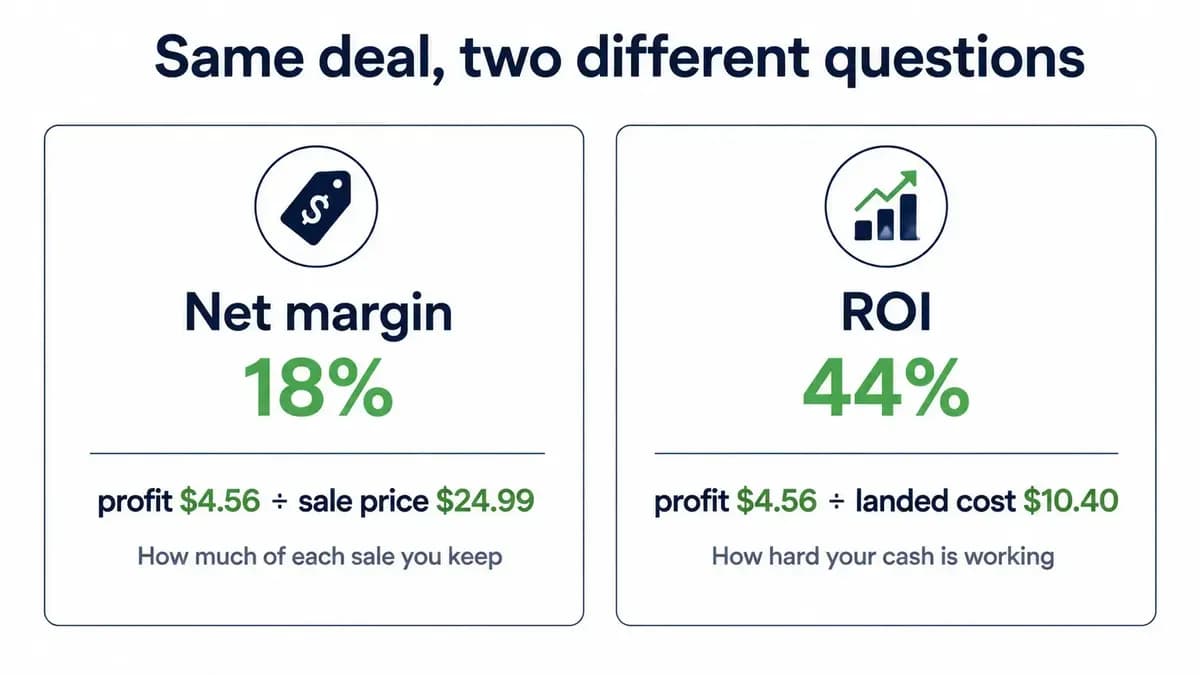
Two numbers tell you if a deal is good, and wholesale sellers need both. Net margin is your profit divided by the sale price. It tells you how much of each sale you keep. A 20% margin means you keep a dollar out of every five that come in.
ROI is your profit divided by what you paid for the unit, your landed cost. This one tells you how hard your cash is working. People miss how much it matters. A cheaper product that sells fast, so you can reorder every few weeks, can beat a higher-margin product that sits for months, because your money gets back to work sooner. The hidden cost of slow-moving stock is a trap on its own.
For a rough guide, most Amazon wholesale sellers run between 10% and 20% net margin. Under 8% is a warning sign. Over 20% is a strong deal.
Worked Example: A $24.99 Sale, Fee by Fee
Let's run one unit all the way through. These are example numbers, so yours will be different. Treat the FBA line as a placeholder until you look up your own.
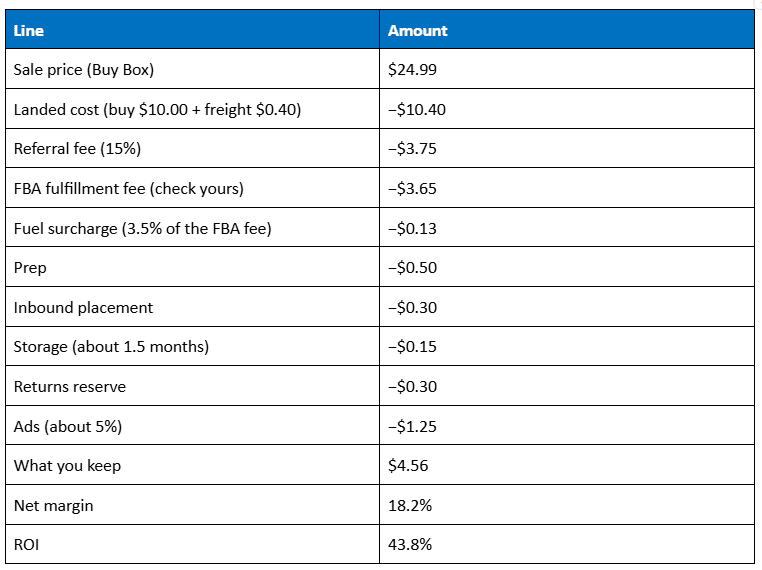
A unit that sells for $24.99 leaves about $4.56 in your pocket. That's an 18% margin and a 44% ROI. A good deal, and one you'd happily reorder.
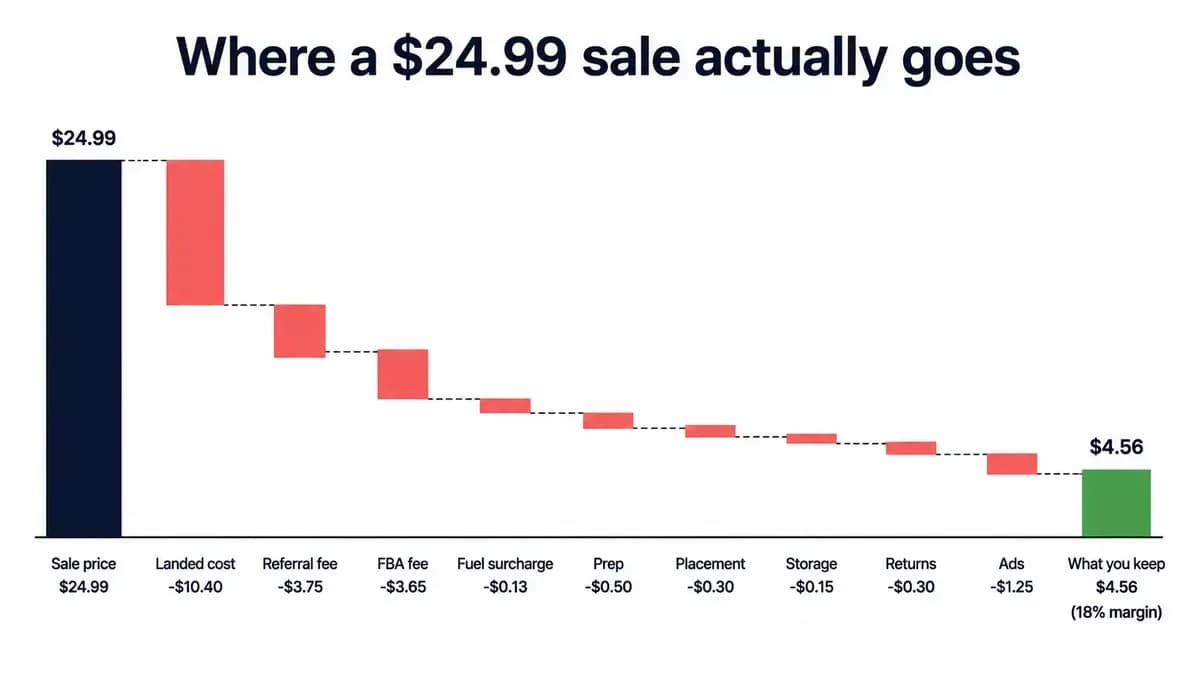
Look at how much rode on one line. Make it a heavier product with a $5.40 FBA fee instead of $3.65, and the same deal drops under 13%. That's why you look up your real fulfillment fee before you trust any of this. Nothing else on the page moves the answer as much.
Reverse Calculation: Your Maximum Buy Price
This next part changes how you negotiate. On a shared Amazon listing, you usually can't set the sale price. The Buy Box price comes from the market. You can't change Amazon's referral rate either. The one thing you control is your buy price. So the real question isn't whether a deal is profitable. It's how much you can pay and still hit your margin.
Now Work backwards. Start with the $24.99 sale price. Take out every cost that isn't the product itself: referral, FBA, surcharge, prep, placement, storage, returns, and ads. That came to about $10.03. Now take out the profit you want to keep, say 20%, or $5.00. You're left with $9.96. That's the most you can pay to land a unit and still hit your target. Take off your freight and you get a buy price of about $9.56. That's your walk-away number. Go into the call already knowing it, and you won't talk yourself into a deal that only looked good on paper.
The Bottom Line: Decide on Net Margin, Not the Sticker Price
In Amazon wholesale, the buy price is the whole game. Once you've paid the distributor, the listing price is out of your hands and the fees are fixed. So the one move that decides whether a deal works is the one you make before you order.
That's the one to get right every time. Start with your real landed cost. Take out the full stack of fees. Check your margin and your ROI before you buy. Better yet, work out your walk-away buy price first, so you know your limit before anyone quotes you. It takes about a minute, and it beats finding out on the payout report.
Once you have that number, the next step is finding suppliers who'll sell at or below it. That's what B2B Supplier Hub does. Search a product, see real wholesale costs and live stock from the distributors who carry it, and check your number against the market in seconds. Start free and price your next order before you place it.
Frequently asked questions
01How do you calculate profit margin on Amazon wholesale?
02What is landed cost for Amazon FBA?
03What's a good profit margin for Amazon wholesale?
04Did Amazon fees change in 2026?
05What's the difference between margin and ROI?
The B2B SupplierHub Team
Wholesale & sourcing
Stop hunting suppliers by hand. Type a UPC instead.
B2B Supplier Hub shows the suppliers in our network carrying a product on one page: wholesale cost, stock, and retail price side by side. Free to search, no card required.