
Industry Insight
How Much Money You Need to Start Amazon Wholesale (2026)
-1200x627.webp&w=3840&q=75)
If you've searched this question, you've probably seen two kinds of answers. Ads that say you can start with $500. And people who say you need $25,000 or you're wasting your time. The truth sits in the middle, and the only way to find it is to add up the real costs one by one.
That's what this blog does. We'll go through what setup costs in 2026, what your first orders will cost, and one expense that most beginners forget completely, even though it's usually the reason a new seller runs out of money. Everything here is a range or a simple example, not a promise. Your exact numbers will depend on your products and your suppliers.
The Short Answer: You Need About $5,000
Let's answer the question right away. Setting up your account and paperwork only costs a few hundred dollars, and technically you can place your first order with $2,000. But if you want a real chance at building something, plan for about $5,000.
The reason is simple. With $5,000 you can order enough units to actually learn what sells. You can survive one wrong pick. And you still have money left to reorder when a product does well. Anything less and you lose one of those three, usually the reorder. The rest of blog walks you through the math, so you can check every number yourself.
Amazon Wholesale Setup Costs: $400 to $700
First, the basics. This is the part beginners worry about most, and it's the smallest cost on the page.
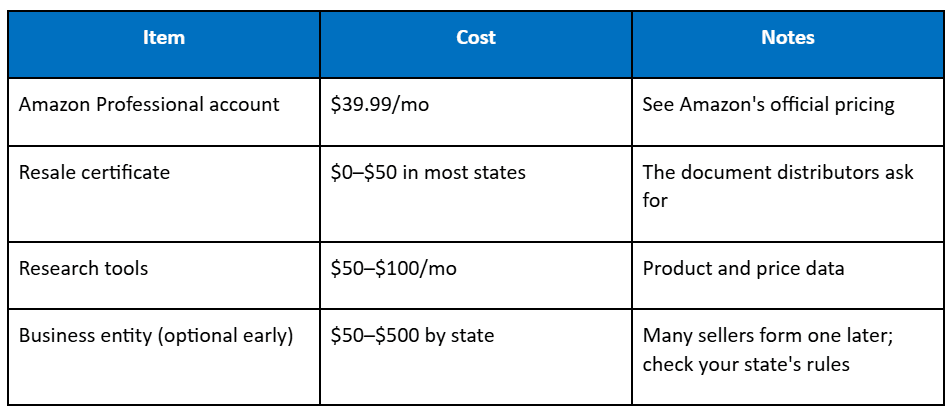
All of it together, including a couple of months of subscriptions, comes to about $400 to $700, depending on your state and how many tools you start with. The account fee is the one fixed number in the table, straight from Amazon's official pricing page.
Here's the thing to notice. The real gate into wholesale isn't money. It's paperwork. A distributor doesn't ask how much capital you have. They ask for your resale certificate and check that you look like a real business. We covered exactly what they check in what distributors look for before approving a seller.
And don't overthink the $39.99. If $40 a month is a problem for your plan, the plan isn't ready yet.
The $5,000 Budget: Where Every Dollar Goes
Now the main numbers. Here's how to split a $5,000 budget.
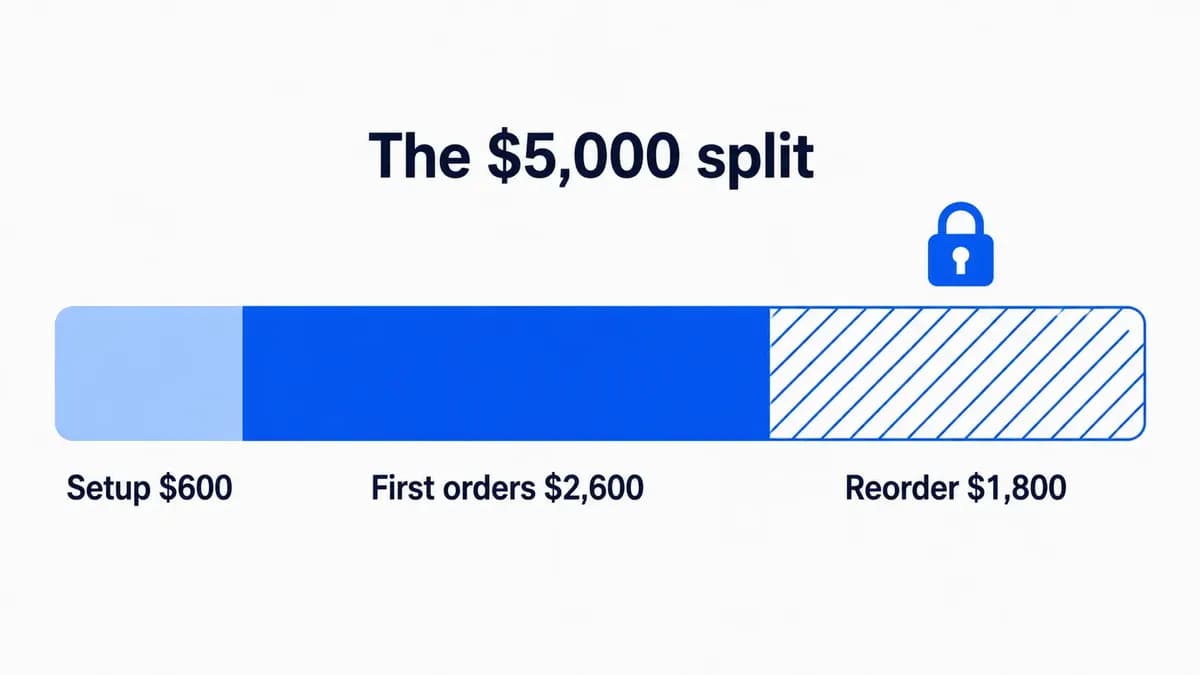
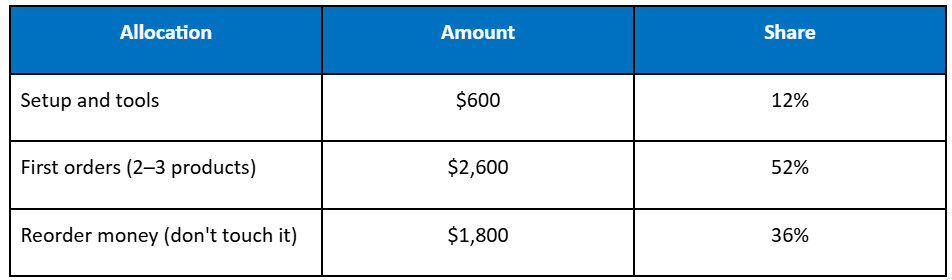
Why $2,600 for the first orders? Because distributors sell in case packs and most have a minimum for your opening order. Your first orders need to be big enough to meet those minimums, but small enough that you can test two or three products instead of betting everything on one.
Here's a simple example. Say you find a product that costs $12 at wholesale. A $1,300 order gets you about 108 units. Do that with two products and you've spent $2,600, met the usual minimums, and now you have real sales data on two products instead of one. Orders this size also give you invoices with more than 10 units, which is what Amazon usually wants to see if you apply for ungating.
Could you spend the whole $2,600 on one product to get a better unit price? You could, and sometimes that's exactly how new sellers get hurt. A cheaper unit price means nothing if the extra units sit in storage for five months. We wrote a full blog on this trap: The Economics of MOQ: When Bigger Orders Hurt Margin.
That leaves one strange part of the split. Why is $1,800, more than a third of the budget, just sitting there? That's the next section, and it's the most important one in this blog.
The Cost Nobody Budgets: The Second Order
Here's a timing problem that catches almost every new seller.
You pay your distributor today. Your products sell over the next six to ten weeks. Then Amazon pays you in cycles, usually every two weeks, and holds part of your money until about a week after each order is delivered. Put it all together, and the money you spend today doesn't really start coming back for about eight weeks. Sometimes longer.
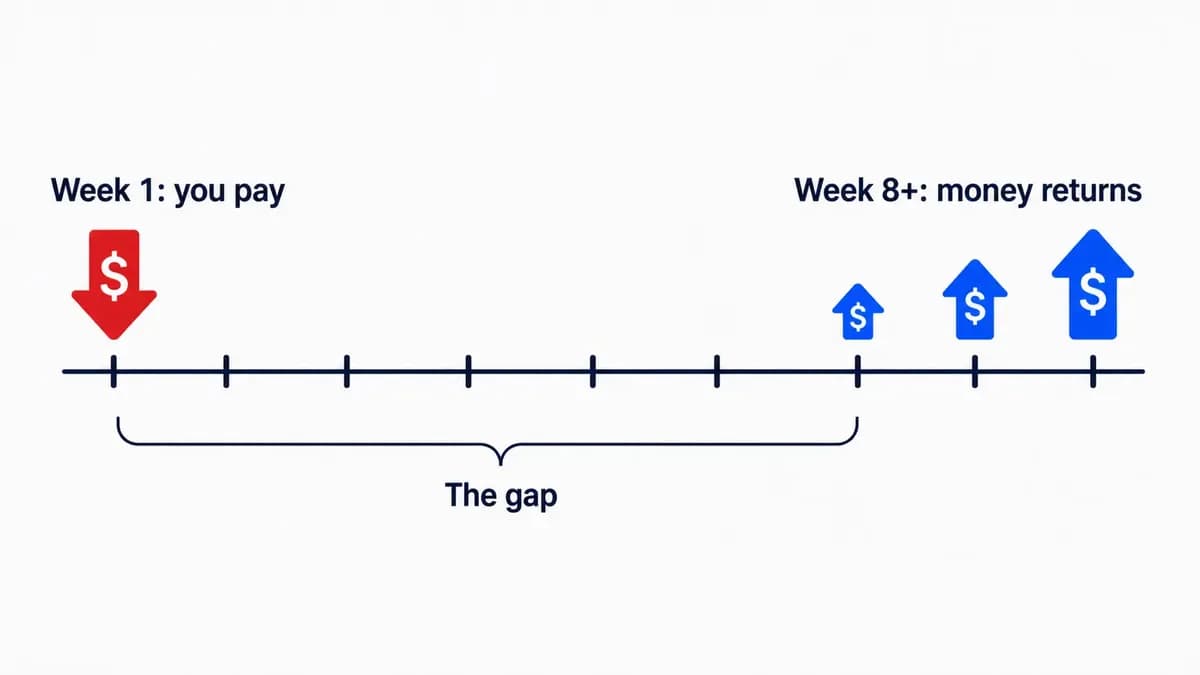
And when it comes back, it's less than you expect. Amazon takes its referral fee first, which is 15% in most categories. Then FBA fees, prep costs, shipping to the warehouse, and returns all come out too. Across the industry, these fees together often take 30 to 45 percent of the sale price. The one piece of good news for 2026 planning: referral fee rates are frozen this year, and FBA fees rose only slightly, so the math you do today should hold. Still, new sellers often plan as if the full sale price comes back to them. It never does.
Now here's the painful part. Imagine your first product sells well. Great news, right? Except now you need to reorder, and you need to reorder soon, because you'll run out of stock in a few weeks. But your money from the first order hasn't come back yet. It's still inside Amazon's payment cycle. If you spent everything on the first order, all you can do is watch your best product go out of stock. You lose sales, your listing loses its momentum, and getting that back is harder than keeping it.
That's the odd truth about this business. A product that sells well eats your cash faster than a product that fails. Sellers who start with $2,000 and quit usually didn't pick a bad product. They picked a good one and had no money left to reorder it. That's the job of the $1,800 in the split. It's not backup money. It's the money for your second order, saved before you place your first.
$2,000 vs $5,000 vs $10,000: What Each Gets You
Here's an honest look at what happens at each budget level.
$2,000. You can start with this much, but you should know exactly what it means. After setup costs, two thousand dollars leaves you enough for one small order of one product, and once that order is placed, your money is gone. So there is nothing left to reorder with, and there is no room to be wrong. Your first product has to sell, your supplier has to deliver, and your timing has to work, all on the first try. A few sellers manage this, but when it works, it's usually because they got lucky, not because the plan was solid. So if $2,000 is what you have, that's fine, but treat this first order as the price of learning the business, not as the start of one.
$5,000. This is where things change, because now the same money can do three jobs instead of one. It buys your first orders across two or three products instead of a single bet. It leaves reorder money waiting, so when one of those products sells, you can buy it again without waiting for Amazon to pay you. And because you spread your orders across a few products, one wrong pick no longer ends everything, since the others are still selling while you recover. That's why $5,000 is the working floor. It's not that the number is special. It's that this is the first budget where a mistake is a setback instead of the end.
$10,000. More money helps, but not in the way most beginners think. It won't find you a better product, and it won't make anything sell faster. What it does is remove pressure. When a product proves itself, you can order more of it right away instead of ordering less than you should. And when something goes wrong, you can wait and think instead of grabbing the first way out, because your account isn't at zero. That freedom matters, since most bad decisions in this business come from sellers who ran low on cash and had to do something. So $10,000 doesn't buy success. It buys you calm, and calm is what good decisions are made from.
Notice what's missing from all three. Any promise about what you'll earn. Anyone who attaches an income number to a starting budget is guessing, or selling you something.
Where to Cut and Where Never to Cut
If money is tight, be careful where you save it.
Some things are safe to skip. You don't need a paid course, because everything in them is already free to read. You don't need done-for-you services. You don't need five tools on day one, since one research tool is enough to start with. And you don't need to rush an LLC before your first order if your state doesn't ask for one yet.
Other things you should never skip. Keep your reorder money, for every reason in this post. Get your resale certificate, because real distributors won't open an account without it. And keep your test orders big enough to mean something. A 20-unit test teaches you almost nothing.
One more cost we haven't talked about is your time. Before you buy any product, you need to know what it costs at wholesale, who actually has stock, and what it sells for at retail. Doing that by hand means hours of digging through supplier portals and browser tabs, for every single product. That's the problem we built B2B Supplier Hub to fix. Search millions of wholesale products free and see the wholesale cost, real stock, and retail price side by side before you spend a dollar. When the numbers convince you, reveal the supplier.
One Thing to Do Before You Start
If you remember one thing from this blog, make it this: how you split your budget matters more than how big it is. A $5,000 budget split the right way will outlast $10,000 spent all at once on one exciting first order. Most sellers who quit in their first year didn't run out of ideas. They ran out of money right when a product finally started working.
So before you send your first dollar to a distributor, do this. Write down your budget. Set a third of it aside and call it your reorder money. Then don't touch it. Not for a tempting deal, not with a promise to pay it back later. If your first product fails, that money pays for your next try. If it works, that money keeps it going. Either way, it's what separates placing one order from building a business.
Frequently asked questions
01Can you start Amazon wholesale with $1,000?
02How much should your first wholesale order be?
03Is wholesale cheaper to start than private label?
04How long until an Amazon wholesale business is profitable?
The B2B SupplierHub Team
Wholesale & sourcing
Stop hunting suppliers by hand. Type a UPC instead.
B2B Supplier Hub shows the suppliers in our network carrying a product on one page: wholesale cost, stock, and retail price side by side. Free to search, no card required.