
Supplier Management
Master Distributor vs Authorized Distributor vs Sub-Distributor
A master distributor buys directly from manufacturers and sells to other distributors, not to resellers. An authorized distributor has a formal agreement with a brand to resell its products under set terms. A sub-distributor buys from a larger distributor instead of the brand, which puts it one layer further down the chain.
Simple enough on paper. But suppliers use these labels loosely. That is not surprising in an industry this fragmented: IBISWorld counts more than 700,000 wholesale businesses operating in the US in 2026. The label tells you two things that matter: how far you sit from the brand, and whether your paperwork holds up the day someone asks you to prove where your products came from. Get this wrong and you end up paying more than you should for inventory you cannot properly document.
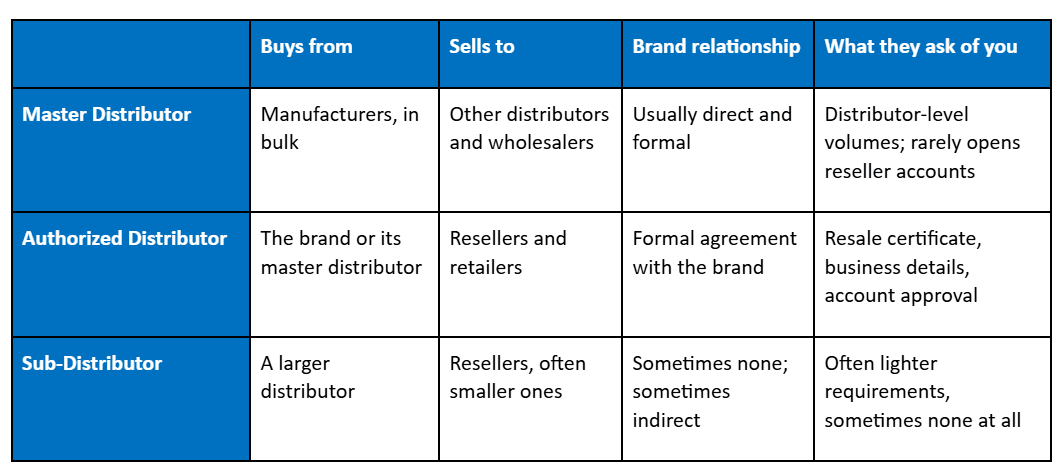
What Each Term Means
Master Distributor
A master distributor sits at the top of the chain, right below the manufacturer. They buy in serious bulk, hold large regional inventories, and their job is to feed other distributors, not to feed resellers. In many industries this is called two-step distribution, because the product takes two steps to reach the businesses that sell it: manufacturer to master, then master to distributor.
The part most resellers miss is that a true master distributor is committed to staying out of your lane. They sell to wholesalers and distributors, and that is it. Some also appoint sub-distributors to cover territories they cannot serve directly. So, if you have ever found a master distributor's website, gotten excited, and then been redirected to one of their distribution partners, that was not a brush-off. That is how their business works.
Authorized Distributor
An authorized distributor is a company the brand has formally approved to buy and resell its products. There is a real agreement behind the word "authorized," and it usually spells out territory, product lines, and pricing rules such as MAP compliance.
What matters most here is that authorization is a relationship, not an inventory position. A supplier can have a warehouse full of genuine product and still not be authorized. The value of an authorized distributor is not the stock on their shelves. It is that their invoices can be traced back to the brand, and the brand will vouch for the relationship if anyone checks.
Sub-Distributor
A sub-distributor buys from a bigger distributor rather than from the brand. They exist for a good reason. Master distributors and large authorized distributors often have order minimums and account requirements that smaller resellers cannot meet, and sub-distributors fill that gap with smaller minimums and easier terms. The trade-off is distance: you are one more layer removed from the brand, and that distance has costs we will get to below.
The Mistake Everyone Makes: Treating These as One Ranking
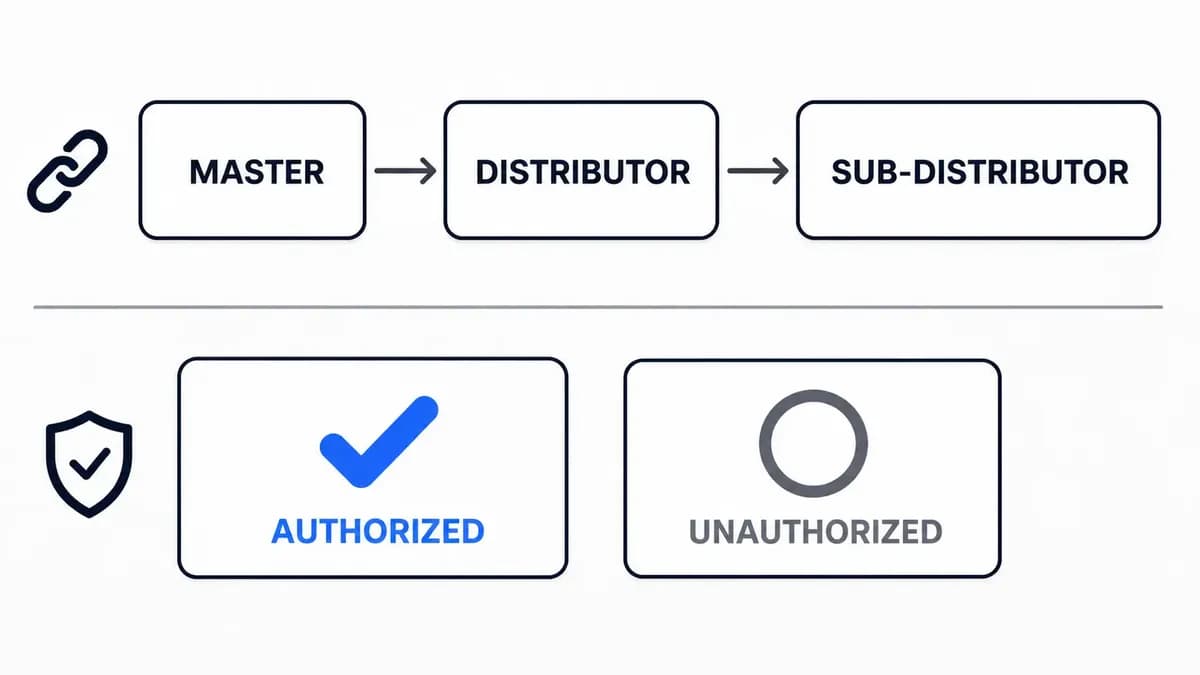
Most sellers hear these three terms and picture a ladder. Master at the top, authorized in the middle, sub-distributor at the bottom. That picture is wrong, and it causes real sourcing mistakes.
These labels describe two different things. "Master" and "sub" describe where a company sits in the chain: who they buy from and who they sell to. "Authorized" describes whether the brand formally recognizes them. Those are separate questions, and the answers do not always line up. A master distributor is usually authorized by the brands it carries. A sub-distributor might be authorized too, or might have no brand relationship at all. Two sub-distributors can carry the same product at the same price, and one is a far safer source than the other. We break down that ladder fully in our guide to how brand authorization tiers work.
This confusion produces three common mistakes:
- Taking "authorized" at face value. Sometimes a supplier who says "authorized distributor" means they are authorized by their supplier, another distributor, not by the brand itself. The wording rarely makes the difference obvious.
- Treating a master distributor as a place to shop. Their pricing is the best in the chain, but it is built for accounts buying at distributor volume. For most resellers, the master is a map of where the chain starts, not a supplier.
- Accepting a sub-distributor's invoice without checking the chain above them. The invoice only proves the last step of the journey, not the whole route.
When a supplier's label is unclear, one question cuts through all of it: who authorizes you, the brand or another distributor? A supplier with a real brand relationship answers that quickly and specifically. A supplier who gets vague just answered it too.
Why Chain Position Matters for Wholesale Resellers
If the product is genuine either way, why care? Three reasons, and each one hits your business directly.
- Cost
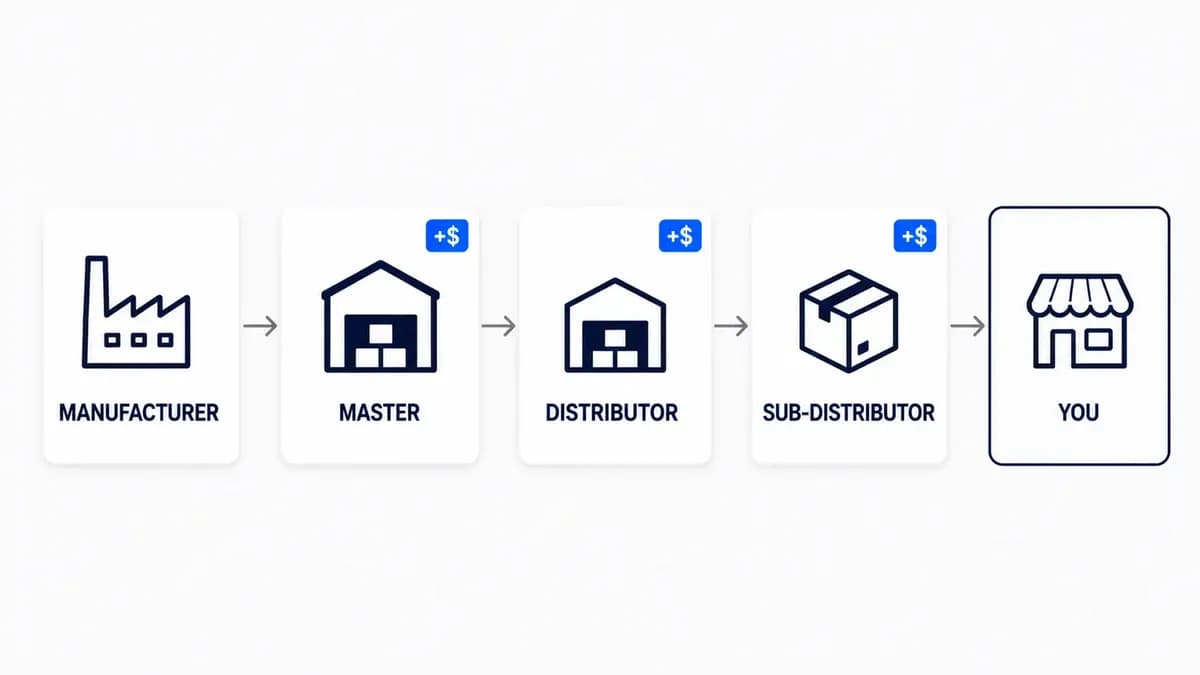
Every layer between you and the manufacturer takes its cut. A master distributor's price reflects one markup. An authorized distributor's price reflects that markup plus their own. By the time a product reaches you through a sub-distributor, two or three margins are baked into your cost, and you compete against sellers sourcing one layer up. Same product, same listing, structurally worse economics.
- Documentation
The further your supplier sits from the brand, the weaker your paper trail becomes. If you sell on Amazon, that day arrives as an ungating request or an inauthentic claim, and both work the same way: they test the chain, not the product. Real goods with an unverifiable supply chain still fail those reviews. This is the line between authorized, middleman, and gray-market supply. An invoice from a distributor the brand recognizes carries weight. An invoice from a sub-distributor nobody can trace often does not, no matter what is sitting in your warehouse.
- Access
Buying higher up the chain is better on both counts above, but higher layers are harder to get into. Masters typically will not open reseller accounts at all. Authorized distributors will, but their approval process is not automatic. Finding out who carries a product and being approved to buy from them are two different problems, and the second one takes real work.
How to Tell Which One You're Talking To: 4 Checks
You do not need to be an expert to figure out what kind of supplier is in front of you. Four checks do most of the work:
Check 1: Ask Who They Buy From
The answer sorts suppliers fast. "We buy directly from the brand" is one answer. "We work with several major distributors" is a different one. Both can be legitimate sources, but you should know which you are dealing with before you commit.
Check 2: Confirm the Brand Lists Them as a Distributor
Many brands publish their distributor networks or will confirm a relationship if you ask. If the brand recognizes the supplier, that is the strongest signal you can get. If the brand has never heard of them, trust the brand over the label on the supplier's website.
Check 3: Look at What They Require From You
A real wholesale distributor asks for a resale certificate, business details, and usually puts you through account approval before you see a price. If anyone can check out with a credit card and no questions asked, whatever that business is, it is not operating as a true distributor.
Check 4: Ask What Supply Chain Documentation They Can Provide
A supplier with a genuine brand relationship can show paperwork that names it. If the answer is defensive or vague, that tells you where they sit in the chain, whatever the website says.
So Which One Should You Buy From?
The practical answer to this question is the highest-positioned supplier that will approve your account and whose terms you can realistically meet. For most wholesale resellers, that is a brand-authorized distributor. It is the point in the chain where pricing is still competitive, invoices hold up under scrutiny, and the account requirements are demanding but reachable. A sub-distributor is a legitimate fallback, but only when the authorization chain above them is documented and you have checked it. Going higher than an authorized distributor usually costs more time than it returns.
Frequently asked questions
01Is a master distributor the same as a wholesale distributor?
02Can a sub-distributor be an authorized distributor?
03Do master distributors sell to resellers?
04How do I verify a distributor is authorized by a brand?
The B2B SupplierHub Team
Wholesale & sourcing
Stop hunting suppliers by hand. Type a UPC instead.
B2B Supplier Hub shows the suppliers in our network carrying a product on one page: wholesale cost, stock, and retail price side by side. Free to search, no card required.