
Sourcing
How to Qualify for Net-30 Terms With Wholesale Distributors
-1200x627.png&w=3840&q=75)
Wholesale has a cash flow problem built into its structure. You pay for inventory today, ship it to Amazon this week, sell it over the next month, and get paid on Amazon's disbursement schedule after that. For most of that cycle your money is sitting in someone else's warehouse rather than in your account.
Net-30 terms fix the front end of that gap. Instead of paying at the time of purchase, you receive the goods, sell them, and pay the distributor 30 days later, often before the inventory has fully sold through. In effect, it's a short-term, interest-free loan from your supplier, which is exactly why distributors don't hand it out to anyone who asks.
Here's what distributors are actually evaluating, what to have in place before you apply, and the sequence that turns a prepay-only account into one with terms.
What Net-30 Really Is From the Distributor's Side
Understanding the risk you're asking someone to take makes the whole approval process legible.
When a distributor grants you net-30, they ship inventory and wait a month for money, financing your purchase out of their own working capital. If you don't pay, they've lost both the goods and the cash. They're not selling you a payment option; they're underwriting you.
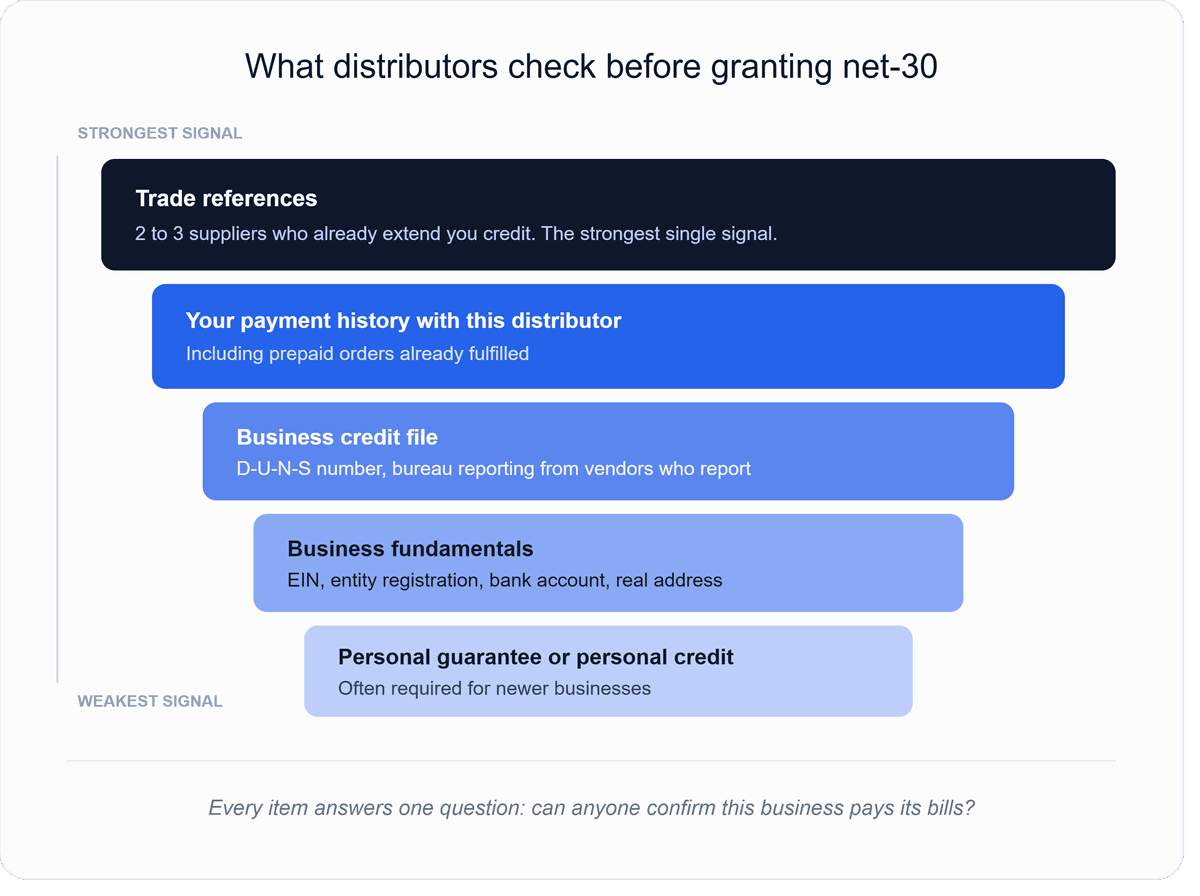
That framing explains everything that follows. Every document on a credit application exists to answer one question: what evidence is there that this business pays its bills? Not whether you intend to, which every applicant claims, but whether anyone can confirm you already have.
Worth knowing on timing: net-30 usually means 30 days from the invoice date, so an invoice dated June 5 is due July 5. That isn't universal, though. Under the Uniform Commercial Code, which governs most commercial sales of goods in the US, the default rule is payment on receipt of goods. Read the terms rather than assuming, especially with a new supplier.
You may also see terms written as 2/10 net 30, which means a 2 percent discount if you pay within 10 days, with the full balance otherwise due at 30. That discount is worth more than it looks on repeat orders and is often the single easiest margin improvement available to a wholesale buyer.
Build the Foundation Before You Apply
Applications get declined for missing basics more often than for bad credit. Five things should exist before you fill anything out.
A properly formed business with an EIN, registered in your state, matching across every document you submit. Mismatches between your application, your resale certificate, and your bank records look like carelessness at best.
A business bank account in the business's name, separate from personal accounts. Distributors' credit departments notice when there isn't one.
A D-U-N-S number from Dun & Bradstreet, which many distributors require before they'll even process a credit application. It's free, and the timing is the part people get wrong: standard processing can take up to roughly 30 business days, so request it well before you need terms rather than during an application. Check first whether you already have one, since D&B sometimes creates a profile for a business automatically.
A real business address and phone. Some distributors specifically won't approve a PO Box, and a working phone number that a credit department can call matters more than it should.
Your resale certificate and any state permits, since these come up on the same application anyway.
Trade References Outweigh Everything Else
The most important section of a wholesale credit application is the one asking for trade references: other suppliers who already extend you credit and can confirm how you pay.
Two or three references from suppliers in your category carry more weight with a credit manager than a bureau file does, because they describe real behavior with businesses like theirs. A credit score is an abstraction. A distributor in your industry saying you've paid on time for eight months is direct evidence.
Which creates the obvious problem for a new reseller: You need trade credit to build trade references and trade references to get trade credit. Three ways through it.
Start with starter vendors. A number of national suppliers extend net-30 to newer businesses with lighter requirements in categories like office, packaging, and industrial supplies. Their value isn't the products; it's that many of them report payment history to the business credit bureaus, which builds a file you can point to later. Requirements vary by vendor and change, so check current criteria directly rather than trusting any list, including this description.
Pay your way into the relationship. Place several prepaid orders with the distributor you actually want terms from, then ask. This is a common and well-worn path: their credit department can see your order history, your payments cleared, and the relationship is real. Some distributors will explicitly tell you to do a few prepaid orders first, which is an invitation rather than a rejection.
Order on a rhythm. A buyer reordering every six weeks generates payment evidence far faster than one placing a single seasonal order, so consistent smaller orders build credibility quicker than sporadic large ones.
The Application Itself
Most distributor credit applications ask for the same things: business details and structure, EIN, D-U-N-S, bank reference, trade references with contact details, an estimate of expected monthly purchasing volume, and a signature that may include a personal guarantee.
Two pieces of advice on completing it.
Call your trade references first. A reference who's expecting the call and responds quickly is worth more than one who takes two weeks to reply to a credit department's email, and slow references stall applications that would otherwise pass.
Be realistic about volume. Inflating projected purchasing doesn't improve your odds and can hurt them, since an initial credit limit is often set at roughly one to two times the value of a typical first order. Terms usually start small and expand with demonstrated history rather than beginning where you'd like them to.
Expect a personal guarantee if your business is young. It makes you personally liable for the balance, which is a real commitment worth reading carefully, and for many new resellers it's simply the price of the first line of credit. It's also often the thing that converts a decline into an approval.
Expect a counter-offer rather than a straight answer. Net-15, a modest credit limit, or a prepay-then-review arrangement are all common openings, and all of them are progress.
After Approval: Protect and Expand the Terms
Terms are easier to lose than to get. Pay early rather than on time, since the payment data your supplier reports and remembers is what supports every future limit increase. Where an early payment discount like 2/10 exists, taking it is usually free margin.
Request increases with evidence rather than need. After six months of clean history and growing order volume, asking for a higher limit is a reasonable conversation. Asking because you're short this month is the version that gets declined.
And keep the account active, because dormant accounts sometimes get reviewed downward. This fits into the broader arc of building a distributor relationship rather than just placing orders, which is covered in what distributors look for before approving an Amazon seller.
One caution specific to wholesale: terms make it easier to over-order, because the pain of payment is deferred. The math on whether a larger order actually helps you doesn't change just because you're paying later, and the economics of MOQ and when bigger orders hurt margin applies with more force on credit than on cash.
Terms Are Worth More With the Right Distributor
Net-30 improves your cash flow, but only with a supplier worth building a relationship with in the first place. Before you invest months of prepaid orders and credit history into a distributor, it's worth knowing what they actually stock and at what cost.
B2B Supplier Hub shows you that upfront: search any product by UPC, MPN, name, or brand and see every verified distributor in the network carrying it, with exact wholesale cost, live stock depth, and the date each listing was verified, free and unlimited. Pick the suppliers whose numbers justify the relationship, then start building the payment history that earns you terms.
Frequently asked questions
01How long does it take to qualify for net-30 with a distributor?
02Can a brand new business get net-30 terms?
03Do I need a D-U-N-S number for net-30?
04 What are trade references and where do I get them?
05Will a personal guarantee hurt me?
The B2B SupplierHub Team
Wholesale & sourcing
Stop hunting suppliers by hand. Type a UPC instead.
B2B Supplier Hub shows the suppliers in our network carrying a product on one page: wholesale cost, stock, and retail price side by side. Free to search, no card required.