
Supplier Management
How to Onboard a New Wholesale Supplier in 90 Days
A seller got approved by a distributor she had been trying to land for months. The account opened, the first invoice came through clean, and she assumed the hard part was behind her.
Six weeks later, she placed her second order and discovered the account manager she'd built rapport with had moved to a different territory, nobody on the new team knew her reorder pattern, and a shipment sat unprocessed for nine days because nobody had flagged it as a repeat customer. Nothing was wrong with the supplier. Nothing was wrong with her. The relationship simply hadn't been onboarded; it had just been opened.
Getting approved by a distributor and being fully operational with them are two different milestones, and treating them as the same thing is one of the most common reasons new supplier relationships underperform in their first few months. Approval means the paperwork cleared.
Onboarding means the relationship actually works the way it needs to when volume increases, when something goes wrong, or when the person you originally dealt with is no longer the person answering the phone. This guide lays out what onboarding a new wholesale supplier actually looks like over a realistic 90-day period, not just the first order but the full process of turning a new account into a dependable part of your supply chain.
Why the First 90 Days Matter More Than the First Order
Most of the risk in a new supplier relationship isn't in whether the first order arrives correctly. It's in everything that happens after that first order, when the relationship is still forming its patterns, and neither side fully knows what to expect from the other yet.
A supplier relationship in its first few months is fragile in ways that aren't obvious from the outside. Communication habits haven't been established, so a delay that would later be a quick phone call becomes a confusing email thread. Reorder timing hasn't settled into a rhythm, so the supplier doesn't yet know when to expect your next order or how urgently to treat a stock question from you.
Neither side has built up the kind of trust that smooths over a mistake, so a small error early on can read as a bigger red flag than it actually is. Ninety days is roughly the window most professional account managers describe, informally, as the point where a new account either settles into a working rhythm or starts showing signs it never will.
Treating that window intentionally, rather than assuming things will sort themselves out, is what separates a supplier relationship that scales smoothly from one that quietly underperforms for a year before anyone addresses it.
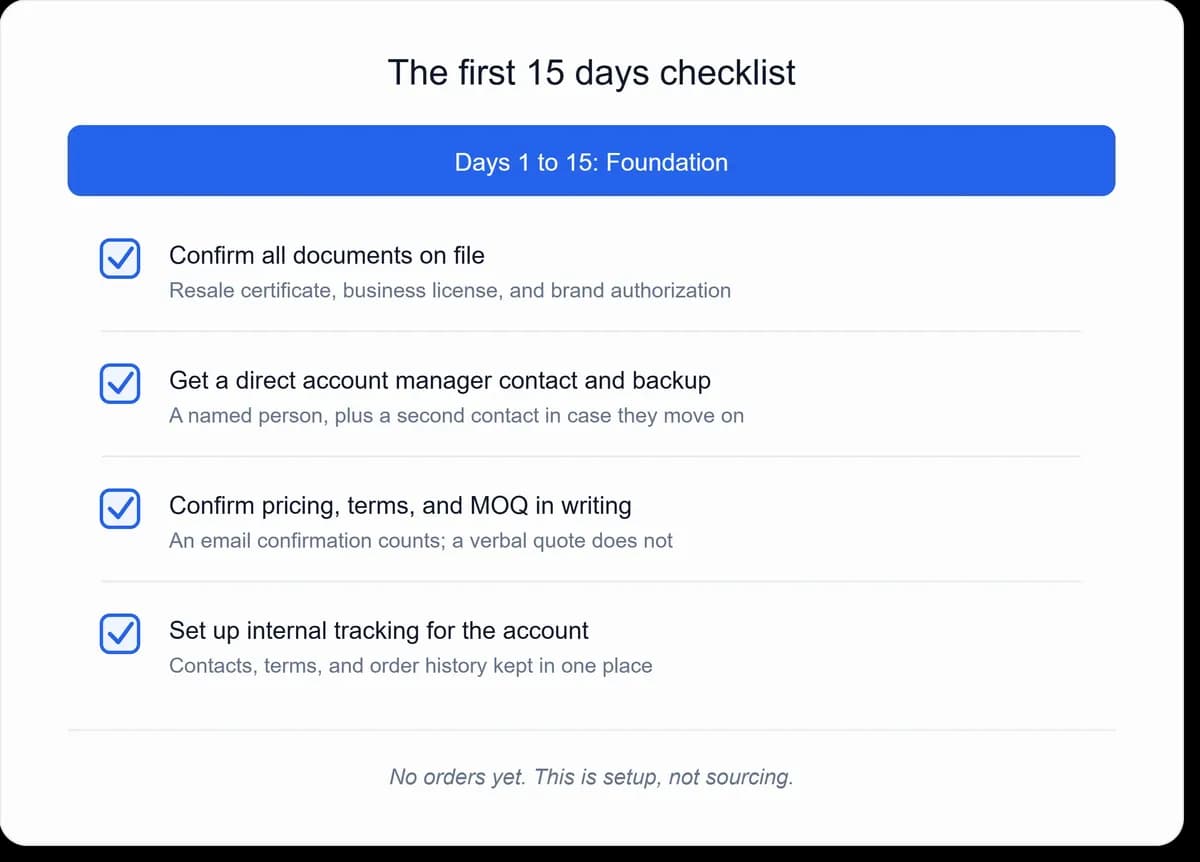
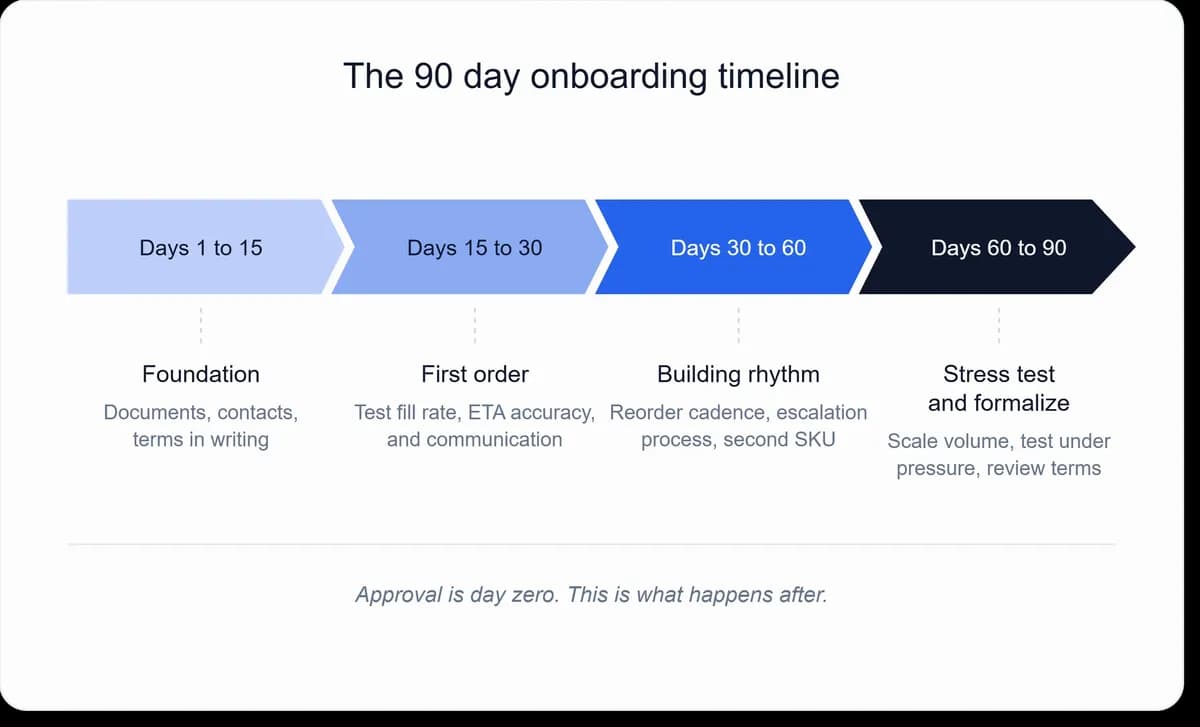
Days 1 to 15: Getting the Foundation Right
The first two weeks aren't about placing orders. They're about making sure everything underneath the relationship is set up correctly before volume gets added on top of it.
Confirm every document is on file and accurate on both sides. This means your resale certificate, business license, and any brand authorization paperwork are with the distributor and that you have your own copy of anything they've sent you, including their W9 if you'll need it for your own accounting. Errors here are easy to miss early and painful to untangle later, particularly around tax documentation.
Get a direct point of contact, not just a general order line. Ask specifically who your account manager is, how they prefer to be reached, and what their backup contact is if they're unavailable. A surprising number of onboarding failures happen simply because the seller never asked for this and defaulted to a generic support inbox that treats every inquiry as a first-time question.
Confirm pricing, payment terms, and MOQ in writing, even if these were discussed verbally during the approval process. Verbal agreements are easy to misremember on either side, and having the actual numbers in an email or portal removes any ambiguity before the first invoice arrives.
Set up your own internal tracking for the account. This can be as simple as a spreadsheet row with the supplier's contact info, agreed pricing, MOQ, lead time, and payment terms. It sounds basic, but sellers managing multiple supplier relationships lose track of the specifics constantly, and having it documented in one place from day one prevents confusion three months in.
Days 15 to 30: The First Order and What to Watch For
The first order is a test, whether or not either side treats it that way explicitly. What you're actually evaluating in this window isn't just whether the product shows up. It's whether the supplier's operational reality matches what was promised during the sales conversation.
Place a moderate first order rather than either a token minimum or your full expected volume. A token order that's much smaller than your real needs doesn't give you a meaningful read on fill rate or communication under normal conditions. A full-sized order before you've seen how the supplier actually performs puts more risk on the table than necessary this early.
Track the specifics against what was promised. Did the fill rate match what you expected, meaning did you receive everything you ordered in the quantities requested? Did the delivery arrive within the lead time window you were given, or was there a gap between the quoted ETA and reality? Was the invoice accurate against what was actually shipped, since discrepancies here early on are worth flagging immediately rather than letting them become a pattern?
Test communication deliberately, not just passively. Send a routine question during this window, something like asking about stock on a related SKU or confirming an upcoming reorder timeline, and pay attention to how quickly and how usefully it's answered. This tells you more about what the relationship will actually be like at month six than anything in the sales conversation did.
Days 30 to 60: Building the Operational Rhythm
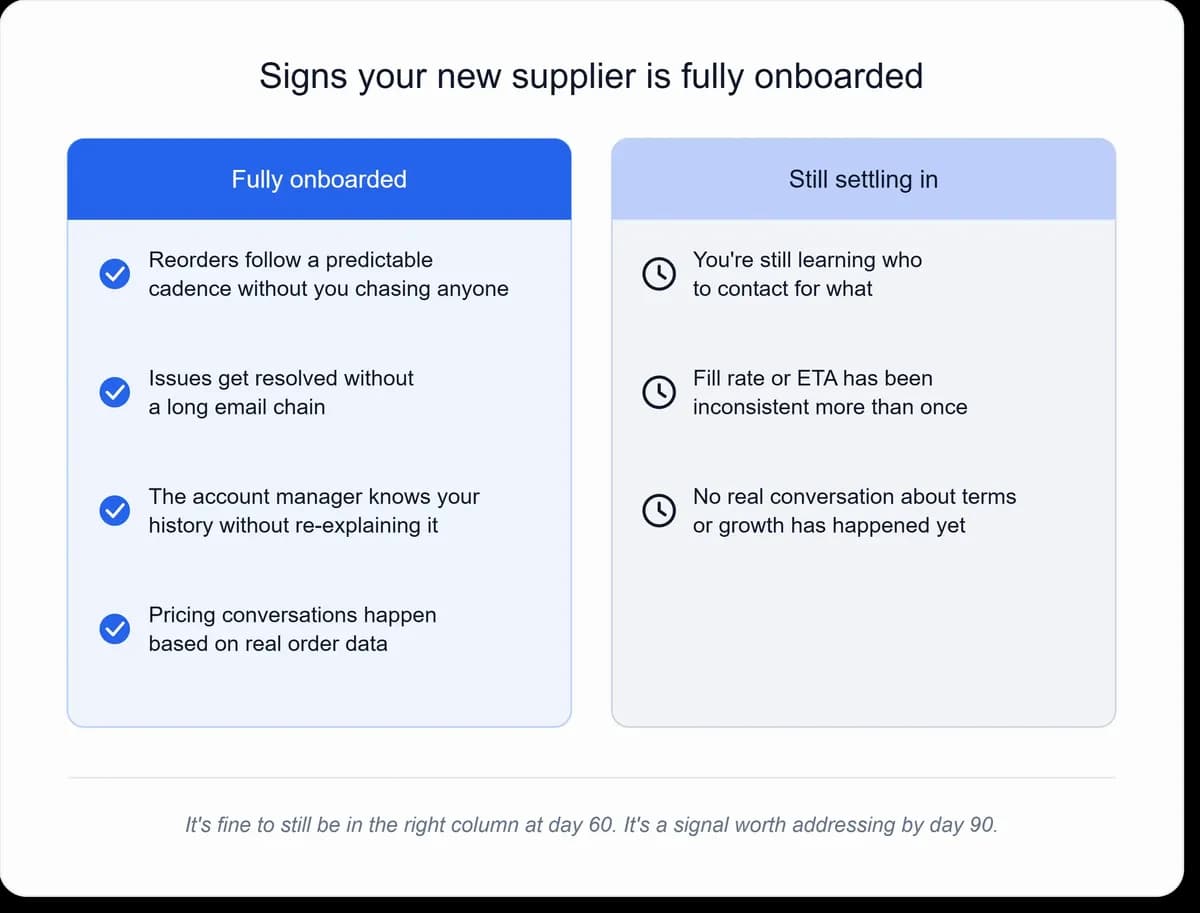
By the second month, the relationship should be moving from a single transaction toward a repeatable pattern. This phase is where a lot of sellers stop paying close attention, assuming the hard part is over once the first order has gone well, which is exactly when small issues start accumulating unnoticed.
Establish a reorder cadence rather than reordering reactively every time. Whether that's a fixed schedule or a reorder point tied to remaining inventory, having a defined rhythm makes it easier for the supplier to plan around your account and reduces the chance of a stockout catching either side off guard.
Clarify how issues get escalated before you actually need to escalate one. Ask what happens if an order is delayed, who to contact if the account manager is unavailable, and what the supplier's process looks like for correcting an invoice error. Having this answer in hand before a problem occurs means you're not improvising during an actual disruption.
Start introducing a second product or SKU if the relationship is going well, and it makes sense for your catalog. This is a good signal test in itself, since how smoothly a supplier handles adding a new item to an existing account tells you something real about their operational flexibility.
Review your internal tracking and update it with what you've actually learned, not just what was promised during onboarding. Real lead times sometimes differ slightly from quoted ones, real fill rates sometimes differ from the number on the price sheet, and it's worth having your own accurate numbers rather than relying only on what you were told at the start.
Days 60 to 90: Stress Testing and Formalizing the Relationship
The final phase is where you find out whether the relationship holds up under real conditions rather than just the calm, early honeymoon period most new accounts experience.
Increase order volume toward what you actually expect to run long-term, if the first two phases have gone well. This is the point where you find out whether a supplier who performed fine at low volume can actually scale with you, since some genuinely can't without more advance notice or a different order cadence than they use for smaller accounts.
Deliberately test the relationship under a less-than-ideal circumstance if a real one hasn't already come up. This might mean placing an order with a tighter timeline than usual or asking about a rush shipment, just to see how the supplier handles pressure rather than only ever seeing them at their best.
Revisit pricing and terms now that you have real order history. Ninety days of consistent ordering is often enough to have an honest conversation about volume tiers or payment terms, something covered in more depth elsewhere on negotiating wholesale pricing, but worth flagging here as a natural milestone to raise it.
Decide, explicitly, whether this supplier earns a place as a primary source for the products you're sourcing from them or whether the relationship stays useful but limited. Not every supplier that clears 90 days needs to become your main source for a given SKU. Some are better suited as a reliable secondary option, and that's a legitimate outcome of the onboarding process, not a failure of it.
The Most Common Onboarding Mistakes
A few patterns show up repeatedly in supplier relationships that never fully settle in, even months after approval.
Treating approval as the finish line is the most common one. The account opening is the start of the process, not the end of it, and relationships that skip a deliberate onboarding period tend to develop their operational habits accidentally rather than intentionally, which usually means those habits favor the supplier's convenience rather than yours.
Going all in on volume before the relationship has been tested is another frequent mistake, and it's the direct cause of situations like the one at the start of this article. A large early order removes your ability to course-correct cheaply if something about the relationship isn't working the way you expected.
Never establishing a real point of contact is a quieter but equally damaging mistake. Sellers who only ever interact with a general order inbox never build the kind of relationship that gets them prioritized during a shortage or given the benefit of the doubt on a shipping delay, because there's no specific person who actually knows their account.
Finding Suppliers Worth the 90-Day Investment
Onboarding takes real time and attention, which makes it worth being selective about which suppliers are worth that investment in the first place. Spending three months carefully onboarding a distributor who turns out to be unauthorized, unreliable, or a poor long-term fit for your catalog wastes exactly the effort this process is meant to protect.
If you want to start relationships with distributors who are already vetted for authorization and operational reliability, B2B Supplier Hub was built to help Amazon wholesale sellers connect with pre-verified accounts, so the 90 days you spend onboarding go toward a relationship that's actually worth building. Visit b2bsupplierhub.com to see which distributors are currently available.
The Short Answer: Why the First 90 Days' Duration is Important
Approval is day zero, not the finish line. Use the first 15 days to get documentation and contacts right, the next two weeks to test the first order carefully, the following month to build a real operational rhythm, and the final month to stress test the relationship and decide where this supplier actually fits in your sourcing strategy. Treating onboarding as a deliberate 90-day process, rather than something that happens automatically, is what turns a new account into a dependable one.
Frequently asked questions
01How long does it take to fully onboard a new wholesale supplier?
02What should I check during my first order with a new supplier?
03Do I need a dedicated account manager for a new supplier relationship?
04 Should I place a large first order to get better pricing?
05How do I know if a new supplier relationship is working out?
The B2B SupplierHub Team
Wholesale & sourcing
Stop hunting suppliers by hand. Type a UPC instead.
B2B Supplier Hub shows the suppliers in our network carrying a product on one page: wholesale cost, stock, and retail price side by side. Free to search, no card required.