
Quarter 4
How to Audit Your Supplier Base Once a Quarter
Most resellers never sit down and check how a supplier is actually performing. Not because they don't care, but because there's no obvious moment to do it. Orders keep arriving, invoices keep getting paid, and as long as nothing is on fire, it feels fine. So the first real look at a supplier usually happens after they've already caused a problem.
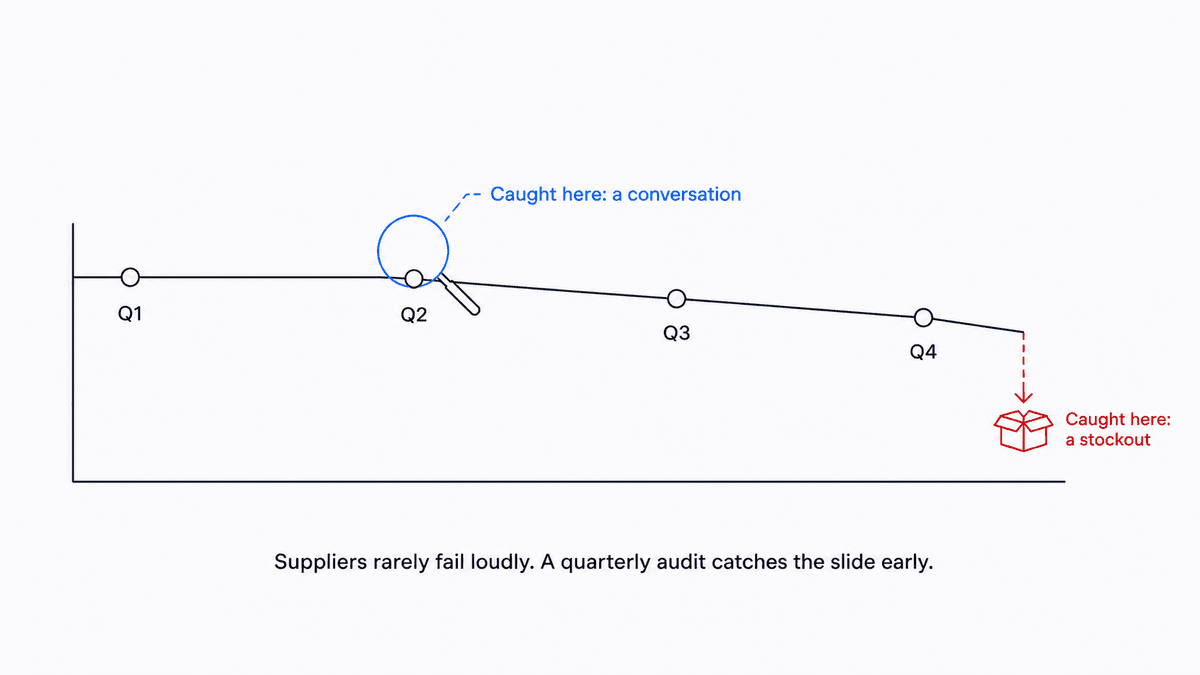
The trouble is that supplier problems build slowly. The price goes up a bit here, a shipment comes in short there, and none of it feels worth stopping for on a normal Tuesday. Then six months later you're wondering why a product that used to make money barely breaks even.
A quarterly audit fixes this. It sounds more formal than it is. Really, it's just 90 minutes with your own invoices and purchase orders, four times a year. This post walks through how to do it without turning it into a project.
Why Once a Quarter and Not "When Something Feels Off"
Because nothing ever feels off until it's expensive. That's the whole problem.
Say a product makes you 10 dollars on every sale after all costs. Your supplier raises the price by 2 dollars, and you don't catch it. You're now giving away a fifth of that product's profit on every single order, and nothing dramatic happened. No scam, no disaster. Just a price change nobody was watching for.
Short shipments work the same way. If you order 100 units and 91 show up, that doesn't hurt today. But on your best seller, those missing units eventually mean empty stock, lost sales, and a rushed reorder at whatever price you can find. Checking once a quarter means you catch these things while they're still small enough to fix with a phone call.
Tier First: Not Every Supplier Deserves the Same Audit
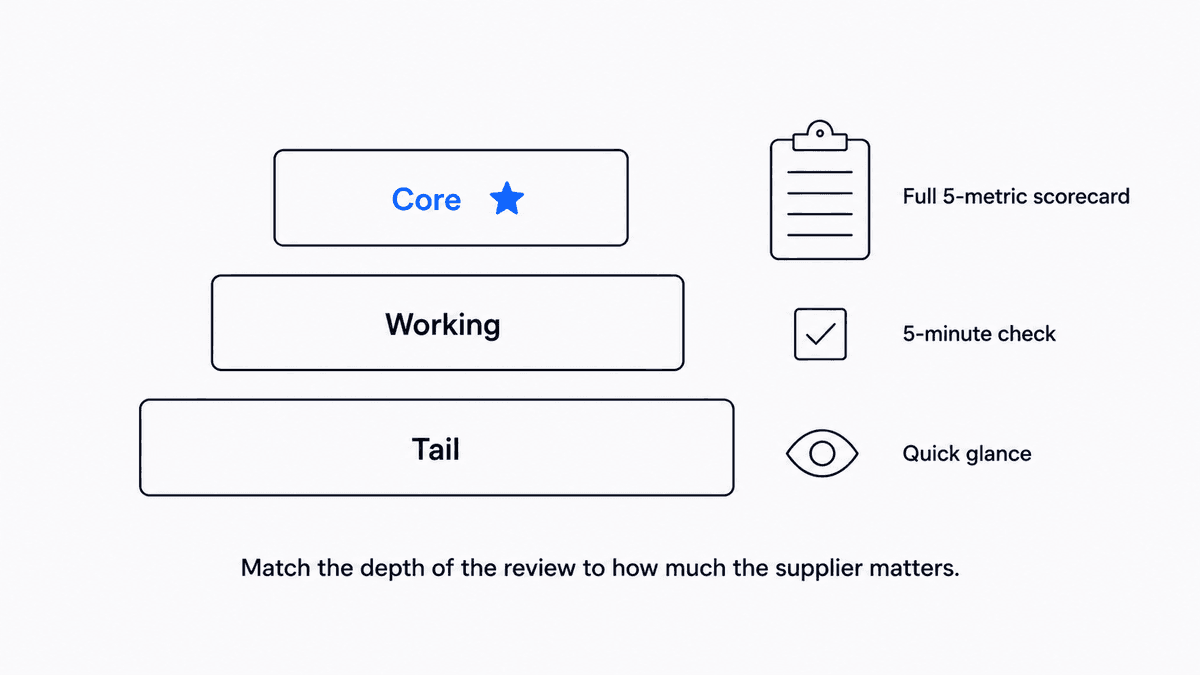
Here's where most people give up before they start. If you have 30 or 40 suppliers, checking all of them properly sounds like a lost weekend. So don't. Split them into three tiers and give each tier a different amount of your attention.
Core Suppliers
The handful that most of your money flows through. Maybe five of them, maybe eight. These get the full check described below.
Working Suppliers
The ones you order from steadily but could replace if you had to. These get five minutes each. Any late shipments this quarter? Any price surprises? Anything you complained about that never got fixed? If it's all clear, move on.
Tail Suppliers
The ones you order from now and then. Two questions: did the stuff arrive complete, and were there any problems? Done.
Most of your time goes where most of your money goes. That's what makes 40 suppliers fit into 90 minutes.
One side note while you're doing this. If you notice that one supplier now touches most of your revenue, write that down. That's a different kind of risk, and it deserves its own attention.
You Already Have All the Data
This is the part people overthink. There's no software to buy and nothing to set up. Everything you need is already sitting in three places: your purchase orders show what you asked for, your invoices show what you paid, and your inbox shows how the supplier acted when something went wrong. A basic spreadsheet with one row per supplier is the whole system.
The 5-Point Supplier Scorecard for Core Suppliers
1. Did They Ship What You Ordered?
Add up what you ordered this quarter versus what actually arrived. One short shipment can be bad luck. Short shipments getting more common is a pattern, and the pattern is what you're looking for.
2. Did They Deliver On Time?
Compare promised dates against actual dates. A supplier who says five days and takes five lets you keep less stock on hand. One who says five and takes eleven forces you to hold extra inventory just to cover for them, and that's your money sitting on a shelf doing their job.
3. Are You Paying More Than Last Quarter?
Pull up this quarter's invoices next to last quarter's for the same products. Price increases are normal in wholesale. Missing them isn't. Every increase should change your numbers the day it lands, not three orders later. If the supplier sends you a price file, check your invoices against that too. We've covered how to read those files in our guide to distributor pricing tier sheets.
4. Are Their Invoices Clean?
Billing mistakes, credits they promised but never sent, and charges that don't match what you agreed to. Each one is small. Added up over a quarter, they're a real number. And honestly, a supplier whose paperwork is always a mess is telling you something about the rest of their operation.
5. Do They Answer When It Matters?
Think back to the last problem you had with them. How long did it take to get a real answer? Search your sent folder and count how many times you had to chase. A supplier who picks up the phone during a problem is worth more than their price list shows. One who goes quiet exactly when you need them is a risk you'll never see in a spreadsheet.
If you want something to measure against, big companies generally expect suppliers to deliver on time about 95 percent of the time and get orders right about 98 percent of the time. But honestly, your own history with each supplier matters more than any industry number. What you're really watching is the direction, because a supplier holding steady at a modest number is less of a worry than a good number that keeps dropping.
Turning the Audit Into a Verdict: 3 Simple Grades
After checking, give each core supplier one of three grades. Keep it that simple on purpose.
Doing fine. Numbers are steady or better. Keep the record though, because a documented history of clean orders and steady volume is exactly what you bring to the table when you ask for better pricing later.
Needs a conversation. Something has slipped two quarters in a row, or one bad quarter cost you real money. Call them, and bring the numbers. "Nine of our last ten orders came in short" is something a rep can actually take to their warehouse. "You guys have been unreliable lately" gets you an apology and no change.
Time to protect yourself. Things keep getting worse, and it's costing you. This doesn't mean drop them tomorrow. It means start lining up a backup now, calmly, on your schedule, instead of scrambling after their next failure. And when you compare possible replacements, do it side by side with the same questions for each, not on gut feel.
The 90 Minutes, Step by Step
Block the first week of every quarter. When it comes, do the same thing every time. Pull the quarter's orders and invoices. Go through your core suppliers with the five questions. Give the working tier their five minutes each. Glance at the rest.
Then end with the one step that makes all of it worth doing. Write down three things: one supplier you're going to call, with the numbers in front of you. One number you're going to watch next quarter. One backup, you're going to start warming up if things don't improve.
That's it. Three actions, not a report. Bigger decisions, like which suppliers to grow next year or which products to walk away from, can wait for a year-end review, where four quarters of these notes give you something solid to decide from. The three actions are the point, because an audit you only file away doesn't change anything.
What a Quarterly Supplier Audit Gets You
Three things, mainly. When you want better pricing, you'll have proof of being a good account instead of just saying so. When a supplier starts slipping, you'll know in weeks instead of months. And if a relationship ever has to end, you'll be deciding from a year of notes instead of one bad week.
One last habit worth attaching to this. While you're looking at a supplier's numbers, it's the natural moment to look at what else is out there: what other distributors charge for your key products, what they have in stock, and how fresh their data is. Checking the numbers first, before committing to any change, is the same habit the audit builds, and it's exactly how we think sourcing decisions should be made.
To start, just block time in the first week of next quarter. Expect the first audit to run longer than 90 minutes, maybe double, since you're setting up the spreadsheet and pulling a full quarter of orders and invoices for the first time. You still check everything the same way. From the second quarter on, the sheet already exists; you're only adding new numbers next to old ones, and the whole thing fits in 90 minutes.
Frequently asked questions
01How often should you review your suppliers?
02What is a supplier scorecard?
03What should a small business track about supplier performance?
04What is a good fill rate for a wholesale distributor?
05Should I tell my supplier about their audit score?
The B2B SupplierHub Team
Wholesale & sourcing
Stop hunting suppliers by hand. Type a UPC instead.
B2B Supplier Hub shows the suppliers in our network carrying a product on one page: wholesale cost, stock, and retail price side by side. Free to search, no card required.