
Licenses & Compliance
Sales Tax Nexus for Amazon Wholesale Sellers
Marketplace facilitator laws make Amazon responsible for collecting and sending in the sales tax on your Amazon sales. But sales tax nexus still matters for an Amazon seller. FBA inventory stored in a state can create a registration duty of your own. That's true even when Amazon collects the tax on your sales there.
This blpg post covers that one question, using state revenue department pages. It doesn't cover every state, and state rules differ. It's general information, not tax advice. Before you register anywhere, or decide not to, talk to a CPA who works with online sellers.
What Nexus Means
Nexus is a connection to a state that's strong enough for the state to make you deal with its sales tax. There are two kinds.
Physical nexus comes from being there: an office, staff, or inventory in the state. California's tax agency gives one example on its page about the Wayfair decision: "maintaining inventory or office locations in California."
Economic nexus comes from selling enough into a state, even with no presence there. Indiana's revenue department says "remote sellers must collect and remit sales taxes even if they are not physically located in a state." Each state sets its own threshold for this. Indiana's page says, "Effective Jan. 1, 2024, Indiana only has the $100,000 threshold." Before that, it also counted transactions.
Does Amazon Take Care of Sales Tax for Sellers?
On your Amazon sales, in states with a marketplace facilitator law, yes. Amazon's Marketplace Tax Collection page says these laws shift "the sales tax collection and remittance obligations from a third party seller to the marketplace facilitator." Amazon's Marketplace Tax Collection overview on its seller forums adds that "there is currently no option for selling partners to opt-out."
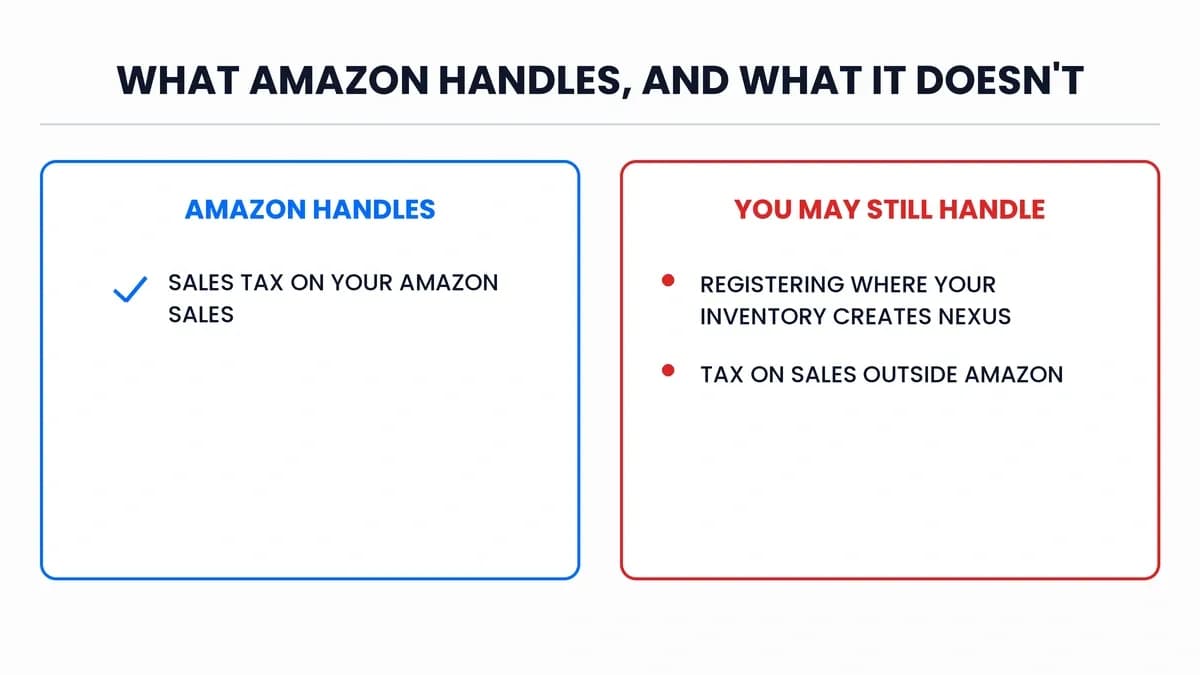
So on your Amazon sales, Amazon handles the state sales tax. You don't add it to your price, collect it or send it to the state.
Amazon doesn't handle your own registration with a state, if the state requires one. It also doesn't handle tax on sales you make outside Amazon, such as on your own website. Those are the two places where nexus still matters.
How FBA Inventory Can Create Nexus
When you use FBA, Amazon spreads your stock across its warehouses. Its own fee update talks about the cost of "distributing inventory to fulfillment centers close to customers." So your units can end up in states you've never shipped to yourself.
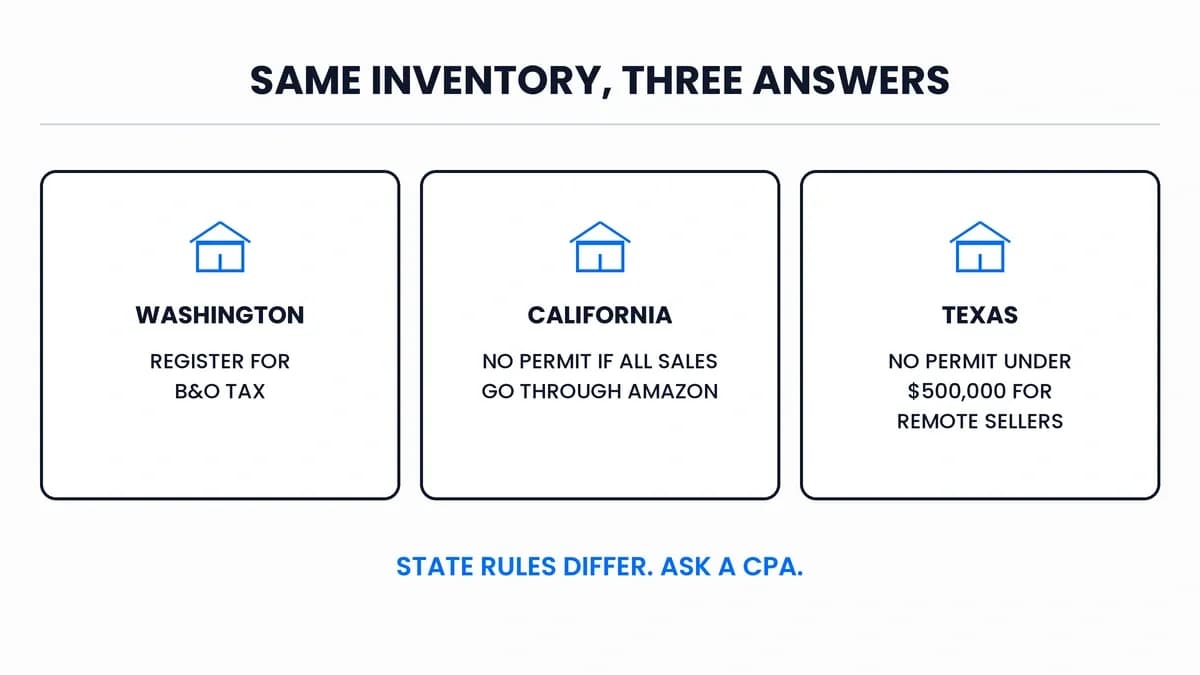
States treat that inventory in different ways. Washington, California and Texas show how much the answers vary.
Washington counts it as physical presence. Its revenue department's marketplace sellers page lists "keeping a stock of inventory in Washington" as physical presence. That includes inventory a marketplace facilitator holds for you. Sellers with that kind of presence "must register to report B&O tax." B&O is Washington's business and occupation tax. You don't have to collect sales tax on sales Amazon facilitates, as long as you have documents that prove Amazon is collecting it. But you still register.
California also treats the inventory as presence, with one exception. Its Publication 109 says "retailers that store inventory in California are generally engaged in business in this state." That includes stock at a third-party fulfillment center. The exception is for sellers whose retail sales all go through a registered marketplace facilitator. For them, "you are not required to register with CDTFA for a seller's permit." The agency suggests keeping documents that show this, such as a written agreement with the marketplace.
Texas draws the line at a dollar amount. The Comptroller's remote seller and marketplace FAQ covers remote sellers with stock in a marketplace's Texas warehouse. Under $500,000, such a seller "does not need to obtain a permit and does not have a collection obligation." That assumes the marketplace has certified that it takes over the seller's tax duties. Above that line, "you must obtain a tax permit." Sellers based in Texas are different again: "you have physical presence in Texas and must have an active sales and use tax permit."
State | Inventory in an Amazon warehouse | If all sales go through Amazon |
|---|---|---|
Washington | Physical presence | Still register for B&O tax |
California | Engaged in business | No seller's permit needed |
Texas (remote seller) | No permit under $500,000 | Permit above $500,000 |
So the same stock in an Amazon warehouse gets three different answers. There isn't one rule to follow, and that's why a CPA is worth paying for here.
Your Home State Is Different
If you have a seller's permit behind your resale certificate, you're already registered there. Our post on the resale certificate vs sales tax permit explains how the two fit together. Your home state may still expect returns from you, even if Amazon collected all the tax. Texas, for example, says marketplace sales go in "item one (Total Texas Sales)" on the return. They stay out of item two, taxable sales.
That same registration is what lets distributors sell to you without charging sales tax. It's also one of the things distributors check before they approve you. Our post on what distributors look for before approving an Amazon seller covers the rest of that list. Once you're registered, you can search a product free. You'll see real cost and real stock from every verified distributor in our network before you apply.
Sales Outside Amazon
Sales on your own website aren't covered by the marketplace facilitator law. You're the seller there, so where you have nexus, collecting the tax is your job.
Texas says it plainly: "You must collect, report, and remit Texas tax on sales made outside the marketplace." California's Marketplace Facilitator Act guide says a marketplace seller that also sells direct to California customers "is generally required to be registered with CDTFA." Your Amazon sales can also count toward a state's economic nexus threshold. The same California guide counts "sales facilitated through a marketplace facilitator's marketplace" toward its $500,000 test.
So if you're adding a second channel, check nexus before you start, not after.
Questions to Take to Your CPA
Bring these to a CPA who works with online sellers:
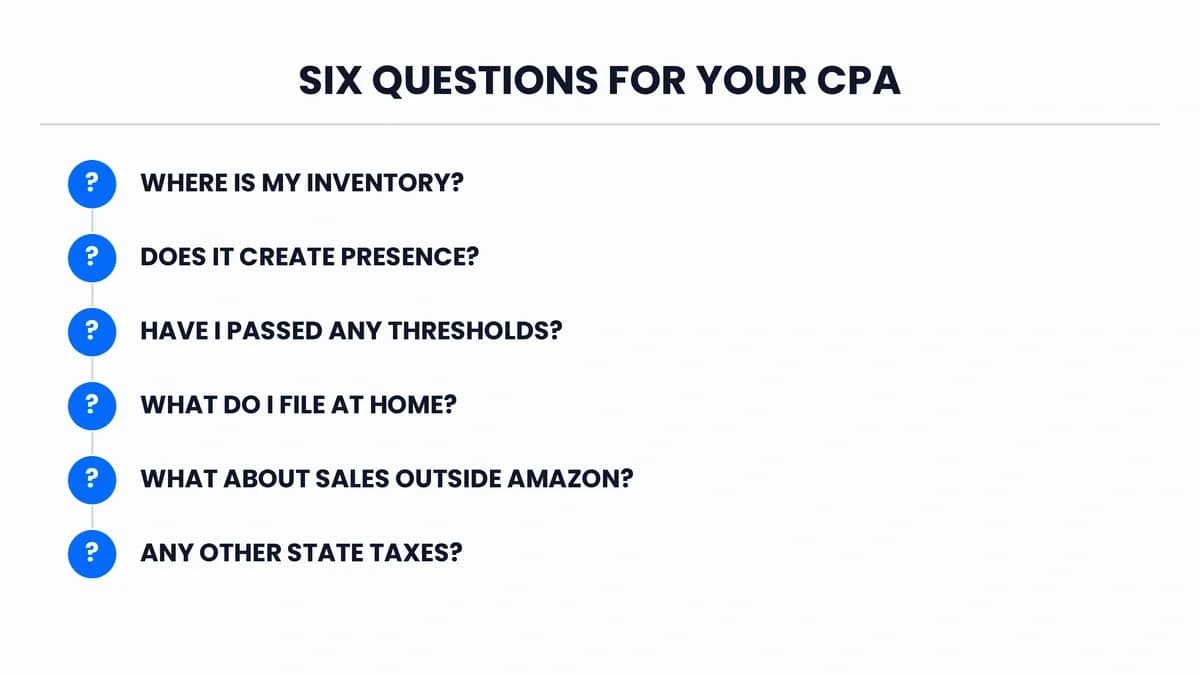
- Which states hold my FBA inventory right now, and have they changed this year?
- Do any of those states treat that inventory as physical presence that needs registration?
- Have my total sales into any state passed its economic nexus threshold?
- Which returns do I need to file in my home state, even with Amazon collecting the tax?
- What do I owe on sales outside Amazon, and where?
- Do any states where I have nexus have other taxes, such as Washington's B&O tax?
Sales Tax Nexus for Amazon Sellers: The Takeaways
- Amazon collects and remits sales tax on your Amazon sales in marketplace facilitator states.
- Nexus still matters because FBA inventory in a state can create a registration duty of your own.
- States differ. Washington requires B&O registration. California doesn't require a permit if all your sales go through a registered marketplace. Texas sets a $500,000 line for remote sellers.
- Your home state may expect you to stay registered and file returns.
- Sales outside Amazon are yours to collect on where you have nexus.
- Talk to a CPA before you register in a new state, or decide not to.
Amazon Collects the Tax, but Registration Is Yours
Marketplace facilitator laws moved most of the sales tax work to Amazon, but not all of it. Sales tax nexus for an Amazon seller is now mostly about where your inventory sits. And each state decides what that inventory means for you.
So find out which states hold your stock, ask a CPA once, and set up what's needed. Then get back to buying. You can open a free account to compare distributors. If a product you want has no distributor in our network yet, you can Request a Supplier and our team will look for one.
Frequently asked questions
01Does Amazon take care of sales tax for sellers?
02What triggers sales tax nexus in California?
03What is nexus for an Amazon seller?
The B2B SupplierHub Team
Wholesale & sourcing
Stop hunting suppliers by hand. Type a UPC instead.
B2B Supplier Hub shows the suppliers in our network carrying a product on one page: wholesale cost, stock, and retail price side by side. Free to search, no card required.