
Amazon Ungating
What Counts as a Valid Wholesale Invoice for Amazon (With Examples)
-1200x627.png&w=3840&q=75)
Amazon rejected the document, and the seller is confused because the purchase was real. They genuinely bought 12 units; they have proof of payment, and they submitted it with the application. The problem is that what they submitted was an order confirmation email, and to Amazon's reviewers, an order confirmation is not an invoice, no matter how real the purchase behind it was.
This distinction fails more ungating applications and account-health responses than any other single cause. Amazon has a specific document in mind when it asks for an invoice, with specific elements it checks in a specific way. This guide shows exactly what that document looks like, with a worked-out hypothetical example.
What Amazon Means When It Asks for an Invoice
A valid wholesale invoice for Amazon is a bill issued by a wholesale supplier, meaning a distributor or the manufacturer, documenting a completed purchase of inventory. It typically must be dated within the last 180 days, show at least 10 units of the relevant products, display the supplier's full business details, and show your name and address exactly as they appear in your Seller Central account.
Notice what that definition is really testing. Amazon isn't checking whether you spent money. It's checking whether your inventory comes from a legitimate wholesale supply chain, which is why the document has to originate from the supplier's billing system and why Amazon may contact the supplier to verify the purchase.
A document you generated, a marketplace receipt, or a pre-sale quote can't pass that test, because none of them proves a wholesale relationship exists. This is one step inside the broader approval process, covered end to end in our guide to how to get ungated on Amazon.
The Anatomy of a Valid Invoice, Element by Element
Reviewers work through a checklist, so it pays to know it.
The supplier's identity: legal business name, physical address, and contact details such as phone or website. This is what makes the supplier verifiable. A Gmail address and no physical address are a red flag even on an otherwise clean document.
Your identity: your business name and address, matching your Seller Central account exactly. Character for character, not approximately. If your account says a suite number, the invoice should too.
The date: within the window Amazon specifies, commonly the last 180 days. Older purchases, however real, don't demonstrate a current supply chain.
The products: itemized lines that identify the actual items with quantities. For ungating, the commonly required threshold is 10 or more units of the products relevant to the application. Item descriptions or UPCs should be specific enough that a reviewer can connect the line to the ASIN you're applying for.
An invoice number and totals: the ordinary furniture of a real billing document. Their absence is what makes homemade documents look homemade.
One detail sellers often don't know: Amazon's guidance has generally allowed pricing information to be redacted. What you paid per unit is between you and your supplier. Everything else, including quantities, must remain visible, and the document must otherwise be complete, uncropped, and unedited.
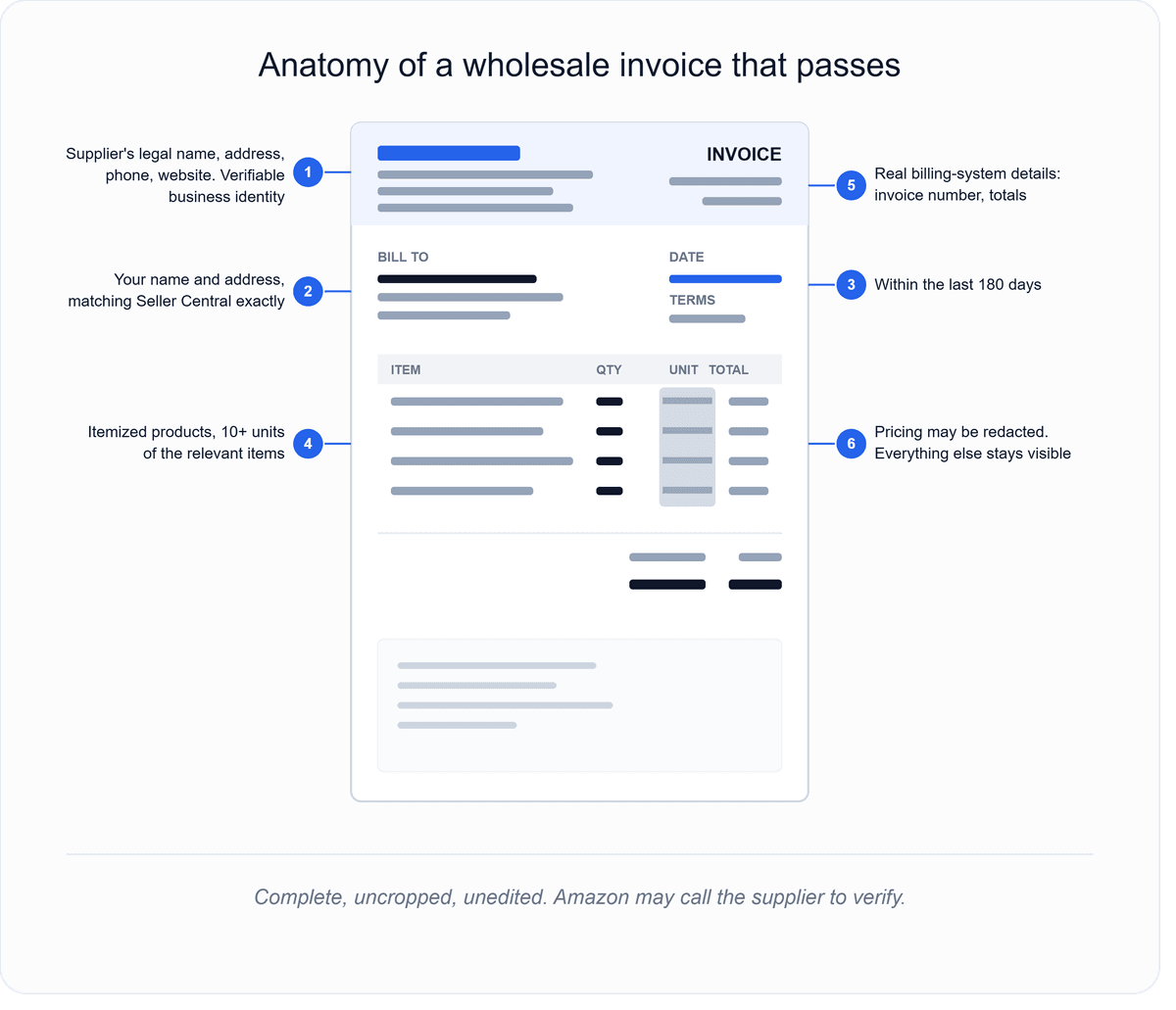
Example: An Invoice That Passes
Here's what the standard looks like assembled, using an illustrative example with a fictional distributor.
Meridian Distribution LLC, 4420 Commerce Drive, Columbus, OH, with a phone number and website in the header. Invoice #18847, dated July 14, 2026. Billed to: Brightline Retail Group LLC, 210 Oak Street, Suite 4, Denver, CO, the exact name and address on the seller's Amazon account. Line items: 24 units of a named stainless water bottle, 32 oz, blue, with the UPC printed on the line; 12 units of the same bottle in black. Subtotal, shipping, and total at the bottom, with unit prices blacked out and quantities left visible. Payment terms: paid by ACH, July 14.
Every checklist element is present: a verifiable supplier, an exactly matching buyer, a recent date, specific products above the unit threshold, and real billing details. If Amazon emails or calls Meridian, Meridian confirms the sale.
That last property is the whole game, and it's why the document can't be faked into existence: validity comes from the supplier being real and reachable, which is also why choosing the right distributor matters more than formatting. What distributors check before they'll open an account for you and issue that first invoice is covered in what distributors look for before approving an Amazon seller.
Three Documents That Look Valid but Get Denied
The retail receipt. A receipt from a retail store or its website proves a retail purchase, which is the opposite of what Amazon is checking for. It doesn't matter that money changed hands or that the products are authentic. Retail sources are not wholesale supply chains, and reviewers recognize retail receipts instantly.
The order confirmation or pro forma invoice. These are pre-completion documents: a confirmation says you placed an order, and a pro forma says what an order would cost. Neither documents a completed wholesale transaction from the supplier's billing system. If this is what your supplier sent, ask them for the final invoice; any legitimate distributor produces one as a matter of routine.
The mismatch. A genuine wholesale invoice, recent, itemized, verifiable, but billed to a name or address that doesn't match Seller Central. Maybe it's your personal name instead of your LLC's, or an old address. Reviewers can't reconcile it, so it fails. This is the most frustrating denial because it's the most avoidable: check the bill-to block against your account before the supplier finalizes the document, and if it's wrong, have them reissue it. It's a two-minute fix on their side.
There's a fourth category that deserves its own sentence: purchased, edited, or fabricated invoices. Those aren't a denial risk; they're an account risk. Amazon treats forged documentation as a serious violation, and no category approval is worth what it costs when verification fails.
A Valid Invoice Starts With the Right Distributor
Everything on Amazon's checklist follows automatically from one decision: buying from a legitimate distributor who invoices properly, because for real wholesale businesses, all of this is just how billing works.
The hard part is finding the distributor who carries your product. B2B Supplier Hub turns that search into a lookup: enter the product's UPC or brand, see every verified distributor in the network carrying it with exact wholesale cost and live stock, free, and reveal the one whose numbers fit your order. Ten units later, you're holding an invoice that passes, from a supplier who picks up the phone when Amazon calls.
Frequently asked questions
01Can I use a retail receipt to get ungated on Amazon?
02Can I black out the prices on my invoice?
03Does the invoice really need 10 units?
04Will Amazon actually contact my supplier?
The B2B SupplierHub Team
Wholesale & sourcing
Stop hunting suppliers by hand. Type a UPC instead.
B2B Supplier Hub shows the suppliers in our network carrying a product on one page: wholesale cost, stock, and retail price side by side. Free to search, no card required.