
Supplier Management
Wholesale Credit Application: What Distributors Check
A wholesale credit application is how a distributor decides whether to ship you goods before you pay. It asks for your business details, your resale certificate, a bank reference and two to four trade references. On most of the forms we read, it also asks the owner to sign a personal guarantee. Fill it in well and you can get net terms, meaning you pay after the goods ship. Leave the reference boxes empty and you're more likely to be offered prepay, meaning you pay before they ship.
The problem is that each distributor's version is a blank PDF with no explanation. So this post goes through the form section by section and explains what each box is really asking. It also covers the two questions that stall new resellers: what to put for trade references when you don't have any, and whether to sign the guarantee.
What the Form Is For
Before the boxes, it helps to know what the distributor is doing with them.
A credit application is really a loan application. When a distributor ships $8,000 of stock on net 30, they've lent you $8,000 for a month with nothing to take back if you don't pay. The form is how they decide whether you'll pay it back, and how much they're willing to risk finding out. Our post on how net 30 terms work from the distributor's side covers that thinking in more depth. This post stays on the form itself.
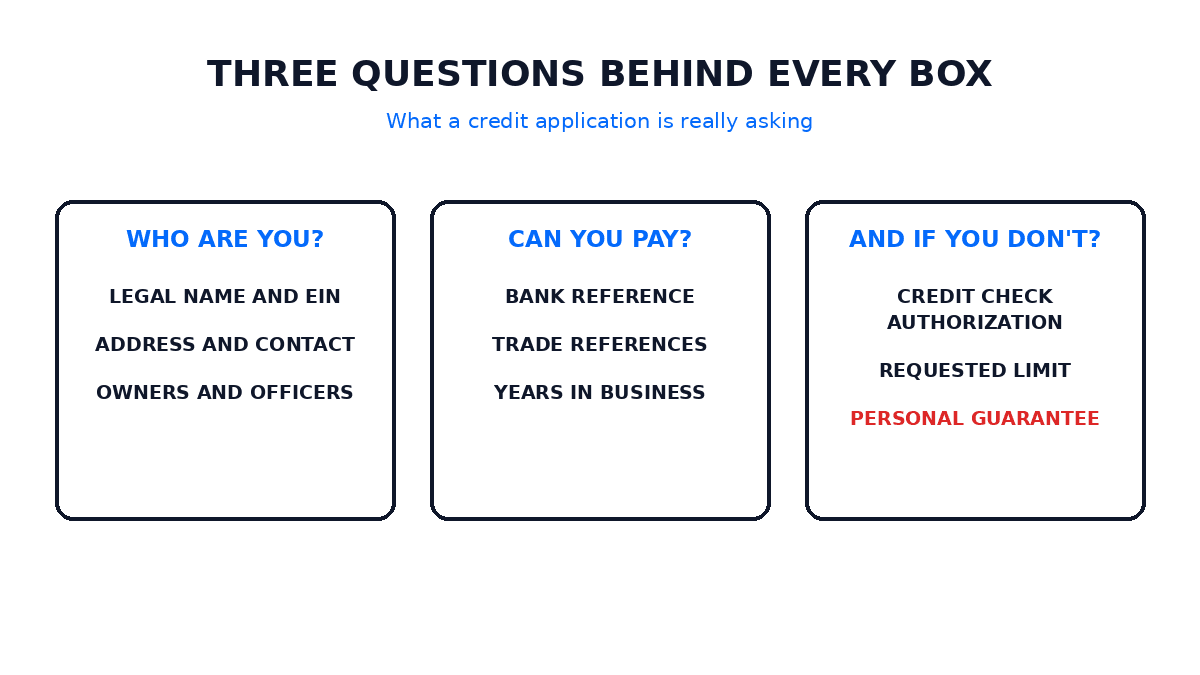
That framing explains every box. Nothing on the application is there to be nosy. Each field feeds one of three questions: who are you, can you pay, and what happens if you don't.
Section by Section: What You're Being Asked
We read four real distributor credit applications from different industries to write this. The layouts differ, the questions don't. The same boxes show up on all of them, in roughly the order below.
Legal name, DBA, business type and EIN
Your legal business name exactly as registered, any trading name, whether you're an LLC, corporation, partnership or sole proprietor, and your EIN. This is the "who are you" section, and it has to match your resale certificate and your bank account to the letter. "Smith Trading" on the form and "Smith Trading LLC" on the certificate is a question you'll be asked.
Address, phone, and accounts payable contact
Where you are and who pays the bills. The forms ask for a street address and a named person for invoices. If that's you, write your name. A real address matters because it's one of the few things they can check in a minute.
Years in business, or date established
Some forms ask it directly. Some ask for your D-U-N-S number instead. That's the ID Dun & Bradstreet gives a business for its credit file, and it tells them the same thing. A new business shouldn't dread this box. Leaving it blank is worse than writing "formed March 2026," because a blank box looks like you're hiding something.
Owners and officers, with home addresses
This is the one that surprises people. Three of the four forms asked for the owner's home address, and some asked for their Social Security number. It's there for two reasons. The distributor may run a personal credit check on the owner, and if you sign the personal guarantee, they need to know who they're holding to it. If the form asks for an SSN and you're not comfortable giving it, ask whether a D-U-N-S number or a business credit report will do instead. Some will say yes. Some won't open the account without it.
Resale certificate
All four forms asked for it, as "resale or exemption certificate number, attached: yes/no." Attach it. A distributor can't sell to you tax-free without one on file, and an application with that box empty may sit until it arrives. If you don't have one yet, our guide to how to fill out a resale certificate is the place to start.
Bank reference
Your bank's name, branch, phone number, your account number and sometimes a named officer. The distributor calls or emails to confirm the account exists, is in your business name, and has been open a while. It's a "can you pay" check. Make sure the account is a business account in the legal name on the form. A personal account in your own name is a mismatch, and it can be the reason a sole proprietor is offered prepay only.
Trade references
Two to four lines asking for businesses you already buy from on credit. The SBA says three to four is typical. There's a full section on this below, because it's the one new resellers get stuck on.
Requested credit limit
How much you'd like to be able to owe at once. Ask for what you'll actually use in a month, not the biggest number you can imagine. A new account asking for $50,000 with no references looks like a risk. One asking for $5,000 with two solid references looks like a customer.
Authorization to check credit
A sentence you sign agreeing that the distributor can pull your business credit, contact your bank and references, and sometimes pull the owner's personal credit. All four forms carried this. You can't take terms without signing it.
Personal guarantee
Three of the four forms ended with a separate signature block for the owner to guarantee the debt personally. There's a full section on this below too, because signing it is a real decision.
What to Put for Trade References
This is the box a new business can't fill in, so it needs the most explanation.
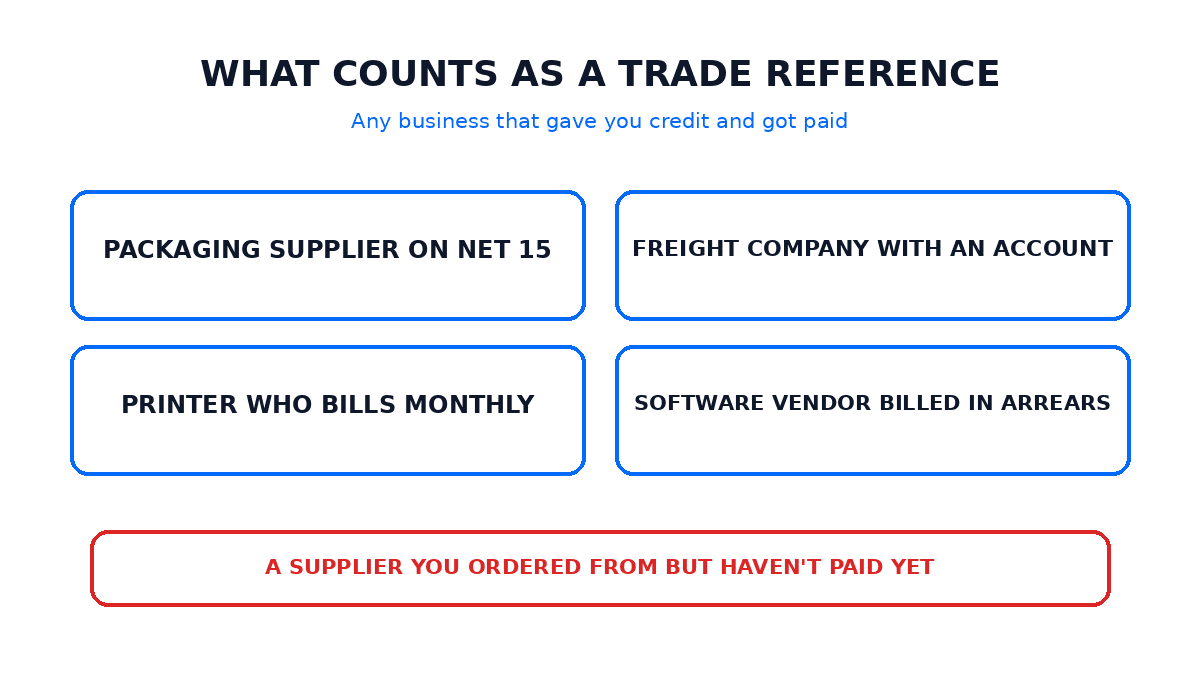
A trade reference is a supplier you've bought from on credit who'll confirm you paid. Dun & Bradstreet, which builds business credit reports from them, defines a trade reference as "a source that supplies commercial payment information" and says it can include "partners, lenders, and suppliers, with which you have trade experiences (payment history)." The important words are payment history. D&B adds that "anticipated payments do not qualify." A supplier you've ordered from once and haven't paid yet isn't a reference.
So what counts? Any business that has extended you credit and been paid. A packaging supplier on net 15. A label printer who invoices monthly. A freight company with an account. A software vendor that bills you after the month ends. The distributor isn't only asking about other wholesale distributors. They're asking whether anyone, anywhere, has trusted you with money and got it back.
The SBA's guidance on business credit applications says applications "will require three to four trade references." Lenders "generally ask for the company name, address, contact name, and business phone number." It also makes a point worth knowing: "some suppliers, especially smaller businesses, do not report payment history to the business credit reporting agencies." That's fine for a reference. The distributor will phone them. They don't need to be in a database.
What to write when you have none
We are sharing three options below, in order of preference.
First, look harder. A business that's been running for six months may already have a reference it hasn't noticed. Did you pay a freight bill after delivery? Did your packaging supplier invoice you? Did a contractor bill you net 15? Those are trade references. Write them down.
Second, be honest and offer something else. Write "new business, no trade credit yet" in the box, attach your bank reference and resale certificate, and ask for a smaller starting limit or a prepaid first order with a review after 90 days. An honest blank with a plan is better than a padded box.
Third, build one on purpose. Our net 30 post covers how to do that step by step.
What never works is inventing one. Distributors call references. If the number goes to a friend who's never invoiced you, the application is over, and the account may be too.
The Personal Guarantee: What You're Signing
Near the bottom of most applications is a separate signature block, and it's the one to read twice.
A personal guarantee means you, the person, promise to pay the business's debt if the business doesn't. Cornell's legal dictionary defines a guaranty as "a promise from a guarantor to a guarantee," under which "a guarantor would be forced to answer for the debt or default of the debtor to the creditor." In plain words, the LLC stops protecting you for this one debt. If the business can't pay the distributor, they can come to you.
The wording on real forms is blunt. One of the four we read had the owner "jointly and severally, unconditionally, and irrevocably personally guarantee the full and prompt payment of all indebtedness." Jointly and severally means each person who signs can be held for the whole amount. It added that "this is a continuing guarantee that shall not be affected by the amount of credit extended." Another required the guarantor's spouse to sign too. Read yours. "Continuing" means it covers future orders, not just this one. "Unconditional" means they don't have to try to collect from the business first.
Three things decide whether to sign it.
A distributor may not open net terms for a new business without one, so refusing can mean prepay. That can be worth it in year one if the account matters. But a guarantee that never expires stays with you after you've stopped using the account. So ask whether it can be limited to a dollar amount or a time period, and ask what it takes to have it released later. And if the distributor offers prepay terms with no guarantee, consider taking them for the first few orders. A paid history is a good way to get terms without a guarantee at all.
This isn't legal advice, and a guarantee is a contract. If the amounts are serious, have a lawyer read it before you sign.
How a New Business Gets Approved Anyway
The honest answer is that the distributor is deciding how much to risk, not whether you're a good person, and a new business can make that risk small.
Start with what the credit check will find. D&B's PAYDEX score runs from 1 to 100 and "is calculated based upon Trade Experiences," meaning reported payments. Experian's business score likewise needs "at least one tradeline and/or one demographic element" to exist at all, per its report FAQ. So a brand new LLC with no reported suppliers doesn't have a bad score. It has no score. Distributors know the difference, and the credit applications we read were built for it.
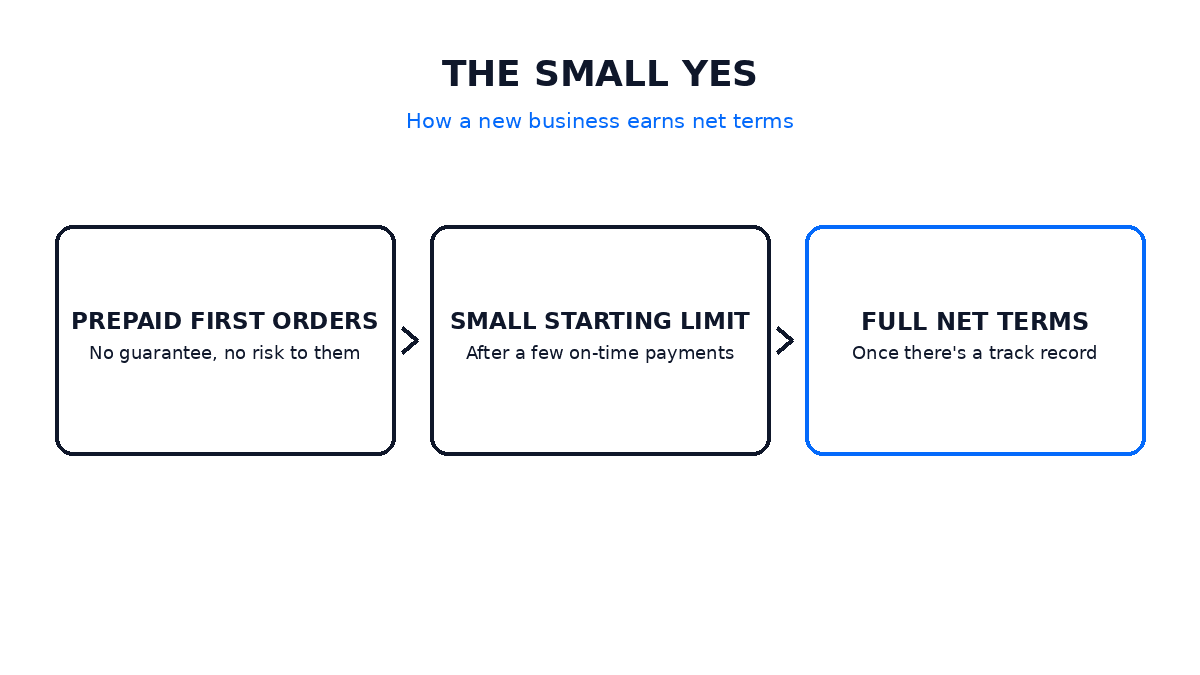
A distributor can handle a new account in a few ways. A small starting limit, raised after a few on-time payments. Prepay or pay by card on the first orders, with terms reviewed at 90 days. Or terms from day one with a personal guarantee doing the work your credit file can't yet. A trade credit insurer's guidance on setting limits for new customers describes exactly this. "Set conservative limits for new accounts, and increase limits only after consistent on-time payments." And "require partial prepayment or shorter terms during the first few orders." That's an insurer's advice to distributors, not a rule, but it matches how the four applications we read were built.
So the way in is to make the small version easy to say yes to. Fill in every box, attach the resale certificate, use a business bank account in the legal name, name whatever references you really have, and ask for a modest limit. Then put a plan in the covering email: "happy to prepay the first two orders and move to terms once you've seen us pay."
Then, once you're in, the first month decides the next twelve. Our guide to your first 30 days with a new wholesale distributor covers what to do after the yes.
Before You Apply Anywhere
Everything above assumes the distributor is worth the paperwork. A credit application takes an hour, a personal guarantee is a real commitment, and your references won't want to be called for every account you try. Spend those on suppliers whose numbers you've already seen.
You can search a product for free and see real cost and real stock from every verified distributor in our network carrying it before you apply to any of them. And if no one you can reach carries the product, you can ask our team to find an authorized wholesale distributor for it, free on every plan, with an answer within 30 days either way.
Wholesale Credit Application: The Takeaways
- The application is a loan application. Every box asks who you are, whether you can pay, or what happens if you don't.
- Your legal name, resale certificate and bank account must match exactly.
- A trade reference is any business that gave you credit and got paid. Freight, packaging and printing count.
- With no references, say so, attach the bank reference, and offer prepay or a small limit first.
- Never invent a reference. They get called.
- A personal guarantee puts your own assets behind the business's debt. Read for "continuing" and "unconditional," and ask about limits.
- A new LLC has no score, not a bad one. Ask for the small version and earn the bigger one.
This is general information, not legal or financial advice. A personal guarantee is a contract, and if the amounts matter to you, have a lawyer read it before you sign.
The Form Is Asking One Thing
Underneath all the boxes, a wholesale credit application asks a single question: if we ship first, will we get paid? Everything you write is evidence. A new business can't fake a long history, and shouldn't try. What it can do is make the honest version easy to say yes to, at a size the distributor can live with.
So fill in every box, attach what they ask for, name the references you really have, and ask for the small version first. You can open a free account and see real cost and real stock from the verified distributors in our network before you spend an hour on anyone's form.
Frequently asked questions
01What to put for trade references?
02Can you give me an example of a trade reference?
03What counts as a trade reference?
04What do trade references mean on a credit application?
The B2B SupplierHub Team
Wholesale & sourcing
Stop hunting suppliers by hand. Type a UPC instead.
B2B Supplier Hub shows the suppliers in our network carrying a product on one page: wholesale cost, stock, and retail price side by side. Free to search, no card required.