
Amazon Ungating
Amazon 'Inauthentic' Complaints: How Invoices Save Your Account
The word "inauthentic" is the most misleading term in Amazon enforcement, and the misunderstanding costs sellers their accounts.
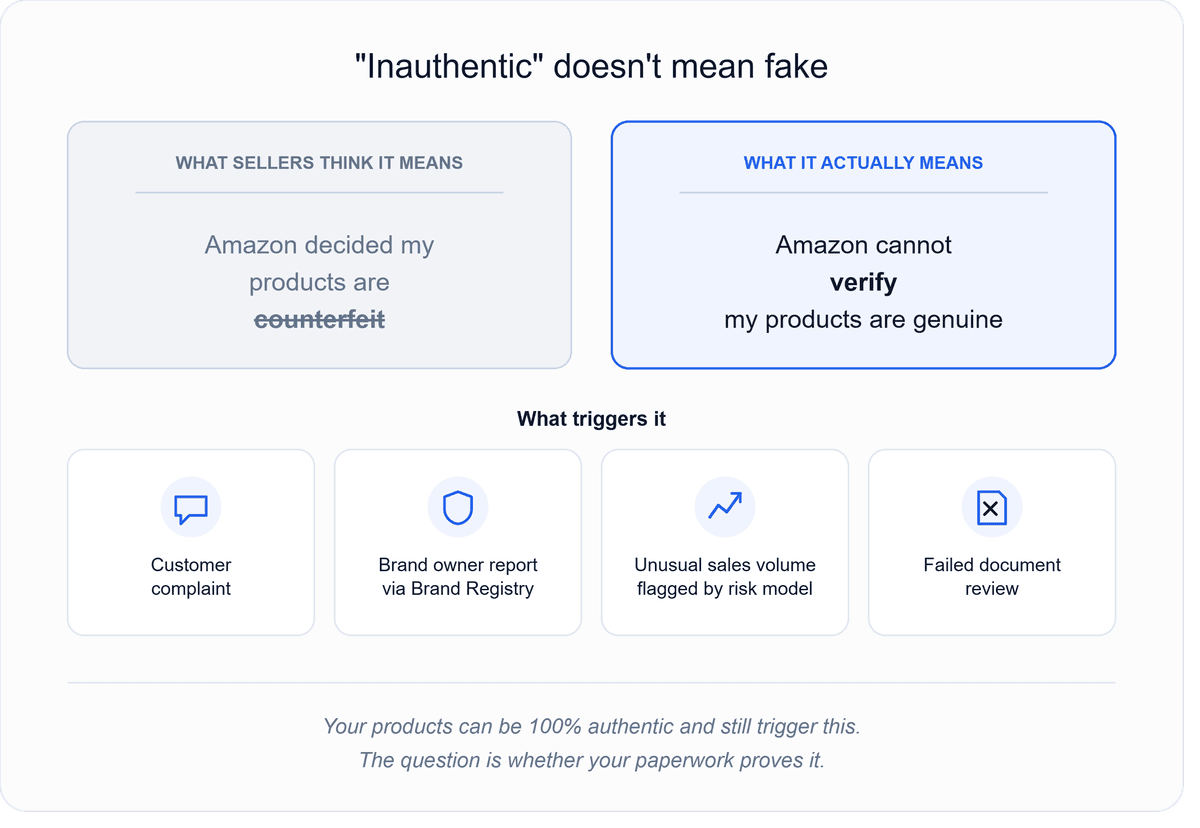
It does not mean Amazon has determined your products are fake. It means Amazon cannot verify that they are genuine. Those are completely different findings, and the second one happens to sellers with completely authentic inventory every day. A single customer complaint, a brand owner report, or an unusual sales spike is enough to trigger it. Amazon acts first and investigates after.
Which is why the outcome of an inauthentic complaint rarely turns on whether your products are real. It turns on whether your paperwork can prove it. This guide covers what triggers these complaints, exactly what Amazon looks for in appeal documentation, why the invoice rules differ from the ones you learned during ungating, and how to build a paper trail before you ever need one.
What Triggers an Inauthentic Complaint
Three sources produce most of them, and knowing which one hit you shapes the response.
Customer complaints are the most common. A buyer reports an item as not as described or suspected counterfeit, sometimes because the packaging differs from the listing images, sometimes because they simply expected something else. One complaint rarely deactivates an account on its own, but complaints accumulate against an ASIN.
Brand owner reports come through Brand Registry. These carry more weight than customer complaints and often need more than invoices to resolve, since the underlying question becomes whether you were authorized to sell the brand at all.
Amazon's own risk models generate the third category, and it surprises sellers most. Selling a large volume of a branded ASIN in a short window, such as a Prime Day surge, can look inconsistent with your documented sourcing pattern and trigger a review on its own. Nobody complained; the data did.
Two consequences follow, at very different severities. Listing-level enforcement removes the ASIN. Account-level enforcement removes your selling privileges, often cited under Section 3 of the Business Solutions Agreement. Unresolved listing-level complaints accumulate and can escalate into the account-level version, which is why ignoring the first notification is the most expensive mistake in this entire process.
Why Genuine Sellers Get Flagged
Understanding the failure modes is what makes the fix obvious.
Unverifiable sourcing is the biggest one. Amazon cannot confirm the supplier you bought from is a legitimate wholesale source, so the authenticity question stays open regardless of the product's actual provenance.
Gray market sourcing is the next. Genuine products bought outside the brand's approved distribution channel are still genuine, but they lack the documentation chain Amazon requires. This is the mechanism explored in our guide to selling gray market goods on Amazon, and it's why gray market inventory carries account risk even when it's authentic.
Retail sourcing fails almost automatically. Receipts from retail stores are not wholesale invoices, and Amazon does not accept them as proof of authorized distribution.
Packaging differences generate complaints even on genuine goods when what arrives doesn't match what the listing images show.
Notice what these have in common. In every case, the product may be perfectly real. What's missing is the documented chain from a verifiable supplier to the unit in the customer's hands.
What Amazon Wants in an Appeal Invoice
This is where the case is won or lost and where the requirements differ from what you may remember from category ungating.
The commonly cited standard for appeal documentation is invoices dated within the last 365 days, a wider window than the 180 days typically cited for ungating applications. Do not assume the two are interchangeable. Your specific notification states what your case requires, and that notice is the authority, not any blog.
Beyond the date, invoices generally need to show the supplier's full business details, including name, address, phone, and website, so Amazon can contact them. They need your legal business name and address exactly as they appear in Seller Central, character for character.
They need itemized products that clearly correspond to the flagged ASIN, not a general order from that supplier. And they need to be complete, unedited, and legible, submitted as clean PDFs rather than cropped photos.
One requirement gets overlooked and sinks otherwise solid appeals: the invoices should account for the sales volume in question. If you sold 400 units of an ASIN and your invoices document 40, the paperwork contradicts the story, and reviewers compare those numbers. Documentation that covers the actual quantity sold is what makes an appeal coherent.
The elements above are the same ones that define a valid wholesale invoice in any context, covered in detail in what counts as a valid wholesale invoice for Amazon. The difference in an appeal is the stakes: here the document isn't unlocking a category; it's defending your account.
For brand owner complaints specifically, invoices alone are frequently insufficient. These cases often turn on authorization, meaning a letter of authorization or evidence that your supplier sits inside the brand's approved distribution chain. If that's your situation, finding the authorized distributors for the brand is the practical starting point, both for the appeal and for whether you should be selling the brand at all.
The Plan of Action Structure Reviewers Expect
Amazon expects a specific format, and appeals that wander outside it get rejected regardless of the documents attached. Three sections, in this order.
The root cause states the actual operational failure in one or two sentences. Not the symptom, and not a defense. "Our supplier verification process did not include collecting invoices from authorized distributors before listing" is a root cause. "Our products are genuine and this complaint is unfair" is not, and it reads to reviewers as a seller who hasn't identified the problem yet.
Corrective actions list what you have already completed, with dates. This section is for finished work: removing the affected ASINs, ceasing purchases from the supplier in question, refunding affected customers, and attaching the corrected documentation. Promises about the future belong in the next section and are generally disregarded here.
Preventive measures describe the systems now in place so it can't recur, named specifically. A verification step before listing any new ASIN, who owns that step, and what document it requires. Generic commitments to "improve our processes" are the single most common reason revised appeals fail again.
Two behaviors to avoid throughout: blaming buyers, competitors, carriers, or Amazon, and submitting template language copied from forums. Reviewers see the templates constantly. And resist the urge to submit something within the hour; a rushed first appeal wastes your strongest opportunity, since revised submissions face more scrutiny than the original.
Build the Paper Trail Before You Need It
Everything above is easier if the documentation existed before the complaint arrived, which is entirely within your control.
Buy from distributors who invoice properly and can be verified, since an appeal is ultimately an audit of your supplier rather than of your writing. Keep every invoice organized by ASIN and date, so that assembling documentation for a specific product takes minutes instead of days.
Match your purchase quantities to your sales volume, and keep the records long enough to cover the full window Amazon may ask about. Where you sell brands with tight distribution, get authorization documentation at the start of the relationship rather than during a crisis.
The sellers who survive inauthentic complaints are almost never the ones who wrote the best appeal. They're the ones whose supply chain was documented before anything went wrong, and who could therefore answer Amazon's question in a day.
One honest caveat about this whole subject: enforcement has trended toward heavier documentation demands, and account-level cases can involve identity or video verification.
If your entire account is deactivated, significant funds are held, or a first appeal has already been denied, that is the point to consider professional help from a reputable seller-appeal specialist or attorney rather than iterating alone. This article is general information about Amazon's documented practices, not legal advice.
The Best Appeal Starts With the Right Distributor
Every element Amazon asks for in an inauthentic appeal traces back to one decision: who you bought from. A verifiable distributor produces invoices that hold up; an unverifiable source produces a problem no writing can fix. B2B Supplier Hub is where that decision gets easier.
Search any product by UPC, MPN, name, or brand and see every verified distributor in the network carrying it, with exact wholesale cost, live stock depth, and the date each listing was verified, free and unlimited. Build your supply chain from suppliers who can stand behind their paperwork, and the appeal you never have to write is the cheapest one of all.
Frequently asked questions
01Does an inauthentic complaint mean my products are counterfeit?
02What invoices does Amazon accept for an inauthentic appeal?
03Can I appeal an inauthentic complaint without invoices?
04How long does an inauthentic appeal take?
05How do I prevent inauthentic complaints?
The B2B SupplierHub Team
Wholesale & sourcing
Stop hunting suppliers by hand. Type a UPC instead.
B2B Supplier Hub shows the suppliers in our network carrying a product on one page: wholesale cost, stock, and retail price side by side. Free to search, no card required.