
Quarter 4
Amazon Q4 Storage Fees 2026: Planning Guide for Wholesale Sellers
-1200x627.png&w=3840&q=75)
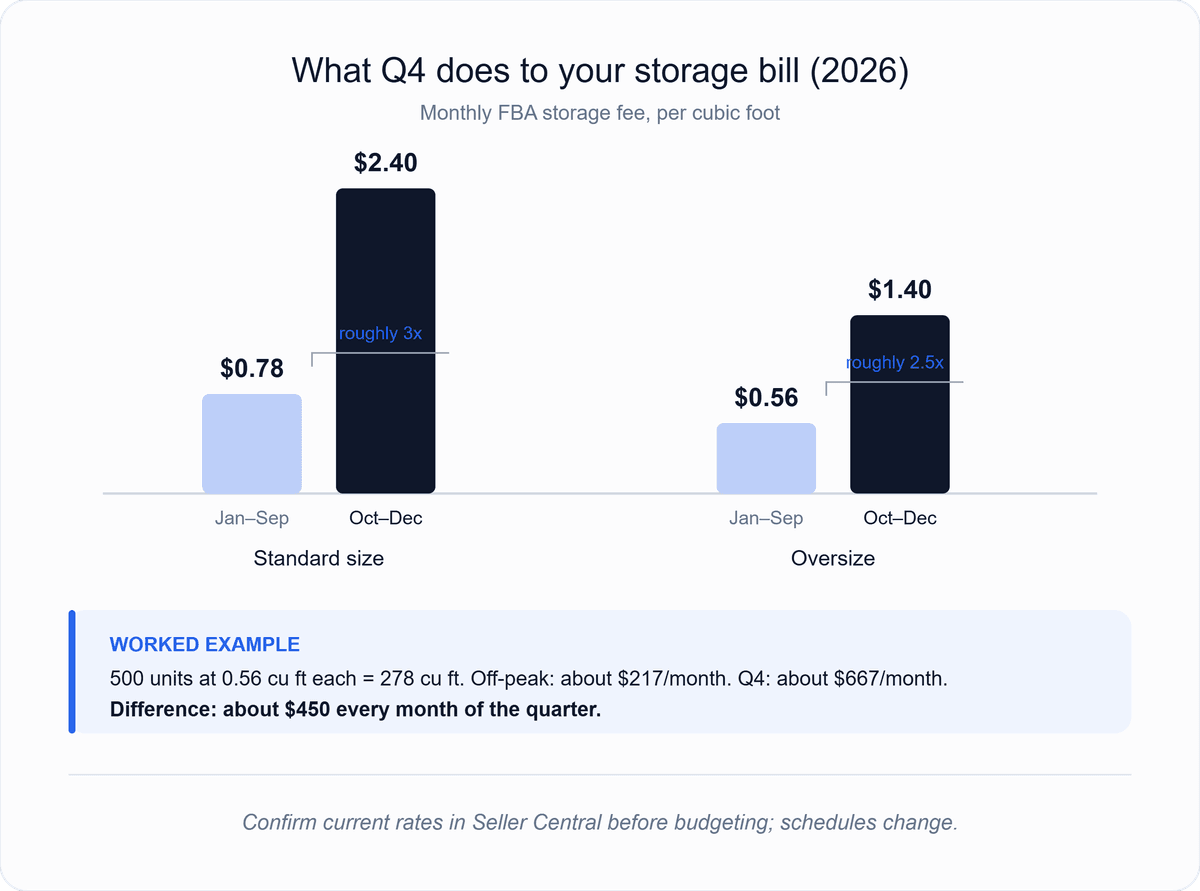
Here's a piece of math every wholesale seller should run before placing September purchase orders. Take a product in a 12 by 10 by 8 inch box, about 0.56 cubic feet. Store 500 units of it in FBA, and from January through September the monthly storage bill runs around $217. Store the same 500 units in November, and the bill is roughly $667 a month. Nothing about the inventory changed. The calendar did.
From October through December, Amazon's monthly storage rates roughly triple, and for wholesale sellers, who buy in bulk by definition, that jump quietly rewrites the economics of every Q4 order.
Order too little and you stock out in the highest-demand weeks of the year. Order too much, and you pay peak rates to warehouse your mistake, with more surcharges waiting behind it. This guide covers the 2026 rates, the fees that stack on top of them, and how to size and time Q4 orders so storage costs stay a line item instead of a margin killer.
The 2026 Q4 Storage Rates
Amazon charges monthly storage on the average daily volume your inventory occupies, measured in cubic feet. For 2026, the published rates are:
Standard-size products: $0.78 per cubic foot from January through September, rising to $2.40 per cubic foot from October through December.
Oversize products: $0.56 per cubic foot from January through September, rising to $1.40 per cubic foot from October through December.
That's roughly a 3x increase for standard-size inventory in the exact months you hold the most of it. The fee is billed monthly in arrears, so October's storage appears on your statement in November, which is worth knowing so the first peak-season bill doesn't read like an error. And because Amazon adjusts its fee schedule periodically, confirm the current numbers in Seller Central's fee pages before you finalize your Q4 budget; the planning logic below holds regardless of the exact rate.
A note on what counts as standard-size, since it decides which rate you pay: standard-size generally means at or under 20 pounds and within 18 by 14 by 8 inches. Anything beyond that falls into the larger tiers, with lower per-cubic-foot rates but more total cubic feet.
The Fees That Stack on Top
The peak rate is only the base layer. Three other charges interact with it, and a badly sized Q4 order can trigger all of them on the same units.
The aged inventory surcharge applies to units that have sat in fulfillment centers past roughly the six-month mark, and it escalates in tiers the longer they sit. The Q4 relevance is what happens after Q4: Holiday inventory that doesn't sell doesn't just carry over to January storage; it starts a clock toward surcharges that can eventually exceed the base storage fee several times over. December's unsold units are next spring's surcharge bill.
The storage utilization surcharge targets accounts holding far more inventory than they sell, measured in weeks of supply. Overbuying for Q4 across your whole catalog is exactly the behavior that pushes an account into this territory.
The low-inventory-level fee operates on the opposite side: Amazon charges a per-unit fee when a product with steady sales drops below about 4 weeks of supply. This is the squeeze that makes Q4 sizing a genuine optimization rather than a "less is safer" rule. Understocking your winners also carries a fee, on top of the lost sales and rank.
The practical takeaway: Amazon's fee structure punishes both tails. The target is the middle, and the widely used rule of thumb for peak season is inbounding what you expect to sell in roughly 8 to 10 weeks, then replenishing from reserve as actual velocity reveals itself.
What This Means for September Purchase Orders
For a wholesale seller, storage fees aren't an October problem; they're a September ordering input. Three adjustments follow directly from the fee structure.
First, size orders from velocity, not from price breaks. Distributor tiers reward bigger orders with lower unit costs, and Q4 storage math pushes back hard against overshooting. A deeper price tier that leaves 300 units unsold in January usually nets out worse than the smaller order once peak storage and aged surcharges land, which is the same tradeoff, sharpened, that we cover in the economics of MOQ and when bigger orders hurt margin.
Second, split the inbound. Buying your full Q4 quantity from your distributor in September doesn't mean inbounding all of it to FBA in September. Holding a reserve at your own warehouse, prep center, or 3PL and feeding FBA in stages keeps average daily volume, which is what Amazon bills on, as low as your logistics allow, and it preserves the option to redirect stock toward whichever products Black Friday proves out. The month-by-month version of this plan lives in our Q4 sourcing timeline and the order dates that matter.
Third, buy from suppliers who can reorder, not just suppliers who are cheap. The staged approach only works if your distributor can actually fill a November top-up, which makes stock depth and data freshness part of the September supplier decision. A listing showing deep, recently verified stock is worth a premium in Q4; the way to read those signals before you commit is covered in evaluating a supplier from the numbers alone.
Finally, write the January plan before Q4 starts, not after. Decide now what happens to anything still sitting in FBA on January 5: price-down threshold, removal order, or a switch to merchant fulfillment. A January decision made in September is a strategy; the same decision made in February, with surcharges accruing, is damage control.
Size the Order Right by Seeing the Supply Side First
Every dollar of avoidable Q4 storage traces back to one moment: the September purchase order that was sized on guesswork. B2B Supplier Hub puts the supply half of that decision in front of you before you commit.
Search any product and see every verified distributor carrying it, with exact wholesale cost, live stock depth, and the date each listing was verified, for free. Deep supplier stock means you can order lean and top up in November instead of warehousing the whole quarter at $2.40 a cubic foot. Check the supplier table first, then write the purchase order.
Frequently asked questions
01How much are Amazon storage fees in Q4 2026?
02Why are Amazon storage fees higher in Q4?
03How do I avoid high Q4 storage fees?
04What happens to unsold Q4 inventory in January?
The B2B SupplierHub Team
Wholesale & sourcing
Stop hunting suppliers by hand. Type a UPC instead.
B2B Supplier Hub shows the suppliers in our network carrying a product on one page: wholesale cost, stock, and retail price side by side. Free to search, no card required.