
Sourcing
Q4 Sourcing Timeline for Amazon Wholesale: Order Dates That Matter (2026)
-1200x627.png&w=3840&q=75)
Every January, the same postmortem happens in seller forums. Someone ran out of stock on December 9 with three weeks of demand left. Someone else is sitting on 400 units that arrived too late for Christmas and now face January storage fees. Both sellers made the same mistake, just in opposite directions, and both made it months before Q4 started.
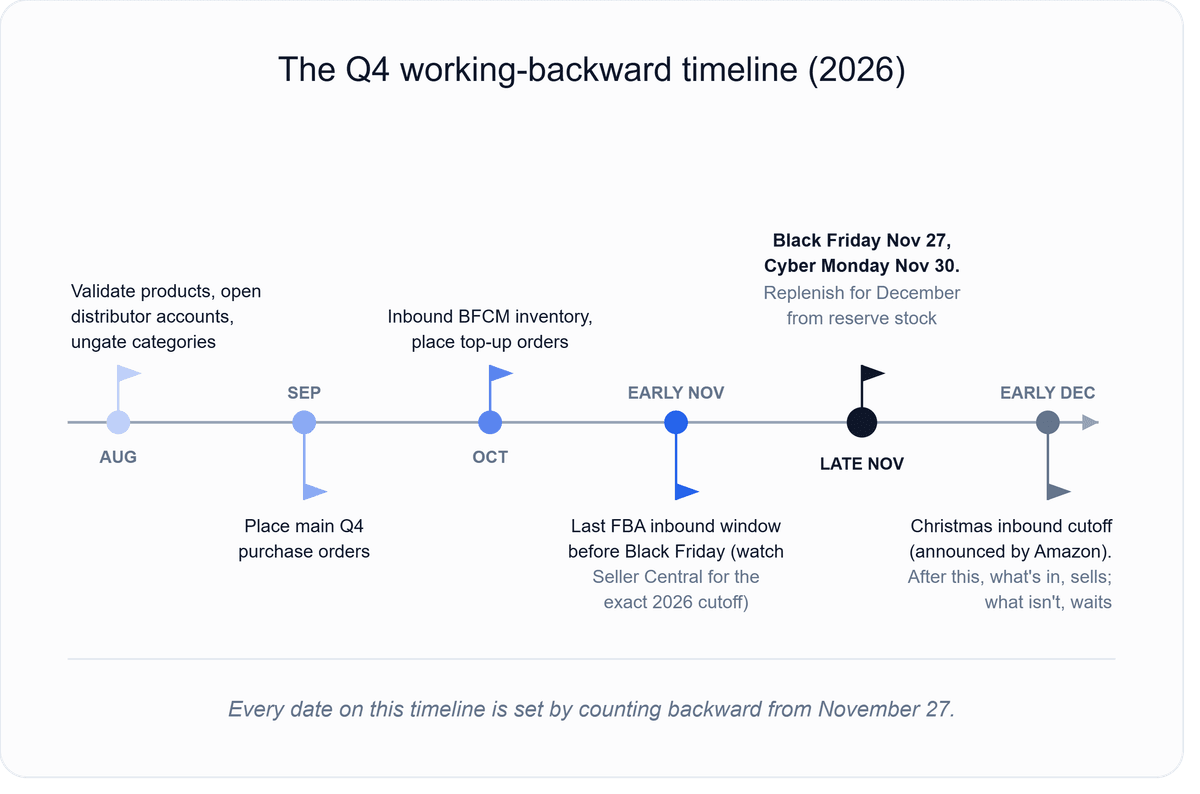
Q4 success for wholesale sellers is mostly a calendar problem. The demand is predictable: Black Friday lands on November 27 in 2026, Cyber Monday on November 30, and the Christmas rush runs into the third week of December. What separates sellers who capture that demand from sellers who watch it is when their purchase orders went out. This is the working-backward timeline, month by month, starting from where you are right now: August.
Why the Timeline Starts in August, Not October
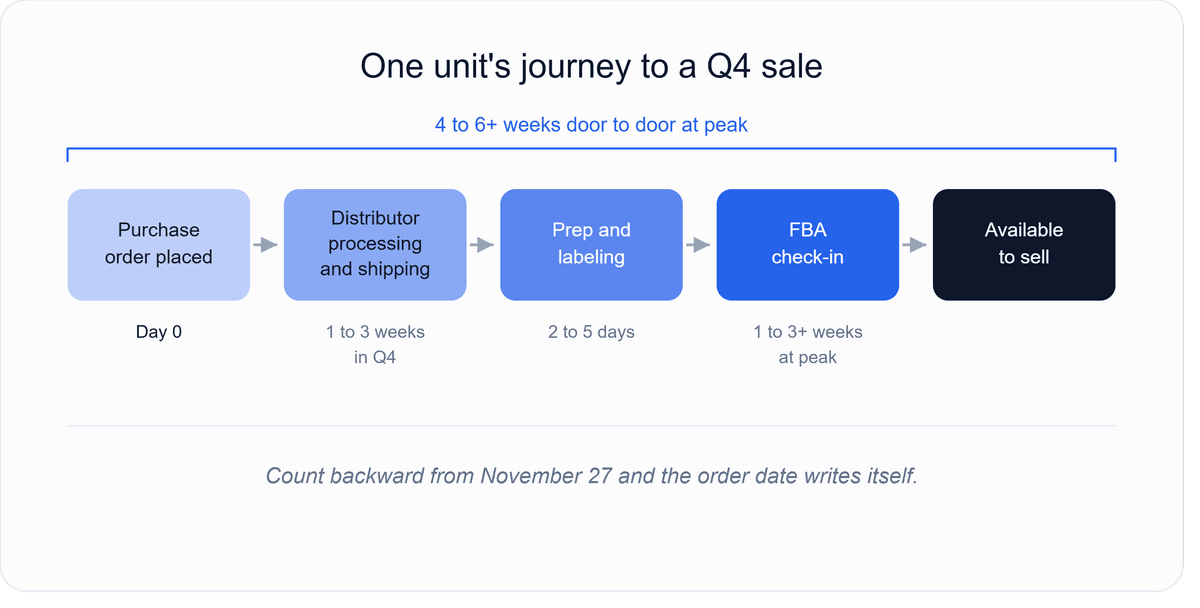
A Q4 unit doesn't exist the day you order it. Between your purchase order and a sellable unit in an Amazon fulfillment center sits a chain of delays, and every link in it stretches during Q4.
Your distributor needs processing and shipping time, which lengthens as their own Q4 order volume climbs. Prep and labeling add days. Then comes the slowest link: FBA check-in. Amazon's receiving times stretch notably from late October onward as every seller in the country inbounds at once. An order that turns into available inventory in two weeks during May can take four to six weeks door-to-door in November.
Layer the money on top, and August gets even more important. Q4 inventory is capital you spend in September and October and recover in November and December. If your budget needs a supplier with payment terms rather than upfront payment, that account needs to exist before you order, and distributor approval itself takes time.
What distributors screen for and how long approval takes is covered in our guide to what distributors look for before approving an Amazon seller; the short version is that a new account opened in August is buying-ready in September, and one started in October is fighting the calendar.
August: Decide What You're Selling and Remove the Roadblocks
August is for the work that has lead times you can't compress: decisions, accounts, and approvals.
First, lock the catalog. Q4 is the wrong season for experiments at scale, so the core of your plan should be products with proven velocity, either your own sales history or listings you can see selling now. This is where reverse sourcing, working backward from products already selling, earns its keep: validate demand first, then find the distributors who carry the winners.
Second, open the supplier accounts you'll need in September. If your Q4 plan depends on a distributor you don't yet buy from, start that application now.
Third, clear your gates. If any Q4 product sits in a restricted category or brand, run the approval process this month, while a denial still leaves you time to fix and reapply. Toys deserve special mention: Amazon has historically applied holiday selling requirements to toys & games for seller-fulfilled orders, based on sales performance in the late-summer and early-fall window.
FBA sellers have historically been exempt from those requirements, but category and brand gates apply either way, and August is when to clear them. The full process is in our guide to how to get ungated on Amazon.
September: Place the Main Orders
September is purchase-order month. The math is simple even though the discipline is hard: an order placed mid-September has roughly six to eight weeks to travel the full chain and be checked in before the pre-Black-Friday inbound window closes, which is a comfortable margin. An order placed in late October is betting the season on everything going right.
Size the orders from data, not optimism. Take your trailing sales velocity, apply a Q4 multiplier grounded in last year's category pattern rather than a hoped-for number, and remember that running out a few days early costs you rank as well as sales, while overbuying meets January storage fees on the other side.
When comparing suppliers for these orders, unit price is the least of it in Q4; stock depth and reliability decide whether a reorder is even possible in November. Our framework for evaluating a supplier from the numbers alone applies double in this season: a listing showing deep stock and a fresh verification date is worth more in September than a slightly cheaper one showing 1 unit and a stale update.
September is also when to confirm the boring logistics: prep requirements, carton and pallet rules, and whether your distributor can ship on your schedule rather than theirs.
October: Inbound, Top Up, and Watch the Announcements
October is execution month. Your September orders should be arriving, getting prepped, and heading into FBA in the first half of the month, ahead of the check-in slowdown.
Two dates to watch for, both announced by Amazon rather than set by the calendar. Amazon has typically run a Prime deal event in October, which both generates early Q4 sales and previews your velocity.
And Amazon publishes its holiday inbound recommendations each fall, stating the date inventory should arrive at fulfillment centers to be available for Black Friday and Cyber Monday; historically that window has fallen in early-to-mid November, and the December counterpart for Christmas availability has fallen in early December. Treat the announced dates as hard deadlines and aim a week earlier because arrival is not check-in.
October is also your last comfortable reorder window. If early sales or the October event shows a product outperforming the plan, a top-up order placed in mid-October can still make December. One placed after mid-November mostly can't.
One cost note for the spreadsheet: FBA storage fees have historically risen for the October-through-December period, which means slow-moving inventory costs more to hold in exactly the months you're holding the most. Budget for it, and let it discipline the September order sizes.
November and December: Sell, Replenish From Reserve, and Know When to Stop
By November, your job changes from buying to steering. The BFCM week of November 27 to 30 will burn inventory faster than any model predicts for your winners, so the practical hedge is holding a reserve rather than inbounding everything at once: keep a portion of stock at your prep center or warehouse in early November, then feed it in as Black Friday results show you where December demand will land.
Early December brings the Christmas inbound cutoff Amazon announces each fall. After it passes, the season is whatever is already checked in. From that point, discipline beats ambition: raise no new purchase orders for Q4 demand, watch your winners' run-out dates, and start the January plan, including what to do with anything that didn't move. December's best sourcing decision is often the order you don't place.
Find September's Suppliers in August
The single slowest step in this whole timeline is the one nobody schedules: figuring out which distributors actually carry your Q4 products, at what cost, with what stock. B2B Supplier Hub collapses that step.
Search any product by UPC, MPN, name, or brand and see every verified distributor in the network carrying it, with exact wholesale cost, live stock depth, and the date each listing was verified, all free. August is for finding and comparing; September is for ordering. Run the searches now, shortlist the suppliers whose stock can carry your Q4, and be the seller whose purchase orders go out on time.
Frequently asked questions
01When should I order Q4 inventory for Amazon in 2026?
02What is the FBA cutoff for Black Friday 2026?
03Is it too late to start Q4 sourcing in October?
04Do FBA storage fees go up in Q4?
The B2B SupplierHub Team
Wholesale & sourcing
Stop hunting suppliers by hand. Type a UPC instead.
B2B Supplier Hub shows the suppliers in our network carrying a product on one page: wholesale cost, stock, and retail price side by side. Free to search, no card required.