
Distributor Authorization
Amazon Transparency Codes: A Wholesale Seller's Guide
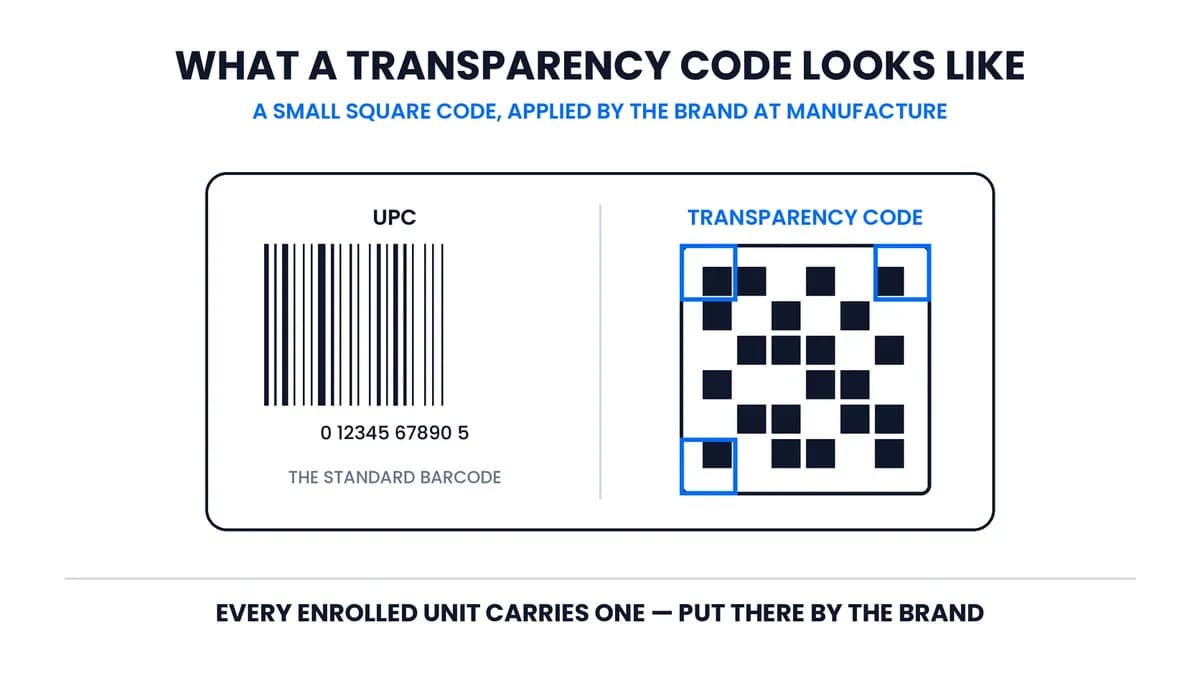
Amazon Transparency codes are unique serial labels that the brand puts on each unit when the product is made. If a listing is transparency enabled, every unit you send to FBA or ship yourself must carry one. Only stock that came through the brand or a distributor the brand supplies will have it. A unit without a code fails the check, and you cannot sell it on that listing.
The part that hurts comes later. You already bought the stock. It arrived sealed and clean. There are no codes on it. The listing sells, the invoice is real, and none of that matters until you can answer one question: where did these units come from, and does that source have codes?
This blog post answers that question for wholesale resellers. If you are new to selling wholesale on Amazon, our Amazon wholesale roadmap for beginners covers the basics first.
What Is Amazon Transparency, From the Reseller's Seat
Amazon calls Transparency a product serialization service and anti-counterfeiting program. Every unit the brand enrolls gets a unique code, printed as a small square barcode on the packaging. Amazon keeps a record of every code and the product it belongs to. When a unit arrives at a fulfillment center, the code is scanned. A shopper can scan it too, with the Amazon Shopping app or the Transparency app, and see that the unit is genuine.
Amazon's own pages explain all of this for brands. They do not explain what it means for the reseller who never touches the code.
Here is the reseller version. The brand is the only party that can create Transparency codes. To enroll, the brand needs a Brand Registry account with the rights owner role, a registered trademark, and a GTIN for each product. It pays per code, starting at $0.05 per code and falling as volume grows. Then it labels the units before they leave the factory, either itself or through a packing partner.
So a Transparency code proves one thing: this unit passed through the brand's hands, with the brand's knowledge. That is the same thing a wholesale reseller is always trying to prove with invoices. The code makes the proof physical, and it sits on the box.
Why the Listing Says Transparency and Your Pallet Does Not
The gap usually shows up in one of three ways.
The brand enrolled the listing after you started buying. You sourced the product months ago and reordered it without a second look. In between, the brand enrolled the ASIN. Your units already in FBA may sell through, but the next shipment is checked when it arrives, and units without codes do not pass. Nothing on the listing looked different. The rule underneath it changed.
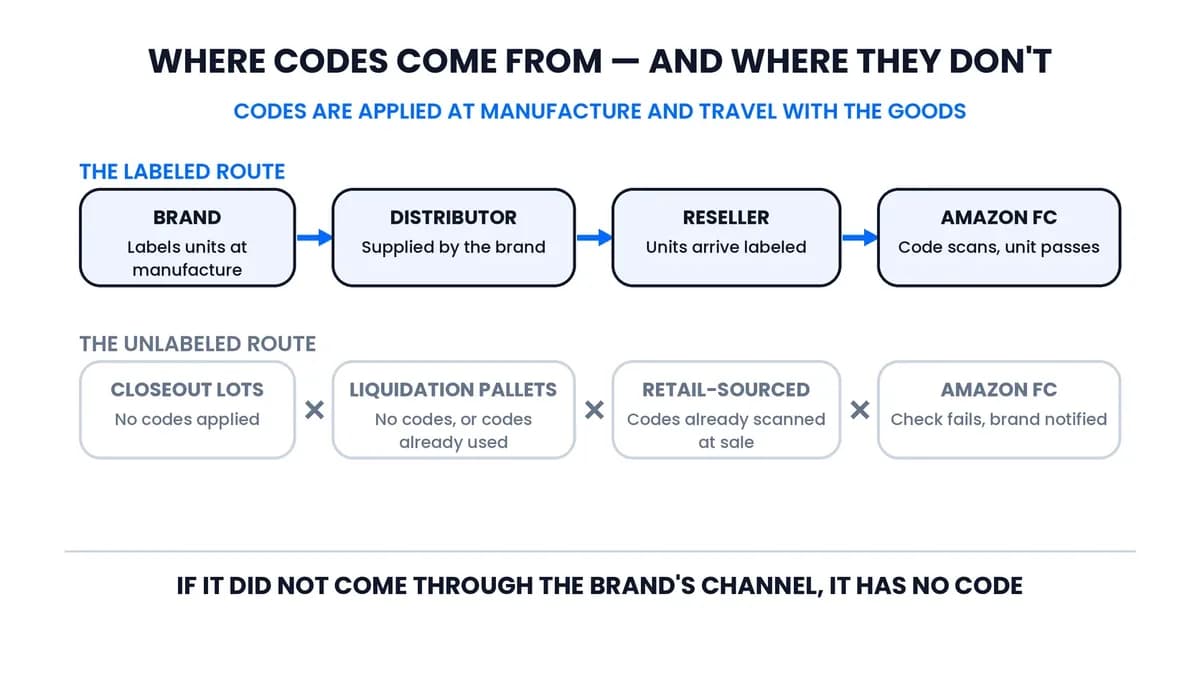
Your supplier sits outside the labeling step. A distributor that buys from the brand receives labeled units, because the brand labels at manufacture and the codes travel with the goods. Stock that took another route, such as a closeout lot, a liquidation pallet, or a middleman who bought from a retail store, usually arrives without codes, or with codes that were already scanned when the unit was sold the first time. Both fail.
The brand enrolled and cut its distributor list at the same time. Transparency is often the last step in a brand's plan to control who sells its products on Amazon. Brands that go this far tend to trim their distributors as well. That is why Transparency products and brands that don't allow Amazon resellers overlap so often.
In all three cases the problem is the same. Transparency never asks whether your invoice is valid. It asks whether each physical unit can prove where it came from. A perfect invoice for stock without codes gets you a perfect invoice for stock you cannot ship.
Can Wholesale Sellers Sell Transparency-Enabled Products?
Yes. Nothing in the program is against resellers. The rule is simple: every unit you list or ship must have a valid code, in any store where the program runs. Amazon does not check who the seller is. It only checks the code.
Many wholesale resellers sell these products with no trouble at all. Their distributor's stock arrives with labels already on, and the codes scan fine when the units reach Amazon. But be clear about one thing. A brand that joins Transparency cares who sells its products on Amazon. It knows exactly which distributors it supplies. And those distributors are careful about which seller accounts they approve.
So the code is the easy part. The hard part is getting approved by a source whose stock carries codes. It is the same wall you already know from brand authorization for Amazon sellers. Getting codes is the easy part. Getting approved by a source whose stock carries codes is the same approval wall you already know from brand authorization for Amazon sellers.
So "can I sell it" becomes "can I buy it from a source the brand supplies directly." Answer that before you look at the margin.
How to Get Amazon Transparency Codes as a Reseller
You cannot, and knowing that early saves weeks.
The brand generates codes in its Transparency portal and is responsible for labeling every unit it makes. There is no reseller portal, no form to request a batch, and no third party that can issue codes for the brand. A unit in your warehouse ends up with a valid code in only three ways:
- The brand labeled it before it shipped, and it reached you through a distributor the brand supplies.
- The brand chose to send codes or labels to a seller it works with directly. This does happen, but it comes from a relationship, not from a request form.
- The brand connected its own serial numbers to Transparency instead of using Amazon-issued codes, so the serial already on the box is the code.
Everything else is a dead end. Buying codes, printing codes, reusing codes from units you already sold, or sending units in without codes to see if they pass all end the same way. The failed check is investigated and the brand is told about it. A brand that just learned you tried to push unlabeled units onto its ASIN is a brand that will not approve your account later.
What you can do is work the one path that is open: buy from a distributor the brand actually supplies. For most products that is the same work as finding the authorized channel in the first place, which we walk through in how to find the authorized distributors for any brand.
4 Checks to Run Before You Buy, Not After
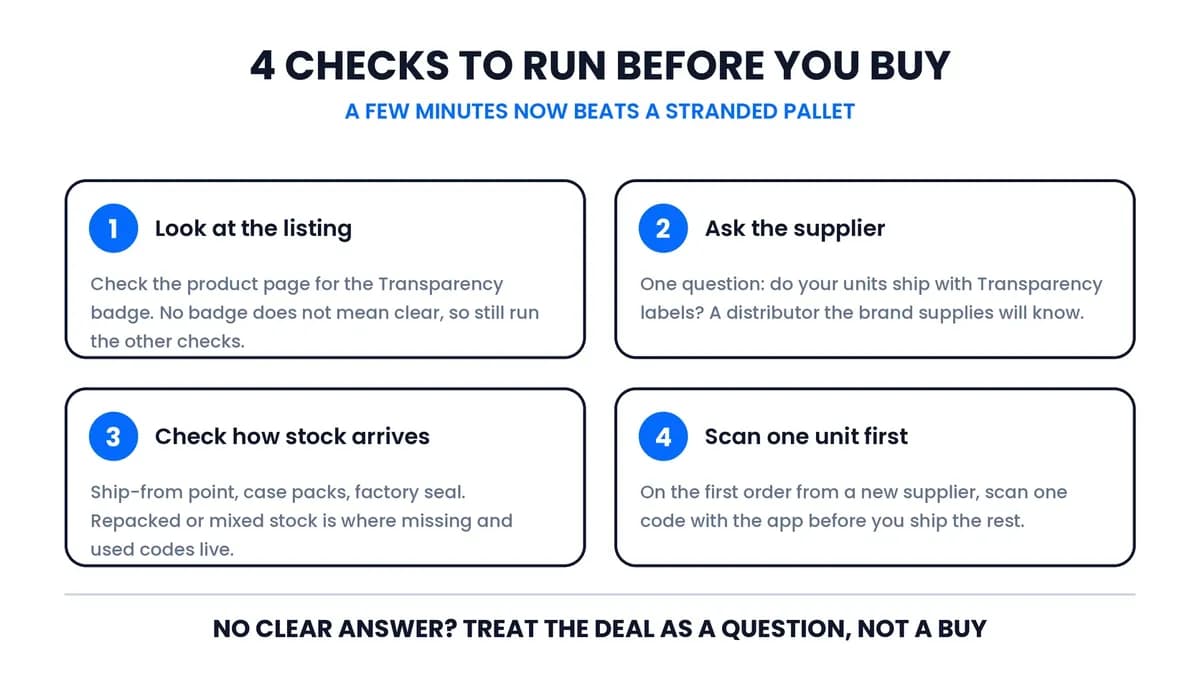
Most Transparency pain is decided at the moment you choose to buy. Four checks take a few minutes and remove most of the risk.
Look at the listing. Products that need Amazon Transparency codes may carry a Transparency badge on the Amazon product page. If you see it, every unit will need a code. Amazon says not every enrolled brand qualifies for the badge, though, so a listing with no badge is not automatically clear, and the next check still matters. If you check many listings a day, our Chrome extension shows the distributor count and lowest wholesale cost in our network on the Amazon page itself, so you can see the badge and the sourcing picture at the same time.
Ask the supplier one plain question. "Do your units for this product ship with Transparency labels on them?" A distributor the brand supplies will know, because the brand told them. A supplier who has never heard of Transparency, or who says you can add the labels yourself, has just told you where their stock came from.
Check how the stock reaches you. Ship-from location, case packs, and whether units are factory sealed. Labels go on at manufacture. Repacked stock, mixed lots, and opened units are where missing or already-used codes live.
Scan one unit before you ship a thousand. When the first case lands, scan a code with the Transparency app. It should match the exact product. Do this on the first order from any new supplier of a Transparency product. It is the cheapest audit you will ever run.
If you cannot get a clear answer on any of the four, treat the deal as a question rather than a buy. A Transparency product is a product the brand is watching, and your paperwork and your units have to agree.
When the Only Supplier You Can Find Has No Codes
This is where most sellers get stuck. The product sells. The listing has the badge. Each supplier you can reach either has no codes or will not say. The distributors the brand really supplies do not advertise, and the ones that are easy to find are the ones whose stock arrives without labels.
You have two moves, and you can use both.
- First, stop searching for the product and start searching for the brand's channel. Codes follow the brand's distribution, so the question changes from "who has this UPC" to "who does this brand sell to wholesale." The brand's website, its dealer locator, and a distributor's own line card get you part of the way. On B2B Supplier Hub you can search the product free and compare real cost and real stock from every verified distributor in our network carrying it, with a freshness timestamp on each listing, before you pay for a name.
- Second, if the search comes back empty, hand it to us. Request a Supplier means our team goes and finds an authorized wholesale distributor who carries the product, reviews their business and catalog, and brings them onto the platform. It is free on every plan, and you get an answer within 30 days, either way. For Transparency products this is the right tool, because a distributor the brand supplies is the only kind of source whose units will carry codes.
One thing we will not promise is approval. Transparency brands are selective on purpose, and the account decision stays with the brand and its distributor. What you skip is the weeks of guessing whether a source is even worth applying to.
What Transparency Changes About How You Source
Transparency forces a habit every wholesale reseller should have anyway: know the physical route of your units, not only the paper trail. Invoices are your first defense when Amazon raises a Section 3 inauthentic complaint. Codes are the second, and the brand controls them completely.
Build it into your routine. When you add a product to your reorder list, note whether the ASIN is Transparency enabled and which supplier delivers labeled units. When you set up a backup supplier for a top SKU, test their codes on the first order, not on the day your main supplier runs out. When a supplier you have used for years suddenly ships unlabeled units for a product that used to pass, do not assume Amazon made a mistake. Something changed upstream, and your next inbound shipment will feel it.
Over time this is good news for resellers who buy correctly. Brands enroll to stop counterfeits and unauthorized stock, not legitimate wholesale accounts. If your units carry codes, you are on the right side of that line, and the sellers who are not are slowly being cleared off your listings.
Check the Badge Before the Pallet Arrives
A listing with the Transparency badge is the brand telling you, in advance, that only units from its own channel will be allowed on that ASIN. Buy from that channel and nothing changes for you. Buy from anywhere else and the invoice will not save the shipment.
So check before the buy, not after the pallet arrives. Search the product free, compare the distributors in our network that carry it, and when nobody does, submit a request to find an authorized wholesale distributor. The approval is still the brand's to give. Knowing which door to knock on is yours.
Frequently asked questions
01How do I get an Amazon Transparency code?
02How much does Amazon charge for Transparency codes?
03Can I sell a Transparency-enabled product without codes?
04How do I scan a Transparency code?
05How do I find wholesale suppliers whose units carry Transparency codes?
The B2B SupplierHub Team
Wholesale & sourcing
Stop hunting suppliers by hand. Type a UPC instead.
B2B Supplier Hub shows the suppliers in our network carrying a product on one page: wholesale cost, stock, and retail price side by side. Free to search, no card required.