
Distributor Authorization
Amazon Section 3 Inauthentic Complaints: The Invoice Fix (2026)
-1200x627.png&w=3840&q=75)
Most sellers respond to an inauthentic complaint the wrong way, and it's not their fault. The word itself points you in the wrong direction.
You read "inauthentic" and you start defending the product. You take photos of the sealed box. You explain that you bought it from a real US distributor. You might even offer to ship a unit to Amazon so they can see it themselves. None of it helps, because Amazon never doubted the product. What Amazon wants to know is where it came from, and the only answer it accepts is paperwork in a specific format, while the clock runs on your listing. Get that right and the complaint can be over in a few days. Get it wrong and you can lose the listing, your payout, and in bad cases the account itself.
This guide will walk you through what the complaint actually means, what to do in the first 48 hours, and how to make sure the invoices in your files can carry the weight when it matters.
Where Complaints Come From, and When They Turn Into Section 3
So if the product isn't the issue, what triggers the complaint? Usually one of three things. A buyer reported the item as "not as described" or suspected a fake. A brand owner filed a report through Brand Registry. Or Amazon's own system noticed something odd, like a big jump in sales that doesn't match your normal buying pattern. Genuine products get flagged through all three routes every day.
The complaint itself is not a disaster. What happens next is what matters. One unresolved complaint sits in your Account Health and adds weight. A few of them, or one on a product that makes you a lot of money, can push you over the line. That's when you get a Section 3 deactivation. That means the whole account goes down, not just one listing. Reinstatement specialists say Amazon has been moving toward full account suspensions lately, even for problems that used to only affect a single listing. So never treat one complaint as a small thing.
The Invoice Amazon Wants to See
The document that answers an inauthentic complaint is a commercial invoice from a wholesale distributor.
Amazon's own rules say what that invoice must have:
- An issue date within the past 365 days before you got the notification.
- Quantities that cover your sales for that product over the same period. If you sold 300 units and your invoice shows 50, that gap alone is a problem.
- The supplier's full contact details.
- A trail back to the original manufacturer. If you didn't buy straight from the brand, you may need to ask your distributor for their own sourcing papers too.
Amazon also asks for your sales records for each product named in the complaint, so it can match what you bought against what you sold. And yes, Amazon may call your supplier to check.
Just as important is what does not count. Retail receipts fail. They prove you walked into a store, not that you're part of a real distribution chain. Order confirmations fail. Pro-forma invoices fail, because they show you planned to buy, not that you actually did. Invoices you wrote yourself fail, for obvious reasons.
We broke down every field of a passing invoice in what counts as a valid wholesale invoice. The point here is simpler. If your supplier can't give you that document, no amount of good appeal writing will save you.
The First 48 Hours: 5 Steps in Order
If a complaint just landed, work through these steps in order.
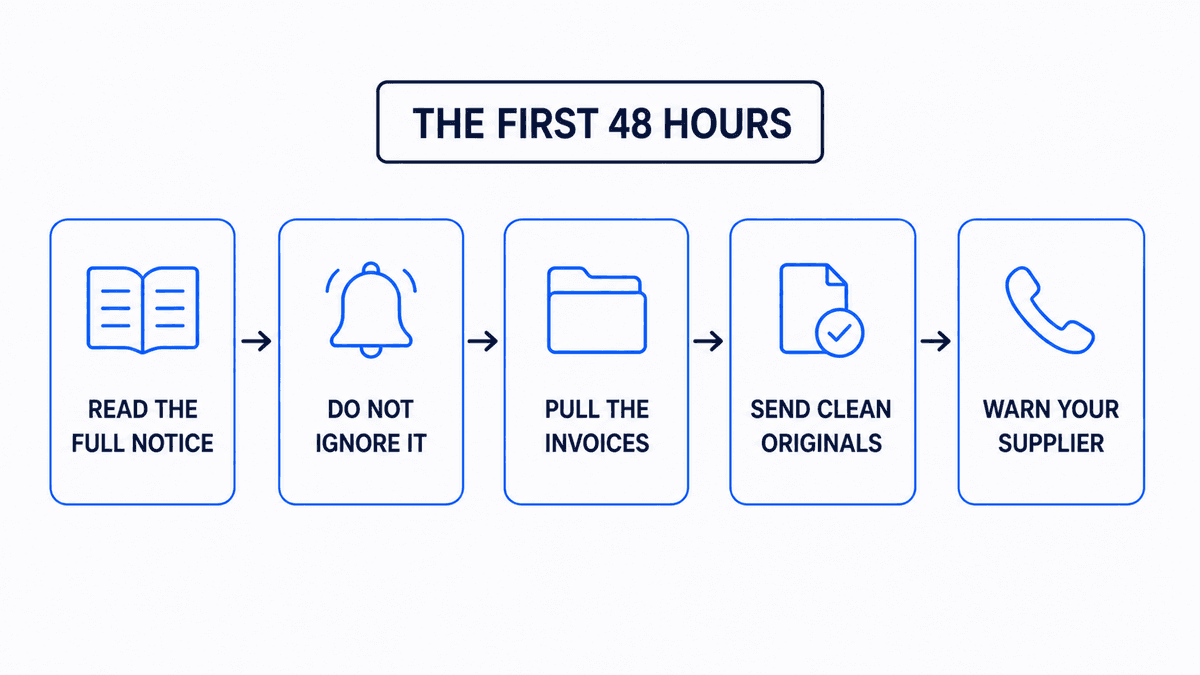
- Read the Whole Notification. Not the first two lines. All of it. It tells you the exact product, the type of complaint, and what Amazon wants. Sellers often answer the wrong thing because they skimmed.
- Do Not Ignore It. Amazon's forums are full of sellers who brushed off the first complaint because sales kept running. Then a second complaint months later took the whole account down. The complaint you ignore today counts against you later.
- Pull the Right Paperwork. You need invoices for that exact product, covering the time period in question. Before you send anything, check four things. Your business name on the invoice matches Seller Central exactly. Your address matches your account info. The dates fall inside the 365-day window. The quantities make sense against what you sold.
- Send Clean Documents. Slow down here, because this is where honest sellers get suspended for "forged" invoices. Amazon rejects anything in an editable format. Never upload a Word or Excel file. Don't convert one to PDF yourself either, because a file that started out editable can look manipulated. Ask your supplier for their original PDF and send that. One thing Amazon does allow, in its own words: you may highlight or circle the product under review if the invoice lists many items, and you may hide the pricing. Touch nothing else.
- Warn Your Supplier. Amazon checks invoices by calling suppliers. A distributor who doesn't pick up the phone can sink a perfect document. A quick message telling them a call may come is cheap insurance.
Writing a Plan of Action That Works
If Amazon asks for a Plan of Action, the structure matters as much as the words. Reviewers expect three parts. Vague language in any of them gets an automatic rejection.
Root cause. Name the real gap. "We did not collect supplier invoices before listing" is a root cause. "We didn't realize there was an issue" is not.
What you fixed. Actions you already took, written in past tense, with dates. Removed the listing on this date. Asked the supplier for supply chain papers on that date. Things you did, not things you plan to do.
How it can't happen again. The process change that closes the gap for good. For example: no new product goes live without full sourcing papers on file, and one named person owns that check. "We will source more carefully going forward" means nothing. Amazon's reviewers have read that line ten thousand times.
One more warning. If your invoice was rejected once, sending the same file again gets the same rejection. Find out which rule it broke, fix that, then resubmit. We explained why real invoices get bounced by Amazon's automated review in our ungating invoice requirements guide.
When the Invoice Alone Is Not Enough
Now the uncomfortable part, because pretending otherwise wastes your time. A distributor invoice proves you bought the product. It does not prove the brand allows you to sell it. Those are two separate things, and Amazon treats them separately.
For many brands, a clean invoice settles the complaint. But some brands require a Letter of Authorization too. Here's the rule that catches sellers constantly: the letter must come from the brand itself. A letter written by your supplier will be rejected, even if the supplier is big and completely legitimate. A distributor can sell you a product. They cannot give you the brand's permission, because it was never theirs to give.
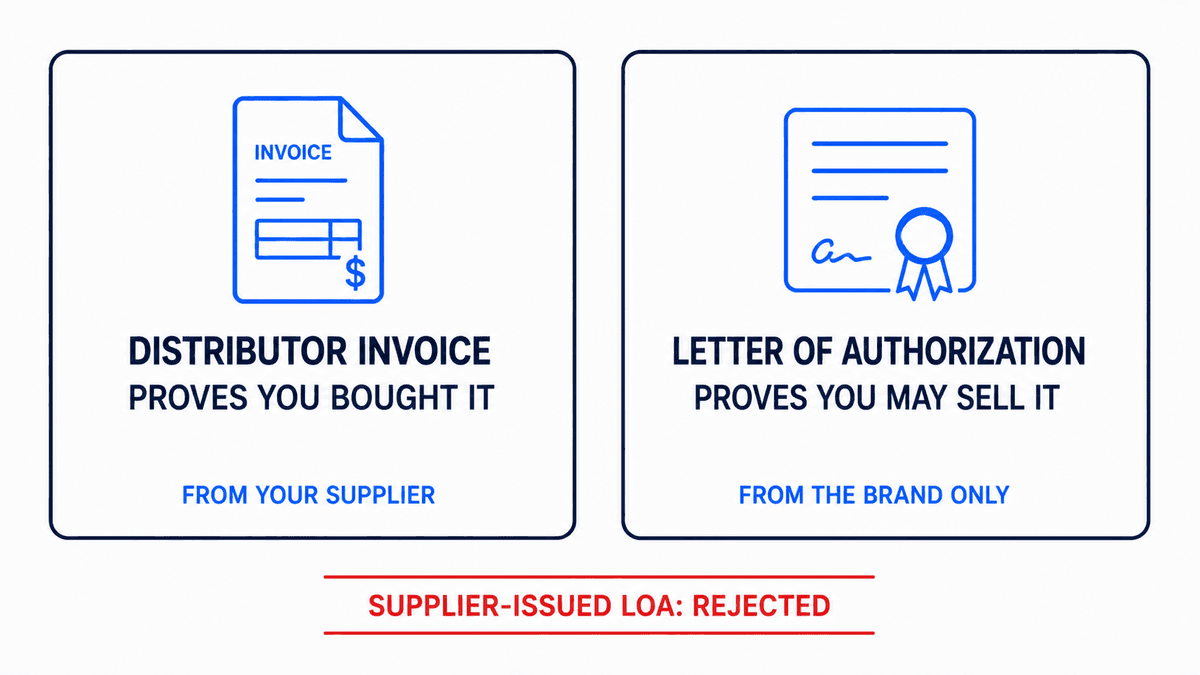
This is exactly where gray market sourcing falls apart. The product can be genuine. The invoice can be real. The appeal still fails, because the supply came from outside the brand's approved network. If you sell anything sourced from the edges of a supply chain, read what actually happens with gray market goods on Amazon before a complaint teaches you the hard way.
So here is the honest version of this post's title. A distributor invoice saves your account when the supply behind it is truly authorized. When it isn't, the invoice is just a receipt for inventory you can't defend.
The Real Fix: Build the File Before Anyone Asks
Everything above is damage control. The sellers who clear complaints in days instead of weeks all did the same thing, and they did it before any complaint existed.
They get the full invoice from every supplier before the first order, not after a problem. They ask the distributor where their own supply comes from. A supplier who gets cagey about that question is telling you something. They keep their Seller Central details matched to their invoices, down to the exact legal name. And they file their papers by product, so answering a complaint is a twenty-minute job instead of a panicked email chase.
The bigger idea is simple: know what you're buying into before your money moves. That's the same thinking behind B2B Supplier Hub. You can search millions of wholesale products free and see the real numbers, with human-verified suppliers behind every listing. The certainty comes before the commitment, not after.
Lastly, The complaint isn't really about your product. It's about your paperwork. Get your invoices in order now, while nobody's asking, because once a complaint lands it's too late to start
Frequently asked questions
01Does an inauthentic complaint mean Amazon thinks my product is fake?
02Can I use retail receipts to answer an inauthentic complaint?
03Is a distributor invoice enough, or do I also need brand authorization?
04Why was my real distributor invoice rejected?
The B2B SupplierHub Team
Wholesale & sourcing
Stop hunting suppliers by hand. Type a UPC instead.
B2B Supplier Hub shows the suppliers in our network carrying a product on one page: wholesale cost, stock, and retail price side by side. Free to search, no card required.