
Amazon Ungating
Are Amazon Ungating Services Worth It?
For most sellers, no. An ungating service can save time and clean up your paperwork, but it cannot buy you the approval, because only Amazon grants that. A service is worth paying for only when it brings genuine expertise or distributor relationships you do not have.
But before you pay anyone, it helps to know what you'd actually be paying for. Ungating services are worth it in a few situations and a waste of money in most, and with the cheapest ones you're not just wasting money, you're risking your account. This blog post breaks down when a service makes sense, when you're better off doing it yourself, and how to tell the difference.
When an Ungating Service Is Worth It (and When It Isn't)
A service can be worth it in few cases. If the category is the one Amazon almost never approves on its own, a broker with genuine distributor relationships can be worth the few hundred dollars. It can also pay off if you have already been rejected on an application that was actually correct and you want an expert set of eyes, or simply if your time is worth more to you than the fee. In those spots, paying makes sense.
For most sellers, though, doing it yourself wins. The easier categories in 2026, like beauty, grocery, toys, sports and outdoors, and automotive, are very doable on your own if your account is healthy and you can get a genuine invoice. One timing note worth knowing right now: toys gets locked down every fourth quarter. Heading into the holidays, Amazon only lets sellers list toys if they already have the sales history and clean account health to qualify, and that gate usually goes up around October. So if you want to sell toys in Q4, you need to be ready before then, not scrambling in November. Miss that window and you're waiting until after the holidays.
People often skip DIY because they hear it's hard. First tries do get rejected fairly often, but almost always for small, fixable reasons like a wrong date or a mismatched business name, not because the whole thing is impossible. Some services like to quote scary failure rates for DIY, but keep in mind they're selling the alternative.
What You're Actually Paying an Ungating Service For
The price range for these services is huge, and the range itself tells you most of what you need to know. No service, at any price, actually approves you. Amazon does that. What you're paying for is help with the paperwork and, in the better cases, help with sourcing. Once you see it that way, the prices start to make sense.
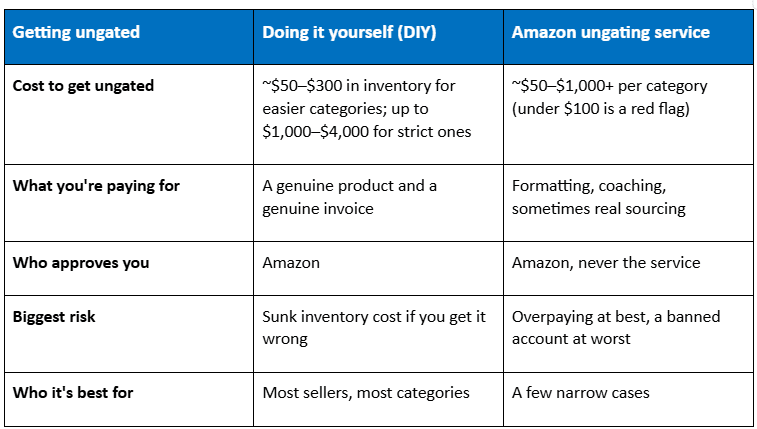
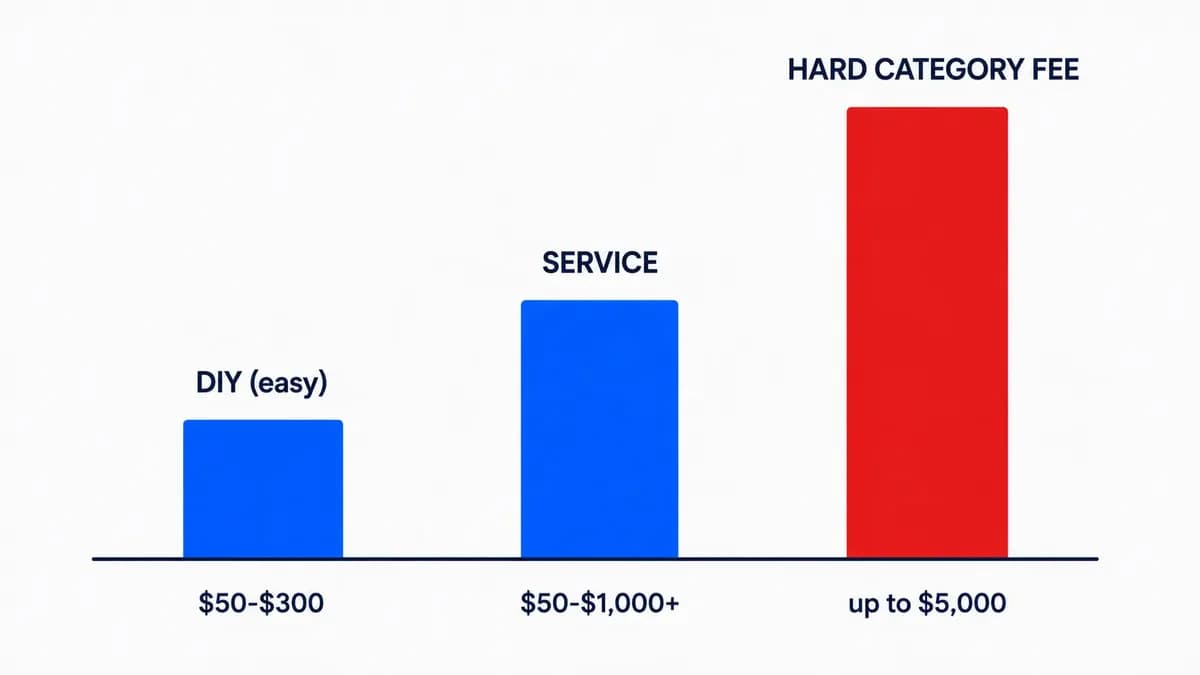
A service charging under about $100 for a hard category is a warning sign. That price usually buys nothing more than form-filling, and sometimes it buys documents you didn't earn through a genuine purchase, which is the dangerous kind. Somewhere in the $100 to $300 range, you're usually paying for legitimate help formatting your application and pointing you toward good suppliers. Around $1,000, you're typically paying a broker to do the sourcing for you through distributor relationships they already have. In short, the price mostly reflects how much sourcing work the service is doing. A cheap "guarantee" is selling you the one thing that gets accounts banned.
What DIY Ungating Actually Costs (Units and Fees)
For most categories, your only cost is buying the units Amazon wants to see on the invoice. That's usually at least 10 units, which often comes to somewhere between $50 and $300 depending on the product. That's it.
Stricter categories ask for more. Sellers describe being asked for as many as 200 units of a single product, which can mean putting $1,000 to $4,000 into inventory before you're approved. And if the application fails, that's money tied up in stock you can't sell on Amazon yet, so the quantity is worth checking before you commit.
There's one more cost no service can make disappear. A few high-value categories, like fine jewelry, watches, collectible coins, and fine art, carry an official Amazon application fee that can run up to $5,000 and is not refundable. That's Amazon's fee, not a service's, so paying a middleman doesn't get you around it.
The Fake-Invoice Risk That Settles It
This one matters more than price. Fake or edited invoices are one of the most common reasons sellers get permanently banned, something appeals specialists and sellers themselves report again and again. Amazon checks the supplier details on your invoice against public records and distributor databases, and once a document gets flagged as fake, getting the account back is rare. That's the whole problem with a cheap service that promises the impossible. You're not buying a shortcut, you're buying the fastest way to lose the account.
The process has also gotten more automated. People who handle appeals for a living say most ungating reviews in 2026 are now done by software, not a person. That means the small details decide everything. Your business name and address have to match your account exactly, the dates have to be right, and the format has to be clean. If a genuinely valid invoice keeps getting auto-rejected, the fix isn't a new invoice, it's getting a human to look at it through Amazon's Seller Issue Form. Our guides on what a valid invoice looks like and the exact invoice requirements walk through the details.
To be fair, doing it yourself isn't risk-free either. A sloppy attempt can cost you the inventory and can leave a rejection on your record that makes later appeals harder. The point isn't that DIY is perfectly safe. It's that the DIY risk is small and in your own hands, while a bad service's risk is neither.
What No Ungating Service Can Solve: Brand Approval
Even the best service runs into one wall it can't get past, and it's worth understanding before you pay anyone.
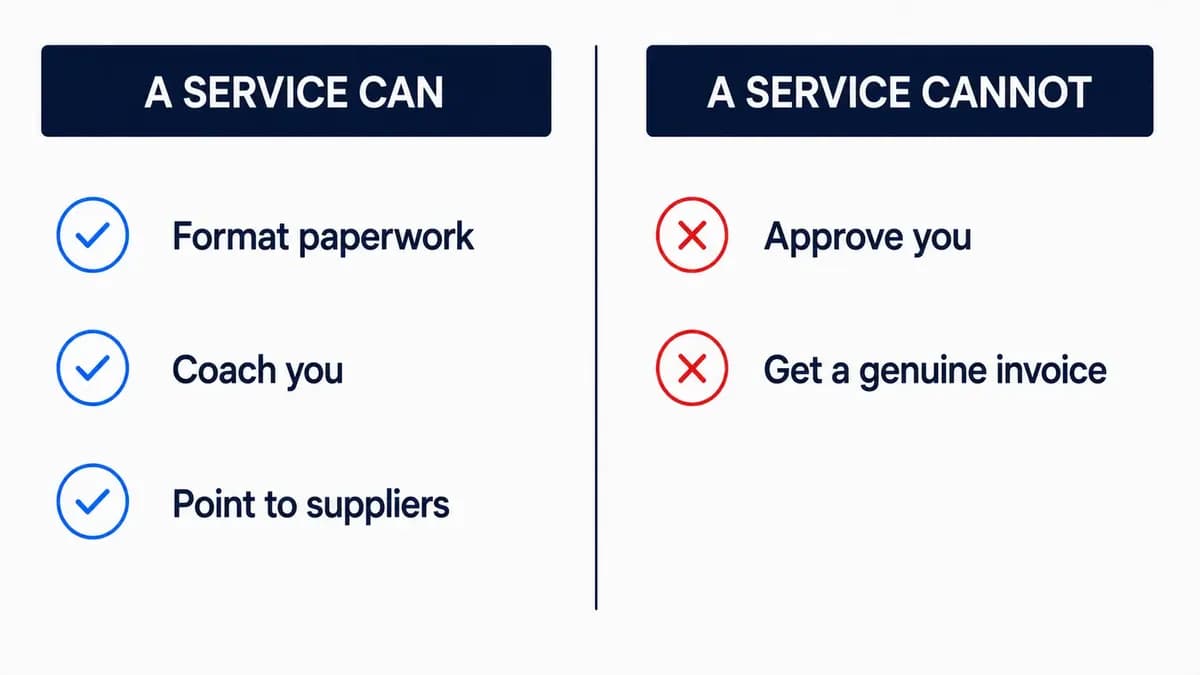
A wholesale invoice is not the same as brand permission. A distributor can sell you genuine product, but selling is not the same as authorizing. More and more brands now keep a list of sellers they have approved, and if you're not on that list, even a flawless invoice won't get you selling their products, and it can even trigger a complaint against your account. No service can add you to a brand's approved list.
So whichever route you take, the whole thing comes down to one input: a clean invoice from a distributor who is actually allowed to supply that product. That's the real bottleneck, not the paperwork around it. Finding that distributor is what you want to get right, and it's the one thing a service can never truly hand you, because it comes down to your own sourcing, not their coaching.
The Bottom Line: Fix Your Sourcing, Not the Paperwork
In the end, the choice is simple. A service can buy you time and cleaner paperwork, but it can never buy you the approval itself, because only Amazon gives that. So a service is only worth paying when you're paying for genuine expertise or sourcing you can't do yourself. It's never worth paying for a shortcut around the invoice, because that shortcut is usually the thing that ends accounts.
The sellers who stop thinking about ungating services altogether are the ones who fixed their sourcing first. Once you can reliably get a clean invoice from a distributor who is actually allowed to supply the product, the gate stops being scary and becomes just another step. If you want to make that step easier, you can search a product free on B2B Supplier Hub and see the wholesale cost and real stock from distributors in our network before you spend a dollar. That's the piece no service can ever hand you, and it's the piece that matters most.
Frequently asked questions
01Are Amazon ungating services safe?
02How much do ungating services cost?
03Can I get ungated without a service?
04Why do ungating services get accounts suspended?
05Are Amazon ungating services worth it?
The B2B SupplierHub Team
Wholesale & sourcing
Stop hunting suppliers by hand. Type a UPC instead.
B2B Supplier Hub shows the suppliers in our network carrying a product on one page: wholesale cost, stock, and retail price side by side. Free to search, no card required.