
Distributor Authorization
Authorized Dealer vs Authorized Distributor vs Reseller
Authorized dealer vs authorized distributor sounds like the same thing said twice. It is not, and the difference shows up on your invoice. A dealer is approved to sell a brand's products, mostly to the public. A distributor is approved to supply those products to other businesses. When a brand or Amazon checks where your stock came from, this is the difference they are looking at
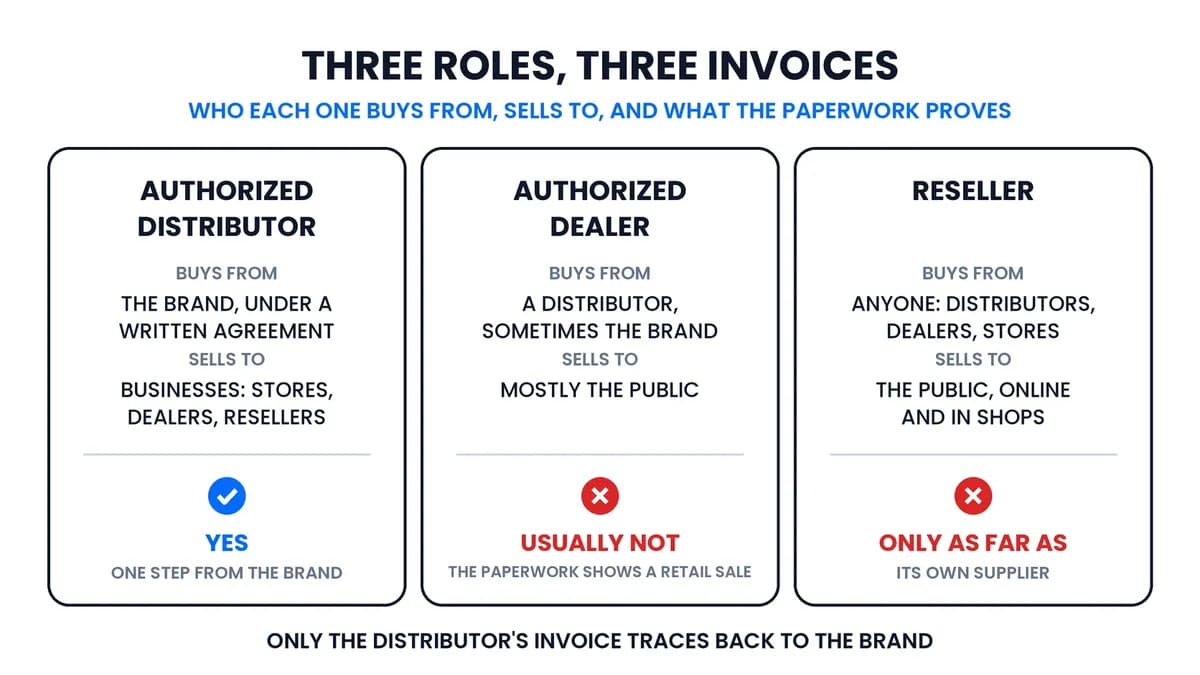
The short answer is this. An authorized distributor buys from the brand under a written agreement and sells to businesses, so its invoice is one step from the brand. An authorized dealer usually buys from a distributor, and the document it hands you is a retail receipt. A reseller is any business that buys stock to sell it again, and the word tells you nothing about where that stock came from. If you buy wholesale to resell, only the distributor's paperwork reliably passes a brand or marketplace review.
The table below puts the three side by side.
Role | Buys from | Sells to | Does the invoice trace to the brand? |
|---|---|---|---|
Authorized distributor | The brand, or the brand's master distributor, under a written agreement | Businesses: stores, dealers, resellers | Yes. One step from the brand. |
Authorized dealer | A distributor, sometimes the brand | Mostly the public, sometimes other businesses | Usually not. The paperwork shows a sale to a customer, not a wholesale purchase. |
Reseller | Anyone: distributors, dealers, stores, liquidators | The public, on marketplaces, online, or in a shop | Only as far back as the reseller's own supplier, which is often a dealer or a store. |
Dealer vs Distributor: The Words Sound Alike, the Paper Does Not
Follow one product through three sets of hands and the difference becomes clear.
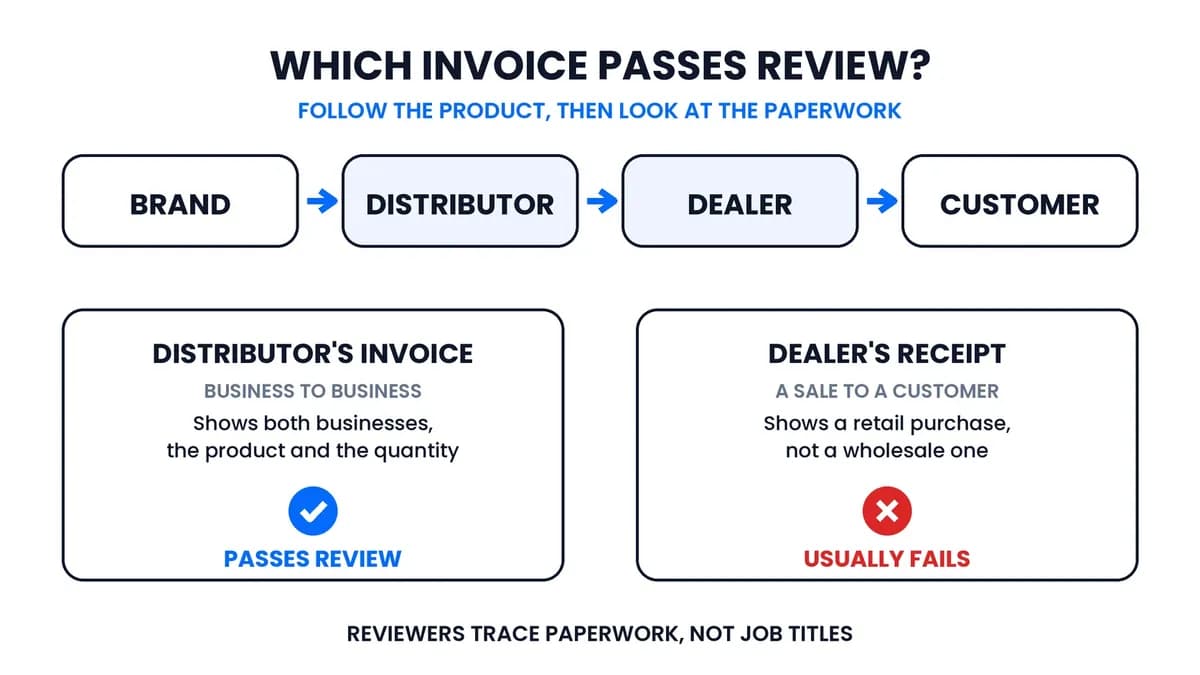
The brand makes the product. It signs an agreement with a company that promises to buy in volume, hold stock, and sell to other businesses. That company is the authorized distributor. Its invoice shows its own business name and address, your business name, the product by MPN or UPC, and quantities that make sense for a business. A reviewer can call the brand and confirm the company is on its list.
The distributor sells to an authorized dealer. A dealer is a seller the brand has approved to sell its products to customers: a shop, a repair center, an online store with a dealer badge. The dealer bought from the distributor, so the dealer's own purchase invoice traces to the brand. The receipt the dealer gives you does not. It shows a retail sale, often in your personal name, with sales tax added and a quantity that looks like a shopping trip rather than a stock order. That is the document that gets rejected in review, even when every unit is genuine.
Then there is the reseller. In plain English, a reseller is any business that buys a product to sell it again, so distributors and dealers are resellers too. In the wholesale world, though, "reseller" means the business at the end of the chain, the one selling on Amazon, Walmart, eBay, Shopify, or a shop floor. A reseller can be approved by the brand or buying from an authorized distributor, or neither. The word tells a reviewer nothing on its own. Where the reseller bought the product tells them everything.
So, can a dealer be a distributor? Yes, and this is where resellers get caught. Some dealers also hold a distribution agreement. Some distributors run a retail counter. The role you dealt with is set by the document you walk away with, not by the sign on the door. If you got a retail receipt, you bought from a dealer that day, whatever else that company does.
What "Authorized Reseller" and "Official Distributor" Really Mean
Brands use "authorized reseller" and "authorized seller" loosely. On one brand's site it means a store the brand has checked out. On another it means a marketplace seller the brand has agreed to leave alone. On an Amazon storefront it is usually a label the seller gave itself. None of those create a paper trail back to the brand.
People also ask about authorized seller vs authorized dealer as if they were two different things. Usually they are the same business seen from two sides. The brand calls it a dealer; the business calls itself an authorized seller. What matters to you is not the name but what the business can sell you and what document comes with it. A dealer that sells you a case of units and writes a proper business invoice from its wholesale account is acting like a distributor for that order. A dealer that rings you up at the register is a store.
The same goes for official distributor vs authorized distributor. "Official" is marketing. "Authorized" means a signed agreement with the brand. A company can be the brand's official partner in a press release and still be a dealer on paper. When a brand publishes its distributor list, that list is the authorization.
Which Invoice Passes Amazon Review
Start with what the law says, because it surprises people. Buying from a distributor, a dealer, or a store and reselling the product is legal. Once a product is sold, the person who owns it can sell it on. That rule is written into US copyright law as the first sale rule. This is general information, not legal advice, but the point holds: nobody is breaking the law by buying retail and reselling.
The gate is somewhere else. It sits in the brand's policy and in the marketplace's review process, and both care about one thing: can the product be traced to the manufacturer through business-to-business invoices? Our hub on brand authorization for Amazon sellers explains how brands enforce this.
Amazon's own community staff put it plainly. In an Amazon moderator's reply on invoices for approval, the guidance is that your documents "should be able to trace your products to the original manufacturer," should include contact details for both your supplier and the manufacturer, and may be checked by Amazon contacting them. The application text sellers paste into Amazon's forums asks for the name and address of the manufacturer or distributor, at least ten units in total, and a date within 180 days. Amazon does not publish these requirements on a help page, so treat them as current practice at the time of writing rather than fixed policy, and check the application text you are shown.
Now hold those requirements against the table. A distributor's invoice meets them as written. A dealer's receipt usually fails the "manufacturer or distributor" line, because a dealer is neither. A reseller's supplier invoice passes only if that supplier was a distributor.
So the distributor vs dealer vs retailer question comes down to this for a wholesale reseller: reputation has little to do with it. What counts is whose paperwork can carry your inventory through a review.
Is It Better to Buy From an Authorized Dealer? When Each Source Makes Sense
An authorized distributor is the right source when you are building inventory to resell. The cost is lower because you are paying wholesale prices. The quantities fit a business. The invoice is the kind a brand or marketplace expects. There is friction too. You apply for an account, you may be asked for a resale certificate and some business history, and some distributors will not open accounts for online sellers at all. Our guide on what distributors look for before approving an Amazon seller covers that side.
An authorized dealer makes sense in fewer cases. You want a handful of units to test a listing, and you accept that this stock will not hold up in a review. Or the dealer has a real wholesale counter and will write you a business invoice from its wholesale account, which some larger dealers do. In that second case, ask one question before you pay: will the invoice show your business as the seller, my business as the buyer, and the product by MPN or UPC? If the answer is a shrug, you are buying retail.
A reseller as your source is where most fake-product complaints on Amazon begin. Another marketplace seller clearing stock, a liquidation lot, a "wholesale" account that is really one person buying from dealers and marking it up. The products may be perfectly genuine. The chain still breaks at the first retail receipt, and a reviewer stops there. Our post on what a valid wholesale invoice looks like walks through the exact fields that separate the two.
Does an Authorized Distributor Certificate Prove Anything?
Resellers often ask whether a distributor can prove its status with an authorized distributor certificate. Some brands issue one. Many do not. A certificate helps, but it is not what a reviewer relies on, because a PDF is easy to make and hard to check.
The stronger checks are the boring ones. The brand's own "where to buy" or "find a distributor" page. An email to the brand's sales team asking whether the company is an authorized distributor for your region and your channel. The distributor's willingness to put its wholesale account details on your invoice. And the distributor's honesty about whether online resale is allowed under its agreement, because some agreements restrict it, and a distributor that hides that is setting you up for a complaint later. For how the layers stack, including master distributors and sub-distributors, check our blog master distributor vs authorized distributor.
If you source across many brands, the authorized distributors listed by brand on B2B Supplier Hub are human-verified before they join our network, which takes the first round of this checking off your desk. You still see the numbers before any name.
How to Tell a Distributor From a Dealer Before Money Moves
You usually cannot tell from a website. You can tell from the first three answers you get.
Ask how they buy the brand. A distributor says "direct" or names the master distributor. A dealer names a distributor. A reseller says something vague about "our suppliers."
Ask what the invoice will show. You want their business name and address, your business name and address, product identifiers, quantities, and a date. If they offer a packing slip, a screenshot, or an order confirmation instead, you are talking to a dealer or a reseller, whatever the job title in the email signature says.
Ask whether the brand will confirm them. An authorized distributor expects this question and often has a brand contact ready. A dealer points you to the dealer locator, which confirms dealer status, not distributor status. A reseller changes the subject.
Three questions and there is no associated cost. Additionally, they separate an invoice that works from one that only looks like it should.
Sometimes every distributor you can find says "we don't carry that." The product may be sold only through a closed group of distributors, or supplied by companies that do not advertise. That is the moment to stop guessing and find an authorized wholesale distributor through a request. Our team goes and finds one, verifies them, and you hear back within 30 days either way.
5 Takeaways You Can Use With Any Supplier
- The label on the company matters less than the document it gives you. Distributor invoices trace to the brand. Dealer receipts trace to a store. Reseller invoices trace only as far as the reseller's own source.
- Before paying anyone new, confirm the invoice will show both business names, product identifiers, and quantities that look like stock rather than a shopping trip.
- Treat "official," "authorized seller," and "authorized reseller" as marketing until the brand confirms the relationship or the paperwork proves it.
- A certificate helps. Brand confirmation helps more. A distributor willing to put its wholesale account on your invoice helps most.
- Buying from a dealer is legal and sometimes sensible for a test. Plan on that stock not surviving a review.
Read the Document, Not the Job Title
Most rejected invoices from honest resellers come down to one mix-up: a source that was authorized to sell was taken for a source that was authorized to supply. That is the authorized dealer vs authorized distributor line, and it is drawn in paperwork rather than reputation. Learn to read the document before you buy, and most of the review problems in this business never reach you.
If you want to see the numbers before you work out who is who,Search a product free on B2B Supplier Hub.. Real cost and real stock from every verified distributor in our network carrying it, before you apply to any of them. Unlock a supplier when the numbers work for you.
Most rejected invoices from honest resellers come down to one mix-up: a source that was authorized to sell was taken for a source that was authorized to supply. That is the authorized dealer vs authorized distributor line, and it is drawn in paperwork rather than reputation. Learn to read the document before you buy, and most of the review problems in this business never reach you.
If you want to see the numbers before you work out who is who, search a product free on B2B Supplier Hub. Real cost and real stock from every verified distributor in our network carrying it, before you apply to any of them. Unlock a supplier when the numbers work for you.
Frequently asked questions
01Which is better, a dealer or a distributor?
02Is it better to buy from an authorized dealer?
03What does "authorized distributor" mean?
04What are the three types of distributors?
05Can a dealer be a distributor?
The B2B SupplierHub Team
Wholesale & sourcing
Stop hunting suppliers by hand. Type a UPC instead.
B2B Supplier Hub shows the suppliers in our network carrying a product on one page: wholesale cost, stock, and retail price side by side. Free to search, no card required.