
Distributor Authorization
California Resale Certificate: How Resellers Get One (2026)
-1200x627.png&w=3840&q=75)
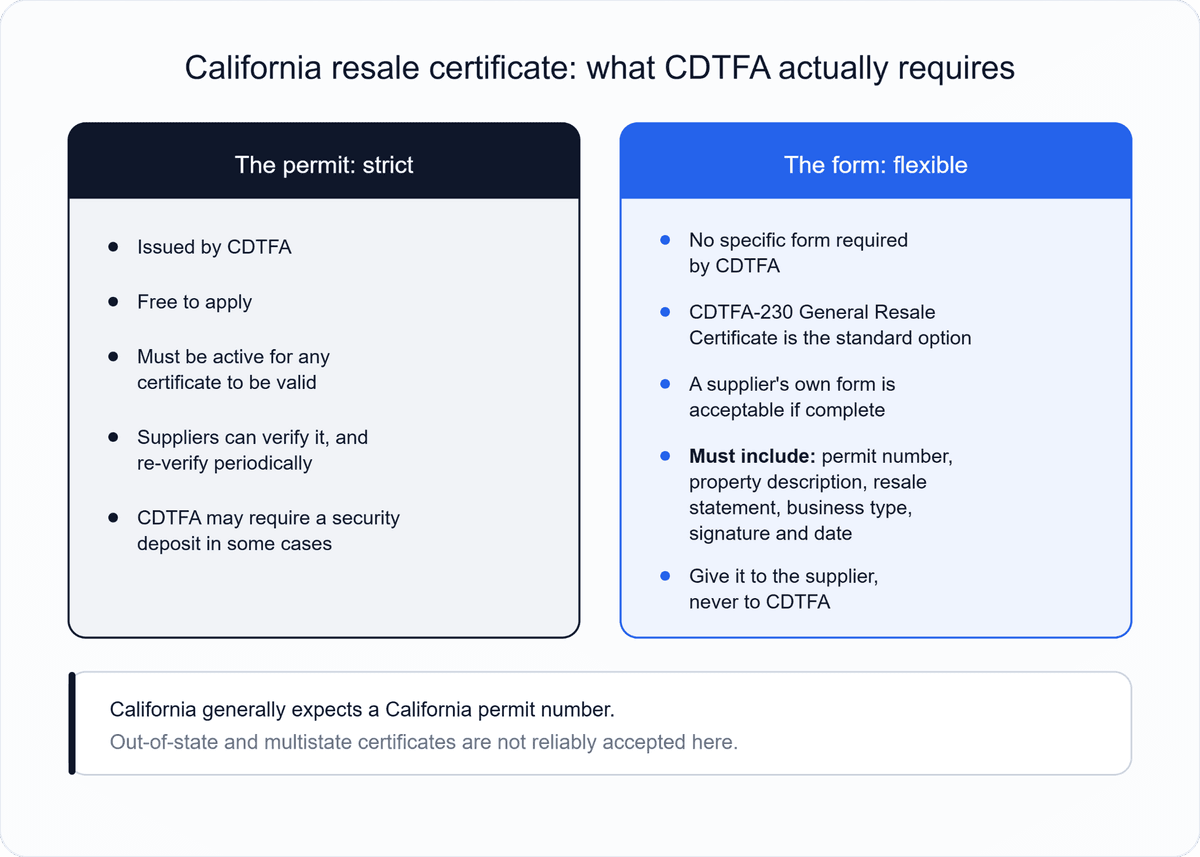
California is unusual on this subject in a way that confuses resellers coming from other states. There is no official California resale certificate that the state issues to you, and California doesn't even require a specific form. CDTFA publishes a general resale certificate you can use, but a supplier's own form works too, as long as it captures the right information.
What California is strict about is the item listed under the certificate: an active California seller's permit. Without a valid permit number to write on the form, no certificate you complete means anything, and California is notably less flexible than most states about accepting certificates from out-of-state buyers.
Here's the whole process, plus the two California-specific rules that catch people out.
The Two Pieces: Permit First, Certificate Second
A California seller's permit is your registration with the California Department of Tax and Fee Administration, or CDTFA, which took over this role from the old Board of Equalization. The permit authorizes you to make sales in California and gives you the permit number that everything else depends on. Applying is free.
A resale certificate is the document you give a supplier so they don't charge you sales tax on inventory you intend to resell. It's governed by Regulation 1668, Sales for Resale, and unlike Texas, which has a single mandated form, California takes a looser approach to format while being strict about content.
That relationship matters: the certificate is only as valid as the permit behind it. If your permit lapses or is suspended, certificates you've issued become invalid immediately, and suppliers may re-verify your permit status periodically. The general permit-and-certificate structure is explained in our guide to resale certificate vs. sales tax permit.
Step 1: Register for a California Seller's Permit
Apply through CDTFA's online registration system. There's no fee for the permit itself.
You'll generally need your business's legal name and structure, your EIN or Social Security number if you're a sole proprietor, your business and mailing addresses, a description of what you sell, supplier information, and estimated monthly sales. If you're unsure whether to register with an EIN or SSN, our comparison of EIN vs. resale certificate covers what distributors expect.
One California-specific possibility to be aware of: CDTFA has statutory authority to require a security deposit from some applicants, typically where the agency sees elevated risk of unpaid tax. Most small resellers won't encounter this, but it exists, and it's worth knowing so an unexpected request doesn't read as a scam.
Register before you need it. Distributor applications routinely ask for the permit number, and a pending registration stalls the account-opening process.
Step 2: Complete a Resale Certificate
Here's where California's flexibility shows. CDTFA states it does not require a specific resale certificate form. You can download CDTFA-230, the General Resale Certificate, from CDTFA's website, and it's the cleanest and most widely recognized option. But a supplier's own resale form is equally acceptable if it contains the required elements, and Regulation 1668 includes a sample certificate as well.
Whatever form you use, it needs to include your valid California seller's permit number, a description of the type of property you sell, the seller or vendor's name, a description of the property being purchased for resale, a statement that you're purchasing it for resale, your business type, and your signature with title and date.
Two fields cause most rejections. The permit number must be accurate and belong to an active permit, since suppliers can and do verify it. And the property description must be specific enough to be meaningful.
Vague descriptions weaken the certificate's protection for the supplier and invite scrutiny, which is why distributors often reject them. Describe what you actually resell, such as "consumer electronics and accessories," rather than something like "all merchandise."
Note also that CDTFA publishes a family of CDTFA-230-series certificates for specific industries and partial exemptions. For ordinary wholesale resale, the general CDTFA-230 is the one you want; the lettered variants exist for narrower situations.
Step 3: Give It to the Supplier, Not to CDTFA
The completed certificate goes to your supplier, who keeps it on file as proof of why sales tax wasn't charged. You never send it to CDTFA. The agency doesn't approve or register individual certificates.
Timing follows the same logic as everywhere else: the supplier needs a properly completed certificate at or before the time of sale because otherwise they're required to charge tax on the transaction.
Regulation 1668 allows a blanket certificate covering all qualifying purchases from a single seller, so you don't need a fresh form for every order with a supplier you buy from regularly. You do need a separate certificate for each supplier, and the general description of goods it covers still needs to be accurate.
The Out-of-State Rule Californians and Non-Californians Both Need
This is the California detail that most surprises resellers, and it runs opposite to what many states do.
California generally expects a California seller's permit number on a resale certificate, and it does not reliably accept resale certificates issued under other states' registrations, including the Multistate Tax Commission's uniform certificate and Streamlined Sales Tax certificates that many other states honor. Texas, by contrast, accepts the MTC form.
The practical effect: if you're an out-of-state reseller buying from a California distributor, don't assume your home-state certificate will work. You may need to register with CDTFA, and whether you're required to is a nexus question that depends on your specific activities in the state. This is genuinely the area where a tax professional earns their fee, and it's worth confirming directly with CDTFA rather than relying on any blog, including this one.
Using the Resale Certificate Correctly
Two rules keep you clear of trouble.
Buy only for genuine resale. The certificate applies to tangible personal property you'll resell in the regular course of business, before making any use of it other than demonstration or display while holding it for sale. Using it for items you'll consume in your own operations, such as office equipment or supplies, is misuse and can trigger use tax liability plus penalties and interest.
Keep your records. California generally requires sales and use tax records, including resale certificates, to be retained for at least four years, and longer if an audit is underway. This applies to certificates you issue and any you accept from your own wholesale customers.
This is general information about California procedure, not legal or tax advice for your situation. Rules change and specifics vary by business structure and activity, so confirm with CDTFA or a tax professional before relying on it.
Permit Sorted? Now Find Distributors Worth Applying To
With your CDTFA permit number and a completed resale certificate, the remaining question is which distributors deserve your application. B2B Supplier Hub turns that from a search into a lookup: enter any product by UPC, MPN, name, or brand and see every verified distributor in the network carrying it, with exact wholesale cost, live stock depth, and the date each listing was verified, free and unlimited. Get the paperwork ready, then send it where the numbers actually work.
Frequently asked questions
01How much does a California resale certificate cost?
02Is there an official California resale certificate form?
03Does California accept out-of-state resale certificates?
04Do I send the resale certificate to CDTFA?
05What happens if my seller's permit becomes inactive?
The B2B SupplierHub Team
Wholesale & sourcing
Stop hunting suppliers by hand. Type a UPC instead.
B2B Supplier Hub shows the suppliers in our network carrying a product on one page: wholesale cost, stock, and retail price side by side. Free to search, no card required.