
Distributor Authorization
Multistate Resale Certificate: Which Form Does Your Distributor Want?
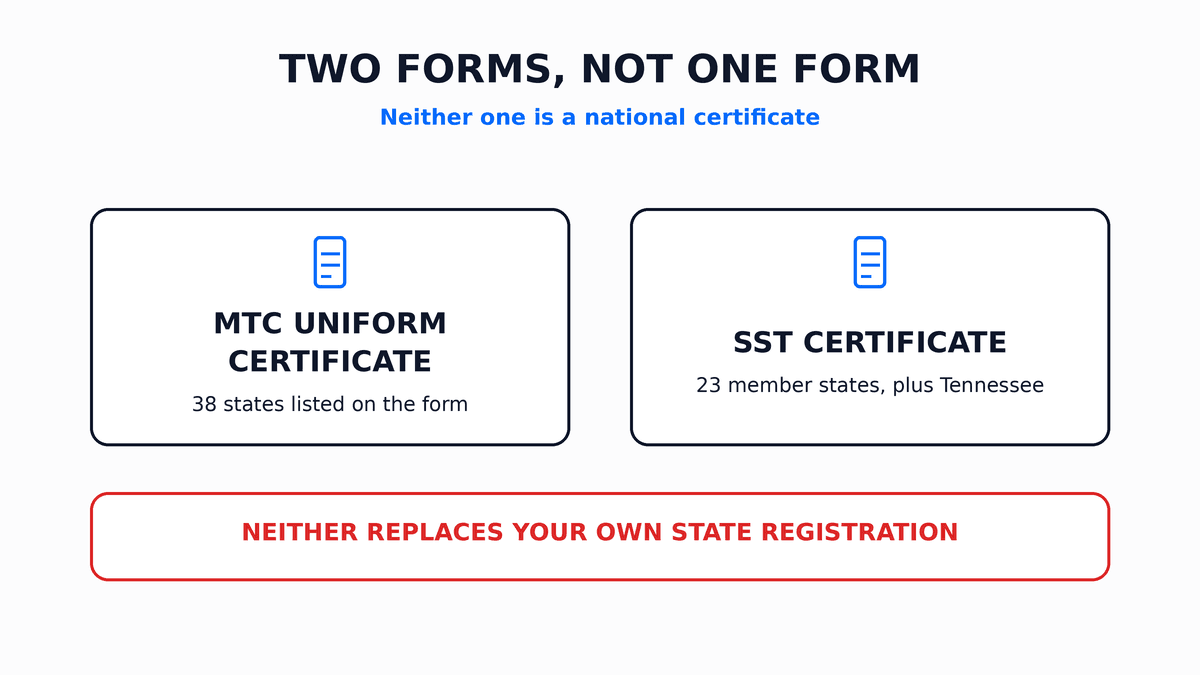
There's no single national resale certificate, and no multistate resale certificate covers every state either. Two forms exist: the MTC Uniform Sales and Use Tax Resale Certificate and the Streamlined (SST) Certificate of Exemption. Most states take one or the other. New York takes neither, and a few states add conditions that change the answer.
Which one you send depends on the state your distributor ships from, not the state you're sitting in. That is the part people get wrong, so it's worth settling before you fill anything in.
What a Multistate Resale Certificate Actually Is
Suppliers don't decide the tax on your order. Your paperwork does, and a resale certificate is what tells them there's none to charge. You're buying to resell, so the tax gets collected later, from your customer.
The complication is that sales tax is a state matter. Fifty states, fifty sets of rules, and your distributor might be in any of them. Two organizations tried to fix that by publishing forms more than one state would accept.
Neither form is a license, and neither replaces one. You still need a sales tax registration in your own state first, and its number goes on whichever form you use. Our post on a resale certificate versus a sales tax permit covers why the permit has to come first.
The MTC Uniform Sales and Use Tax Resale Certificate
This is the older of the two, published by the Multistate Tax Commission. People call it the uniform sales and use tax resale certificate, the MTC resale certificate, or just the multijurisdiction form.
The states that take it are printed on the form itself. The certificate's own preface says the listed states "have indicated that this certificate is acceptable as a resale/exemption certificate." The MTC's resource page puts the number at 36. The form itself lists more, which tells you how settled this is.
So read the footnotes. Nearly every state on that list has one, and some of them change the answer completely.
Illinois won't take your home-state number on this form. Its note says plainly that "no other state's registration number is acceptable." Illinois has its own certificate, CRT-61, which needs an Illinois account ID.
Maryland is the same. Certificates without a Maryland sales and use tax registration number "will not be honored by the State."
Florida adds a step on the seller's side. The selling dealer "must also obtain a resale authorization number from the Florida Department of Revenue." So you can hand over a perfect form and still see tax on the invoice. The missing piece is theirs, not yours.
California and Pennsylvania both carry the same note: "This certificate is not valid as an exemption certificate." It still works for resale, which is what you're doing. But a distributor skimming that note can read it as a rejection.
Michigan limits blanket certificates. Four years, "unless a lesser period is mutually agreed to."
The MTC's own advice is worth repeating. If you want to know whether a state will accept the form, ask that state's revenue department.
The SST Certificate of Exemption
The Streamlined Sales Tax project took a different route. Rather than one form many states tolerate, member states agreed on a shared set of rules and a shared form.
Twenty-three states are full members: Arkansas, Georgia, Indiana, Iowa, Kansas, Kentucky, Michigan, Minnesota, Nebraska, Nevada, New Jersey, North Carolina, North Dakota, Ohio, Oklahoma, Rhode Island, South Dakota, Utah, Vermont, Washington, West Virginia, Wisconsin and Wyoming. Tennessee is an associate member. You can download the form from the Streamlined Sales Tax site.
Some states appear on both lists, which is why your distributor's preference matters more than your own. Michigan, Ohio and Georgia will take either. Send whichever one their accounts team is used to seeing.
Which States Take Which Form
We are sharing the list, so you don't have to open two PDFs to answer one question.
The MTC certificate lists these states: Alabama, Alaska (ARSSTC), Arizona, Arkansas, California, Colorado, Connecticut, Florida, Georgia, Hawaii, Idaho, Illinois, Iowa, Kansas, Kentucky, Maine, Maryland, Michigan, Minnesota, Missouri, Nebraska, Nevada, New Jersey, New Mexico, North Carolina, North Dakota, Ohio, Oklahoma, Pennsylvania, Rhode Island, South Carolina, South Dakota, Tennessee, Texas, Utah, Vermont, Washington and Wisconsin.
The SST certificate covers its member states, listed in the section above. Michigan, Ohio, Georgia, and several others sit on both lists, so either form works and your distributor's preference decides it.
New York is on neither. For a New York supplier you need ST-120.
Six of the MTC states attach a note that changes what you should do:
State | What the note changes |
|---|---|
Illinois | Won't take another state's registration number on this form |
Maryland | Certificates without a Maryland registration number aren't honored |
Florida | The seller also has to get a resale authorization number from the state |
California | Valid for resale only, not as a general exemption certificate |
Pennsylvania | Same as California, resale only |
Michigan | Blanket certificates run four years unless you agree to less |
Everywhere else on that list, a correctly filled MTC form carrying your own state's registration number is what the distributor expects.
Does a Resale Certificate Work in All States?
No, and this is the question behind most rejected applications. Your own state's certificate is designed for sales inside your state. Buy from a distributor in another state and you're asking that state to recognize your paperwork. Whether it does is that state's call.
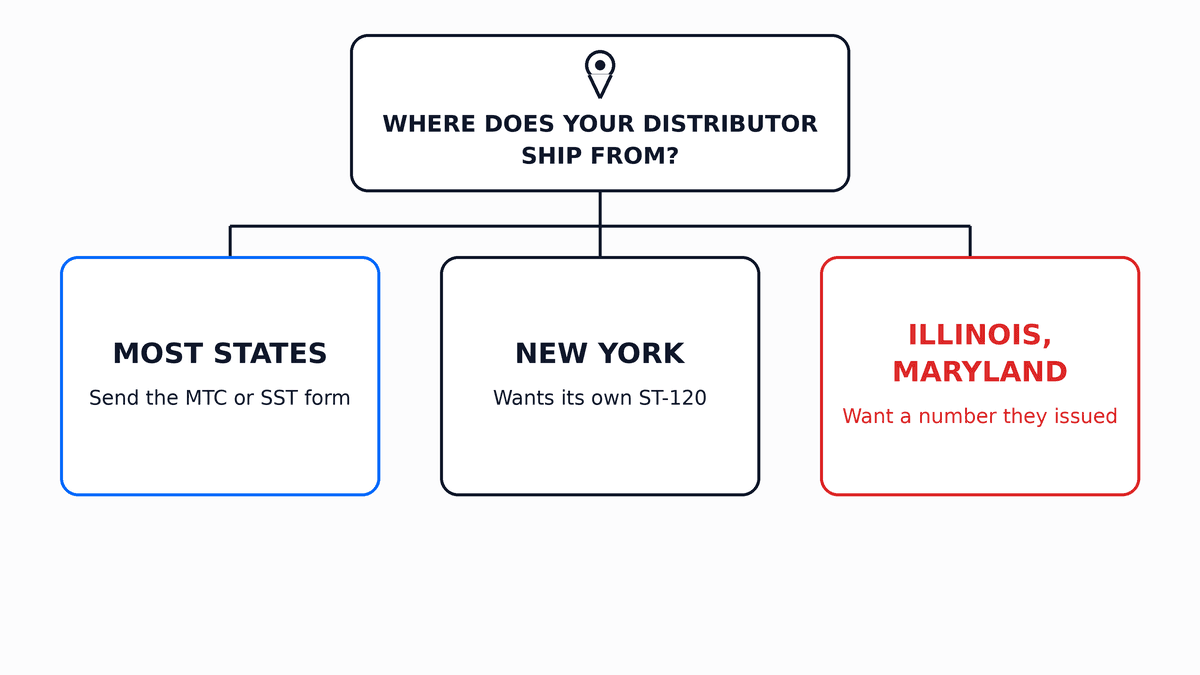
Three situations come up again and again. The distributor's state takes a multistate form, so you send the MTC or SST version with your home-state number on it. That's the easy case and it covers most of the country.
The distributor's state wants its own form. New York is the clearest example, since it isn't on the MTC list, and its ST-120 is what a New York supplier expects. We've covered that one in our New York resale certificate post.
The distributor's state wants a number it issued. Illinois and Maryland both say so on the MTC form. If you buy regularly from a distributor there, registering in that state may be the only route.
Blanket or One Transaction?
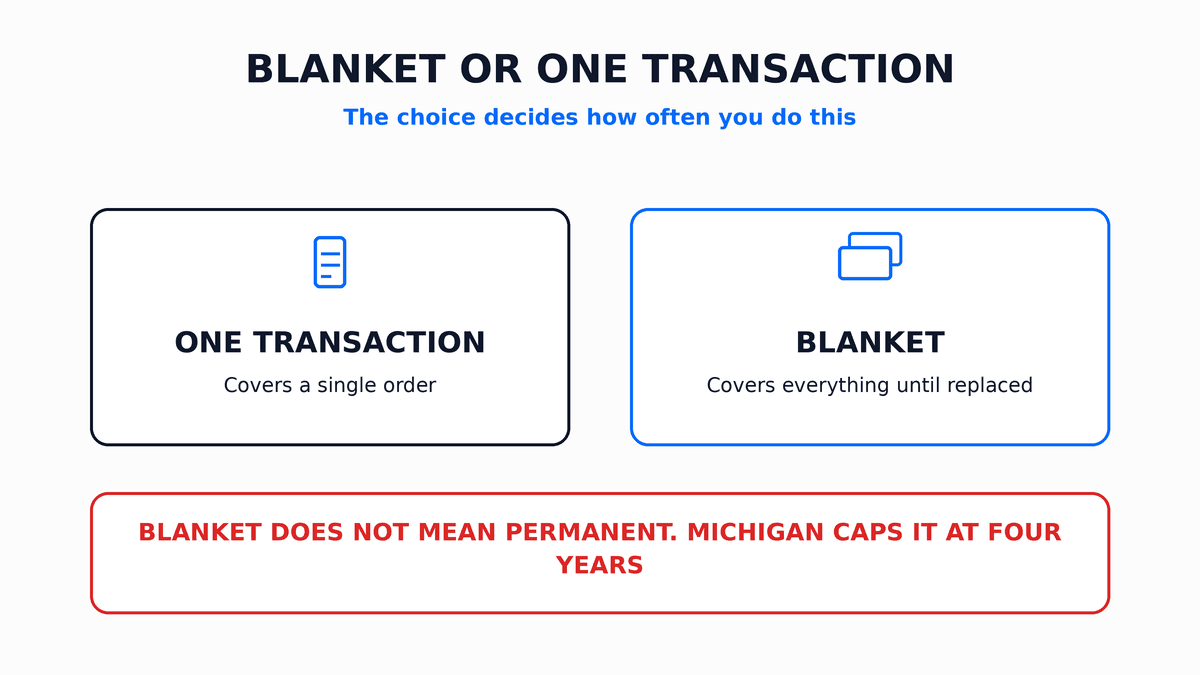
Both multistate forms ask you to choose, and the choice decides how often you'll be doing this. A single-transaction certificate covers one order. A blanket certificate covers everything you buy from that supplier until it's replaced, which is what you want with a distributor you'll reorder from.
Blanket doesn't mean permanent, though. Michigan's note on the MTC form caps blanket certificates at four years, "unless a lesser period is mutually agreed to". A distributor can set a shorter refresh on their own account anyway. Some do that without telling you, and the first you hear of it is tax appearing on an invoice.
So treat a blanket certificate as something that lapses. Note the date you signed it, and ask the supplier how long they'll hold it.
If You Buy From Several States
Illinois and Maryland are manageable when it's one distributor each. Five distributors in five states is where the paperwork stops being occasional.
The workflow that keeps it manageable is simple. Register in your own state once. Keep a filled MTC form and a filled SST form ready to go, both carrying your state number. Then ask each new supplier one question before you send anything. Which form does your accounts team want, and do you need a number issued by your state?
That last question is the one that changes your workload. A distributor's accounts team answers it in a sentence, and the answer puts you in the easy case or the Illinois case right away.
If the answer is that they need a number from their own state, you have a decision rather than a form to fill in. Registering in another state brings filing duties with it. That's a conversation for your accountant, not something to do on the strength of one order. It may be simpler to search for the product and see what else is available. A distributor in an easier state may have it at a cost that works.
What Your Distributor Actually Does With It
Your distributor files the certificate and leans on it later, which is why small errors get it rejected.
The certificate protects the seller, not you. If an auditor decides a sale should have been taxed, the distributor is the one who owes it, and the certificate is their evidence. That's why their accounts team is strict about fields you might think are cosmetic.
A blank or vague description of what you're buying will get the form rejected, and so will a number that doesn't match the state printed on it. A missing signature date does the same.
And a rejected certificate isn't only an admin problem. The supplier charges you sales tax on that order, so your landed cost goes up by whatever the rate is. Getting it back means a refund claim with your own state, not a message to the distributor. On a first order placed to test a product, that's often enough to make the numbers look worse than they really are.
Our guide on what distributors look for before approving a seller covers the rest of the application. The certificate is one piece of it, and the piece with the most ways to get it wrong.
State Forms We've Covered
If your distributor is in one of these, go straight to their own form:
And if you've never filled one in before, how to fill out a resale certificate walks through the fields that get forms rejected.
None of this helps if nobody you can reach carries the product in the first place. When that's the problem, you can ask our team to find an authorized wholesale distributor for it, free on every plan.
Multistate Resale Certificate: The Takeaways
- There's no national resale certificate. Two multistate forms cover most states.
- Which form to send depends on your distributor's state, not yours.
- Read the footnotes on the MTC form. Several states change the answer.
- Illinois and Maryland want a number issued by their own state.
- New York isn't on the MTC list. Use ST-120 for a New York supplier.
- Michigan blanket certificates run four years unless you agree on something shorter.
- The certificate protects the seller in an audit, which is why they're fussy about it.
This is general information about published state and commission guidance, not tax or legal advice. Rules change, and for your own situation you should talk to an accountant.
Send the Form Their State Accepts
The assumption that causes the trouble here is that your own state's certificate travels. It often does, through one of the two multistate forms, but not always, and the exceptions are written on the forms themselves.
So before you fill anything in, find out which state your distributor ships from. The answer to that one question decides the form, and most of the extra emails never happen. You can open a free account and see real cost and real stock from the verified distributors in our network before any of this paperwork starts.
Frequently asked questions
01What is a multi-state resale certificate?
02Does a resale certificate work in all states?
03How do I get a resale certificate in the US?
04Is an EIN the same as a resale certificate?
The B2B SupplierHub Team
Wholesale & sourcing
Stop hunting suppliers by hand. Type a UPC instead.
B2B Supplier Hub shows the suppliers in our network carrying a product on one page: wholesale cost, stock, and retail price side by side. Free to search, no card required.