
Distributor Guides
Case Pack Meaning: Inner Pack, Master Carton and What They Do to Your Order

A distributor's catalog shows two numbers side by side: the cost, say $8.00, and the case pack, say 48. The case pack is the number of units in one shipping case, and it is the step your order moves in. Most resellers look at the cost. The case pack often matters more. It decides how many units you have to buy, how long they sit on your shelf, and how much cash they hold up. This guide explains the case pack meaning in plain words. It also covers the two terms that come with it, and what all three do to a real order.
What Is a Case Pack? Three Terms in Plain Words
Distributors call one single item an “each.” The three terms below are just boxes of eaches, from small to big.
- Case pack: how many items come in one case. You usually have to order in full cases.
- Inner pack: a smaller box of the same item inside the case. GS1 US says it is not usually sold to shoppers on its own.
- Master carton: the big outer box that holds several inner packs or cases. Some catalogs use it as another word for the case.
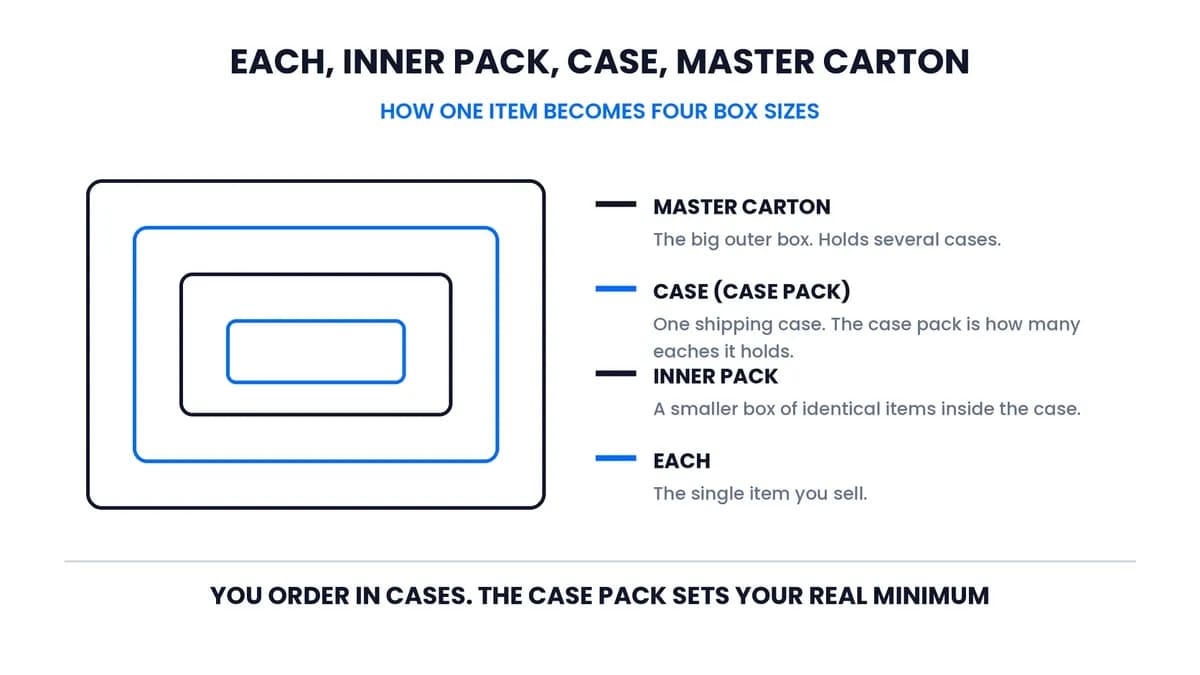
You buy most products by the case because of how goods move. A B2B wholesale distributor buys from the brand in large lots and sells to resellers like you in cases.
How Pack Size Changes Your Order
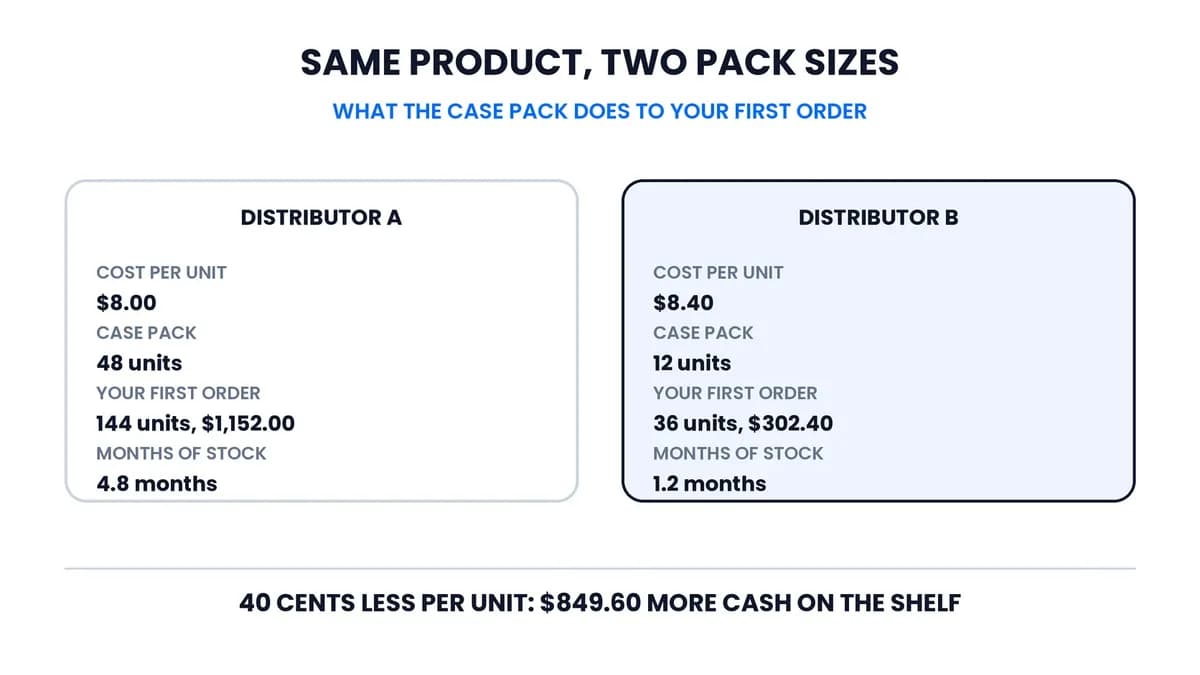
Say you sell about 30 units a month of one product, and two distributors carry it. Here is how the choice plays out. The prices are made up to show the calculations.
Distributor A | Distributor B | |
|---|---|---|
Cost per unit | $8.00 | $8.40 |
Case pack | 48 | 12 |
Minimum order | 100 units | 1 case |
Your first order | 144 units (3 cases) | 36 units (3 cases) |
Months of stock | 4.8 | 1.2 |
Cash up front | $1,152.00 | $302.40 |
A looks cheaper by 40 cents a unit. Now look at what its case pack does.
A asks for at least 100 units, but its cases hold 48. Two cases come to 96, which is short, so your first order is three cases: 144 units. That gives you the rule worth remembering. Your real minimum is the order minimum rounded up to the next full case. Some distributors will open a case to sell you less, but only if you ask.
At 30 sales a month, those 144 units last almost five months. B's cases hold 12, so three of them cover about a month and you reorder as you sell. The gap shows up in cash. A's first order costs $1,152.00, and B's costs $302.40. The difference, $849.60, sits on your shelf as stock, and you pay to store it.
So what does A's lower price buy you? If you bought the same 144 units from B, you would pay $57.60 more. That is the full saving, and you get it in return for holding about $850 of extra stock for months.
Sometimes that trade is worth it. If the product sells steadily and cash is not tight, A's bigger case can be the better buy. If the product is new to you, seasonal or dropping in price, B's smaller case is the safer one. Our post on when bigger orders hurt margin covers this trade-off in more detail. Pack size also shapes the price itself, since distributors often cut the price at a full case and again at a full pallet.
Whichever way you lean, put pack size next to cost for each supplier before you pick one.
Case Pack Meaning on a Catalog: How to Read the Line
On a distributor's catalog, case pack quantity can show up as "Case Pack," "CP," "Pack," "Qty/Case" or "CS." The label changes, but the number always means the same thing: how many eaches are in one case. Before you trust it, check three other things on the same line.
The unit of measure comes first. It tells you whether the price is per each, per inner pack or per case. If one supplier lists $96 for a case of 12 and another lists $8.40 a unit, the first is really $8.00 a unit. Our guide to reading a distributor price sheet shows where this column usually sits.
Next is stock. A catalog that shows 20 in stock might mean 20 units or 20 cases of 12. Ask which before you plan a reorder around it.
Last is the barcode. A shipping case can carry its own GTIN-14, printed as an ITF-14 barcode, separate from the UPC on each item. When you look a product up, use the UPC on the item itself. The code on the carton identifies the box, so it will not match the product you sell.
Case Pack vs Inner Pack: What to Do When the Case Is Too Big
The inner pack exists so a case can be split. A case of 48 might hold eight inner packs of six. If 48 units is more than you can sell in a sensible time, ask whether the distributor sells by the inner pack. Some do, often at a slightly higher unit price. Others will open a case and pick single units for a broken-case fee. Either option changes the math above, so get the price in writing before you compare suppliers.
The master carton is where catalogs disagree most. Some suppliers use "case" and "master carton" for the same box. Others mean a bigger box that holds several cases. If a catalog shows both, ask which one the case pack number refers to, because the two counts can be far apart.
Case Packed vs Individual Units on Amazon
Pack size changes how you ship, wherever you sell. On Amazon, it also changes how you create a shipment.
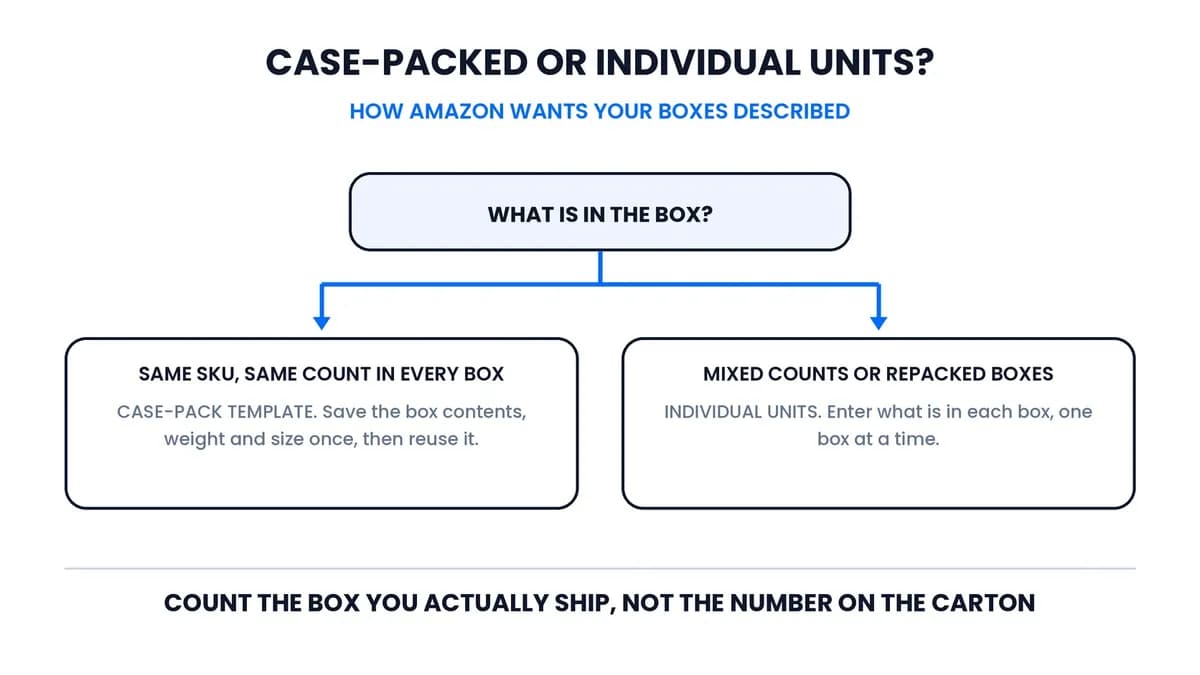
When you send stock to Amazon, you pick one of two options:
- Case-packed: every box holds the same product. You save the box details once as a case-pack template (what is inside, the weight and the size) and reuse them next time.
- Individual units: you list what is inside each box, one box at a time.
A full case from your distributor usually fits the case-packed option, as long as every box has the same number of units. Problems start when you open cases and repack them. Count what is in each box you send, and do not rely on the number printed on the carton. Before you make your first template, check Amazon’s current case-pack rules in Seller Central.
5 Questions to Ask a Distributor About Pack Size
Put these in your first email to any new distributor:
- Is the price on your catalog per each, per inner pack or per case?
- How many units are in a case, and is there an inner pack?
- Will you sell by the inner pack or by the each, and what does that cost?
- Is your stock count in units or in cases?
- Does your case pack number refer to the case or the master carton?
They sit well alongside the other questions to ask a wholesale distributor before your first order.
Sometimes the answers rule a supplier out. Maybe the only distributor you know sells in master cartons and you need a smaller pack. If so, ask our team to find an authorized wholesale distributor for it. Request a Supplier is free on every plan, and you get an answer within 30 days either way.
The Case Pack Is Your Real Minimum
For a reseller, the case pack meaning that matters most is simple: it is the smallest amount of money you can put into a product at a time. Two suppliers can be 40 cents apart on cost and still lead to very different orders. You only see it once you round up to a full case and count the months of stock inside. Do that math before you choose who to buy from. You can search a product free to compare real cost and stock from the distributors in our network carrying it, then unlock a supplier when the numbers work for you.
Frequently asked questions
01What does case pack mean?
02What does case pack quantity mean?
03What is the difference between a case and a pack?
04What does 'vendor pack' mean?
The B2B SupplierHub Team
Wholesale & sourcing
Stop hunting suppliers by hand. Type a UPC instead.
B2B Supplier Hub shows the suppliers in our network carrying a product on one page: wholesale cost, stock, and retail price side by side. Free to search, no card required.