
Sourcing
Dropshipping vs Wholesale on Amazon: Why the Seller of Record Rule Decides It
If you sell on Amazon, wholesale is the safer choice. Amazon requires you to be the seller of record on every order you ship. That rule blocks the most common way people dropship: buying an item from another store and having that store ship it to your customer. Dropshipping can work for a Shopify store that is testing products. Wholesale is the model you can build an Amazon business on.
Most articles on dropshipping vs wholesale are written for Shopify store owners. Their rules are different, so their advice does not carry over. On Amazon, the policy answers most of the question before you look at a single number.
This blog post follows one decision from start to finish. You have a product that sells. You can supply it two ways. Here is what each way costs you in money, control, and risk to your account.
Who Has to Be the Seller of Record on Amazon?
Amazon spelled out its drop shipping rules in an announcement to sellers about the drop shipping policy. "Seller of record" means the business named as the seller on the order. On Amazon, that has to be you.
In practice, four things follow from that rule. Your business name must be on the packing slip, the invoice, and the outside of the box. Anything that names the company that really shipped the item has to come off first. You handle every return yourself. And you still follow the rest of your seller agreement.
The announcement also says what is not allowed. You can't buy from another online store and have it ship straight to your customer when the package doesn't name you as the seller. Packages that show another seller's name or contact details are out too. Breaking these rules can hurt your account health and your ability to ship orders yourself.
Now think about how dropshipping is usually taught. A customer buys on your listing. You order the same item from a big retail site and type in the customer's address. The box shows up with the retailer's name and invoice inside. Amazon's rules ban exactly this.
There is a version that follows the rules. A supplier ships for you in a plain box with no other company's name on it. Your name is on the paperwork, and you take care of returns. But to get that, you need a real supplier, an approved account, and terms that allow plain-box shipping. By then you are in a wholesale relationship. The supplier just does the shipping.
A second problem shows up later. If Amazon ever asks where your stock came from, you need invoices from a real supplier in your business name. Those invoices have to match what you sold. Retail order confirmations don't do that job. Our guide on what an authorized distributor is and how to check one explains why the supplier behind an invoice matters as much as the invoice itself.
Dropshipping vs Wholesale at a Glance
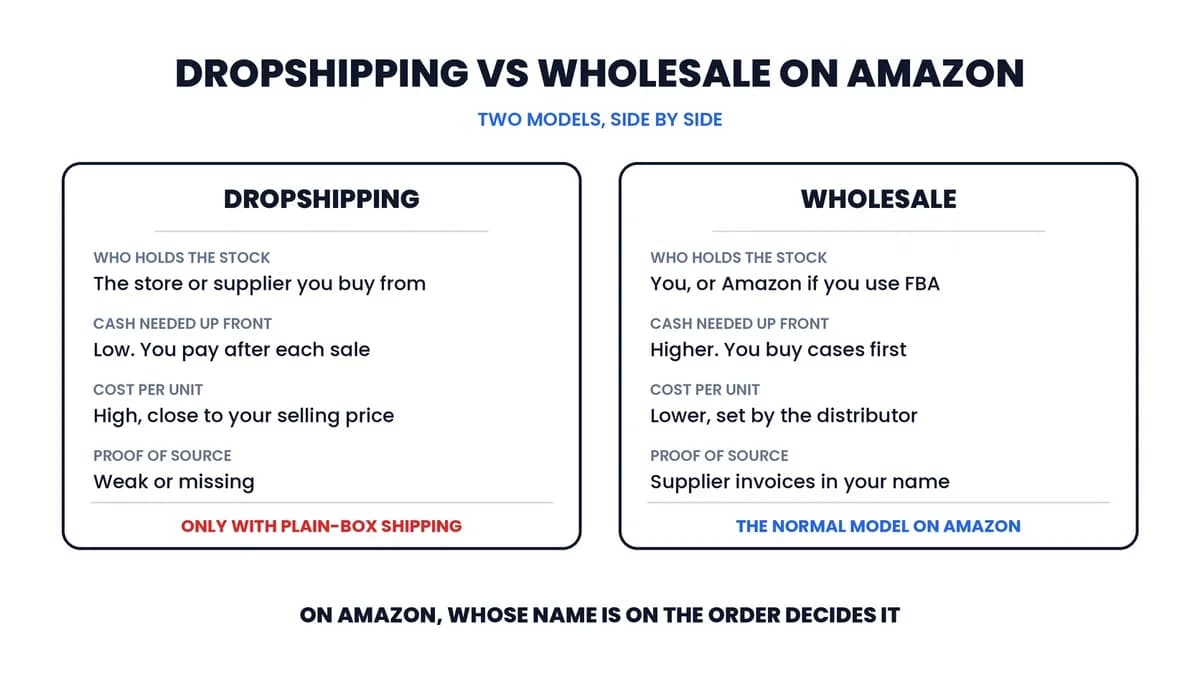
Here is how the two models compare for someone selling on Amazon.
Dropshipping on Amazon | Wholesale on Amazon | |
|---|---|---|
Who holds the stock | The store or supplier you buy from | You, or Amazon if you use FBA (Fulfillment by Amazon) |
Cash needed up front | Low. You pay after each sale | Higher. You buy cases before you sell |
Cost per unit | High, close to your selling price | Lower, set by the distributor |
Shipping speed and packaging | Decided by someone else | Decided by you |
Fit with Amazon's rules | Only with plain-box shipping under your name | The normal model, if the supplier is real |
Proof of where stock came from | Weak or missing | Supplier invoices in your name |
Best for | Shopify stores testing ideas | Sellers who want repeat sales on Amazon |
Dropshipping vs Wholesale Cost: Where the Money Goes
People often say dropshipping is cheap and wholesale is expensive. That is only true for the first day. Look at what each order costs instead.
With dropshipping, you pay nothing until someone buys. Then you pay close to full price for that unit, because the store you buy from wants its own profit. You also ship the order yourself. So every late delivery counts against your account. If your source runs out of stock after a customer has paid, you have to cancel the order, and that counts against you too.
With wholesale, you pay for a case or more before you sell anything. That money stays tied up until the stock sells. In return, each unit costs less. You can send the stock to Amazon's warehouses. And you get a price you can plan around. The costs to watch move to different places: freight, prep, storage, and stock that sells slower than you hoped. Our wholesale price calculator guide shows how to work out your real cost and profit line by line.
Example: One $40 Product, Both Models
These numbers are invented to show how the math works. They are not real fees or prices. Use your own numbers before you buy anything.
Say a product sells for $40. With dropshipping, you pay $30 per unit, shipping included. After $6 in selling fees, you keep $4 a unit. No money leaves your account until a customer orders.
With wholesale, you pay $20 per unit and buy a case of 48. That is $960 out of your account before your first sale. After $6 in selling fees, $7 for Amazon to ship it, and $1.50 for freight and prep, you keep $5.50 a unit. The difference per unit looks small. What matters is how each number changes over time.
The $4 from dropshipping can disappear overnight. If the store raises its price, your profit drops and you can't do anything about it. You have no account with them and nobody to call. The $5.50 from wholesale comes from a price you agreed with a supplier, so you can track it. It can also get better. Bigger orders, better terms, and a second supplier for the same product all push it up.
The risk sits on the wholesale side too. If the case doesn't sell, that $960 is stuck in boxes. So buying in bulk vs dropshipping comes down to two skills. You need to pick products that sell. And you need to know what more than one supplier charges before you buy.
Wholesale vs Dropship Pros and Cons
Both models have real downsides, and it helps to see them plainly.
Dropshipping needs very little cash to start. You can try a product without holding any stock. For a Shopify store that is still working out what sells, that is useful. On Amazon, though, it runs into trouble fast. You have to be the seller of record. Your profit moves whenever your source changes its price. You don't control how fast orders ship or what the box looks like. And you have no supplier invoices to show if Amazon asks questions.
Wholesale costs less per unit and lets you use FBA, which makes your offer eligible for Prime. You get invoices in your name and a product you can reorder for years. Over time, a supplier who knows you is more likely to look after you when stock runs short.
The hard parts of wholesale are real, though. Cash goes out before sales come in. And you have to get approved. Distributors choose who they sell to. Many ask for a resale certificate, a registered business, and proof that you are a real company before they share prices. Some brands also limit who can sell their products on Amazon. Our guide on how to open a wholesale account covers what distributors usually ask for.
So is wholesale better than dropshipping? On Amazon, for most sellers, yes. It takes more work to start, but what you build stays in place.
Can You Dropship From a Wholesale Distributor?
Sometimes. Some distributors will ship single orders straight to your customers. On Amazon, this can follow the rules if the box is plain, your business is named as the seller, and you handle every return.
Before you go this way, keep three things in mind. You still have to apply and get approved, just like any wholesale account. Your account takes the hit if their warehouse ships late. And the price per unit may be higher than the case price, because the distributor is packing each order for you. Ask before you assume.
This is why most Amazon wholesale sellers buy in bulk and send the stock to FBA. Single-order shipping from a distributor can help with slow sellers or bulky items. For most products, it works better as a backup than as your main setup.
Dropshipping vs FBA Wholesale: 3 Questions to Decide
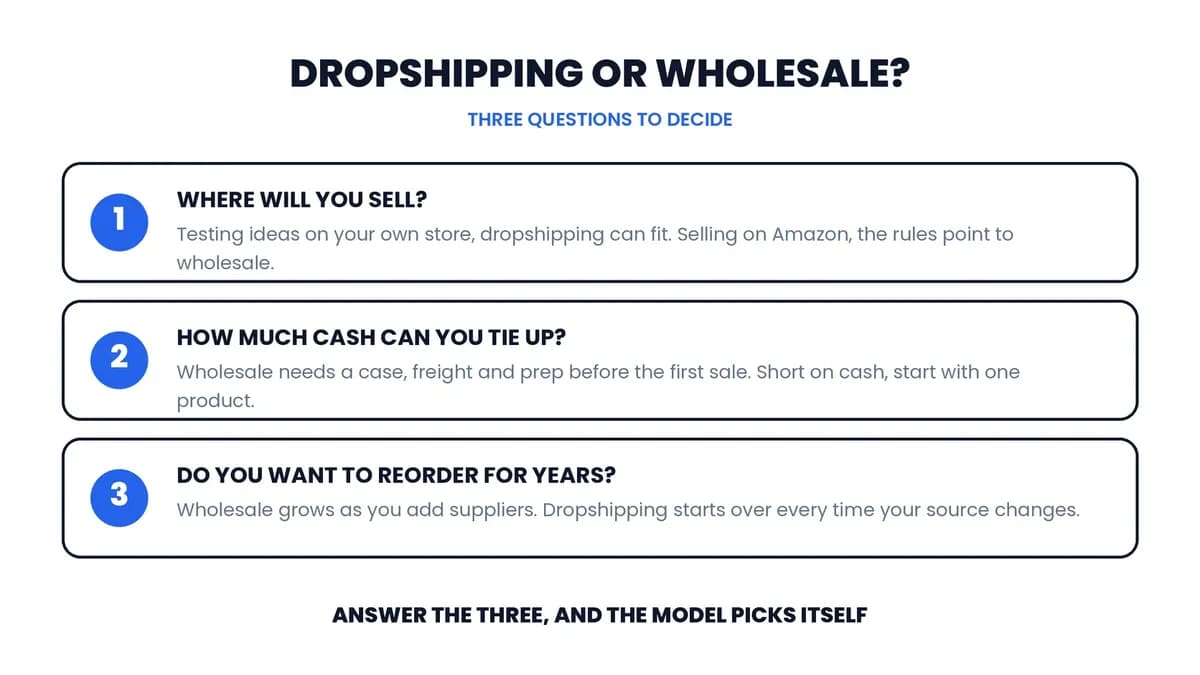
If you are still choosing between dropshipping vs FBA wholesale, answer these three questions.
- Where will you sell? If you are testing ideas on your own Shopify store, dropshipping can be a fair place to start. If you are selling on Amazon, the rules point you to wholesale.
- How much cash can you tie up in a first order? Wholesale needs enough to buy a case, pay for freight and prep, and get through a slow month. If you can't do that yet, start with one product instead of switching models.
- Do you want a product you can reorder for years? Wholesale grows as you go. Each supplier you add gives you a backup and a chance at a better price. With dropshipping, you start over every time your source changes.
If you also sell on Walmart, eBay, or your own site, check each one's rules on who must appear as the seller. A setup that works on one channel may not pass on another.
Once you have picked wholesale, our Amazon wholesale for beginners roadmap walks through each stage, from setting up your business to your first reorder.
Where New Wholesale Sellers Get Stuck: Finding the Supplier
Picking wholesale is the easy part. Finding the right supplier is where most people slow down.
The suppliers that are easy to find online are often middlemen. They charge more, and their invoices may not hold up if a brand or Amazon checks where the stock came from. Real distributors rarely advertise to resellers. And to see a distributor's real cost and stock, you usually have to apply and wait to be approved, one supplier at a time. Since comparing takes so long, most sellers stop at the first supplier that says yes.
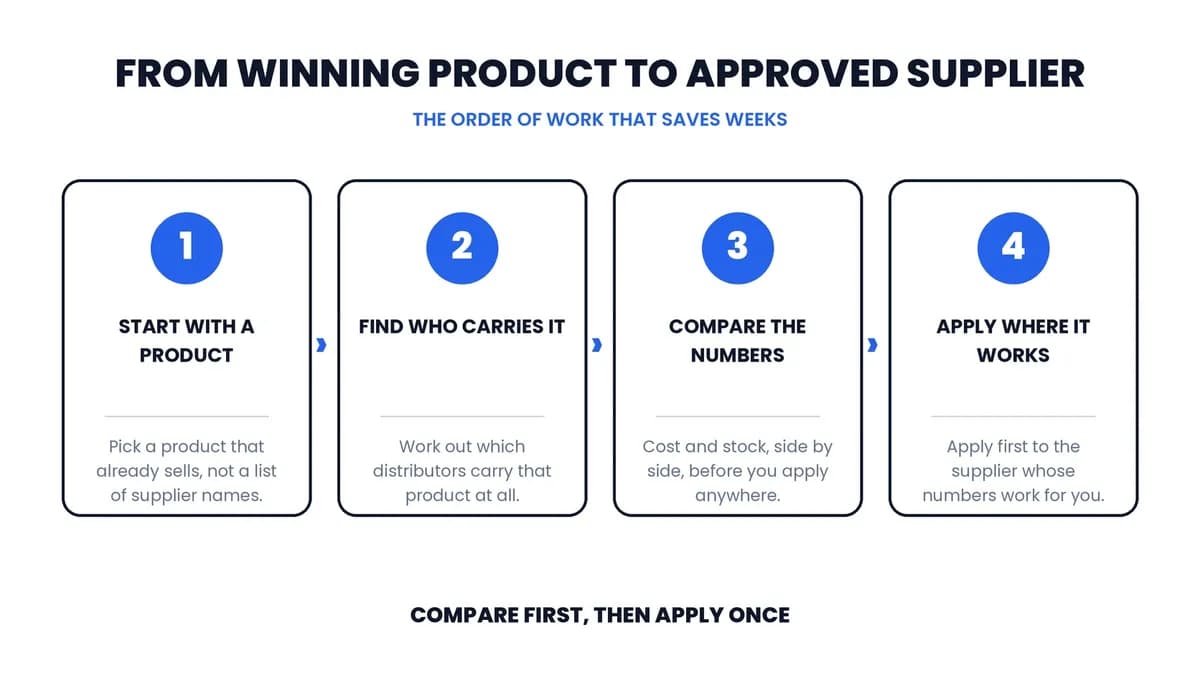
A better order of work looks like this:
- Start with a product that already sells, not a list of supplier names.
- Find out which distributors carry it and what they charge.
- Compare cost and stock across them before you apply anywhere.
- Apply first to the one whose numbers work.
Plenty of good sellers still do this by phone and email. You can also search a product free on B2B Supplier Hub and see real cost and real stock from the verified distributors in our network, before you apply to any of them. The supplier still has to approve you. The difference is that you apply knowing the numbers. If a product isn't in our catalog yet, you can submit a request to find an authorized wholesale distributor. Our team goes and finds one, and you get an answer within 30 days either way.
4 Things to Do This Week
- Pick one product you want to sell on Amazon. Check whether its brand limits who can sell it.
- Work out the real cost per unit for both models, with fees, freight, and prep, using your own numbers.
- Find at least two suppliers that carry the product. Compare their cost and stock side by side.
- Get your resale certificate and business documents ready before you contact distributors. Most will ask for them. (This is general information, not tax or legal advice.)
Whose Name Goes on the Order
The dropshipping vs wholesale choice looks like a question about cash. On Amazon, it is mostly about whose name goes on the order. With wholesale, that name is yours, and so are the stock, the invoices, and the price you reorder at. That gives you something you can keep building on.
When you are ready to start, create a free account, search the product you want to sell, and look at the numbers before you apply to anyone.
Frequently asked questions
01Is drop shipping dead in 2026?
02Is wholesale better than dropshipping for Amazon sellers?
03Can you dropship from a wholesale distributor on Amazon?
04What is the main cost difference between dropshipping and wholesale?
The B2B SupplierHub Team
Wholesale & sourcing
Stop hunting suppliers by hand. Type a UPC instead.
B2B Supplier Hub shows the suppliers in our network carrying a product on one page: wholesale cost, stock, and retail price side by side. Free to search, no card required.