
Sourcing
How Many Sellers on an Amazon Listing Is Too Many?
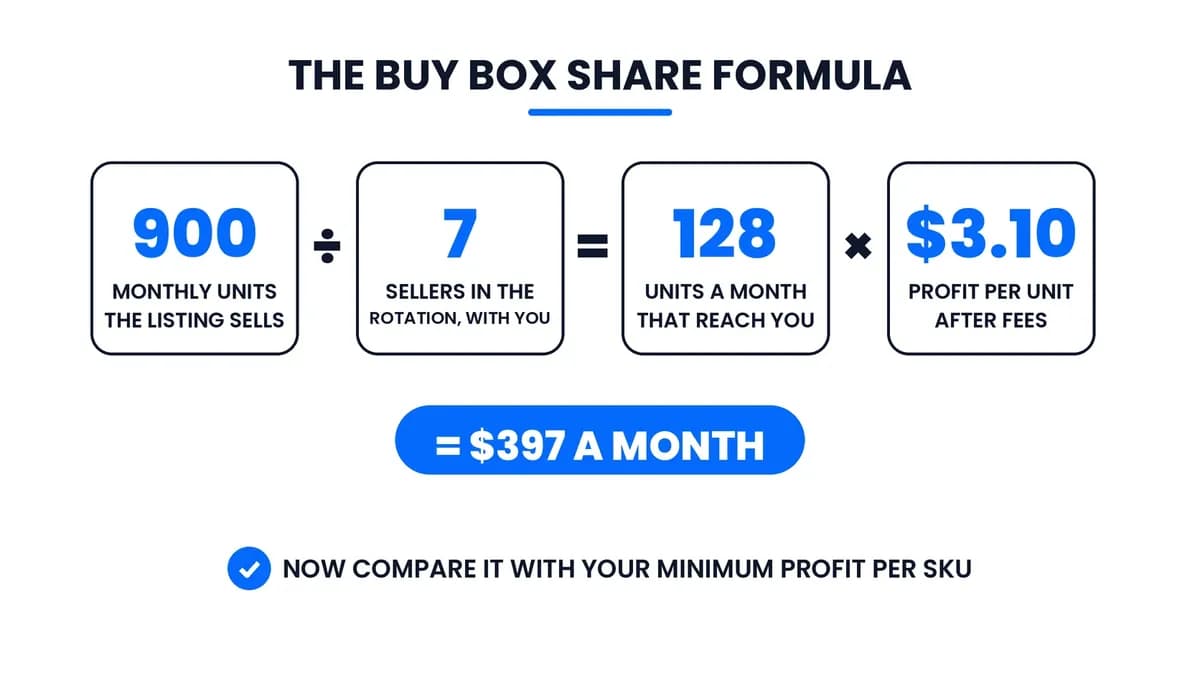
As a working rule, more than 10 to 12 FBA sellers sharing the Buy Box on a wholesale listing is too many, unless the listing sells enough units each month that your share still clears your minimum profit per SKU. Amazon does not publish a number like this. It comes from simple math. Take the listing's monthly sales, divide by the number of sellers in the Buy Box rotation (including you), and multiply by your profit per unit after fees. If the result is below what a SKU has to earn to be worth carrying, skip it.
That is the short version. The formula only works if the inputs are right, and that is where most sellers slip. They count every seller on the page when only a few are getting sales, or they use today's seller count when the listing is adding new sellers every week. The rest of this post goes through the inputs one by one, using a listing with 14 sellers as the example.
Why 14 Sellers Tells You Nothing on Its Own
You are looking at a distributor's catalog. One product stands out, the retail price is good, and the cost leaves room. You open the Amazon listing and it has 14 sellers.
Is 14 too many? On its own, you cannot tell. If the listing sells 1,500 units a month, 14 sellers is fine. If it sells 150, it is not. So "how many sellers is too many on Amazon" has no single answer. The real question is how many units you will get after the other sellers take theirs.
Count the Buy Box Rotation, Not the Seller Count
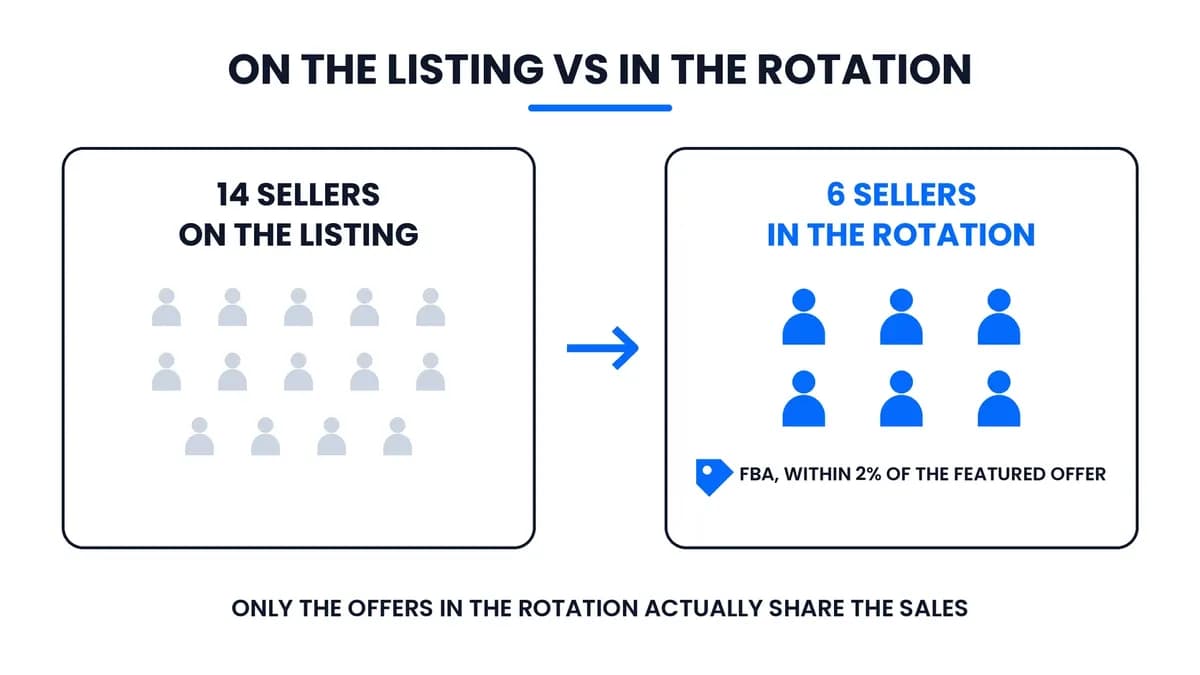
The seller count on a listing includes everyone: FBA sellers, merchant-fulfilled sellers, sellers priced too high to get sales, sellers with two units left. Only some of them actually get sales.
Amazon says the Featured Offer (what most of us still call the Buy Box) goes to the most competitive offers, based on price, delivery speed, fulfillment method, seller performance, and availability. Amazon does not say how it weighs these or how the Featured Offer moves between sellers. What follows is how experienced wholesale sellers read it, not an Amazon rule.
On a listing where everyone sells the same new product, the sellers who take turns in the Buy Box are the FBA sellers priced close to each other. A seller priced 8% above the Featured Offer is on the listing but not in the rotation. A merchant-fulfilled seller with a five-day delivery estimate rarely wins against Prime offers.
So open the offer list and count the FBA offers within about 2% of the Featured Offer price. That is your competition. The 2% band is a rule of thumb, not an Amazon threshold. On a 14-seller listing, the count is often 5 to 8.
Also check whether Amazon itself is on the listing. If Amazon Retail is in stock at a competitive price, lower your share estimate a lot. Amazon has not said how it treats its own offers, but sellers who have shared a listing with it will tell you the Buy Box rarely leaves Amazon while it is priced to win.
The Buy Box Share Formula, With a Worked Example
Here is how to calculate Buy Box share before you buy. You need four numbers.
- Monthly units the listing sells. Estimate this from sales rank, and check it against the 90-day rank history, not today's rank.
- Sellers in the rotation. The FBA offers within about 2% of the Featured Offer.
- Your share. Start with an even split. If 6 sellers are in the rotation, you become the seventh, so your share is 1 in 7, about 14%. Sellers with more stock and sharper pricing usually take more, so this is a starting assumption.
- Profit per unit after fees. Cost, inbound, prep, referral fee, FBA fee, and storage. Referral fees alone range from 8% up to 45% depending on the category, so do not use one flat number.
Now lets do the calculations.
Say a listing sells about 900 units a month. There are 14 sellers on the page and 6 in the rotation. You join as the seventh. Your share is about 1/7, so around 128 units a month. Your landed cost is $11.40, the Featured Offer is $24.99, and after the referral fee, FBA fee, and storage you make $3.10 a unit. That is about $397 a month in profit, on roughly $1,460 of inventory for one month of cover.
Is that worth doing? It depends on your floor. If every SKU has to make at least $500 a month to justify the reorders and the cash, this one fails, even though 14 sellers looked fine. If your floor is $250, it passes, as long as nobody new shows up.
Change one input and the answer changes. Same listing at 1,800 units a month: you get about 257 units and $797 in profit. Now 14 sellers is comfortable. Same listing with 11 sellers in the rotation instead of 6: you get 75 units and about $233. Now it is too crowded, and the seller count on the page never changed.
This is why "should I sell on a listing with 20 sellers" has no honest yes or no. Twenty sellers on a 4,000-unit listing can be a good product. Twenty on a 300-unit listing will lose you money.
How Many FBA Sellers Is Too Many? Where the 10 to 12 Rule Comes From
Once you are the 12th or 13th seller in a rotation, your even share is around 8%. For 8% to cover the reorders, prep, shipping, and monitoring every SKU needs, the listing has to sell well over 1,000 units a month. Most listings do not. That is the whole rule.
Two cases where you can ignore it.
- The first is very high volume. Some consumables and replacement parts sell so many units that 15 sellers can all make money. Run the formula instead.
- The second is a lower cost than the other sellers. If your distributor is one step closer to the brand than theirs, you can price under the band and take more than an even share. A lower cost is the only lasting advantage on a shared listing. You can search a product free on B2B Supplier Hub and see real cost and stock from every verified distributor in our network that carries it, before you apply to any of them.
What the Seller Count Tells You About Supply
The seller count also tells you how the product is distributed. Twenty-five FBA sellers within a dollar of each other means the product is easy to get, and your position will never be protected. Three FBA sellers holding a steady price on a product with real demand usually means it is hard to source, and the low count protects you once you are on it. The hard part there is finding the supplier. If a product like this is not in our catalog yet, you can request a supplier. Our team will look for an authorized wholesale distributor who carries it, verify them, and bring them onto the platform. It is free on every plan, and you hear back within 30 days either way.
Amazon Listing Competition Changes After You Buy
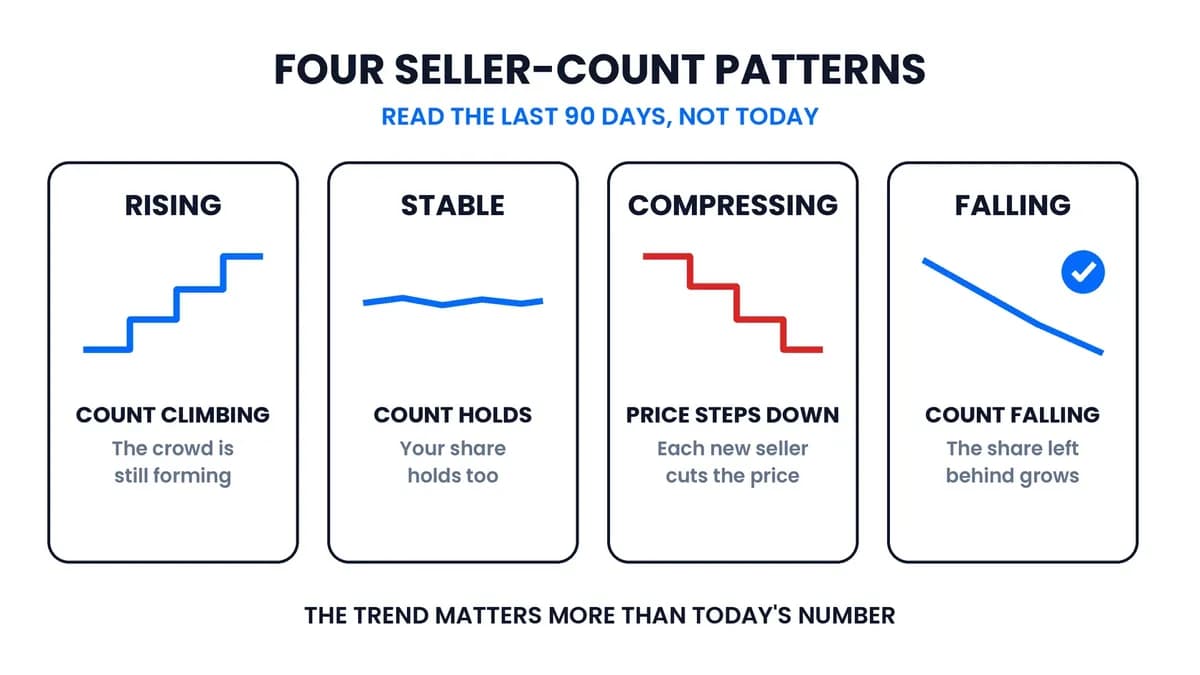
Today's seller count is a snapshot. What matters is how many sellers on an Amazon listing you will face when your inventory arrives. Four things to check in a price-history tool:
- The trend. A listing that went from 5 sellers to 14 in two months may be at 20 by the time your stock lands. Twelve stable sellers is a safer bet than seven rising ones.
- Price compression. If the price dropped every time a new seller arrived, the listing is in a slow price war and your profit per unit will be lower than today's number. If the price held while sellers joined, the brand probably enforces a minimum advertised price.
- Who is arriving. Three new sellers in the same week usually share a source, such as a distributor opening the product to new accounts. Expect more. One new seller every few months is normal.
- Who is leaving. If the count has been falling while the rank holds, the remaining sellers are about to split more sales. That is a good time to buy in.
For the rest of the product checks, see how to find wholesale products to sell on Amazon and the Amazon wholesale beginner's roadmap.
When to Walk Away, and When to Exit a SKU You Own
Do not buy when any of these is true:
- Your projected monthly profit at an even share is below your floor.
- The seller count is rising and the price is falling at the same time.
- Amazon Retail is in stock at a price your cost cannot beat.
- You would need more than about 15% of the rotation to make the numbers work.
Exit a SKU you already carry when:
- Your real share over the last 60 days is below what you modeled, and the trend says it will not recover.
- Profit per unit has fallen to less than half of what it was when you bought in.
- The same cash would earn more on a SKU where you would hold 25% instead of 9%.
Exit at a price that still clears your cost. Racing to the bottom lowers the price for everyone, including you, on the stock you still hold.
Run the Four Numbers Before the Purchase Order
Go back to the listing with 14 sellers from the start of this post. You still do not know if it is a good buy, and that is the point. The seller count was never going to tell you. What tells you is how many of those sellers are in the rotation, how many units the listing moves, what you make on each unit after fees, and whether the seller count is rising or falling. Ten to 12 is where to start being careful. The formula is where you make the call.
Those four numbers take ten minutes to pull. Sellers who skip them end up with inventory on crowded listings, waiting for a share that never comes. Sellers who run them every time build a catalog where each SKU earns its place, and they know before the order goes out which products will hold up when new sellers arrive.
If you are about to buy into a listing now, search the product free, check the competing seller count and sales rank next to real wholesale cost from distributors in our network, and run the numbers before you apply to anyone. Create a free account to start. No card required.
Frequently asked questions
01How many sellers is too many on Amazon?
02How do you calculate Buy Box share?
03Is Amazon FBA oversaturated?
The B2B SupplierHub Team
Wholesale & sourcing
Stop hunting suppliers by hand. Type a UPC instead.
B2B Supplier Hub shows the suppliers in our network carrying a product on one page: wholesale cost, stock, and retail price side by side. Free to search, no card required.