How to Find Wholesale Products to Sell on Amazon (2026)
The B2B SupplierHub Team··13 min read
Most product research happens in the wrong order. A seller finds a product that looks good, gets excited, and starts hunting for a supplier. Weeks later one of two things turns up. Either the brand does not take new resellers, or the one distributor willing to open an account charges so much that no profit is left. The product was never going to work, and the seller found that out at the end, after spending the most time.
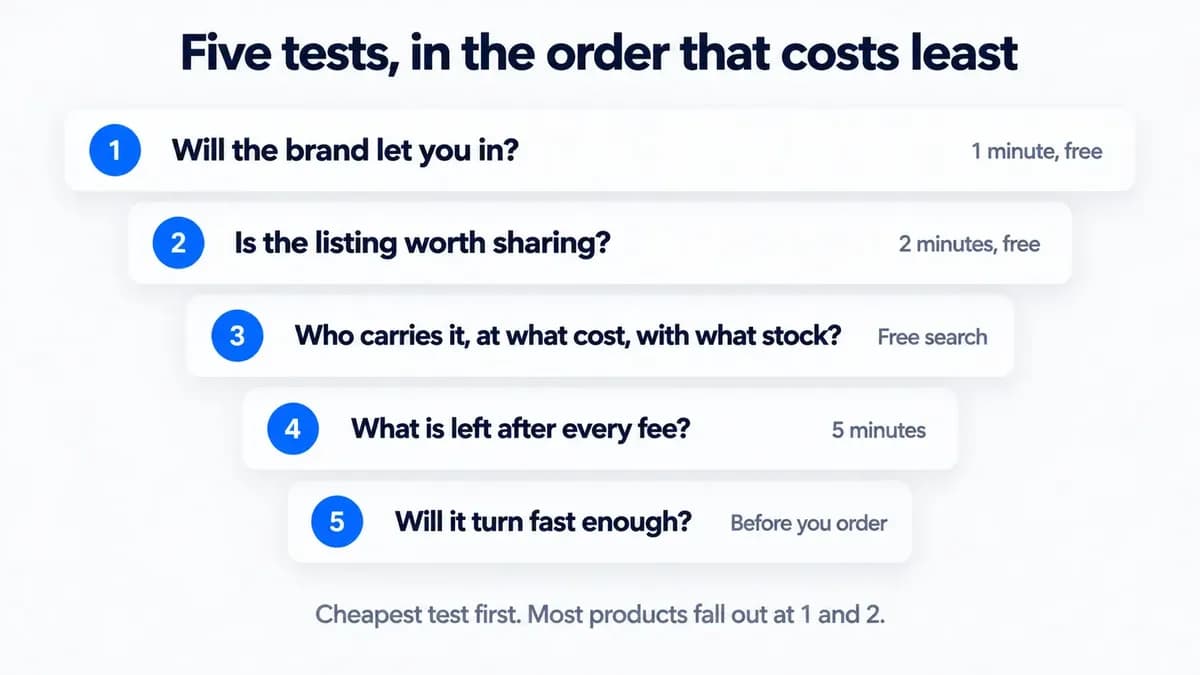
There is a better order. Instead of looking for products to buy, look for reasons to drop them, and find those reasons while they are still cheap to find. The few products that survive all five checks below are the ones worth your money.
The order matters more in 2026 than it used to. The sellers left on Amazon are fewer and better funded, the fee system now charges you for buying the wrong quantity, and a lot of invoice checks run through software before a person sees them
5 Places to Find Wholesale Product Ideas
Most people start at the Best Sellers page. So does everyone else in the category, which is the problem. Here are five better places, in the order that tends to give you products you can actually buy.
Brands you are already approved for. If a distributor approved you for one brand, look at the rest of that brand's range. Approval is the check most products fail, and you have already passed it. This is the cheapest research there is, and it gets skipped because it feels too obvious.
Your own reorder list. Some products get priced once and then reordered for years without a second look. The demand is proven. The open question is whether another distributor carries the same product cheaper, or with better stock, and that is what reverse sourcing is for.
Competitor storefronts, read for brands. Competitor storefronts. Do not copy the product list. Read it for brands. A storefront shows which brands sell to resellers like you, and once you have the brand, the distributor is not far. We cover that trail in .
Frequently asked questions
How many sellers on a listing is too many?
There is no fixed number. Read how the price behaved as sellers came and went. A stable price with twelve sellers beats a price war with four.
Can I use an Alibaba invoice or a retail store receipt to get ungated?
No. Retail receipts, order confirmations, and pro forma invoices are rejected. You need a commercial invoice from a distributor whose business Amazon can verify, with the required unit count and your business name matching your account exactly.
Do I need brand approval before I buy?
Check it before you buy anything. Buying first and applying second is the most common reason stock ends up unlistable.
How big should my first order be?
TB
The B2B SupplierHub Team
Wholesale & sourcing
Stop hunting suppliers by hand. Type a UPC instead.
B2B Supplier Hub shows the suppliers in our network carrying a product on one page: wholesale cost, stock, and retail price side by side. Free to search, no card required.
The boring middle of a category. The quiet middle of a category. Steady rank, average volume, nothing exciting. Big operators skip these because the numbers are too small to move their business. For a smaller one, a shelf of steady products at stable prices often earns the most.
Best Sellers, last. Best Sellers, last. Use it, but assume anything on it is already crowded.
One warning before the checks. Most tools push a different method: take a distributor's price list, run it against Amazon, and see what looks profitable. That shows what the distributor has, not what you are allowed to sell, and the best items on the list are usually gated. We explain the difference in our post on price list analyzers. This guide works the other way round. Product first, supplier second.
The 5 Tests, in the Order That Costs You Least
Each test costs more than the one before it. Run them in order and a product that fails the first never eats the time of the fourth.
Test 1: Will The Brand Let You In?
One minute, free, on the Amazon listing. Open the listing and check two things. Does the brand or category ask you to apply for approval? And does the brand still take new resellers at all? They are not the same thing. An approval request is a process: you get an invoice and apply. A brand that keeps a fixed list of approved sellers is a closed door, and no invoice opens it.
If it is a closed door, stop there. Do not buy a unit and hope. Stock you cannot list is the most expensive mistake in wholesale, and it usually starts by skipping this one minute. Our guides on how to check if a brand is gate and sourcing name-brand products legally, go through the checks in detail.
A brand's own seller list beats any invoice you bring, so this test removes a lot of products before a single dollar moves. That is the point of running it first.
Test 2: Is The Listing Worth Sharing?
If you sell this product, you share the listing with everyone else already on it, so the first thing to do is look at who that is. Count the sellers, then check whether the price has held while sellers came and went or drops every time a new one arrives, and see whether the rank is steady or jumps around and what the current offer promises on delivery.
You will see rules like "under ten sellers is good," and they are a fair starting point but not proof, because four sellers who cut price every week are worse company than twelve who have held the same price for a year. What you are reading is how the sellers behave, not how many there are.
If you are checking a product on B2B Supplier Hub, the Retail Insights panel on the product page shows the retail price, sales rank, how many sellers are on the listing, and a price history chart, so you can do this test without switching tabs. It does not tell you who those sellers are, so that part you still read on Amazon.
Test 3: Who Carries It, At What Cost, With What Stock?
This one is a free search. The usual way to learn a distributor's real cost is to find them, apply, wait for approval, then open the price list. One distributor at a time, weeks each. That is why most sellers never compare. They buy from whoever approved them first, and years go by.
It can work the other way round.Search the product free on B2B Supplier Hub by UPC, name, or model number, and you see real cost and real stock from every verified distributor in our network carrying it, side by side, each with a freshness timestamp, before you apply anywhere. The supplier's name is the only part you pay for, and only once the numbers work.
Two things can happen. If numbers come back, carry the best cost into test four. Nothing has been spent yet. If nothing comes back, that does not mean no distributor carries the product. It means none in our network carries it yet. In that case,submit a Request a Supplier. Our team, real people, finds an authorized wholesale distributor who carries it, reviews their business and catalog, and brings them onto the platform. It is free on every plan, and you get an answer within 30 days either way.
For research done straight on Amazon listings, our Chrome extension shows how many distributors in our network carry the product and the lowest wholesale cost among them, on the listing itself, with one click to compare. It is free on every plan for a limited time.
The source matters this early becausemany ungating checks now run through software before a person sees them. Retail receipts, order confirmations, and pro forma invoices (a quote made to look like an invoice) are rejected. So are invoices under ten units, invoices outside the category's date window, and invoices where the business name does not match the seller account exactly. A product only counts as a candidate if the distributor behind it can issue an invoice that passes, and checking that for free now beats finding out after the order is placed.
Test 4: What's Left After Every Amazon Fee?
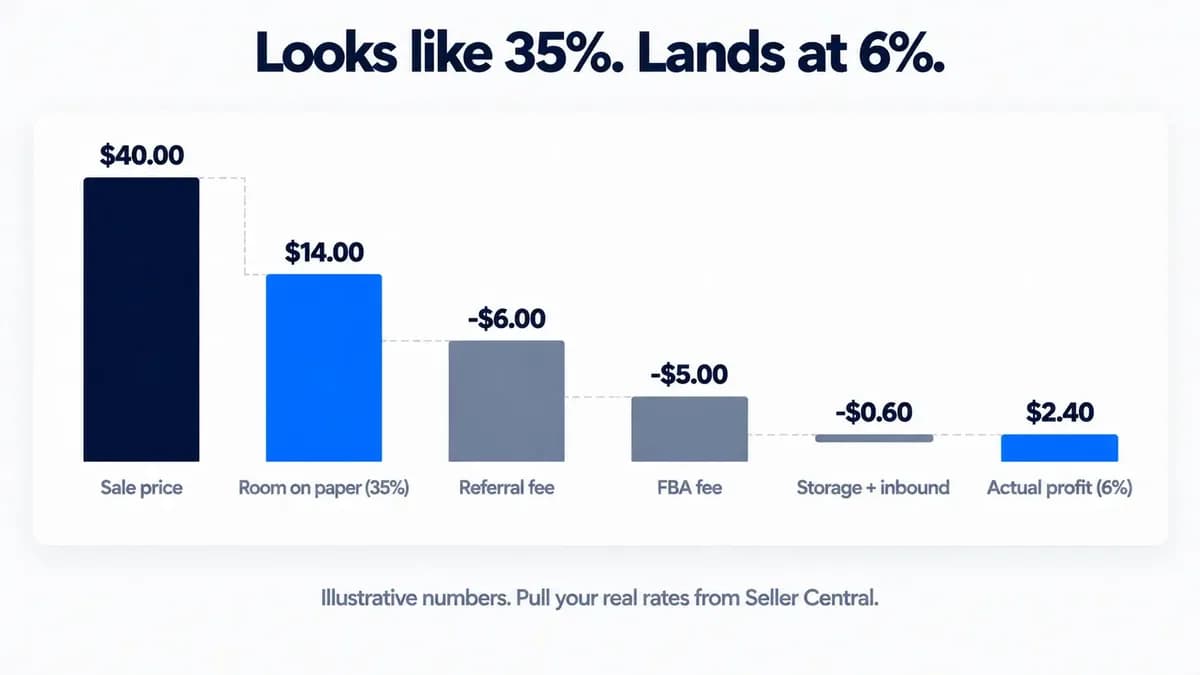
Five minutes, now that you have a real cost. This is the test where "looks like 35%" turns into "actually 6%," and it is where most bad wholesale buys come from. The wholesale cost looks fine next to the retail price, and then the fees take their share.
Here is the 2026 fee stack, in the order it applies.
Inbound placement. A per-unit fee that depends on how many locations you send stock to.
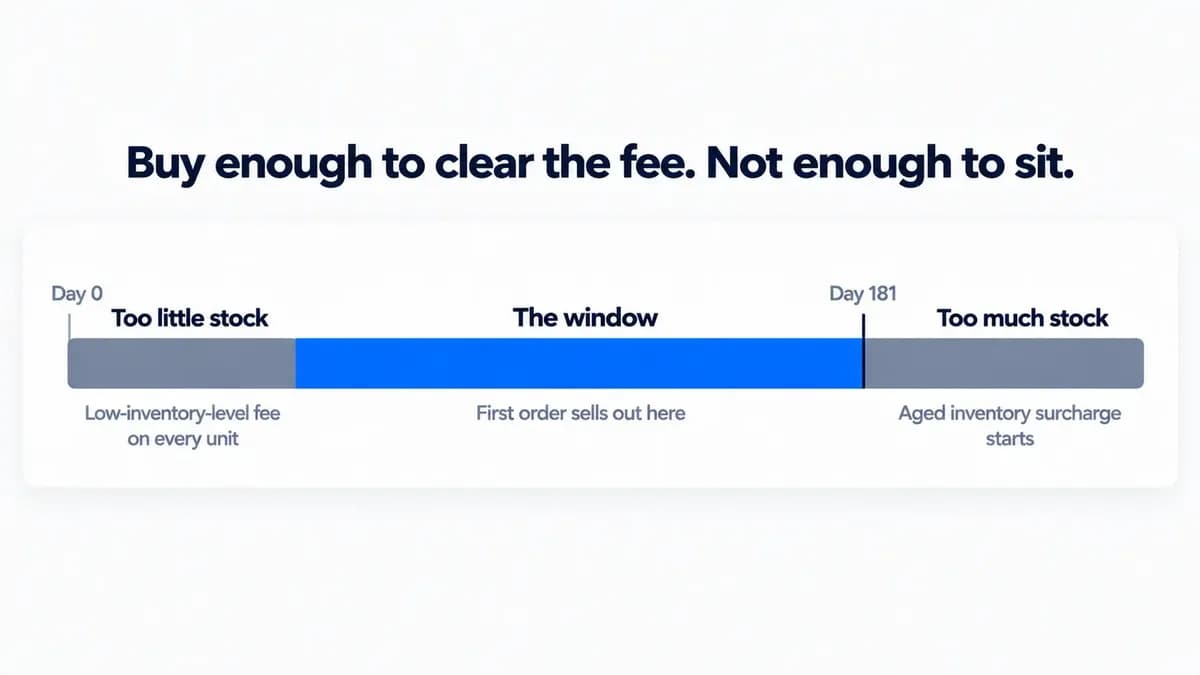
Aged inventory surcharge. The old long-term storage fee is gone. The surcharge now starts at 181 days in the warehouse, and Amazon raised the top of the scale again on January 16, 2026, with a new tier for stock older than 456 days.
Low-inventory-level fee. The newest one, and the one that confuses people most. If your days of supply on a product drops below Amazon's threshold, you pay an extra charge on every unit you sell while you are under. So you get charged for having too little stock and charged for having too much, and we come back to that in test five.
Now a worked example. These numbers are made up to show the shape of the math. They are not benchmarks, and the exact rates for your product live in Seller Central, so pull them from there.
Say a product sells for $40 on Amazon and a distributor lists it at $26. On paper, that is $14 of room, about 35% of the sale price. Now take the fees off. A 15% referral fee is $6.00, a fulfillment fee for an item this size might be around $5.00, and storage plus inbound placement spread across the unit adds about $0.60. What is left is $2.40, or 6% of the sale price. Nothing about the product changed between the two numbers. The second one is the math done the way Amazon does it.
The Retail Insights panel on every B2B Supplier Hub product page has a per-unit profit calculator with fields for the referral fee, FBA fee, storage, and inbound, and it shows net profit and ROI after those fees. Put the cost from test three into it and see what you would actually make after selling fees. If you prefer a spreadsheet, our wholesale price calculator post walks through the same math.
Do not carry an "average margin" number in your head for this test. Every range you see online is unsourced, and averages hide the fact that the same product can be a winner at one distributor's cost and a loser at another's. Run the math on the real cost each time.
Test 5: Will It Turn Fast Enough?
This is the test almost everyone skips, and a product can pass every test above and still lose money on quantity.
The 2026 fee system has a window. Buy too little and the low-inventory-level fee kicks in on every unit. Buy too much and the aged inventory surcharge starts at day 181. You want the first order to sell out inside that window, and you want to know that before you place it.
This is where case packs and price tiers fight you. A product that only clears test four at the second price tier may need a quantity that fails test five, and at that point the answer is to walk away rather than buy up to the tier.
One timely note, with Q4 storage rates starting October 1. Any order that lands in an Amazon warehouse after that date carries the higher Q4 rate from test four for as long as it sits there, and if a product is a slow turner, that alone can flip test four from a pass to a fail. Our Q4 storage fees guide has the dates.
What to Do With a Product That Passes All Five
If a product made it through all five tests, you have something rare: a product the brand will let you sell, on a listing worth sharing, from a verified distributor, at a cost that survives the fees and a quantity that turns. What is left is the routine part, and it is covered elsewhere on this blog so we will not repeat it here.
Open the account with the distributor. Our post on how to open a wholesale account covers the documents. Place the first order at a size that fits test five, keep the invoice exactly as issued, and check it against the invoice requirements before you submit it anywhere.
One thing we want to be plain about. Seeing the numbers before you apply removes the wait to see the numbers. It does not remove the distributor's approval. Some distributors will still say no to a new account, or say yes with an opening order you did not plan for, and no tool changes that. What changes is that you walk into that conversation already knowing the cost, the stock, and the profit, instead of finding out after you are approved.
For products that were close but did not clear, add them to a watchlist with price and restock alerts. Costs move and stock comes back, so a product that fails test four today may pass it next quarter at a different distributor's cost, and you want to hear about that without checking by hand.
Run It Weekly, in Batches
The tests only work if you run them in batches. Doing one product at a time is how people end up spending an afternoon on a product that fails test one.
Once a week, collect a batch of candidates from the five sources at the top of this post. Run tests one and two on all of them in one sitting, and expect most to fall out there. Take the survivors to test three, then four, then five. What comes out the far end is a short list, usually a handful, and each product on it has passed every check. Watchlist the near-misses and move on.
Nothing in this method needs a tool, though the tools make test three fast enough that comparing distributors becomes something you do every week instead of something you mean to do.
Start With the Product You've Reordered Longest
Most products that lose money looked fine on the surface. They failed a check nobody ran. The brand was closed, or the listing was a price war, or the cost only worked at a quantity that could not sell through. All of it is knowable in minutes, for free, before any money moves
If you want to try it right now, take the product you have reordered the longest without a second look. Search it free and see what every verified distributor in our network is charging for it today, next to the profit after fees. If it comes back empty, submit a Request for a Supplier and let our team go find one. Either way, you will have a real cost in front of you instead of a guess.
Big enough to stay above the low-inventory threshold and small enough to sell out well before day 181. Let the sell-out speed decide, not the price tier.
Is Amazon wholesale still profitable in 2026?
Yes, for products that pass all five tests, and no for the rest. The fee changes in 2026 were small on the main fees and sharp on the inventory fees, so the profit is in choosing products and quantities carefully rather than in any category being "good." We run the full numbers in our blog post on is Amazon wholesale still profitable.

-1200x627.webp&w=3840&q=75)