
Distributor Authorization
Amazon IP Complaint vs Inauthentic Complaint: What Clears Each
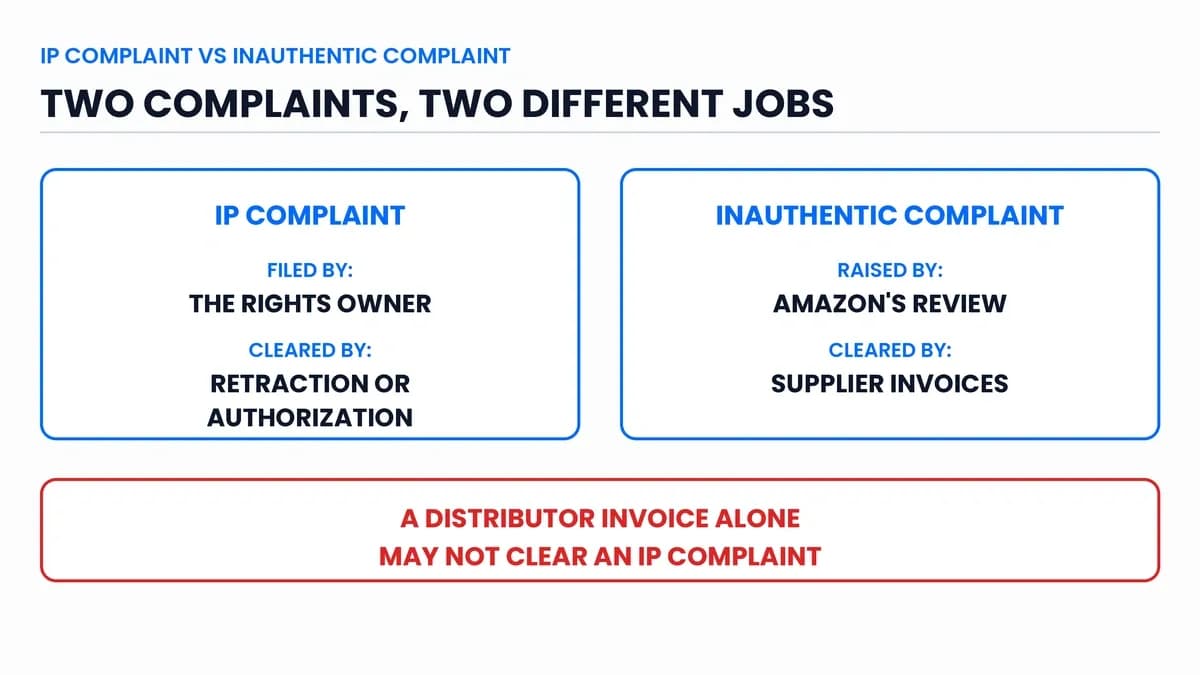
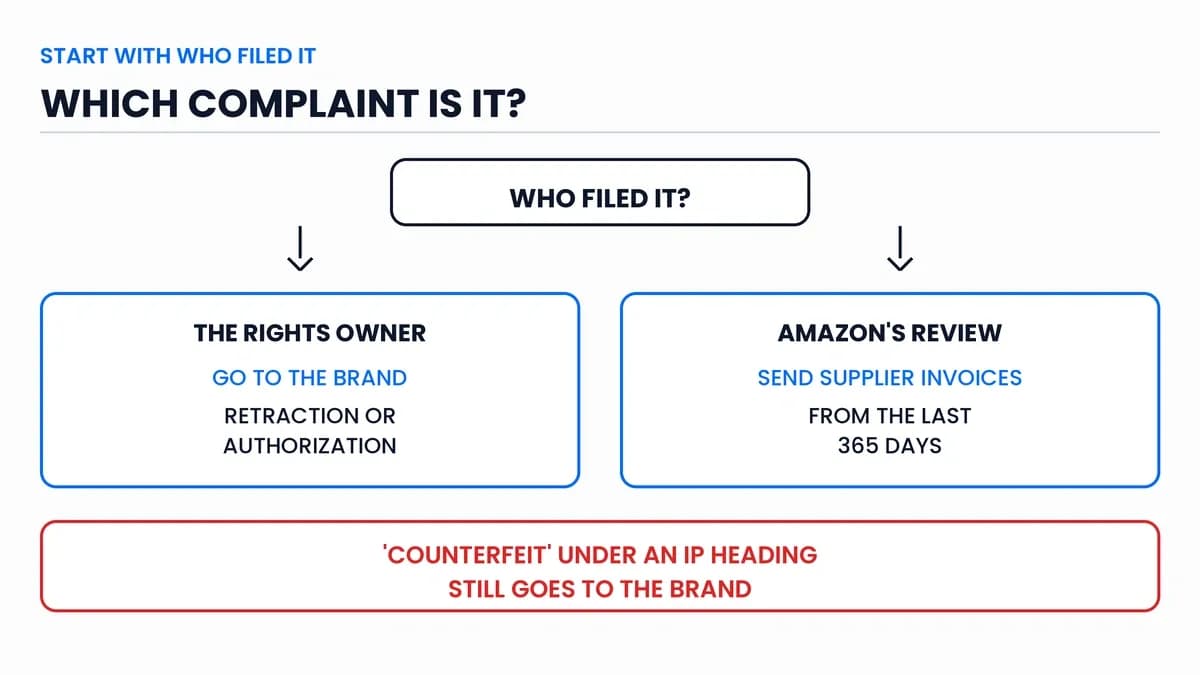
An IP complaint comes from the brand or rights owner. It's usually cleared only when they retract it or give you authorization. An inauthentic complaint comes from Amazon's own review, and you answer it with supplier invoices. That's the Amazon IP complaint vs inauthentic complaint difference that matters. Each one needs different people and different paperwork.
So if you send distributor invoices to an IP complaint, you can lose time waiting for an answer that won't come. This post puts the two side by side, so you know which job you're doing before you start. It's general information, not legal advice. If your account is at risk, talk to a lawyer who handles Amazon cases.
What Each Complaint Is
An IP complaint says you're infringing someone's intellectual property. IP here means intellectual property, not an internet address. The USPTO says a trademark can be "any word, phrase, symbol, design, or a combination of these things that identifies your goods or services." The US Copyright Office says copyright "protects original works of authorship," and its examples include photographs. And a patent lets an inventor stop others from "making, using, offering for sale, or selling" the invention, according to the USPTO.
The rights owner files the complaint, and on Amazon that's usually the brand. Amazon's Brand Registry page says enrolled brands can "report suspected IP infringement" with its Report a Violation tool. Amazon also has "a publicly available form for reporting alleged intellectual property infringements such as copyright, trademark, and patent concerns." So an IP complaint is the brand telling Amazon you shouldn't be selling its product the way you are.
An inauthentic complaint is about where your stock came from. Amazon wants to see that the units you sold trace back to a real supply chain. Our post on Section 3 inauthentic complaints covers what sets these off and how they escalate. And "inauthentic" doesn't have to mean Amazon thinks your product is fake. It means Amazon wants proof of where it came from.
Amazon IP Complaint vs Inauthentic Complaint at a Glance
IP complaint | Inauthentic complaint | |
|---|---|---|
Who starts it | The brand or rights owner | Amazon's own review |
What it claims | You're infringing a trademark, copyright or patent | Your supply chain can't be verified |
Who can clear it | The rights owner, by retracting it | You, with documents Amazon accepts |
What clears it | A retraction from the rights owner, or their authorization | Supplier invoices that meet Amazon's rules |
What doesn't | A distributor's invoice, on its own | Retail receipts or edited invoices |
What Clears an IP Complaint
The brand filed it, so the brand usually has to undo it. An Amazon staff reply on the seller forums says so directly. "The brand or rights owner who issued the violation will need to issue a retraction directly to amazon." If the retraction "is provided or issued by the supplier or distributor it will not be accepted." The same staff member adds, "We do not accept forwarded or attached retractions."
In another thread, a seller posted the Amazon notice they got. It says Amazon "can only accept retractions if the rights owner clearly states that they made an error." It also asks for "an invoice, letter of authorization or a licensing agreement from the manufacturer or Rights Owner."
Look at who those documents come from: the manufacturer or the rights owner. An Amazon staff member in that thread put it plainly. "Having sourced it from an authorized distributor, while good for authenticity purposes, may not protect you from intellectual property complaints."
So your distributor invoice can prove your stock is genuine and still not clear an IP complaint. The complaint can be about permission instead: whether the brand allows you to sell its product the way you are. That leaves you three options:
- Contact the brand and ask for a retraction. Explain where you bought the stock. Then ask them to send the retraction to Amazon directly.
- Show authorization from the rights owner. That means a letter of authorization or a license from the brand. Our post on brand letters of authorization covers who can issue one.
- Point out a mistake. If the brand filed against the wrong listing or the wrong product, ask them to retract and say it was an error. That's the kind of retraction the notice says Amazon accepts
Timing matters too. In a thread about an old complaint, an Amazon staff reply said "six months have passed, so the violation is not present in the account." Because of that, "the retraction will not be an option to reinstate the listing." The rights owner could still give the seller a letter of authorization to send in for review. So don't wait on an IP complaint and hope it goes away.
What Clears an Inauthentic Complaint
With an inauthentic complaint, the paperwork is yours to provide. Amazon wants to see where the units came from. One Amazon notice a seller posted on the forums asks for:
- "Supplier information, including name, phone number, address, and website"
- "Buyer information, including name, phone number, address, and website"
- "Item descriptions," where you can highlight the affected ASINs
- "Item quantities"
- "Invoice date (must be issued in the last 365 days)"
It also says "you can only send PDF, JPEG, PNG, or GIF files." And "the documents that you send must be authentic and unaltered."
A real distributor invoice should cover every line of that list. A retail receipt isn't an invoice at all. Our post on why Amazon rejects invoices covers that and the other reasons a genuine invoice still fails. Amazon can also ask for more than an invoice, and the Section 3 post covers that step.
That makes the supplier you choose your best defense. Buy from a distributor whose invoices carry every detail on that list, and keep them on file before anyone asks. You can search a product free and see real cost and real stock from every verified distributor in our network that carries it.
When a Complaint Says "Counterfeit"
The word "counterfeit" is where the two complaints overlap. Some IP complaints say your product is counterfeit. That sounds like an authenticity question, so invoices seem like the answer.
But it's still a rights owner's complaint. In one forum thread, a seller's Account Health showed "counterfeit" under the Received Intellectual Property Complaints title. An Amazon staff member replied that counterfeit, in that sense, can mean a product "being sold without the authorization from the brand owner." The fix offered was an authorization letter, not an invoice.
So check which heading your complaint sits under in Account Health. Then read what the notice itself asks for. If it's an IP complaint, start with the brand. If it's an authenticity review, start with your invoices.
Why Wholesale Sellers Get Both
As a wholesale reseller, you sell someone else's brand. That puts you in line for both kinds of complaint.
Some brands control who sells their products on Amazon. If you're not on their list, they can file IP complaints, even against genuine stock. Our post on selling gray market goods on Amazon covers what happens then. And because you didn't make the product, Amazon may also ask you to prove your supply chain.
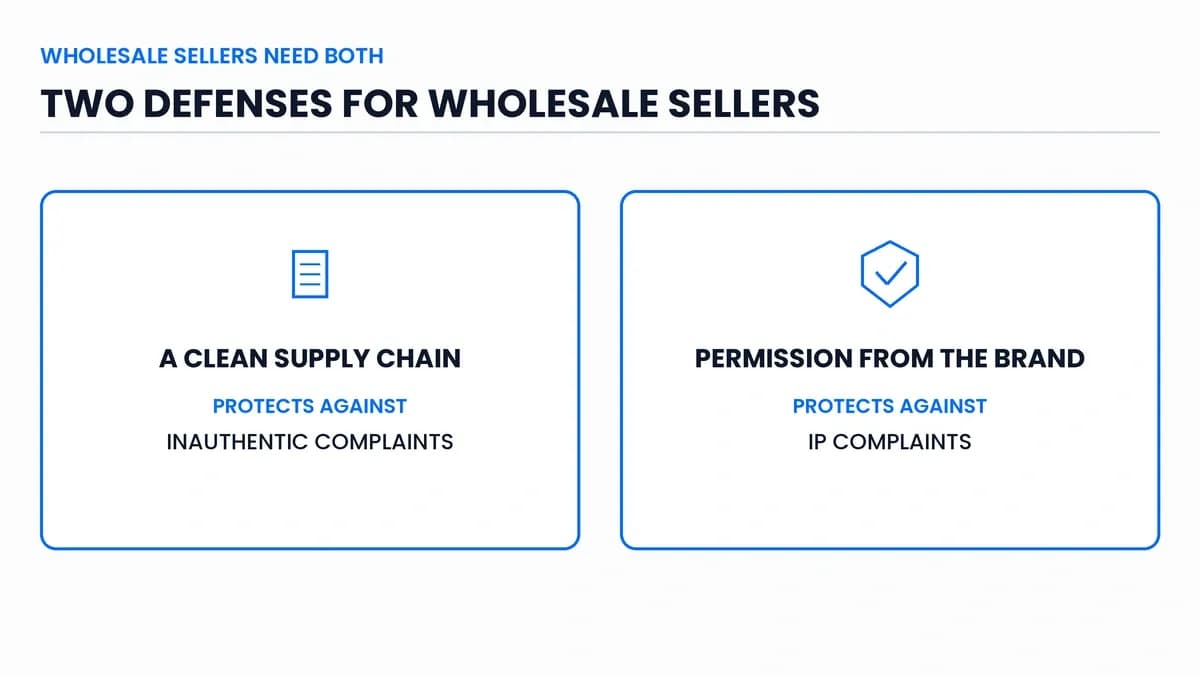
So the two defenses are different, and you need both:
- Against inauthentic complaints: a clean supply chain. Buy from distributors whose invoices meet Amazon's rules, and keep them.
- Against IP complaints: permission. Know whether the brand restricts sellers, and get authorization where it does. Our brand authorization guide covers how to tell.
If you can't find a real distributor for a brand you want to sell, don't buy from a middleman instead. Their invoice may not pass Amazon's review. You can Request a Supplier and our team will look for an authorized wholesale distributor who carries it.
IP vs Inauthentic Complaints: The Takeaways
- An IP complaint comes from the rights owner. An inauthentic complaint comes from Amazon's review of your supply chain.
- IP complaints are usually cleared by the rights owner retracting directly to Amazon, or by their authorization.
- A distributor's invoice helps prove authenticity, but Amazon staff say it may not protect you from an IP complaint.
- Inauthentic complaints are answered with supplier invoices that meet Amazon's rules. One notice asked for invoices from the last 365 days.
- A "counterfeit" complaint under the IP heading still starts with the brand.
- Wholesale sellers need both a clean supply chain and, where the brand requires it, permission.
Know Which Job You're Doing
Both complaints show up in Account Health, and both can take listings down. But the brand answers one, and your paperwork answers the other. So in any Amazon IP complaint vs inauthentic complaint case, work out which one you have before you send anything.
The best time to prepare is before you buy. Check whether the brand restricts sellers, and buy from a distributor whose invoices will pass Amazon's review. Our brands page lists the brands on B2B Supplier Hub. Pick one, and you can compare real cost and real stock from the verified distributors in our network that carry it, before you apply.
Frequently asked questions
01What is an IP complaint on Amazon?
02What does IP mean on Amazon?
03Does Amazon verify product authenticity?
04Can an invoice clear an IP complaint?
The B2B SupplierHub Team
Wholesale & sourcing
Stop hunting suppliers by hand. Type a UPC instead.
B2B Supplier Hub shows the suppliers in our network carrying a product on one page: wholesale cost, stock, and retail price side by side. Free to search, no card required.