
Industry Insight
Jungle Scout Supplier Database Review: Does It Find US Distributors?
If you buy finished branded goods and resell them, the Jungle Scout Supplier Database answers a question you are not asking.
It is a customs-records tool. It is built to find factories and the companies that import from them. That is a real job, and it does it well. It is not the job of finding the US distributor who will sell you four cases on terms.
Both jobs get called "finding a supplier," which is how the confusion starts. This sits inside the wider question of which sourcing tools do what, and the gap between those two jobs is where resellers waste a subscription.
What the Jungle Scout Supplier Database Actually Searches
It searches US customs import records. When a container arrives in the United States, its bill of lading becomes public. A bill of lading is the shipping document that travels with the container. It names who shipped it and who received it. It also lists the goods, the HS code, the weight and the quantity. An HS code is the customs category number for the goods.
Per Jungle Scout's own feature documentation, you can search four ways: by product keyword, by company name, by supplier name, or by ASIN. ASIN search covers Amazon.com only.
The results are richer than people assume, so here is the full documented set. A supplier result gives you a monthly shipment graph and a table of shipments, with dates, customers, descriptions, HS codes, weights and quantities. A company result adds total imports since 2014, total shipments, total unique customers, its top 10 customers, and its top product categories. You can filter by country of origin and by HS code. The data updates monthly.
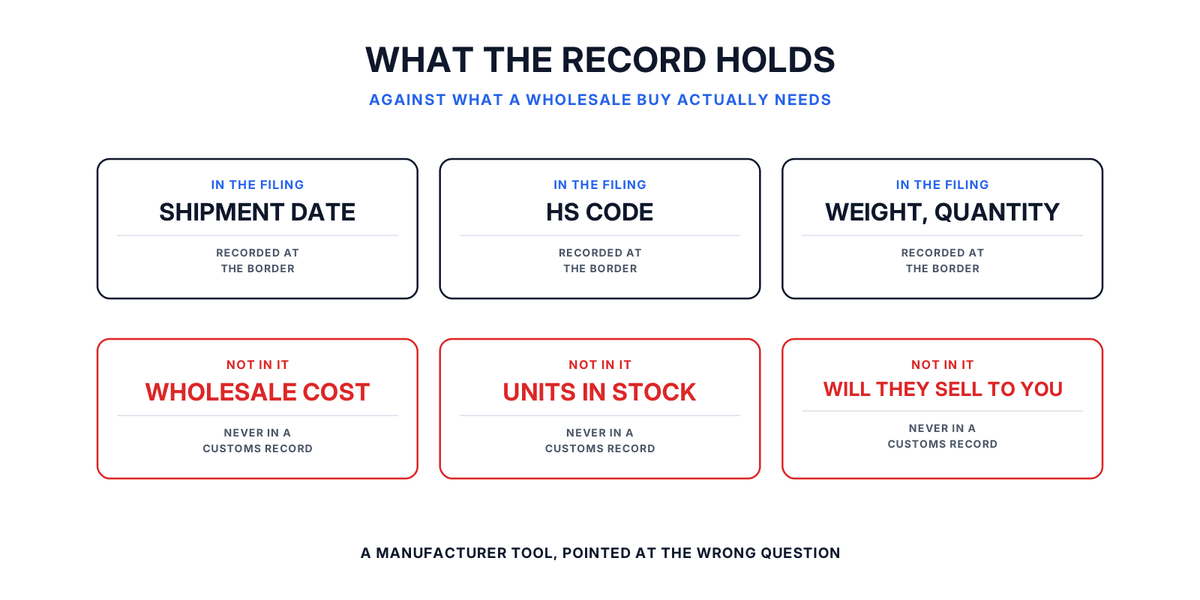
Now read that list again with a buying decision in mind. There is no wholesale price in it. No minimum order. No stock figure. No lead time. There is no phone number, no email and no named buying contact either. The tool offers a button that runs a Google search for the company's contact details, which tells you it does not hold them.
One fair caveat on price. Jungle Scout also sells a Supplier Tracker, where you save your own quotes and purchase orders and compare them. That is your data, typed in by you. It is not a price the Supplier Database knows.
Does Jungle Scout Find US Distributors? Usually Not the One You Buy From
Customs records capture one step: a factory abroad shipping a container to a company in the United States. The company named on that import is the importer of record.
A wholesale reseller usually operates further down the chain. You buy finished, branded, already-imported goods from a US distributor who holds stock, gives you terms, and ships you a few cases. When that distributor buys from the brand, nothing crosses a border, so no customs record is created. Their sale to you does not create one either.
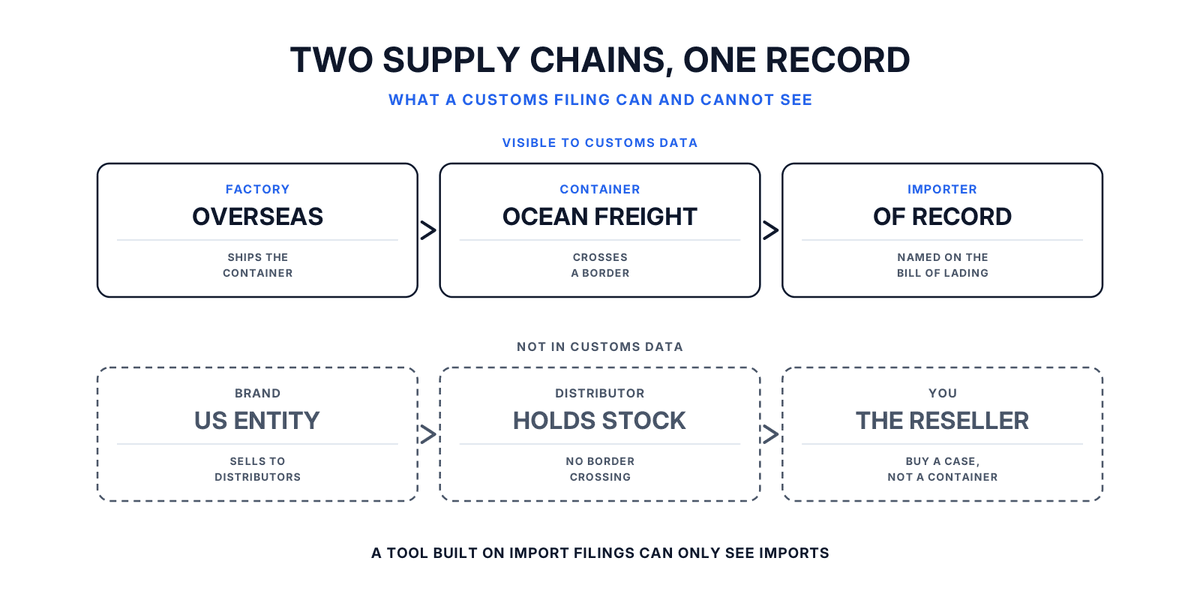
Here is the honest exception, and it matters in our categories. Plenty of branded goods are imported. In Electronics, Sports & Outdoors and Tools, the importer of record is often the brand's own US arm. Sometimes it is an authorized US master distributor. In those cases a real distributor does appear in the data. So the limit is narrower than "you will never see a distributor." The real limit is that customs records cannot see the domestic step. They cannot tell you cost, stock, or whether anyone will sell to you.
There is a fourth move people try, and it deserves a straight answer rather than silence. You find the factory, open its top 10 customers, and look for a US company that might sell wholesale. Sometimes that works. Often what you get is a company name and nothing else. You still do not know their cost, their stock, or whether they have a catalog you can buy from. You do not know whether they sell to marketplace resellers, or whether the brand authorizes them. You have a lead, not a supplier.
Where the Supplier Database Genuinely Works: Private Label
We want to give credit where it is due, because for private label this tool does things no distributor directory can.
If you are launching your own branded product, customs records are the right dataset. You can see which factories already ship that category at scale, how often they ship, and in what volumes. Shipment frequency is a real signal about whether a factory is actually running, and it is hard to get any other way.
The company search is built for competitor research. Jungle Scout says so plainly: look up a brand and see the suppliers it orders from most. Start from a competitor's name and you can work out who makes their product. Start from an ASIN and the tool points you to the company that made or supplied it. For someone deciding where to place a first production run, that is a genuine shortcut past weeks of guessing.
The filters make it usable rather than a data dump. Country of origin narrows you to a region you are willing to buy from. The HS code filter keeps you inside the right product category instead of drowning in loose keyword matches. History back to 2014 lets you tell a factory with ten years of steady shipments from one that appeared last spring. The Supplier Tracker then holds your shortlist, your quotes and your sample notes in one place while you negotiate.
That is a well-built tool for a real job. The trouble is only that "supplier database" sounds like a distributor list, and for wholesale it is not one.
Four Answers a Wholesale Buy Needs
A wholesale buying decision needs four answers. Customs records carry none of them.
- Who sells it domestically. The importer of record is often the brand itself, or a logistics company. Neither one sells you a case.
- What it costs you. Shipment records show weight and quantity. They never show a wholesale unit price.
- Whether it is in stock. Shipment history tells you what moved months ago. It says nothing about what sits on a shelf today.
- Whether they will sell to you. This is the one that costs the most time, and the data is silent on it. Plenty of importers do not sell to marketplace resellers.
It answer none of those four and you have a manufacturer research tool. That is exactly what it is, correctly built for a different business model.
Jungle Scout Supplier Database Accuracy: Where the Data Is Soft
Even inside its own lane, read the results with care. Company names in import filings are typed by hand. Jungle Scout says so itself. One supplier can appear several times because of spelling differences or missing parts of a name, so supplier searches return close matches. One factory can look like four companies.
Consolidators and freight forwarders are a second problem. These are logistics companies that pack and ship other people's goods. They appear as the shipper, which hides the factory behind them.
The records are also historical. A factory that stopped shipping two years ago still shows up in a graph until you check the dates. None of this makes the data useless. It makes it a starting point for research rather than a verified answer, which is how public records usually work.
Jungle Scout Pricing: Which Plan Includes It
Pricing matters here because the Supplier Database is not on the entry plan. On the Catalyst plan page, as of October 2026, Starter runs $49 a month billed monthly and does not include the Supplier Database. Growth Accelerator runs $79 a month billed monthly and includes it.
So the question for a wholesale reseller is whether $79 a month is worth paying for import records you will rarely act on. For most wholesale operations it is not. For a private label launch it reasonably might be.
Jungle Scout Alternatives for US Wholesale Sourcing
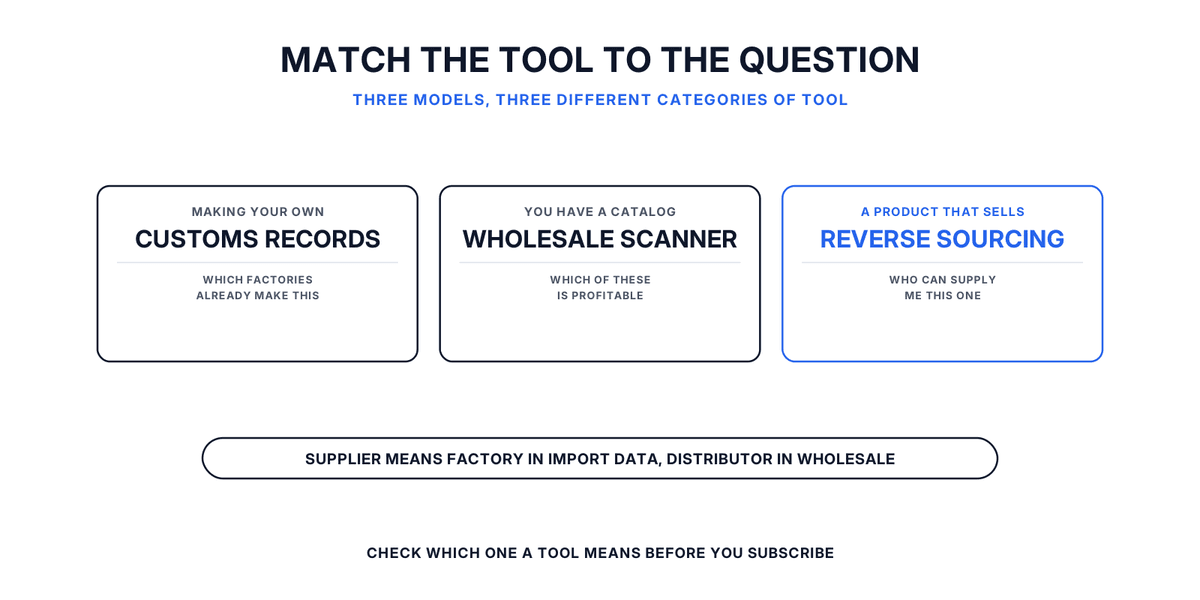
If your question is "this product sells, who in the US can supply it," you need a different category of tool. Three honest options:
Trace the brand, then the distribution. Start from the product, work out who makes it, then find the US distributors the brand actually approves. Our guide on how to find the manufacturer of a product covers the label, barcode and trademark trail.
Wholesale scanners. These take a distributor catalog you already have access to and tell you what is profitable on Amazon. Useful once you are approved somewhere. They will not find you the distributor. We compared the main ones in our Scan Unlimited alternatives and SmartScout alternatives write-ups.
Reverse sourcing. This runs the search backwards. Instead of starting from a catalog and hunting for profit, you start from a product that already sells and ask who carries it. That is the approach B2B Supplier Hub takes. You search a product free and see real cost and real stock from every verified distributor in our network carrying it. The supplier's name is what costs a credit, not the numbers you need to make the decision.
When a product is not in any catalog you can reach, that is a different problem again. You can ask our team to find an authorized wholesale distributor for it. That is free on every plan, with an answer within 30 days either way.
Jungle Scout for Wholesale: The Takeaways
Usable whether or not you ever open our site:
- "Supplier" means factory in import data and distributor in wholesale. Check which one a tool means before you subscribe.
- Customs records carry weight, quantity and HS codes. They never carry wholesale price, minimum order or stock.
- Shipment frequency is a real quality signal for a factory. It tells you nothing about a distributor.
- The company named on an import is often the brand itself, not a route to supply.
- A factory's top 10 customers can surface a US importer worth chasing. It is a lead, not a verified supplier.
- Check any name from customs data against spelling variants before you treat two records as two companies.
- As of October 2026 the Supplier Database sits on Growth Accelerator at $79 a month, not the $49 Starter plan.
A Factory Is Not a Distributor
The Jungle Scout Supplier Database is a competent tool pointed at a question most wholesale resellers are not asking. It can show you who makes a product and who brings it into the country. It cannot tell you who will sell you a case next week, at what cost, from what stock.
That is worth knowing before you pay for it. It is also worth remembering whenever a tool says "supplier" without saying which link in the chain it means.
Frequently asked questions
01Does the Jungle Scout Supplier Database find US distributors?
02What are some good alternatives to Jungle Scout?
03What's better, Helium 10 or Jungle Scout?
04What is the best product research tool for Amazon sellers?
The B2B SupplierHub Team
Wholesale & sourcing
Stop hunting suppliers by hand. Type a UPC instead.
B2B Supplier Hub shows the suppliers in our network carrying a product on one page: wholesale cost, stock, and retail price side by side. Free to search, no card required.